Many names came from a parent’s given name, an occupation, or a location.  This article takes a look at the possible origins and history of some of our family names.  It is possible that this information will give clues to help with further research.


Introduction

This document looks at the surnames (maiden names for the women) of all of my great-grandparents and my husband’s great-grandparents.  The information available varied slightly for different names depending on how the name was developed and any specifics I could use to refine details surrounding the name given that some names arose in multiple locations.


Dad’s Family


McCracken

Origin: Scottish & Northern Irish

Location: Ulster, North Ireland, Galloway, Scotland

Form of: Mac Reachtain, Mac Neachtain, McNaughton

Translation: Son of Reachtain, Neachtain

Meaning: Pure, clear

History: “Likely descends from migrations of Gaelic speakers from Argyll and other western Scottish areas into Galloway around the 8th century or later.”

Immigration: Our family appears to have immigrated to Pennsylvania around the time of or soon after the Revolutionary War although more research is needed to confirm.

Variations: MacCracken, McCrackan, McCrachen, McCraken

Ellis

Origin: English and Welsh.  Other similar names originated elsewhere.

Location: England, Ireland (Ulster), Wales

Form of: Elis, Elys, Elias, Eliyahu

Meaning: Jehovah is God (English), kind, benevolent (Welsh)

History: The name dates to the 13th century in England.  Biblical influences and the Crusades played a part in its popularity.  It spread throughout England, Ireland, and Wales. 

Immigration: Many immigrated to American in colonial times.  Our Ellis immigrant ancestors have not been identified.  However, they were in the colonies before the Revolutionary War concluded and possibly much earlier.

Variations: ap Ellis, Elles, Elless, Allis, Elis, Elys, Elias, Elliss, Elice, Ellys, Elic, Alles, etc.  Some of these may be simple misspellings.  However, this is a subset of how this name has been found in records.  

Peelle

Origin: English

Location: Northern England along border with Scotland

Form of: pel in Old French

Translation: stake or post

Meaning: Lived by or worked at a “peel”, a small tower, wood fort, palisade, or boundary marker.  Also, a person built like a post.

History: Name came about after the Norman Conquest.  May also have connections to the Dutch word for a region or Italian pelle, which would be for a tanner.  In our case, it is most likely related to the English meaning.  Of note, Peel Castle exists on the Isle of Man in or near the town of Peel.  We have no known connection to the castle or town.  Read about Peel Castle. More about Peel Castle.

Immigration: Our earliest ancestor in America was Lawrence Peele who arrived in 1621 on the ship the Margaret & John

Variations: Peelle, Peele, Peel, Peale, Peile

Jury

Origin: English with Norman French influence

Location: Jewish communities

Derives from: Juerie, juierie, jurie, Jewry.  Alternate juree.

Meaning: Jewry, Jewish quarter. Alternate: sworn or oath, such as a juror.

Meaning: Often referred to someone who was not Jewish, but who lived in or near the Jewish part of town.  Alternate, a juror.

History: Came about after the Norman Conquest.  Influenced by Old French.

Immigration: William Jury was born in England and immigrated to Canada prior to 1835 when he married.  Three of his four children plus his widow immigrated to the United States in 1869.

Variations: Jewry, Juerie, Jury, Jurey

Mom’s Family

Pellett

Origin: French given our family history, can be considered English in other situations

Location: Auvergne-Rhône-Alpes and Savoie (Key regions)

Form of: Old French Pelle/Pel, or less common the name Pell

Translation: fur or skin

Meaning: furrier, dealer in furs, skins

History: Many Huguenots (French Protestants) moved to Ireland from France after the 1685 Revocation of the Edict of Nantes.  The move was made for religious reasons, which matches family lore.  Read more about the family’s movement for religious reasons.

Immigration: Our earliest ancestor in the United States was Francis A. Pellett, a Quaker, who immigrated in the late 1700s.

Variations: Pellet, Pellette, Pellatt, Pelete, Pellot

Conner

Origin: Ireland, England, Scotland

Location: Connacht, Munster (and other providences)

Form of: Anglicized form of Connor from Ó Conchobhair (or Conchúir).  In English, it comes from connere or cuner, which is an inspector/tester, typically of weights/measures or ale.  In Scotland, it is considered a variant of Connor.

Derived from: con meaning hound/wolf and cobhair meaning desire/aid

Meaning: lover of hounds or wolf lover.  The full Ó Conchobhair is a descendant of Conchobhar, which was the name of several kings and clans.

History: In Ireland, it has strong royal associations. The O’Connors were one of the most prominent Gaelic clans.  Americans often descend from Irish immigrants during the famine of the 1800s with a lesser number coming from England.

Variations: Connor, Conor, O’Connor, Connors, Conners, O’Conor

Thomas

Origin: England and Wales

Location: Breconshire (most common), Cornwall

Form of: Te’oma

Translation: Son of Thomas

Meaning: Twin

History: It became popular after the Norman Conquest of England in 1066 and grew with the Crusades.  It did not develop in one specific area due to biblical ties as Thomas was one of the Twelve Apostles.  Also found in other European countries.  Very common name today.

Immigration: Our Thomas immigrant family has not been identified.  However, they were in America by the time of the Revolutionary War.

Variations: ap Thomas, Thomason, Thomson, Tomson, Tomas, Thom, Thoma, etc.

Ashby

Origin: England with strong Norse/Viking influences

Location: Locations with the name Ashby are common in Leicestershire, Lincolnshire, Northamptonshire, and other northern/eastern counties.

Derived from: askr and by in Old Norse

Translation: ash tree and farm/dwelling

Meaning: farm or home near the ash trees

History: Concentrated in areas with a lot of Norse influence.

Variations: Ashbee, Ashbey, Ashbe


My Husband’s Dad’s Family

Thomson

Origin: Scotland

Location: Strongly associated with Ayrshire and the Scottish Lowlands/Borders (Strathclyde region).

Form of: Te’oma

Meaning: Son of Thom, son of Thomas, twin

History: It is sometimes referenced in Scottish Gaelic as Angelicized form of MacThomais or MacThomaidh.  Also, sometimes connected to MacTavish.  Often people with the name have a Scots-Irish connection due to migration to Northern Ireland.  It is not linked to a specific clan, but is related to Clan MacThomas in some areas.

Immigration: Arthur Reid Thomson immigrated to Canada.  From there he moved southward to the United States.  He was in the states by the middle of the 1800s.

Variations: Thompson, Thomason, Thomasson, MacTavish, McThomas, Tomson.  Thompson with a “p” is more common in England while Thomson without a “p” is more common in Scotland.

Klinefelter

Origin: German

Location:

Form of: Americanized version of Kleinfelder

Derived from: Klein and Felder

Meaning: small field

Usage: A person who works on a small farm, can also be a person from a place called Kleinfeld, which is a name that occurs multiple times in Germany.

History: Reflects common German surname patterns, which referenced land size, occupation, or place of origin.

Immigration: Johann “Hans” Peter Klinefelter arrived in the United States in the mid-1700s.

Variations: Kleinfelder, Kleinfelter, Klinefelter, Kleinfeld

Van Allen

Origin: Netherlands

Translation: “Van” means “of” or “from” and often used to indicate a person’s place of origin.

Meaning: from Oudenallen in South Holland, Netherlands.  Possibly Van Alen meaning from Hallen.  Alternately, son of Allen.

History: This spelling is rare in the Netherlands today.  Allen is also used in English and Celtic with different meanings.  Many Van Allen families descend from Dutch settlers in New York/New Netherland in the 1600s. 

Immigration:  Our Van Allen immigrant has not been identified.  However, the family does tie back to the state of New York.  The earliest identified person in the Van Allen line is John Van Allen who was born in 1828 in New York, possibly near Rochester.  His father was also John, but nothing is known about him.

Variations: Van Alen, Vanallen, Van Allen

Hanson

Origin: Scandinavia, England, Germany

Form of: Hans is a short form of Johannes (John).  Anglicized form of Hansson/Hansen.

Translation: son of Hans

Meaning: God is gracious

History: Found in Scandinavia and Germany.  Showed up in England in the 13th century.  Sometimes found in the Jewish community as it is linked to the Hebrew name Hanna/Chana.

Immigration: Our ancestors followed the path of many others from Scandinavia, moving to the upper Midwest.  Nelson “Nels” Hanson immigrated to Wisconsin sometime prior to 1850.

Variations: Hansson, Hansen, Hanssen, Henson, Hampson.

My Husband’s Mom’s Family

Helm

Origin: German, English

Translation: German – helmet, protection; English – shelter for cattle, barn

Meaning: German – helmet maker, short for Helmhart, Helmold, Helmut, or Wilhelm; English – someone living near a barn, herdsman

History: In England, it appeared in the 12th century.  Meanwhile, in Germany it was derived from given names.

Immigration: Johann (Phillip) Helm immigrated to the United States in 1857.

Variations: Helms, Helme, Helmbrecht

Herzberger

Origin: German

Form of: Herz & berg

Translation: Heart & mountain/hill, mountain of the heart

Meaning: from Herzberg with multiple locations in Germany named Herzberg.  May also use the heart of the mountain to describe a location.

History: Strong association with German communities, including Ashkenazic Jewish.  Associated with the various places in Germany named Herzberg.  Uncommon in the U.S.A.

Immigration: Maria Katherina Elizabeth Herzberger immigrated to the United States in 1861 (just days before she married).

Variations: Herzberg, Hertzberger, Hertzberg

Kutzner

Origin: German

Location: Silesia (now partly in Poland)

Derived from: Kotze

Meaning: Blanket Maker, make or sell wool garments or blankets, coarse woolen cloth.

History: Movement from the original area to other parts of Germany.  Today, most common in North Rhine-Westphalia, Lower Saxony, and Brandenburg.  Interestingly, Brazil is one of the countries with a Kutzner population.

Immigration: Herman Kutzner immigrated circa 1864.

Variations: Kutz, Kutzer, Kautzner

Schmidt

Origin: Germany

Derived from: smit or Schmied

Meaning: blacksmith or metal worker.  Equivalent of the English name Smith.

History: Originated during medieval times.  It was prominent in the area that became Prussia, but extended throughout German-speaking areas.  Is also a Jewish surname with a similar meaning.  Very common in Germany and relatively common in the United States.

Immigration: Wilhelmina “Minnie” Schmidt immigrated to the United States in 1884.

Variations: Schmid, Schmitt, Schmitz, Schmied, Smith, Szmidt

Learnings

The above name descriptions provide a lot of information.  Probably the most surprising meaning behind a name was that Jury often related to living in or near a Jewish community.  I had always assumed that it related to a jury.

Besides being interesting, some parts can potentially be useful.  For the Pellett family, it provides information that is consistent with the family story.  Thus, adding credibility to the story.

Meanwhile for the Kutzner and Van Allen names, it provides details regarding locations that can be useful when researching earlier generations.


Grok and Gemini AIs contributed to this research.

Prompt: A Name With Meaning

#52ancestors52weeks


Her mom dies and her dad travels for work.  She is an only-child and lives with her grandparents, who raise her as a sophisticated city girl only to fall in love with and marry a country boy who lives half-way across the country.  This requires leaving everyone she knows and changing her religion.  Then they move to Canada, but return.  Over the years they have a large family.  And, when they are grown, her dad who has worked all over the eastern half of the country moves in with her.  All these changes had to change her perspective on life a lot!


Blanche Klinefelter on the porch in Pittsburgh, Pennsylvania – Image made clearer using Gemini AI

The Early Years

Blanche Mabel Klinefelter was born September 27, 1887 in Pittsburgh, Pennsylvania to Judge Sharpless and Emma (Ackermann) Klinefelter.  On December 30, 1888, when Blanche was only 15 months old, her mother died in childbirth along with Blanche’s brother Daniel.

Blanche’s father worked in construction and later was a superintendent of large building projects.  His work took him all over the eastern half of the country.  Read more about Judge Sharpless Klinefelter.

Thus, Blanche lived with her grandparents, Joseph Gazzan & Caroline (Stetler) Klinefelter in the East Liberty/East End area of Pittsburgh.  She grew up at 5612 Harvard St.; however, the home no longer exists.

Her father would visit when able.  However, he remarried in 1896 to Lois Campbell.  He had two daughters with her: Carolyn Elmina and Hortense Lucille.  Now, she had to share her father with her half-sisters and his wife in addition to with his work.  Although Blanche knew her half-sisters, they lived in Ohio.  Thus, it wasn’t like having true sisters that lived in the same household.  Besides, the older of them was nine years her junior.

Despite all of this churn, Joseph and Caroline made sure that Blanche grew up to be a cultured young lady.  She graduated 8th grade at the Highland School in the East End neighborhood of Pittsburgh, Pennsylvania.  Upon graduation, she received a watch that could be worn on a chain or that could be pinned to a dress.

By this time, Pittsburgh was a very fast-growing metropolis.  By 1900, Pittsburgh had just over 320,000 inhabitants and in the next 10 years the population would grow to over half a million.

Marriage

In early September 1905, Blanche accompanied her grandparents to Denver Colorado.  Joseph made the trip to attend the National Encampment of G.A.R. (the Grand Army of the Republic) that was held the week of September 4.  Read more about Joseph Klinefelter and G.A.R.

At the same time, Herbert Thomson was also traveling.  He lived in Nebraska; however, he was returning from Alberta, Canada, where he owned property.

As fate would have it, Blanche and Herbert ended up in the same location at the same time.  They met at the train depot in Colorado Springs, Colorado.  Herbert was thirteen years her senior, but Blanche and Herbert hit it off.

Blanche’s grandparents thought he would be a good catch for Blanche because he owned land.  One thing led to another and Herbert decided to make a trip to Pittsburgh, Pennsylvania. 

He ended up proposing and they married approximately three months after they first met.


The Wedding


W A Stanton is the Baptist Minister who married Herbert Thomson and Blanche Klinefelter

On December 6, 1905, Blanche and Herbert were married in the parlor of the Shady Avenue Baptist Church.  It is unknown how many guests attended the wedding.  However, the invitation appears to indicate that it was a formal affair.  Of interest is that her grandparents names are on the invitation and not her father’s name although he was most likely in attendance as her half-sisters signed as witnesses to the wedding.  Her grandparents also sent out formal announcements of the wedding.

The photograph of the pastor must have been given to Blanche and Herbert at their wedding.  It was one of several gifts.  They later stated that the gifts that they had received were “useful, handsome, and valuable.”

The Wedding Dinner


Following the evening wedding, a six-course dinner was served at a nearby hotel.  The most likely location was the Hotel Schenley as it was just over two miles from the church and would have provided an elegant dinner. 

Based on their station in life, menus of that era, the location, the time of year, etc., Grok AI suggested the following as a possible menu.  I am sure that this is NOT the menu for their wedding dinner, but it gives a hint of what it might have been like.


“Hors d’Œuvres Blue Point Oysters on the Half Shell Celery Hearts · Queen Olives · Radishes · Salted Almonds Amontillado Sherry

Potage Cream of Green Turtle (a warming, celebratory classic for December gatherings) or Consommé with Julienne Vegetables and Fine Herbs Bread Sticks · Toasted Points

Poisson Broiled Shad à la Maître d’Hôtel (fresh Pennsylvania river fish, simply prepared and hearty) or Filet of Sole with Lemon Butter Cucumbers in Cream · Small Parisienne Potatoes Rhine Wine or Sauternes

Entrée Guinea Hen or Chicken Breast à la Maryland (breaded, fried crisp, served with cream gravy, corn fritters, and bacon—a substantial, festive Pennsylvania favorite) Asparagus Hollandaise · Green Peas

Rôti Roast Philadelphia Capon with Watercress and Currant Jelly (local poultry, roasted to perfection—symbolizing home and family pride) or Saddle of Lamb with Mint Sauce Mashed Potatoes · Glazed Sweet Potatoes · Cauliflower in Cream Sauce · Buttered String Beans Claret or Champagne (poured generously for toasts to the bride—raised as a daughter by her grandparents—and the couple’s new life together)

Entremets & Dessert Roman Punch (iced rum-citrus sherbet to refresh the palate) Bride’s Cake (a tall, richly fruited cake with marzipan, white icing, and sugared winter fruits/flowers—cut amid cheers and well-wishes) Charlotte Russe with Preserved Fruits Neapolitan Ice Cream · Petits Fours · Meringues Assorted Fancy Cakes · Fresh Fruit Compote Cheese (Roquefort and others) & Crackers Demi-Tasse (black coffee) · Liqueurs · Cigars for the Gentlemen”


Grok went on to suggest that a small orchestra may have played music while the guests ate, visited, and possibly danced in the seasonally decorated ballroom

Arrival in Nebraska

Once married, Blanche left her life in the bustling city behind and moved from Pittsburgh, Pennsylvania to Herbert’s farm outside Palmyra, Nebraska.  Herbert and Blanche  arrived in Palmyra via train with Blanche in all her city finery.

Even if Blanche had visited farms or had other knowledge of them, nothing could have really prepared her for life on the farm, where the closest town had just over 300 people.  The roads were dusty, the prairie wide-open where you could see for miles, and wild animals were abundant.  It was quite a change.


The Nebraska Reception

Upon arrival in Nebraska in mid-December, Herbert’s parents, Arthur Reid and Margaret (Ronald) Thomson held a reception at their home for their youngest son and his new bride.  The event included a four-course dinner.  

Grok AI suggested that the  menu for this dinner would be quite different than the wedding dinner

Herbert & Blanche (Klinefelter) Thomson’s Family in 1915

“Soup / Starter Scotch broth (thick barley soup with root vegetables—carrots, turnips, onions—from the cellar, bits of mutton, beef, or chicken from the farm, and perhaps pearl barley …). Served with homemade bread, oatcakes/bannocks (simple flat oat breads baked on the stove), or biscuits. Side of homemade pickles, relishes, or canned beets for contrast.

Main Course / Roast … chicken, goose, or pork (fresh from the farmyard or hog-killing season—…. Stuffed with sage-onion dressing; served with rich gravy (pan drippings thickened with flour/milk), mashed potatoes (creamed with butter), candied sweet potatoes or glazed carrots, boiled cabbage or turnips …, and green beans or corn (canned/dried from harvest).

Sides / Vegetable Course Additional hearty accompaniments: Scalloped or creamed corn (Midwest staple), coleslaw or simple cabbage slaw (vinegar-dressed), applesauce (from stored apples), and more rolls, oatcakes, or cornbread passed around. Perhaps a small dish of buttered parsnips or onions if available.

Dessert Homemade pie (apple from stored fruit, pumpkin from preserved squash, or mincemeat with preserved fruits/meat…). Or shortbread cookies (buttery oat shortbread, a direct Scottish touch), spice cake, or fruitcake (spiced preserved fruits). Served with strong black coffee, fresh milk/buttermilk, or tea—warming for winter.”

Grok depicted the scene as was typical of rural family life in the early 1900s – no frills, but plenty of food and fellowship.


Herbert & Blanche (Klinefelter) Thomson’s Family in 1915

Big Changes


Blanche likely missed the fancy houses, places of culture, and nice stores.  However, it is said that Blanche missed wearing  large hats, fancy gloves, and hooped skirts more than anything else.  None of them were of any use on the farm.  Not all city women could make this transition.  One must assume that Blanche was open to accepting a new perspective and that she must have really loved Herbert!

In addition, despite having half-sisters, Blanche grew up effectively as an only child.  Her father was also an only child and her grandfather only had one living brother who lived hundreds of miles away.  Thus, it must have been quite a shock when she met Herbert’s large family.  Big family gatherings happened frequently and were quite contrary to the small family of which she was accustomed.

In the coming days and years, Blanche would experience the Presbyterian religion.  Leaving behind the Baptist Church, she would become very active in the Palmyra Presbyterian Church.  Read more about the Palmyra Presbyterian Church.

Besides family size, location, and religion, Blanche had to deal with culture shock of a different type.  She came from a family where many recent generations were from German immigrant families; whereas, Herbert’s family was Scottish through and through.


Klinefelter Family 1809

Her Roots

Over time, Blanche adapted to country living.  However, she kept in touch with her family back in Pennsylvania and was very proud of her roots – the Klinefelters, Ackermanns, Stetlers, McGinleys, and, of course, William Hurrie, the famous bell ringer who rang the Liberty Bell when the Declaration of Independence was read.  Read more about William Hurrie.

During the next several years, various members of the family visited.  During these visits, Blanche asked her relatives to write down pieces of their family history.  Her grandmother Caroline Klinefelter gave her an autograph book, which she used to record family history.  When the Freedom Train came to town, Blanche was responsible for making it known that the family descended from William Hurrie.  Read more about the Thomson family and the Freedom Train.


Canada

For two years around 1920, Herbert and Blanche embarked on a new journey when they moved to Herbert’s property near Stettler, Alberta, Canada.  There Blanche experienced a new country.  Although the town was thriving, it was quite remote.  The 160-acre farm was three miles north of the northeast corner of the village of Stettler, which lies over 140 miles northeast of Calgary.  

Although their stay was short, Blanche and Herbert brought home a wonderful souvenir of their time in Canada – their seventh child, May Viola, who was born during their stay.

The following two photos are both marked as being taken in 1928.  However, they do not appear to be from the same year.  The first photograph was taken when they were on a later trip to Stettler.  George Ackermann is included in the photo.  He is a relative of Blanche in her mother’s family, who was visiting from California.

In Canada 1928. Herbert, Blanche, and family. Plus George Ackermann. Retouched by Gemini AI.
Herbert and Blanche (Klinefelter) Thomson's Family in 1928
Herbert and Blanche (Klinefelter) Thomson’s Family 

After the experiment of living in Canada, the family returned to Palmyra where they stayed with the exception of trips to the north land.


Blanche and Herbert’s House in Palmyra, Otoe, Nebraska many years later. Photo was taken in 2024.

Dad Moves In

After their Canada adventure, Blanche and Herbert returned Nebraska and farmed for many years.  In 1945, Blanche’s father Judge who was 81 and a widower, moved in with Blanche and Herbert.  Over the years, Judge had divorced Lois and remarried to Martha Edward, who had subsequently died.  Therefore, Judge moved into one of the rooms that Blanche and Herbert’s children had vacated when they became adults.

The following year, with Herbert’s health declining and Judge in his eighties, the three of them moved into Palmyra. They lived across the street from Taggart Park.

In 1948, change happened again when Herbert died.  Blanche was well able to take care of herself and her home.  Her father continued to lived with her.

Later that year, Blanche’s oldest son Alexander James Thomson and his wife Donna Isabelle (Van Allen) Thomson made a trip to Canada.  While they were gone, Blanche cared for the oldest four children, making sure that they made it to school each day.  Virginia had been born, but wasn’t in school yet.  So, she stayed with her mother’s brother and his wife.  Rachele wasn’t born until they returned from the trip.  Thus, she got to go along.

In 1951, Blanche made her last known trip to visit Canada. 


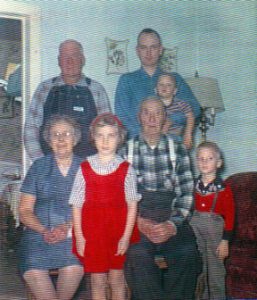
5-Generations: Judge Klinefelter; Blanche (Klinefelter) Thomson; Alexander Thomson; James Thomson; and James’ 3 children

Blanche died June 21, 1964, only weeks after taking a five generation photo that included Rod and his siblings.  Blanche had been looking forward to celebrating her father’s 100th birthday.  To honor her father, she planned to present family members with a family history booklet that included her father’s ancestors.  The booklet was finished by family and a page added to honor Blanche, the beloved mother of eight, grandmother of 25, and great-grandmother of at least 12 at the time of her death.  It also honored her role as family historian.

Use the audio recording below to hear Blanche talk about her life.


Just know – all that change throughout Blanche’s life had to have changed her perspective in multiple ways!


Afterward

Her father died in August at age 100 and her son Alexander died a few days later.  

Prompt: Changed My Thinking

#52ancestors52weeks

How often is it that a train coming through town is a reason for a family reunion?  That was the case for the Thomson family.


Story of The Thomson Family & The Liberty Bell, The Lincoln Star, Lincoln, NE, July 9, 1915 via newspapers.com

1915 Liberty Bell Tour

Trains played a big part in the history of the Thomson family, as Blanche Thomson, a city girl from Pittsburgh, Pennsylvania had met her future husband Herbert Thomson on a train platform in Colorado Springs, Colorado in 1905. 

So, it seemed appropriate that the family would visit any trains that related to their family. The first significant visit to a train was in 1915.


The Request

Blanche (Klinefelter) Thomson, Rod’s great-grandmother, heard that the Liberty Bell was going to be loaded on a train for travel across the county to an exposition in San Francisco.  She was very interested in this happening. She had seen the famous bell when she visited Philadelphia as  a child and it remained a special memory.  Moreover, she heard that it was going to make a stop in Lincoln, Nebraska, a few miles from their home near Palmyra.  So, she did what any descendant of the most famous bell ringer in the country would do when the most famous bell in the country came to town.  She put in a request for her family to attend the festivities.

Blanche wrote to the Lincoln Commercial Club asking if they could reserve seats for her family.  She explained her connection to the Liberty Bell and said that “[S]he wanted her children to see the world-famous emblem, this sacred relic which their direct ancestor had rung.”


William Hurrie Lineage

Blanche and family’s viewing of the Liberty Bell was nearly 140 years in the making.  It all started on July 8,1776 when Andrew NcNair was away from his role as doorkeeper to Congress for the day.  William Hurrie, who would later hold that position, substituted for Andrew.  And, it was on that day that Congress asked for the people of Philadelphia to be called together to hear the first official public reading of the Declaration of Independence.

William Hurrie rang the Liberty Bell to notify people of the reading and the rest is history. Read more about William Hurrie, the doorkeeper.  Read about WIlliam Hurrie’s family.


Guests of Honor

As a result of Blanche’s request, Blanche, her husband Herbert Thomson, and their children were guests of honor at the Commercial Club Luncheon.  The date of the event in Lincoln was 139 years and 1 day after Blanche’s ancestor rang the 2080 pound bell declaring independence.

They were guest of the president of the Commercial Club and were also greeted by the mayor and the secretary of the Commercial Club.  After the luncheon, the family was taken to the site of the Liberty Bell program and were seated on the platform where speeches were given.


The Program

Security was tight with National Guard and police in charge, but that didn’t stop people from pushing past others for their chance to see the famous bell.  The time allotted in Lincoln simply could not accommodate everyone who wanted an up-close view.  However, the number of people that got within a half-a-block from the bell and who were considered close enough to get a glimpse of it, range from 25,000 to 40,000.

The program that day was cut a bit short mostly because people simply could not hear over the crowd.  Of course, it was also 88 degrees and several people fainted or had heat-related issues.  No one was afforded the opportunity to hear the sound of the bell.  However, it had been rung the previous February to proclaim liberty throughout the land.  This time it wasn’t just heard in Philadelphia, instead, the tones of the bell were sent over the transcontinental telephone line, which had just been completed.  As the bell was struck with a mallet, the sound of the bell was heard in San Francisco.  It was also recorded. Note: In 1944, they rang the Liberty Bell again for D-Day. It rang out seven times – once for each letter in the word “Liberty.”


The Crowd In Lincoln, NE at the Liberty Bell Source: Nebraska State Journal, July 10, 1915 via Newspapers.com

Liberty Bell 1915

Liberty Bell 2003

Photo taken in Philadelphia, Pennsylvania during our visit in 2003.


1948 Freedom Train Tour

Thomson family at the Freedom Train in Lincoln, Nebraska in 1948.


Having been honored guests when the Liberty Bell had come to town in 1915, many people were aware that the Thomson family had a connection to the days of the American Revolution.  So, when in 1948 the Freedom Train put Lincoln, Nebraska on their list of scheduled stops, it only seemed fitting that the Thomson family again be honored guests.  However, Blanche and Herbert’s children were now grown with families of their own.  Thus, it an opportunity for a family reunion.


Why An Exhibit

In 1948, the Attorney General of the United States “became concerned with the complacency of the American people, their lack of appreciation of the freedoms that have been won for them during the last 160 years…”  Thus, an exhibit traveling by rail called the Freedom Train was born.  It was to travel to 300 cities across the nation.

The train consisted of seven cars.  Three held exhibits, one was for baggage and equipment, and the other three were for the crew.  Thirty or forty men traveled on the train, with a significant majority of them being Marines that guarded the train 24 hours a day/7 days of the week.


Ad for a commemorative book about the documents on the Freedom Train.

The Museum

The Freedom Train was a “moving symbol of America’s year of rededication to the ideals and practices of democracy.”  This train carried 127 exhibits including many documents of American’s heritage: such as,

  • The Declaration of Independence (Jefferson’s rough draft with changes marked on it)
  • The Constitution (George Washington’s personal copy of the draft of Constitution with his corrections marked on it)
  • The Bill of rights (original copy)
  • The Gettsburg Address (actual copy he read when he gave the address) 
  • A letter Christopher Columbus wrote about discovery of America
  • WWI & WWII documents
  • A flag that flew at Iwo Jima

To protect the precious artifacts, the train and everything on it was fireproof with the exception of the artifacts themselves. To ensure that the documents remained safe, they were put in envelopes that were waterproof, fireproof, and shatterproof.  Then they were placed in steel cases with multiple layers of glass that protected them from damage from light.


Rededication Week

Each city held its own activities focused on rededication to the principals on which this country was founded.  They held Rededication Week in the days leading up to the arrival of the Freedom Train at their location.  The goal was to remind everyone of the value of their heritage and their own responsibility in preserving those freedoms.


Daily Theme

In Lincoln, Nebraska each day had a specific focus with rallies, speeches, music, and other events planned around the specific topic.  The focus areas were:

  • Sunday – Freedom of Religion
  • Monday – American Justice
  • Tuesday – Veterans
  • Wednesday – Women
  • Thursday – Labor and Industry
  • Friday – Schools (Including both teachers and students)
  • Saturday – Municipal
  • Sunday – I am an American Day. Dedicated to those 21 and over that had been naturalized within the previous year.


The Pledge

Everybody got into associating with the Freedom Train. Even Kellogg’s cereals.

During the weeks leading up to the arrival of the Freedom Train and for some time after, films were shown at clubs, organizations, etc. about the documents and history of the founding of the country.  There also were radio programs on the subject.  Additionally, the newspaper ran articles, not only about the event, but also focused on some of the key documents aboard the Freedom Train.  During the week, people were also encouraged to take the following pledge:

I am an American.

Free to speak – without fear.

Free to worship God in my own way.

Free to stand for what I think right.

Free to oppose what I believe wrong.

Free to choose those who govern my country.

This heritage of freedom I pledge to uphold.

For myself and all mankind

After the week of rededication, the red, white, and blue Freedom Train was to be parked at the Missouri Pacific railroad station on Sunday.  The public could view the document from 10 a.m. to 10 p.m., but could only accommodate approximately 10,000 people.  Therefore, it was recommended that families only bring children age twelve and up as the documents would not be meaningful to youngsters and both time and space for viewing the exhibit were limited.


Viewing The Exhibit

Special Showing

Judge Klinefelter signs the register at the Freedom Train in 1948

A special showing between 9 a.m. and 10 a.m. before the doors opened to the public was held for by-invitation-only guests. Most of the guests were city, county, and state officials, and the press.  However there were a few special guests.  Among them were Blanche, her father Judge Sharpless Klinefelter, and 24 of her descendants.  The only other guest with the distinction of having a connection to the documents on the train was a woman whose grandfather worked on the original draft of the 14th Amendment.

As the family exited the exhibit, they were invited to sign the rededication scroll.

The chairman in charge of the train said, “A family rich in American tradition as this one, certainly deserves a little special treatment.”  It was mentioned by someone present, however, that a history researcher claimed that Andrew McNair was the bellringer who called together the citizens of Philadelphia to hear the first public reading of the Declaration of Independence.  To which, Judge scoffed and replied, “Andrew McNair, eh? Hump!”  Following the viewing of the exhibits on the Freedom Train, Judge and his descendants enjoyed a picnic dinner at Antelope Park.


The General Public

At 10 a.m. the public started boarding the train.  The first ones on had been in line since 5:45 a.m.  The line varied from two to three blocks in length.  However, with every Lincoln police office on duty and the fire department assisting, the crowd remained orderly.

High school bands played to entertain the people waiting.  Meanwhile veteran groups sold refreshments.  However, no peddlers or others who followed the train were allowed to sell their wares as it was considered a serious subject and the people organizing the events did not want a circus environment.

By the end of the day, 8,241 people would board the train and view the exhibits.  And, a half-hour after the last person exited the exhibit, the train was on its way to its next destination.


People waiting to see the exhibits on the Freedom Train. Adapted from The Lincoln Star, Lincoln, NE, May 17, 1948, via Newspapers.com


One More Freedom Train

The Bicentennial brought about another Freedom Train.  It was bigger.  Since it stayed longer at many locations, the train traveled in both 1975 and 1976.  This time, they charged admission ($2 for adults, $1 for children) to defray costs.

The Thomson family didn’t hold a big reunion for the Bicentennial Freedom Train.  This is likely because Judge and Blanche, who seemed to be the biggest voices for the family’s history in Philadelphia, had all died prior to this date.  Still, when the train came through Omaha, my husband’s mother took him and his siblings to see the Freedom Train. 

To learn more about this Freedom Train check out The Story of the 1975-1976 American Freedom Train and The American Freedom Train Comes to Pittsburgh.


Featured Image: Source: St. Louis Star-Times, St. Louis, Missouri , June11, 1948 via newspapers.com

Prompt: Reunion

#52ancestors52weeks


by L. L. Thomson


Many people over the years have spent their later days in a retirement home.  However, few have lived in a retirement home as many years as Elizabeth Mason (Stackhouse) Brooks lived at the Home for Aged Protestant Women.

Elizabeth’s History

Elizabeth Mason Stackhouse, Rod’s 5th great-grandmother, was born March 19, 1802 to Stephen and Amy (Vandyke) Stackhouse. Note: Vandyke has many different spellings in records with Van Dyke and Vandike being common.  Her birth likely took place in Falls Township, Bucks County, Pennsylvania where the Stackhouse family had lived since they arrived in America in 1682.

In February 1822, Elizabeth married Joshua Brooks in Tulleytown, Bucks, Pennsylvania.  In that year, he is listed in Falls Township.  However, previously, he was listed in Newtown, Bucks, Pennsylvania.  He is listed in tax records with William Brooks and John Brooks.  William is believed to have been his father and the likely owner of the Brooks House in Newtown, which we visited. 

Elizabeth and Joshua became the parents of Ann Rue, Emma Vandyke, Stephen S., Henry G., Sarah C. and Samuel S.  Ann Rue married Jesse Klinefelter.  They are Rod’s 4th great-grandparents.  Ann married James Hendrickson after Jesse died.

In 1828, Joshua, Elizabeth, and their oldest four children moved west to the bustling city of Pittsburgh, where Joshua was in business with a member of Elizabeth’s family.  They built stationary engines.  Joshua was a skilled blacksmith.

Joshua died unexpectedly in 1869 while visiting his daughter Ann R. (Brooks) Klinefelter Hendrickson.


Home for Aged Protestant Women

In 1870, Elizabeth can be found in her daughter Sarah’s household.  It is unclear if Elizabeth lived there the entire time between when Joshua died in July 1869 and March 3, 1874 when she moved to the Home for Aged Protestant Women (HAPW). 


Why?

The obvious question is why did Elizabeth go to live at the facility?  Even if she didn’t want to remarry or had no prospects for marriage, why didn’t she continue to live with Sarah or go live with one of her other children? 

Sarah had a husband and two growing children at the time Elizabeth moved into the HAPW.  Perhaps, the family needed the space Elizabeth had been occupying.  There also could have been conflicts with three generations in the same space.  It wouldn’t be the first time a family found multiple generations to be a challenge.  So, for whatever reason, Elizabeth did not stay in Sarah’s home.

When considering Elizabeth’s other children, her oldest daughter, Rod’s 4th great grandmother, Ann Rue (Brooks) Klinefelter Hendricks, was a two-time widow.  She had lost her second husband only a couple of months before her father died.  By the time her mother entered the Home for Aged Protestant Woman, Ann was working as the Matron of the Poor House.  So, she wouldn’t have had a place to house her mother.

Elizabeth and Joshua’s second daughter Emma Vandyke Brooks has been a bit difficult to trace.  She was in Pittsburgh, Pennsylvania; Muscogee County, Georgia with her brother Stephen; and later is in Missouri.  Stephen, as mentioned, was in Georgia.  Moving in with his family would have required traveling south, but it was post-Civil War so it was definitely doable.  Yet, Elizabeth stayed in Pittsburgh.

Her son Samuel had drown while he was working as an steamboat engineer when he fell overboard on a run between Louisville, Kentucky and Pittsburgh, Pennsylvania.  And, Elizabeth’s son Henry was also said to have died before 1870.  The circumstances and exact date are unknown.

So, Elizabeth moved to the Home for Aged Protestant Women.


The Home

The Home for Aged Protestant Women, situated on five well-groomed acres near the Pennsylvania Line on Rebecca Avenue, had opened its doors only two and a half years before Elizabeth moved in.  It had been founded by Jane Holmes on land donated by James Kelly.  Oversight was performed by the Board of Managers and was an auxiliary of the Women’s Christian Organization.

The Application

Entry to the home required that the applicants lived in Pittsburgh/Allegheny for ten years, be over sixty years of age, and an application/acceptance fee. The women paid the $200 fee when they moved into the facility unless it was not practical or feasible for them to make the payment.  Then an exception or alternative was arranged.

The payment wasn’t really for care as the cost over their stay far exceeded this amount.  Instead, it was to “guarantee the respectability and good behavior of the inmates.”  Additionally, they wanted the women to consider themselves paupers.  Note: In this era, the word inmate simply referred to anyone in an institution of any type.


The Rules

In addition to being required to be respectable and have good behavior, the women were also prohibited from using tobacco or any stimulants.  The facility was  very strict about behavioral rules.  The year after Elizabeth moved in, the managers evicted a woman for repeated violations.


To move in applicants had to sign the following:


In consideration of my admission into the Home for Aged Protestant Women, Wilkinsburg, Allegheny County, Pennsylvania, as an inmate, subject to its rules and regulations. I, the undersigned, do hereby assign and transfer to the said Home for Aged Protestant Women, Wilkinsburg, Allegheny County, Pa., to and for its absolute use, all my property and effects, and with the same legal effect as if delivered into its actual possession; and I do further agree to and with the said corporation that if I shall hereafter receive or become entitled to any money or property of any kind, real or personal, I will at once give information thereof to the managers of said corporation, and will assign and transfer the same to the said corporation if I remain at the home. And I do also hereby engage and promise that I will comply with all the rules of the institution.

Witness my hand and seal this  . . . day of  . . . .  A. D. 19…

(Seal)

Witness present.

Pledge from early 1900s

Source: Pittsburgh Press, August 11, 1901


After the women entered the HAPW, their room, board, care, and funerals were all free of charge.  Funding was provided by charity subscriptions, donations, and interest on the endowment fund.

The part that is unclear is how the “property and effects” portion was carried out or exactly what it covered.  Clearly, if a woman inherited land, the implication would be that the Home for Aged Protestant Women would be entitled to it.  However, Elizabeth did have spending money.  So, they didn’t seem to take that from the women.  It is also unclear what happened to their personal effects upon their death.


Source: Pittsburgh Press, August 11, 1901

Living At The Home For Aged Protestant Women


The Home Itself

On March 3, 1874, Elizabeth moved into the HAPW.  It was a one hundred feet by forty feet brick building, which contained three floors and a basement.  Elizabeth could enjoy the common spaces that included the parlor, chapel, sitting room, and dining room.  Her bedroom was one of thirty-seven bedrooms in the facility, although when she moved in under twenty were in use.  Additional rooms included the kitchen, a room for baking, two pantries, four rooms for provisions, a laundry, a drying-ironing room, two rooms for clothes, and two bathrooms. 

The home even had an elevator and fire escapes.  The large solid fire escapes  were designed to make exiting in as emergency as easy as using a regular staircase.  This was critical given many of the residents’ step wasn’t what it had once been. 

The rooms in the home were large and spacious.  The thick carpets, paintings on the wall, furniture, and knickknacks would still be in use years later.  The bedrooms were beautifully furnished with churches in the area donating money for many of the furnishings.  By the 1900s, the rooms in the house were described as “old-fashioned comfort.”


Daily Routine

The women spent their days entertaining each other, napping, or pursuing personal interests.  Elizabeth definitely kept busy.  She went out a lot, but also spent a good deal of time in her room.  She wrote letters daily and spent a good amount of time reading.

However, she was often found in her rocking chair making various items including: pin cushion covers, silk stockings which she knitted, lace ties, and wash cloths.  Some she used, such as, the silk purse that she carried.  Some gifted to friends and family.  Others she sold.  In her later years, she shared that “she never has been able to get along without plenty of spending money and never will.”

If bored of other activities, the women could just take in the sights of the property: the huge shade trees, manicured lawns, and gardens.  The live-in gardener and his crew could be seen tending to the property to keep it looking proper.  Other times they could watch workmen on the property, such as, in 1882 when a significant expansion was undertaken.

When it was mealtime, she joined the other ladies of the house in the dining room.  It was an elegant affair.  Tables were adorned with perfectly white cloths, china, silver, and flowers.  Sparkling water was provided from the facility’s private spring.

A Christian facility would be amiss if it did not provide Sunday services in the Chapel.  Thus,  ministers in the area took turns bringing the word to the women of the HAPW.  Occasionally, the women were graced by entertainment.  And, of course, there were visitors to the facility. 


Kept on Going!

On Elizabeth’s 98th birthday, family and friends called upon her with the youngest two visitors being Carolyn and Hortense Klinefelter, her great-grandson Judge Klinefelter’s (Rod’s great-great grandfather) youngest children.  Family, friends, and observers thought she just might make one hundred since she seemed as strong as ever and didn’t seem to slow down. Read more about Judge Klinefelter.

In the fall of 1900, Elizabeth was described as looking like a well-kept seventy-year-old.  According to a reporter, she had “bright eyes and rosy cheeks and nimble fingers.”  He went on to say, “She has a face so serene and a heart so contented that they are sort of magnets to attract all bright things her way.”

Elizabeth still took care of herself.  And, although she wore glasses, she was known for always looking over the top of them.  She said that he needed glasses no more now than when she was young.  And, the article said that she still had her second sight.  I am suspecting that  they meant that she still had her women’s intuition.

Her door was almost always open during the day.  Inside the sunny room, Elizabeth could be seen busy knitting, reading, or writing.  On the wall, was a 5-generation photograph.  It seems very possible that it was of Elizabeth, her daughter Ann Rue (Brooks) Klinefelter Hendrickson, her grandson Joseph Gazzan Klinefelter, great-grandson Judge Sharpless Klinefelter, and one or more of Judge’s daughters. There are other possibilities, but for various reasons this option seems to rise above some of the others.


Change In Routine

Still, Elizabeth’s routine had changed a little over the years.  She didn’t get around as easily as in the past as one of her knees gave her trouble.  Thus, going out was no longer part of her regular routine.  Elizabeth’s visiting was mostly limited to the ladies near her room on the first floor.

The facility had also changed over the years.  For instance, it now had electric lights.  Additionally, a large addition of bedrooms was added in the 1880s and the addition of a second dining room.  It now was home to over fifty women.  Likely other rooms had also been added in the addition to support the daily routine and care of the inmates at the HAPW.

In the summer of 1901, Elizabeth was unwell to the point that she took to her bed.  It was the first time she had done so in the many years that she had lived at the home.  They thought for a moment that this might be the end, but she rallied and became her bright, cheerful, industrious self, once again. 


Keys to A Long Life

Elizabeth’s keys to a long life seem to be not working too hard, having a strong constitution, and avoiding too much worry.  She said that she never had to watch what she ate or drank. And, she always stopped working when she was tired.  Read about it in her own words in the adjacent newspaper image.  This was printed August 11, 1901, less than a month before she died.  Notice:  At 99 she got her own byline.

The only odd thing in the article is that it says she raised a family of nine children.  Records have only been found for six children and I suspect this is a typo or misunderstanding of what Elizabeth said.  She was raised in a family of nine children, but appears to have had raised six children.  Being the youngest of her siblings and marrying at age 20, it seems that she wouldn’t likely have been the cook in the family, but you never know.


Through it All

Born shortly after Washington D.C. became the Nation’s capital, Elizabeth lived through the presidencies of Thomas Jefferson, James Madison, James Monroe, John Quincy Adams, Andrew Jackson, Martin Van Buren, William Henry Harrison, John Tyler, James Polk, Zachary Taylor, Millard Fillmore, Franklin Pierce, James Buchanan, Abe Lincoln, Andrew Johnson, Ullysses S. Grant, Rutherford B. Hayes, James A. Garfield, Chester A. Arthur, Grover Cleveland (twice), Benjamin Harrison, and William McKinley.

Those years were a time of great invention.  During Elizabeth’s life, some of the major inventions include: gas and electric lighting, tin cans, the steam locomotive, photographs, the typewriter, stethoscopes, the sewing machine, the revolver, the telegraph, Morse Code, the internal combustion engine, dynamite, traffic lights, barbed wire, the telephone, the vacuum, motor vehicles.  All of these are important to our lives today.   

At the time that Elizabeth died, she was only six months shy of her hundredth birthday!  Quite a feat in days when so many did not survive childhood.  She had lived through the War of 1812, the Mexican-American War, and the Civil War.  See had also experienced people heading west during the Gold Rush.  Additionally, she had lived through the loss of her parents, all her siblings, her husband, and at least two children.


Afterward

The name of the facility was later changed to Rebecca Residence.  However, it appears to have continued the same vision.  While doing the research for this story, I discovered a Finding Aid for the records for Rebecca Residence.  The records are housed at the Senator John Heinz History Center in Pittsburgh, Pennsylvania.  Interestingly, the records go back to the founding of the facility and even include applications for admission and visitor logs.  This is another of many reasons to make a trip to the Pittsburgh area.

The Rebecca Residence moved to a new facility in 1999. According to the History of Allegheny County, Pennsylvania, the original building  became 3 Rivers Center for Independent Living.  Today, Google Maps shows a sign in front of the building at 900 Rebecca Avenue that says, “Community Psychiatric Centers.”

I think Jane Holmes would be impressed that her vision was realized and that although in use in different ways, the facility she helped open is still in use after 150 years.


Featured Image: Pittsburgh Post, October 21, 1900

Prompt: Institution

#52ancestors52weeks


Family history is about facts and stories.  However, it is also interesting to look at it from a statistical perspective.  Statistics about a family can include number of direct ancestors, size of family tree, immigration years, longevity, causes of death, military service branches, occupations, political leanings, religious beliefs, and more.  This article takes a look at a few set of statistics using both numerical and  visual methods.


Family Tree Size

The chart shows the size of my official trees compared to the size of the same tree on Ancestry.com.  It might seem odd that they are different sizes.  Many people synchronize their trees on ancestry.com with their local tree.  However, I have chosen not to do that.  In part, I use the tree on ancestry when researching people or entire family lines (e.g. Lemuel McCracken’s ancestry).  In that case, I have added many people to my tree online that I haven’t yet attached to the family or where I have created a temporary attachment that allows me to do additional searching. (And, yes, I make notes on them that they are not confirmed relationships.)

You will notice that in the case of Rod’s family that the online tree is actually smaller.  This comes from data that we learned in places other than ancestry.com.  In the case of my family, much of the information I had from other sources was already in my tree before I did an initial upload.

You will also notice a huge difference in the size of Rod’s family tree and my family tree.  The primary reason, besides the fact that I have been researching my family tree for a longer period of time, is that three of his family lines immigrated to the United States in the mid-1850s while most of my family lines immigrated prior to that time.  See the Immigration section for more details.


Military

The chart shows the relatives in our families that served in the Revolutionary War by surname with the surnames grouped by color into the various family lines.  It demonstrates that the Klinefelter family line had the most participants followed by the Ellis family line.  See Soldiers and Fireworks for more charts about military service.

Immigration

McCracken-Pellett

The chart shows the earliest year that I can confirm each family line was in the United States.  In some cases, it is when the family immigrated to the United States.  However, often it is the earliest record for someone in that family line.  For example, if I show someone was born in the United States in 1780 and I have no records that show the specific date that the family came to the country (or Colonies), it would be included in the 1751-1800 range.

Of the families identified back as far as my 5th great grandparents, a vast majority of them were in the United States prior to 1800.  Five of those identified never immigrated to the United States. It is very likely that with additional research that some of the families where I do not know a firm immigration date will be found to have been in the country at an earlier time period than their current category.

The forty that are yet to be determined are in that category either because I hit a brick wall in research or more likely simply because I haven’t had time to research those families in depth.  I suspect that they will split with a smaller percentage having early arrival dates and the larger percentage never having immigrated.


Immigration

Thomson – Helm

The Thomson-Helm chart looks very different than the McCracken-Pellett chart. You will notice that the number of families with known dates in the United States or Colonies is much smaller.  This is because three of Rod’s four main family lines did not immigrated to the United States until the mid-1800s.

Of the 103 family lines that are not yet determined, a vast majority are expected to fall into the category of “Never Immigrated.”  With additional research many of these can be verified.  However, a portion of them are from Eastern Europe likely in or near Poland and Ukraine.  These family lines may be impossible to trace with any accuracy.

Name Infographic

Helm

Phillip & Mary, their children, grandchildren, and the spouses

This image shows the prevalence of given names in Phillip and Mary Helm’s family.  I created it for a post about the confusion around the Helm family due to so many people having the same or similar names.  This type of graphic does not include the numerical values.  Instead, it demonstrates the values using the size of the text.  Clearly, the variations of the name Wilhelm/Wilhelmena are the most common name in the family.  The actual numbers aren’t always important when looking at trends or prevalence of certain pieces of data.  This type of chart can also be useful in looking at locations of birth/death, causes of death, or any other piece of data or characteristic with repetitive values.

The blog Helm Confusion further discusses information about this graphic.


Age at Time of Death

Pellett

The chart shows the age of death of members of the Pellett family.  My mom is the person in the center semi-circle.  This provides a visual that shows not only age of death of ancestors, but also trends (or lack there of) by generation and by family line.

One thing that is obvious from this chart is that the further back the generation the younger people tended to die on average.  That said, you will see examples of people living longer back many generations.  So, the fact that the average lifespan today is greater than it was generations ago seems to be based a lot on eradicating  and minimizing childhood diseases and  the availability of more advanced medical assistance rather than any changes that make humans naturally live longer.

In the chart, the ones that died very young often are women who died in childbirth.  When all the charts are completed (Okay, created.  With genealogy, nothing is ever complete), this chart will have a companion chart that shows cause of death when known.  This will give a bit of insight into the correlation between age of death and cause of death.

It is also interesting to look at the age of death compared to location, time period, and cause of death.  One of my observations, which is not proven, is that early settlers in cities often lived longer than their descendants who moved westward. 

I have a section on the website for Statistics.  The Earliest Ancestor sections have data in them.  However, most other sections are blank right now.  Expect this section of the website to start to take shape in 2025.

DNA

Lemuel & Louisiana


Descendants of Lemuel and Louisiana

This chart is focused specifically on DNA matches related to my research of Lemuel L. and Louisiana (Matteer) McCracken.  The first three entries show that 95 total descendants of Lemuel and/or Louisiana have taken DNA tests with one of the companies that members of our closer family have tested.  A considerable majority of them are descendants of the children that they had together.  However, it is possible that additional descendants have tested with other companies or simply do not match as third cousins and beyond are not guaranteed to match.


McCracken DNA Matches

The 80 DNA matches who have been identified as descendants of James  & Rachel (Kelly) McCracken show why this couple appears to be Lemuel’s maternal grandparents or great-grandparents (Y-DNA indicates Peppard is likely our paternal line).  It does include descendants of a couple of people that are not proven by records to be their grandchildren, but where DNA and available data indicate that it is very likely that they are members of this family. 


Peppard DNA Matches

Similarly, the 119 matches to descendants of Johnathan and Elizabeth (Gilmore) Peppard indicate why they are believed to be Lemuel’s grandparents.  In this case, there are another 18 matches that are in the Bailey family.  However, this specific Bailey family has a Y-DNA match to the Peppard family along with many autosomal matches to the Peppard family.  Thus, it is believed that this specific Bailey family descends from the Peppard family despite a different paper trail. 

The graphic also shows a group of matches through Louisiana to the Matteer family.  We do have a paper trail on Louisiana back to her parents.  However, the DNA matches help prove in her family line.

Additionally, several hundred DNA matches to Louisiana have been identified that are believed to fit into several earlier generations of her family.  This information will be shared when it is finalized. 

I have worked more on Lemuel’s ancestors since I have been working to identify his parents.  In his case, an additional 1200 matches have been identified that are believed to most likely be related to Lemuel.  However, it is possible that some of them are not actually connected the way they appear.