Doing genealogy has lots of challenges regarding reading and understanding documents from the past. I have encountered documents in a variety of languages. However, sometimes the most difficult issue when reading documents is the specific “language,” as in words or phraseology used.
The Claim
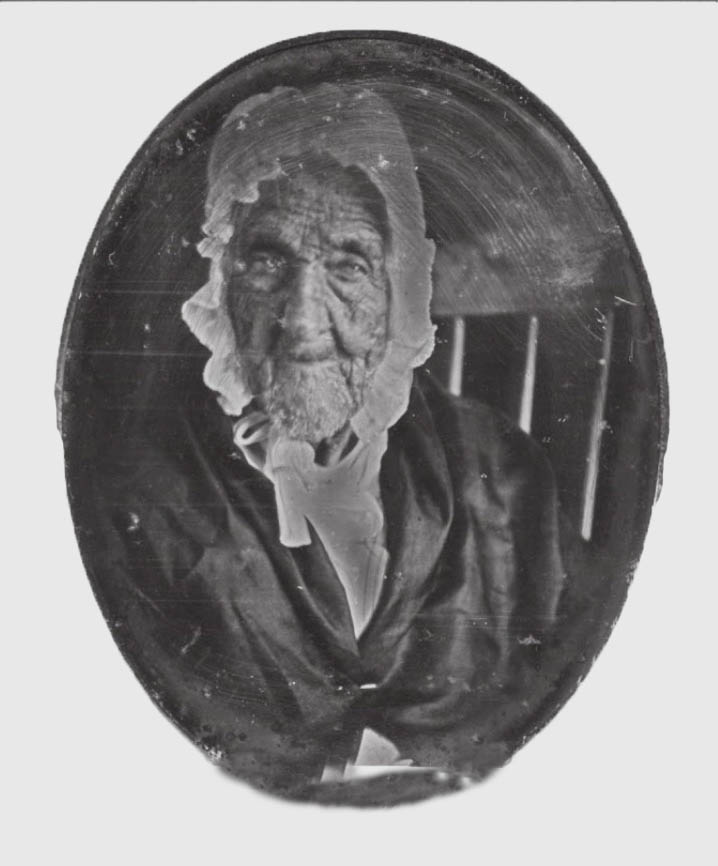
Margaret (Leber) Moses, shown in the image above at age 102, claimed to be near kin or a near relative of Rod’s 7th Great Grandfather William Hurrie, who famously rang the Liberty Bell to announce the signing of the Declaration of Independence. Read more about William Hurrie.
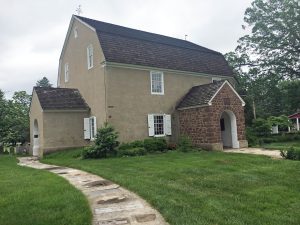
Margaret lived in Trappe, Montgomery, Pennsylvania and attended the Augustus Lutheran Church. The Old Trappe Church, A Memorial of the Sesqui-Centennial Services of Augustus Evangelical Lutheran Church, Montgomery County, Pennsylvania, which was published in 1893 documented her claim. In 1917, the claim was also included in Old Roads Out of Philadelphia by John Thomson Faris.
 Augustus Lutheran Church Graveyard
 Augustus Lutheran Church Graveyard
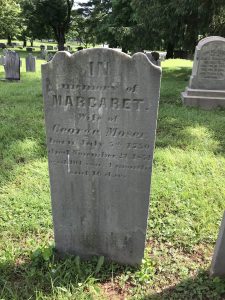
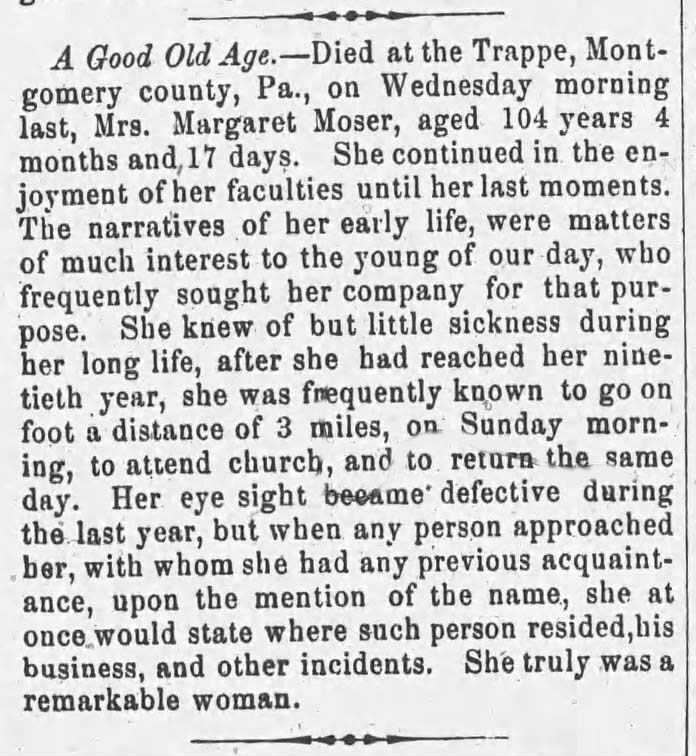
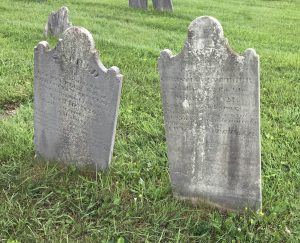
Margaret was mentioned in the church memorial as she was the oldest person to ever have been buried in the graveyard at the time it was written. She had died at age 104 years, 4 months, and 16 days. It stated that she was buried not far from Reverend Muhlenberg. When we visited the church and graveyard, we found both of their graves. Although not immediately adjacent, they were not far away from each other.
Although interested in her story, our primary reason for our visit to the graveyard was not, however, to visit her grave. It was to visit the graves of Rod’s 5th Great Grandparents Christian and Ann (McGinley) Stetler. Having died in the early 1800s, their graves were also nearby.
Who Was Margaret?
We did wonder how Margaret was related to William Hurrie. Ann (McGinley) Stetler was William’ granddaughter. And, we knew that Margaret and the Stetler family both had ties to Augustus Lutheran Church. However, the only thing we knew about Margaret was what was written in the church history.
Shingling
It turns out that Margaret was a very formidable woman. She was born July 5, 1750 in Montgomery County, Pennsylvania. She was engaged to George Moser when he got the call to serve. George was in the process of shingling his new barn at the time. So, while George went off to fight for America’s freedom, Margaret did what needed to be done. She climbed up on the barn and finished shingling it.
Troops in Trappe
While George was serving, the war came knocking at her doorstep. American soldiers decided to camp in Trappe. Augustus Lutheran Church was used as a barracks and a hospital. The church secured its place in history, by not only being used by the troops, but also with a visit from General Washington.
Despite the presence of the American troops (or because of the presence of the American troops), the church and area was not without threats of violence. The Reverend wrote in his journal that he was so disliked by the British that they threatened him with capture, torture, and even death. Apparently, they did not care for him and others in the area giving aid to the American troops.
After George finished his service, he served for his brother Peter who did not wish to serve. This may be because Peter was busy building a very large family and did not feel he could leave his wife and children. Once that service was complete, George came home.
Life Post-War
Reverend Muhlenberg married them in Trappe in May 1782. They were together until George’s death in 1806 at age 66. Margaret outlived him by 48 years. They had no children.
Meaning of the Phrase
The meaning of the phrase “near kin” or “near relative” is not clear and has been a stumbling block in understanding how she was related to William Hurrie. In some cases, it is used similar to next of kin. In other cases, the term “near of kin” implies that they were “almost like a member of the family.”
The Bible uses the term “near kinsman,” which is very similar. In that case, it is a close male relative and at least one reference implied that there was an order of closest, next closest, etc.
Possible Relationships
Since we don’t have clarity around the words that were used, let’s take a look at the possible relationships to see which ones can be ruled out.
Relationships to consider are:
- A direct relative (sibling, cousin, etc.)
- A relative by marriage
- Related via her husband George
- Related via a marriage of a child
- Related via William Hurrie’s wife Mary
- Related via the Stetler family since Christian married William Hurrie’s granddaughter
- A close friend . . . so close that they were like family
Direct Relative
Margaret was born in Montgomery County, Pennsylvania. However, her parents, Phillip Leber/Lever and Anna Margretha Muellerin/Mueller were both born in Germany. Since William Hurrie was from Scotland, it seems that a direct relationship is nearly impossible.
Related Through Her Husband
George Moser was born in Germany as were his parents. Thus, this connection also seems nearly impossible.
Related through A Marriage of A child
This scenario can be ruled out since George and Margaret never had any children.
Related to William’s Wife
William was married to a woman named Mary. Her surname and heritage is unknown. It is possible that she was related to Margaret. However, I have not yet found a woman named Mary in Margaret’s family tree who would have been reasonably close in age to William Hurrie. That said, this remains a possibility.
Related Via the Stetlers
The Stetler family lived in Montgomery County, Pennsylvania and were of German heritage. Additionally, they have ties to Augustus Lutheran Church. Since William’s granddaughter Ann McGinley married Christian Stetler, it is possible that she was the connection between Margaret and William Hurrie. This seems like a bit of a stretch genealogy-wise since she would have been, for example, a cousin to the husband of William Hurrie’s granddaughter. That doesn’t seem very near, but it wouldn’t surprise me as people were a bit more generous in those days as to who was family.
That said, to date I have found no connection between Margaret’s family and the Stetler family.
Close Friends
It is definitely possible that Margaret considered herself a close friend of William’s granddaughter. They both lived in the same general area and it is very possible that they knew each other well. It should be noted, however, that Margaret was considerably older than Ann and that Ann died over 30 years before Margaret.
More Questions
One factor that I believe must be considered in figuring out the meaning of “near kin” in this case is to consider how Ann McGinley, a Scottish/Irish young lady, who lived in the center of Philadelphia became acquainted with and married Christian Stetler, a man of German heritage who lived near Trappe. The distance isn’t great and if traffic cooperates, you can make the drive between the two locations in less than an hour. Even today, though, it is full of twists and turns. In the Colonial days, it would have taken much longer to make the trip.
Prompt: Language
#52Ancestors52Weeks