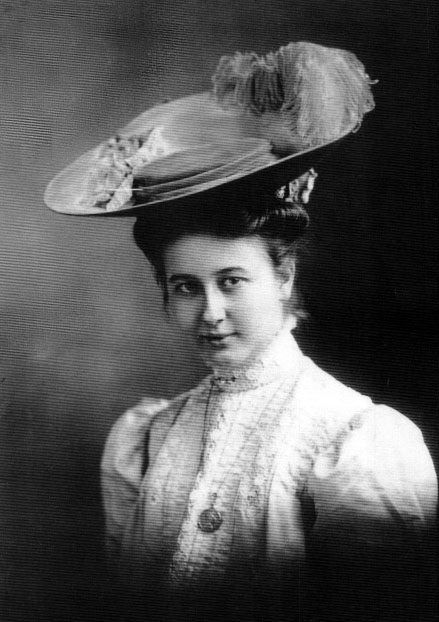
Her mom dies and her dad travels for work. She is an only-child and lives with her grandparents, who raise her as a sophisticated city girl only to fall in love with and marry a country boy who lives half-way across the country. This requires leaving everyone she knows and changing her religion. Then they move to Canada, but return. Over the years they have a large family. And, when they are grown, her dad who has worked all over the eastern half of the country moves in with her. All these changes had to change her perspective on life — a lot!
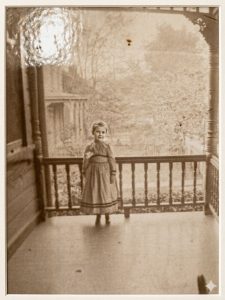
The Early Years
Blanche Mabel Klinefelter was born September 27, 1887 in Pittsburgh, Pennsylvania to Judge Sharpless and Emma (Ackermann) Klinefelter. On December 30, 1888, when Blanche was only 15 months old, her mother died in childbirth along with Blanche’s brother Daniel.
Blanche’s father worked in construction and later was a superintendent of large building projects. His work took him all over the eastern half of the country. Read more about Judge Sharpless Klinefelter.
Thus, Blanche lived with her grandparents, Joseph Gazzan & Caroline (Stetler) Klinefelter in the East Liberty/East End area of Pittsburgh. She grew up at 5612 Harvard St.; however, the home no longer exists.
Her father would visit when able. However, he remarried in 1896 to Lois Campbell. He had two daughters with her: Carolyn Elmina and Hortense Lucille. Now, she had to share her father with her half-sisters and his wife in addition to with his work. Although Blanche knew her half-sisters, they lived in Ohio. Thus, it wasn’t like having true sisters that lived in the same household. Besides, the older of them was nine years her junior.
Despite all of this churn, Joseph and Caroline made sure that Blanche grew up to be a cultured young lady. She graduated 8th grade at the Highland School in the East End neighborhood of Pittsburgh, Pennsylvania. Upon graduation, she received a watch that could be worn on a chain or that could be pinned to a dress.
By this time, Pittsburgh was a very fast-growing metropolis. By 1900, Pittsburgh had just over 320,000 inhabitants and in the next 10 years the population would grow to over half a million.
 Marriage
 Marriage
In early September 1905, Blanche accompanied her grandparents to Denver Colorado. Joseph made the trip to attend the National Encampment of G.A.R. (the Grand Army of the Republic) that was held the week of September 4. Read more about Joseph Klinefelter and G.A.R.
At the same time, Herbert Thomson was also traveling. He lived in Nebraska; however, he was returning from Alberta, Canada, where he owned property.
As fate would have it, Blanche and Herbert ended up in the same location at the same time. They met at the train depot in Colorado Springs, Colorado. Herbert was thirteen years her senior, but Blanche and Herbert hit it off.
Blanche’s grandparents thought he would be a good catch for Blanche because he owned land. One thing led to another and Herbert decided to make a trip to Pittsburgh, Pennsylvania.
He ended up proposing and they married approximately three months after they first met.
The Wedding
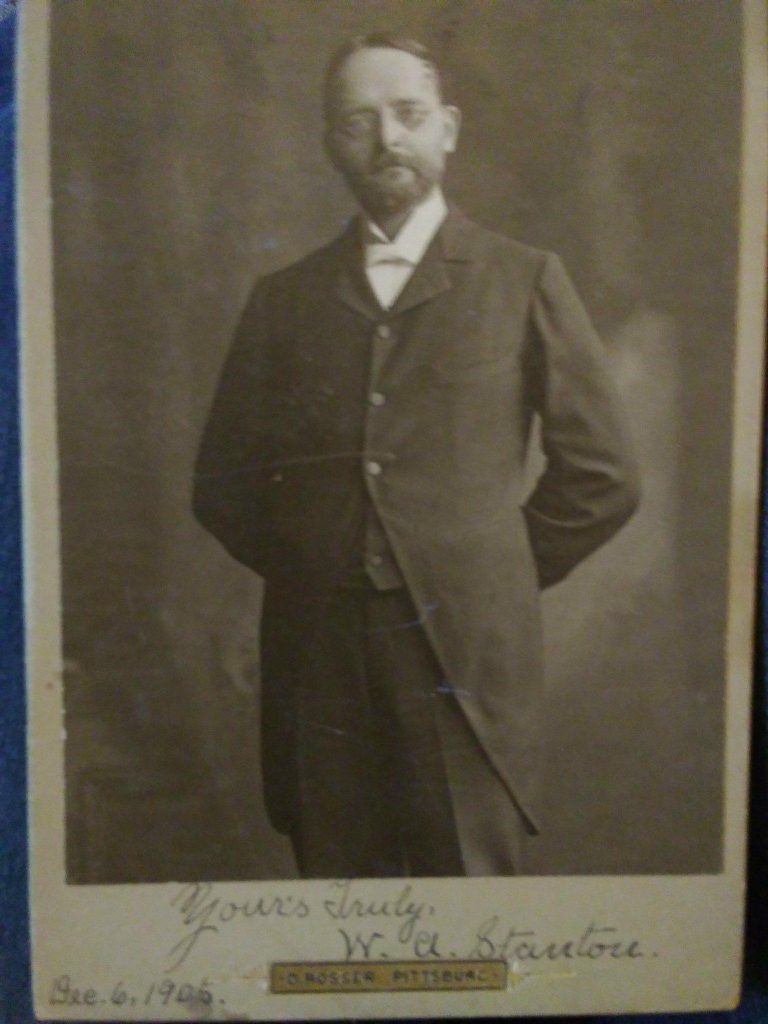
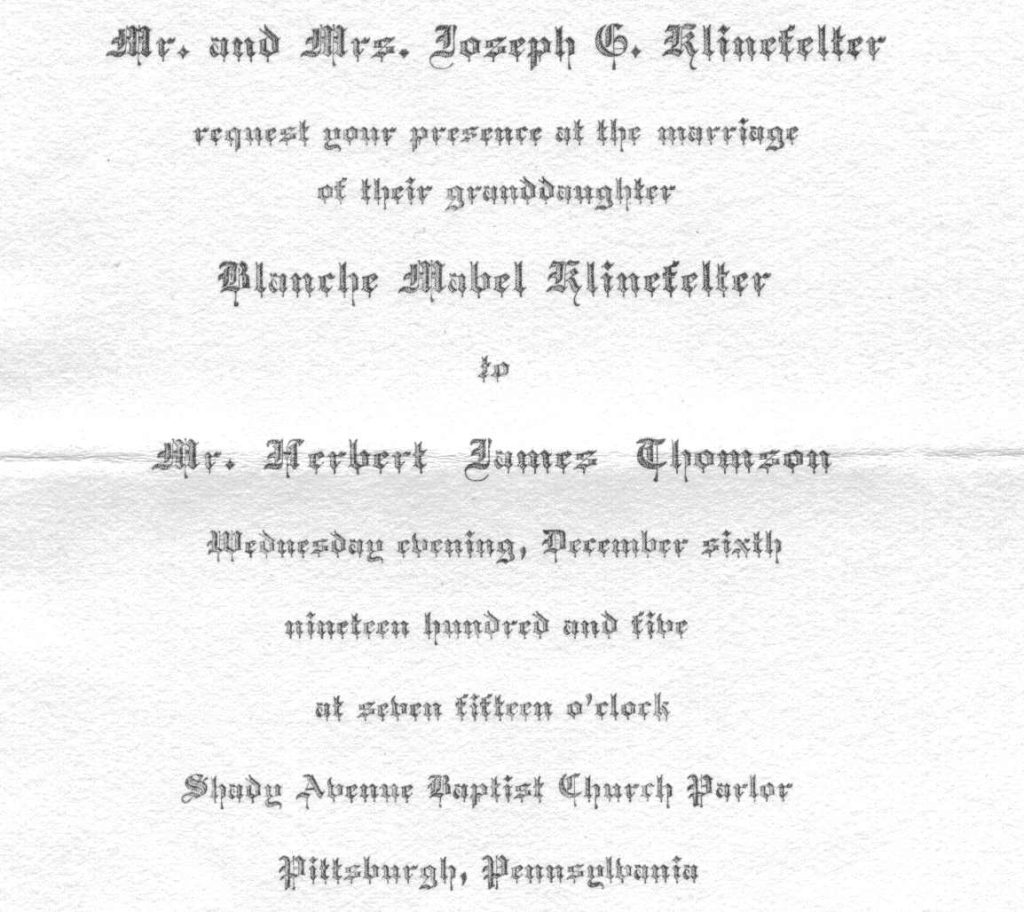
On December 6, 1905, Blanche and Herbert were married in the parlor of the Shady Avenue Baptist Church. It is unknown how many guests attended the wedding. However, the invitation appears to indicate that it was a formal affair. Of interest is that her grandparents names are on the invitation and not her father’s name although he was most likely in attendance as her half-sisters signed as witnesses to the wedding. Her grandparents also sent out formal announcements of the wedding.
The photograph of the pastor must have been given to Blanche and Herbert at their wedding. It was one of several gifts. They later stated that the gifts that they had received were “useful, handsome, and valuable.”
The Wedding Dinner
Following the evening wedding, a six-course dinner was served at a nearby hotel. The most likely location was the Hotel Schenley as it was just over two miles from the church and would have provided an elegant dinner.
Based on their station in life, menus of that era, the location, the time of year, etc., Grok AI suggested the following as a possible menu. I am sure that this is NOT the menu for their wedding dinner, but it gives a hint of what it might have been like.
“Hors d’Œuvres Blue Point Oysters on the Half Shell Celery Hearts · Queen Olives · Radishes · Salted Almonds Amontillado Sherry
Potage Cream of Green Turtle (a warming, celebratory classic for December gatherings) or Consommé with Julienne Vegetables and Fine Herbs Bread Sticks · Toasted Points
Poisson Broiled Shad à la Maître d’Hôtel (fresh Pennsylvania river fish, simply prepared and hearty) or Filet of Sole with Lemon Butter Cucumbers in Cream · Small Parisienne Potatoes Rhine Wine or Sauternes
Entrée Guinea Hen or Chicken Breast à la Maryland (breaded, fried crisp, served with cream gravy, corn fritters, and bacon—a substantial, festive Pennsylvania favorite) Asparagus Hollandaise · Green Peas
Rôti Roast Philadelphia Capon with Watercress and Currant Jelly (local poultry, roasted to perfection—symbolizing home and family pride) or Saddle of Lamb with Mint Sauce Mashed Potatoes · Glazed Sweet Potatoes · Cauliflower in Cream Sauce · Buttered String Beans Claret or Champagne (poured generously for toasts to the bride—raised as a daughter by her grandparents—and the couple’s new life together)
Entremets & Dessert Roman Punch (iced rum-citrus sherbet to refresh the palate) Bride’s Cake (a tall, richly fruited cake with marzipan, white icing, and sugared winter fruits/flowers—cut amid cheers and well-wishes) Charlotte Russe with Preserved Fruits Neapolitan Ice Cream · Petits Fours · Meringues Assorted Fancy Cakes · Fresh Fruit Compote Cheese (Roquefort and others) & Crackers Demi-Tasse (black coffee) · Liqueurs · Cigars for the Gentlemen”
Grok went on to suggest that a small orchestra may have played music while the guests ate, visited, and possibly danced in the seasonally decorated ballroom
Arrival in Nebraska
Once married, Blanche left her life in the bustling city behind and moved from Pittsburgh, Pennsylvania to Herbert’s farm outside Palmyra, Nebraska. Herbert and Blanche arrived in Palmyra via train with Blanche in all her city finery.
Even if Blanche had visited farms or had other knowledge of them, nothing could have really prepared her for life on the farm, where the closest town had just over 300 people. The roads were dusty, the prairie wide-open where you could see for miles, and wild animals were abundant. It was quite a change.
The Nebraska Reception
Upon arrival in Nebraska in mid-December, Herbert’s parents, Arthur Reid and Margaret (Ronald) Thomson held a reception at their home for their youngest son and his new bride. The event included a four-course dinner.
Grok AI suggested that the menu for this dinner would be quite different than the wedding dinner
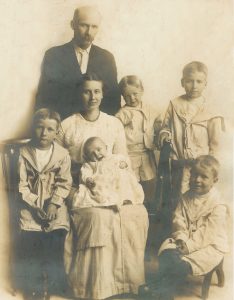
Herbert & Blanche (Klinefelter) Thomson’s Family in 1915
“Soup / Starter Scotch broth (thick barley soup with root vegetables—carrots, turnips, onions—from the cellar, bits of mutton, beef, or chicken from the farm, and perhaps pearl barley …). Served with homemade bread, oatcakes/bannocks (simple flat oat breads baked on the stove), or biscuits. Side of homemade pickles, relishes, or canned beets for contrast.
Main Course / Roast … chicken, goose, or pork (fresh from the farmyard or hog-killing season—…. Stuffed with sage-onion dressing; served with rich gravy (pan drippings thickened with flour/milk), mashed potatoes (creamed with butter), candied sweet potatoes or glazed carrots, boiled cabbage or turnips …, and green beans or corn (canned/dried from harvest).
Sides / Vegetable Course Additional hearty accompaniments: Scalloped or creamed corn (Midwest staple), coleslaw or simple cabbage slaw (vinegar-dressed), applesauce (from stored apples), and more rolls, oatcakes, or cornbread passed around. Perhaps a small dish of buttered parsnips or onions if available.
Dessert Homemade pie (apple from stored fruit, pumpkin from preserved squash, or mincemeat with preserved fruits/meat…). Or shortbread cookies (buttery oat shortbread, a direct Scottish touch), spice cake, or fruitcake (spiced preserved fruits). Served with strong black coffee, fresh milk/buttermilk, or tea—warming for winter.”
Grok depicted the scene as was typical of rural family life in the early 1900s – no frills, but plenty of food and fellowship.
Big Changes
Blanche likely missed the fancy houses, places of culture, and nice stores. However, it is said that Blanche missed wearing large hats, fancy gloves, and hooped skirts more than anything else. None of them were of any use on the farm. Not all city women could make this transition. One must assume that Blanche was open to accepting a new perspective and that she must have really loved Herbert!
In addition, despite having half-sisters, Blanche grew up effectively as an only child. Her father was also an only child and her grandfather only had one living brother who lived hundreds of miles away. Thus, it must have been quite a shock when she met Herbert’s large family. Big family gatherings happened frequently and were quite contrary to the small family of which she was accustomed.
In the coming days and years, Blanche would experience the Presbyterian religion. Leaving behind the Baptist Church, she would become very active in the Palmyra Presbyterian Church. Read more about the Palmyra Presbyterian Church.
Besides family size, location, and religion, Blanche had to deal with culture shock of a different type. She came from a family where many recent generations were from German immigrant families; whereas, Herbert’s family was Scottish through and through.
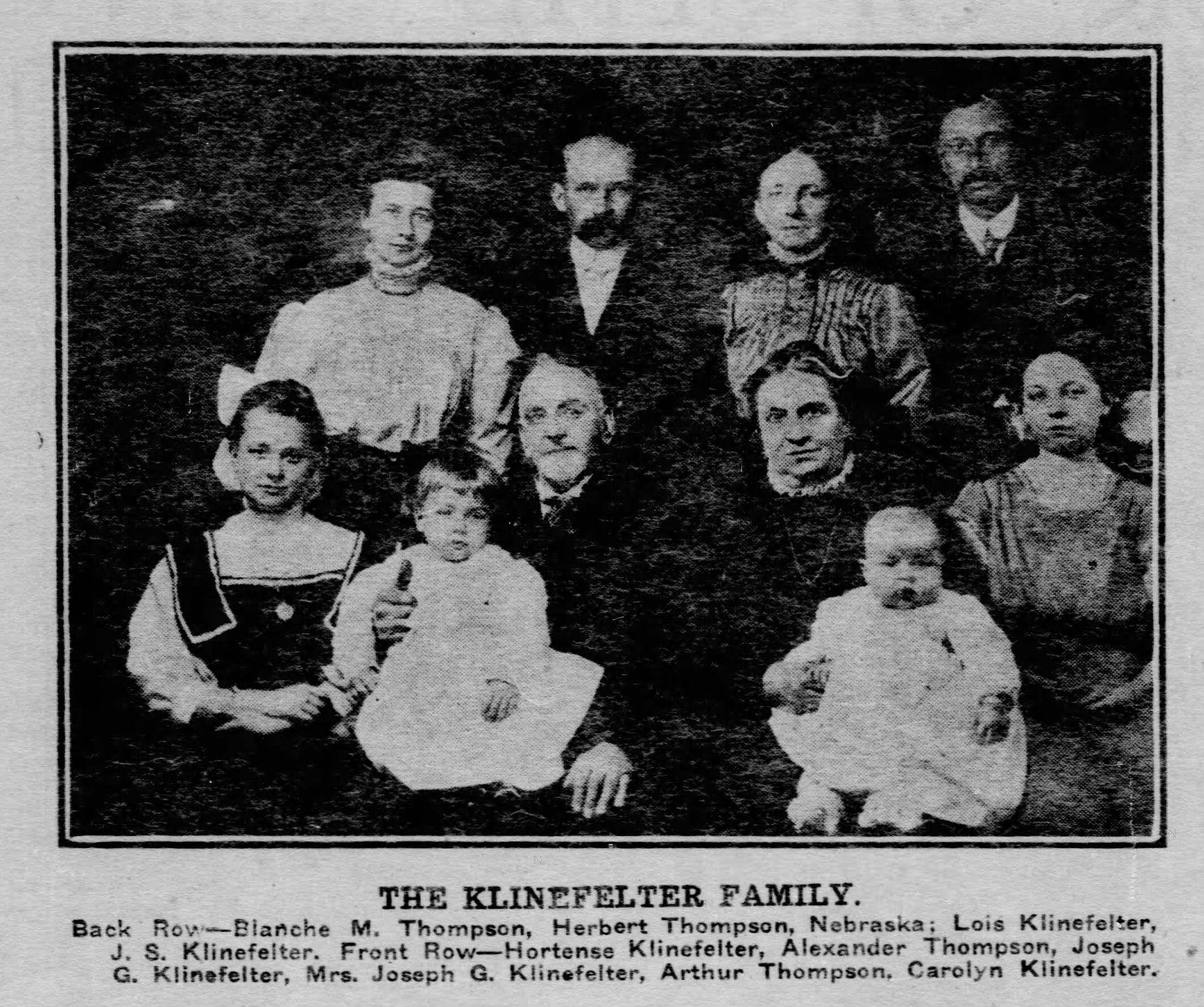
Her Roots
Over time, Blanche adapted to country living. However, she kept in touch with her family back in Pennsylvania and was very proud of her roots – the Klinefelters, Ackermanns, Stetlers, McGinleys, and, of course, William Hurrie, the famous bell ringer who rang the Liberty Bell when the Declaration of Independence was read. Read more about William Hurrie.
During the next several years, various members of the family visited. During these visits, Blanche asked her relatives to write down pieces of their family history. Her grandmother Caroline Klinefelter gave her an autograph book, which she used to record family history. When the Freedom Train came to town, Blanche was responsible for making it known that the family descended from William Hurrie. Read more about the Thomson family and the Freedom Train.
Canada
For two years around 1920, Herbert and Blanche embarked on a new journey when they moved to Herbert’s property near Stettler, Alberta, Canada. There Blanche experienced a new country. Although the town was thriving, it was quite remote. The 160-acre farm was three miles north of the northeast corner of the village of Stettler, which lies over 140 miles northeast of Calgary.
Although their stay was short, Blanche and Herbert brought home a wonderful souvenir of their time in Canada – their seventh child, May Viola, who was born during their stay.
The following two photos are both marked as being taken in 1928. However, they do not appear to be from the same year. The first photograph was taken when they were on a later trip to Stettler. George Ackermann is included in the photo. He is a relative of Blanche in her mother’s family, who was visiting from California.
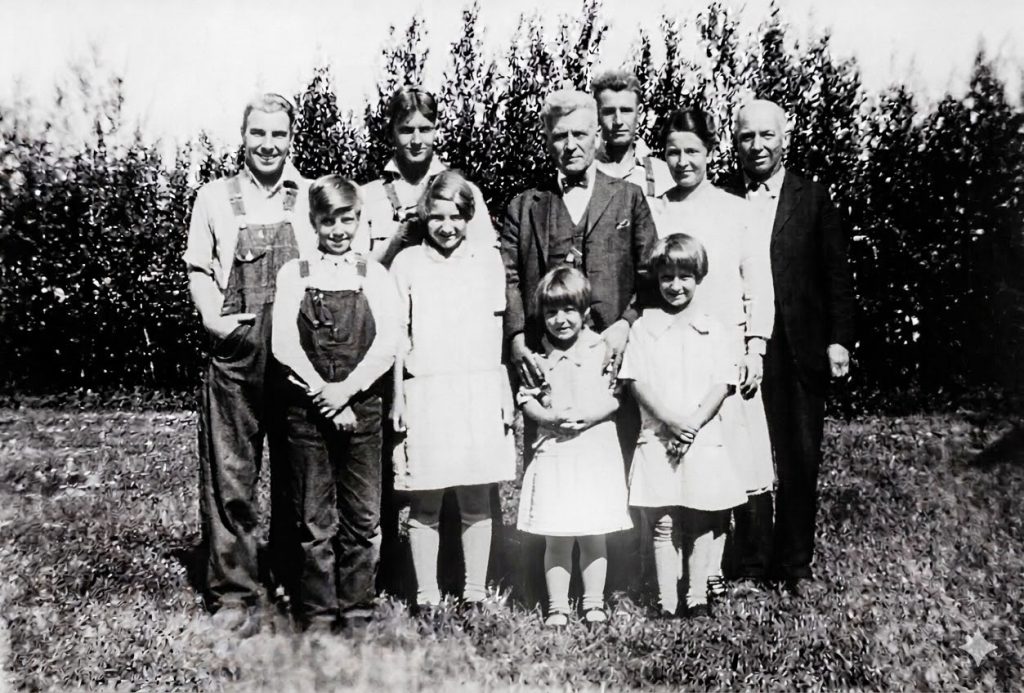
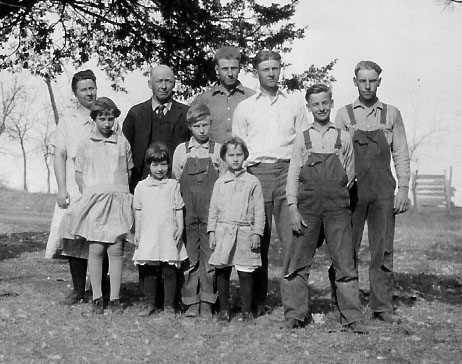
After the experiment of living in Canada, the family returned to Palmyra where they stayed with the exception of trips to the north land.
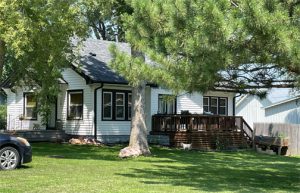
Dad Moves In
After their Canada adventure, Blanche and Herbert returned Nebraska and farmed for many years. In 1945, Blanche’s father Judge who was 81 and a widower, moved in with Blanche and Herbert. Over the years, Judge had divorced Lois and remarried to Martha Edward, who had subsequently died. Therefore, Judge moved into one of the rooms that Blanche and Herbert’s children had vacated when they became adults.
The following year, with Herbert’s health declining and Judge in his eighties, the three of them moved into Palmyra. They lived across the street from Taggart Park.
In 1948, change happened again when Herbert died. Blanche was well able to take care of herself and her home. Her father continued to lived with her.
Later that year, Blanche’s oldest son Alexander James Thomson and his wife Donna Isabelle (Van Allen) Thomson made a trip to Canada. While they were gone, Blanche cared for the oldest four children, making sure that they made it to school each day. Virginia had been born, but wasn’t in school yet. So, she stayed with her mother’s brother and his wife. Rachele wasn’t born until they returned from the trip. Thus, she got to go along.
In 1951, Blanche made her last known trip to visit Canada.
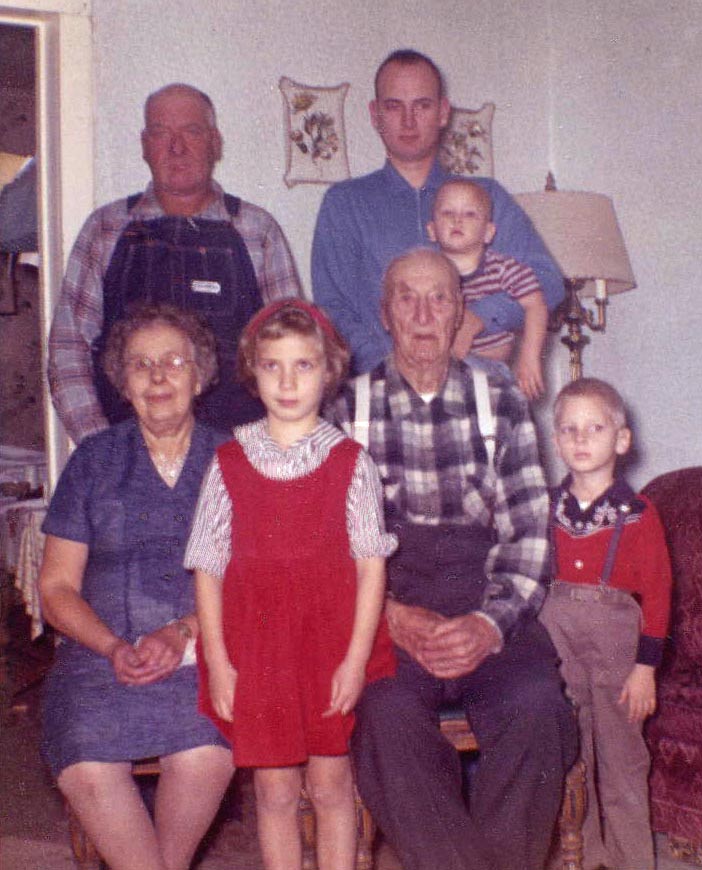
Blanche died June 21, 1964, only weeks after taking a five generation photo that included Rod and his siblings. Blanche had been looking forward to celebrating her father’s 100th birthday. To honor her father, she planned to present family members with a family history booklet that included her father’s ancestors. The booklet was finished by family and a page added to honor Blanche, the beloved mother of eight, grandmother of 25, and great-grandmother of at least 12 at the time of her death. It also honored her role as family historian.
Use the audio recording below to hear Blanche talk about her life.
Just know – all that change throughout Blanche’s life had to have changed her perspective in multiple ways!
Afterward
Her father died in August at age 100 and her son Alexander died a few days later.
Prompt: Changed My Thinking
#52ancestors52weeks