William Jury, born circa 1812, left England for a new life in Canada.  With that move he set in motion many moves to come.
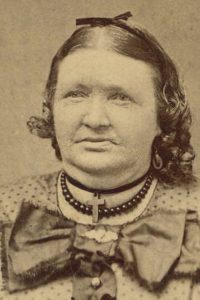
 

Eleanor (Willett) Jury

Canada

About 1830, William set sail for Canada.  After he arrived, he met his future wife Eleanor “Ellen” Willett, who had also arrived In Canada from England.  They began a new life together in 1835 and became the parents of four children.  In 1848, William built a big barn on the property.  He would not live to enjoy the fruits of his labor as he soon became ill with typhoid fever and died.


Somehow Eleanor managed to raise the children.  Much of the burden likely fell on John, who was 12 when his father died.  He became a shingle maker and when he was 22, he married Matilda White.


Moving to Kansas

In 1868, at only 30 years of age, Matilda died. She was buried in the graveyard of a country church about 4 miles west of Drumbo, Ontario, Canada. It isn’t known if this is the event that set in motion plans to move to America.  However, in the fall of 1869, John, his children, his mother, his sister Ellen, and his brother’s family headed southward.  Only his sister Ann(Jury) Carr stayed in Canada.


November 23, 1869, they are listed as new arrivals at the Western House Hotel in Ft. Scott, Kansas.  The cooks at the hotel were African Americans and this was a whole new experience, especially for the children.  They had never encountered an African American prior to arriving in Ft. Scott.
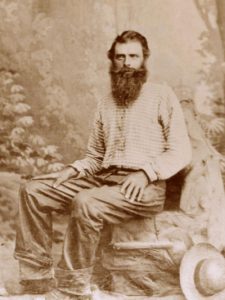
 

John Jury, Sr.

Getting a House

From Ft. Scott, the family traveled 18 miles southwest of Ft. Scott to a friend’s home.  They spent a few days with their friends before moving into a clapboard house.  They stayed in this house until spring.  Then John Sr. bought a farm that had a log house.  The house had a tar paper roof.  It was gone with the first storm that blew in.  So, John Sr. relied on the skills he had learned in Canada and built a shingle roof using black walnut.


The Grasshoppers

When the MK&T Railroad came through the area, the some of the workers boarded with the family.  They were all Irishmen and John Jr. remembers them wearing red shirts.  However, the railroad workers moved on and so did the family.  About 1873, grasshoppers were so bad “they looked like snow coming down.”  The family lost all their crops. 


So, family sold out and moved to Missouri.  It is believed that his brother’s family also moved as they had son born in Chiliothe, Livingston, Missouri on Christmas day 1873.  They spent the winter, summer, and next winter in this location.  They raised good crops of corn, broom corn, and tobacco.  However, they lost several horses before returning to Kansas
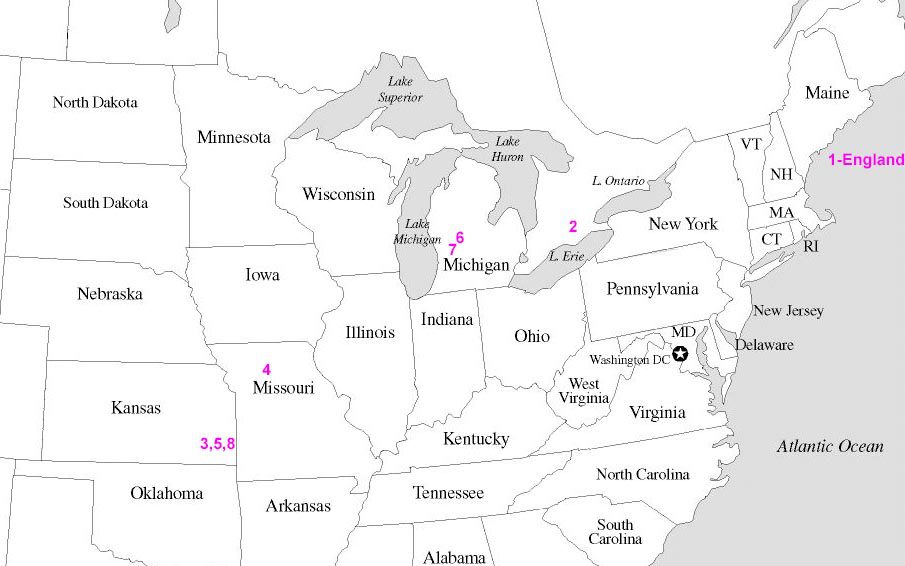
 

Credit: Department of Geography, University of Alabama

Kansas Again

It was during this stay in Kansas that John Jr. claims that he met up with Frank and Jesse James.   They were running from the law and he gave them directions through the woods.  In exchange, he helped him pull a heifer out of a muddy buffalo wallow.  Whether the story is true is unknown. (More search may shed light of the feasibility of the details of this story.)


Michigan

However, after 3 or 4 years back in Bourbon County, Kansas, the family was on the move again.  This time, John’s sister Ellen stayed behind as she had married Thomas Harnett of Hiattville.  However, John had remarried to Harriett Warner and it is assumed that she made the trip with them as they headed north.  John, his brother William, and his mother finally settled  near Sand Lake, Michigan where John Jr. hauled logs and shingles. 


After about a year, the family decided that they had moved too far north.  So, they headed southward, but only for a short distance.  This time they purchased 40 acres of timber land near Tallmadge, Ottawa, Michigan, about 8 miles west of Grand Rapids, Michigan. They remained until 1883 when John’s mother Eleanor (Willett) Jury died.
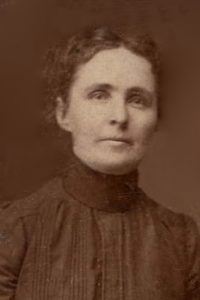
 

Matilda (Jury) Peelle

South Dakota

With his mother gone, John Sr. pulled up roots again.  This time his brother did not join them in their travels, electing to stay in Michigan. 


John sent his wife, daughter Matilda, and daughter Hattie back to Kansas.  It is believed that they traveled via stagecoach.  It is unknown where his wife and Hattie stayed, but Matilda went to stay with John’s sister Ellen (Jury) Hartnett.


Meanwhile, John Sr., John Jr., and possibly his other sons went to check into homesteading in South Dakota.  They found it to be very busy as many people were wanting land.  They ended up spending 50 cents to simply sit in a chair overnight.  Mighty pricey for the 1880s.


So, they headed back to Kansas.


Kansas Yet Again

By 1885, John was back in Kansas.  This time to stay.  John Sr. and Harriett lived in multiple locations, but all within spitting distance of Hiattville. He died at his home north of Hiattville in 1911.   


Continuing The Tradition

John’s children each moved small distances with John Jr. moving the furthest. Wilbert stayed the closest moving only to Kansas City, Missouri. Meanwhile, Matilda, who married William J. Peelle, moved as far away as Wichita.  Both Walter and John Jr. lived in Western Kansas.  However, after a time, Walter returned to the Hiattville area and John Jr. moved to Redlands, California.


John Jr.’s children kept the moving spirit alive with some in Western Kansas, some in California, and one who really went rogue and ended up in Bucks County, Pensylvania.


Portions of the story are based on notes of John Jury Jr., brother to Matilda Jury.  The notes are not complete as only a portion of the pages have been preserved.
We think of people today as living longer than people of days gone by.  People today do have the advantage of modern medicine and easier lives.  However, even someone born in 1683 could live to a ripe old age.


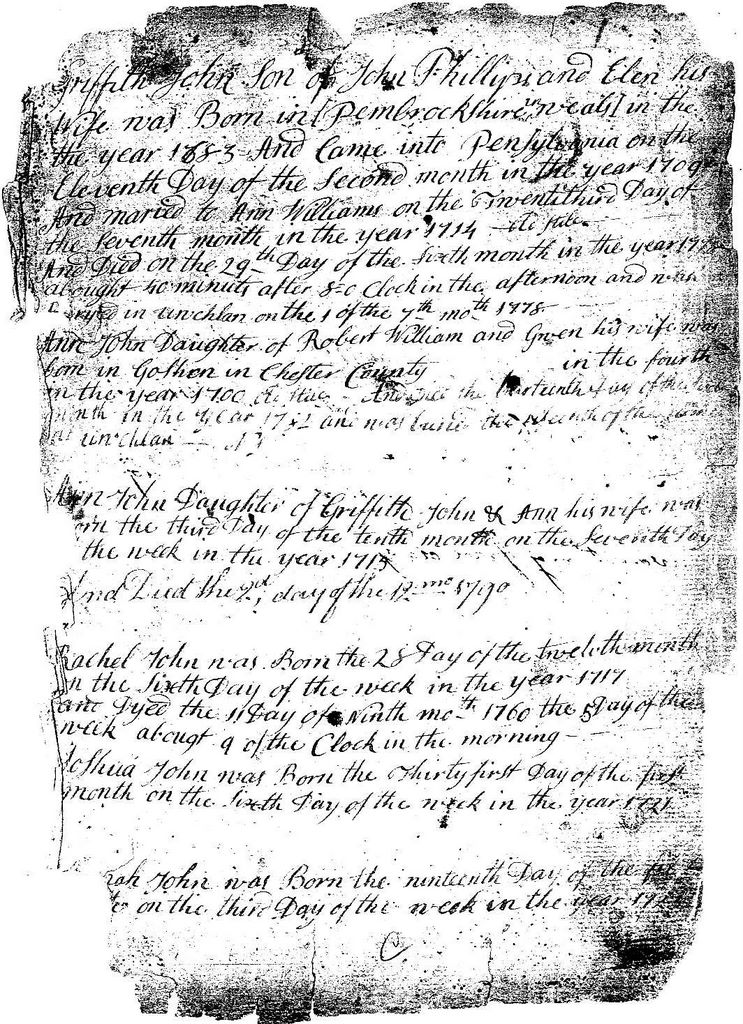
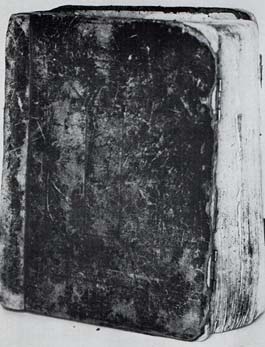
Page from Griffith John’s Bible

The Early Years

My 6th-great grandfather Griffith John was born in Haverfordwest, Pembrokeshire, Wales in 1683.  It is said that he was the second child of six children. His father was John Phillips (John ap Phillips) and his mother was Elinor “Ellen” Haward.  The naming delta is due to naming conventions in Wales  at the time.  Per earlier naming conventions Griffith would have been known as Griffith ap John (Griffith of John).  However, it was a time of change in naming conventions and he simply became Griffith John.


Arrival In America

Griffith, his brother Samuel, and Samuel’s wife Margaret arrived in America on the eleventh day of the second month of 1709.  Many people have recorded this date as February 11, 1709.  However, if the notes in the Bible use Quaker dating of that era, the date would be April 11, 1709, which seems more likely since they are said to have sailed in December.


Griffith and Samuel each had a Bible from Wales.  The Bibles that they brought with them supposedly contained a story about a member of the family being knighted for his role fighting in the Crusades.  The validity of this story is unknown.  However, it is known that they could read and write.  And, it was said that besides Welsh, they spoke English with a strong Welsh accent.


Marriage

It is believed that upon arrival in Philadelphia, Samuel, Griffith, and Margaret went to the Goshen area in Pennsylvania that was then known as the Welsh Barony.  However, it isn’t until 1714 when Griffith and Ann Williams requested permission to marry at the Chester Monthly Meeting of the Society of Friends that we find a record that is verified to be the Griffith of our family line. The Griffith John that is documented in that area in the interval prior to 1714 appears to be a much older widower who came to America before the brothers.


At the time of his marriage, Griffith was 31 years of age; however, Ann, daughter of Robert and Gwen (Cadwalader) Williams, was only 14.  Apparently, her parents, who are believed to have been the first settlers in Goshen township, approved of the marriage. If not, it seems highly unlikely the Society of Friends would have approved since her father was referred to as “King of Goshen.” The couple wed on the twenty third day of the seventh month of 1714.  .


Uwchlan Township

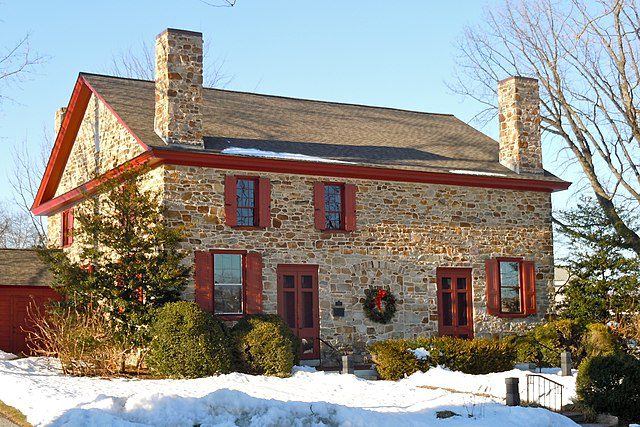
Griffith John was one of the first men to purchase a plantation in Uwchlan Township.  A plantation in those days was really another word for farm.  Plantations could be of any size and were not limited to the large plantations of South.  His initially was stated to be 100 acres and lie about 1.5 miles west of Lionville, which was about 25 miles west of Philadelphia.


Records appear to show fluctuation in the size of his property over the years. By 1765, Griffith’s property included 120 acres with buildings, 10 acres of woodland, 2 horses and two cows.  Five years later, records only listed 115 acres and stated that he had gained 3 sheep.  He had no servants, which was keeping with the Quaker life style, which focused more on getting by instead of getting rich.


Uwchlen Meeting House Built in 1756 Still Stands Today

His Ministry

Griffith had become interested in various religions including the Society of Friends (Quaker faith) while still living in Wales.  Once in America, he associated with people of the Quaker faith and not only joined them, but, along with his brother, became a Quaker minister.


Griffith was one of the founders of the  Uwchlan Monthly Meeting, which was located near Lionville.  Griffith and  Samuel, were the first ministers at the church, providing services in their native tongue.


The early meetings were held in homes, with the very first being in the home of John Cadwalader, who is likely Ann’s grandfather.  Later, a log cabin was built for meetings.  It wasn’t until 1756 that a 2+-story stone structure was built.  The new building also served as a library and school.


The War


Seizure of The Meeting House


When the Revolutionary War came knocking on their door, the Quakers, being pacifists, denied the use of their building to support the war.  However, the Continental Army seized the meeting house. Ironically, Revolutionary War soldiers that died at the meeting house were also buried in the Quaker graveyard, leaving the stain of war on the grounds forever.


Seizure of The Home


Members of the Uwchlan Meeting met in private home while the meeting house was used as a hospital. It was unlikely, however, that the Quakers met in Griffith’s house since George Washington, who is said to have visited soldiers at the meeting house, issued the following order on March 25, 1778.

“The Honorable the Congress having appointed Matthew Clarkson and Major John Clarke Esquires Auditors to settle and adjust the accounts of the Main Army they are to be respected accordingly; Any persons who have any accounts to be audited by them may find them at the house of Griffith Johns about three miles beyond the Pay-Master Generals quarters.” 

Although there were at least two other men named Griffith John, the location described likely aligns with this particular Griffith John.  If true that the Army used his home, it would have placed him in the middle of a war that he did not believe in.


Longevity

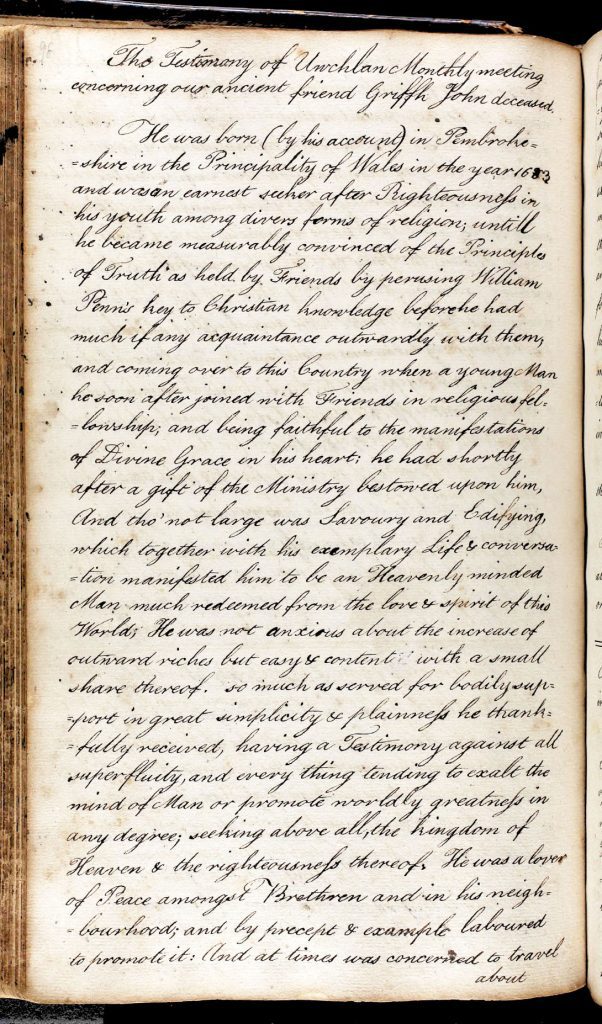
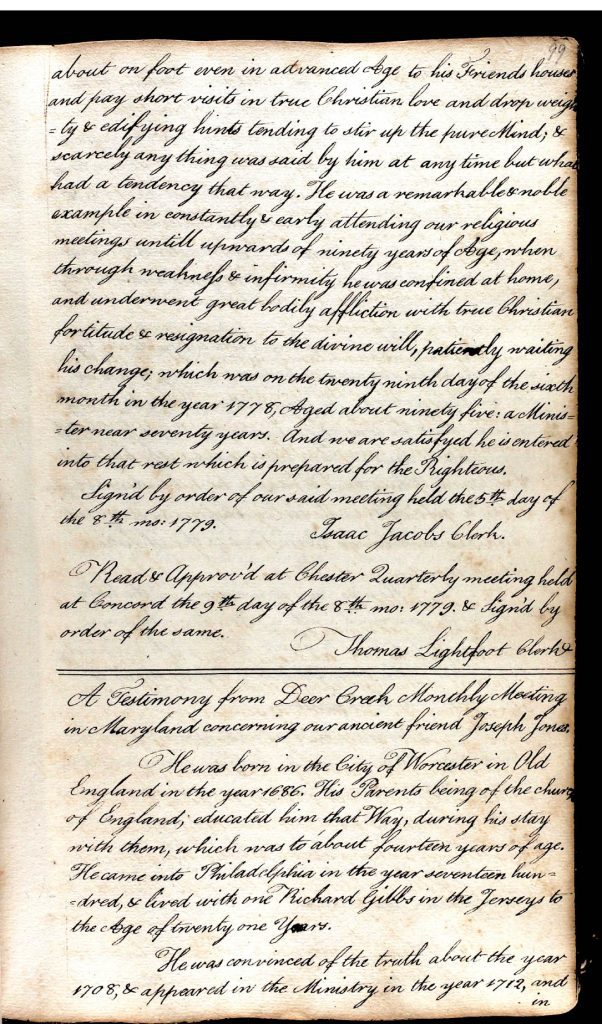
Griffith died on the 29th day of the sixth month of 1778.  By this time the calendar had changed; thus, this date would be June 29, 1778.  He was 95 years of age.  He had been married 64 years, fathered six sons and six daughters, and had been a minister for approximately 70 years. He had continued attendance at meetings until physically no longer able.


Although he lived the plain and simple life of Quakers, Griffith managed to leave a small inheritance to each of his living children and to his grandchildren in the cases where his child was no longer living.  Most of the children received 15 pounds of Pennsylvania currency with the grandchildren receiving 10 shillings. Griffith Jr. received the plantation as he had stayed in the area and help care for his parents.  Additionally, Griffith Jr. had to provide specific amounts of numerous items, such as, wool, wheat, and apples for Ann as long as she chose to live at the plantation.  The provisions changed if she were to move away.


The year following Griffith’s death, the meeting published a testimony to him.  You can read a copy of the original document in its entirety below.

Afterward


Many years later when the Civil War broke out, the members of the Uwchlan Meeting willingly gave up their meeting house to be used as a hospital.  What was different this time was that their dislike of slavery was stronger than their dislike of war.  Thus, they supported abolition by passively helping the north in their fight.


Credit to Marijane “Johnnie” Zerphey, who traveled across the United States and to Wales researching the John family.  Many facts herein are based on my research.  However, I have supplemented them with information from her extensive research.


Grandpa’ McCracken’s Aunt Minnie Alameda Munroe unknowingly left the family a wonderful gift even though she didn’t name them in her will.  The only people included in her will were Charles Munroe (her husband), Mabel Raukohl (her niece), and The Old Peoples Home of Illinois Conference of Methodist Episcopal Church in Quincy, Illinois.


The Probate Paper


Grandpa had kept a paper he had received from the Probate Court in Quincy, Illinois regarding his Aunt Minnie’s estate.  It listed all of her heirs, leading to many surprising discoveries. (Thank s to Grandpa and my dad for saving this document!)


The list of heirs was quite lengthy and contained names unknown to the family. The names of these unknown people were sprinkled amongst the known names. Aunt Minnie had no known children nor did her husband Charles.  So, who were these people?


Margaret Armstrong

Addie Brown 

Martha Boswell,

Eleaner Kealen

Anna Macklin

John Macklin

Lester Macklin

Oltis Macklin

William Macklin

Lawrence McCracken

Bertha Neal


The most prominent name was Macklin, but the name that caught my attention the most was “Lawrence McCracken.”  None of the records I had found at that point for Lemuel and Louisiana McCracken, Minnie’s parents, listed a son Lawrence.  Who was Lawrence McCracken? 

The 1860 Census

After much digging, I had some records, but they didn’t come together into a clear picture.  Finally, I started going page by page manually walking through the 1860 census for Lee County, Iowa where Lemuel supposedly lived at the time, but where a census record for that year had not yet been found.  Eventually, I found a census record that had been poorly recorded and poorly transcribed.  As transcribed online, it included the names shown.


I had expected to find Lemuel, Louisiana, and their son Lemuel Franklin/Francis. However, none of the names were quite right and there were extra people.  The names “Samuel “and “Lemuel” look very similar in handwriting of the time, so that was a likely match, but Rosannah was way off. And, who were Delormah, Mary, and Lewis?  


Still, I was sure this had to be our family. 


Census Record

(as transcribed online)


Samuel McCracker

Rosannah McCracker*

Mary McCracker

Lewis McCracker

Delormah McCracker

Samuel McCracker


* Rosannah is an apparent misunderstanding of Louisiana that occurred in multiple documents.

The Surprises 


After many, many hours of research I determined how each of these people fit in the family tree, learning many surprises along the way.  (I was going to number the surprises, but that became a bit complex.)


Lemuel McCracken

I found that Lemuel had been married to Sarah Dufer before he married my great-great grandmother.  It is assumed his first wife died, but no information has been found about her death.

Lawrence McCracken

Delormah McCracken

Lawrence McCracken was the same person as Delormah McCracken.  His name was Delorma (various spellings) Lawrence McCracken.  He was the son of Lemuel and his first wife.  We had never heard of him before the probate papers. He had been living with another family in 1870.  Thus, he didn’t show up with the family in that census.  And, although he was only 15, he stayed in Iowa when Lemuel and Louisiana moved to Kansas. He later married and had 8 children.  We have DNA matches to many of his descendants.

Louisiana Matteer

Louisiana Johnson

Louisiana Badgley

Louisiana’s maiden name was not Johnson as the family had always believed or Mattser as some researchers believed.  Instead, it was Matteer.  Her parents were Matthias Matteer and Mary Rodgers.  She was the oldest of their 10 kids.  After her mother died, Matthias and his new wife Elizabeth Soloman moved to Lee County, Iowa with many of his kids.  Louisiana joined them sometime before 1859, coming from Ohio.


Louis McCracken

Louis Badgley

Louis was the son of Louisiana and James Badgley.  We hadn’t known he existed and something appears to have happened to him between 1860 and 1870 as  no records are found for him after 1860.  Additionally,  he is not mentioned in the probate papers for Minnie.


Mary McCracken

Mary Badgley

Mary Macklin

Mary was the daughter of Louisiana and James Badgley.  Her existence was also a surprise.  She married John Macklin in 1865.  They moved to Adams County, Illinois, where Lemuel and Louisiana’s children Frank, Minnie, and Ida later lived. It is believed , but not yet proven, that after Louisiana died, Mary raised her half-sister Minnie, who was 27 years younger than her.  It is important to note that prior to that time Minnie was called Frances.  The name change is a mystery that has yet to be solved, but Frances and Minnie are clearly the same person.


And, The Rest


Mary and John had 8 children.  The remainder of the people in the probate document are their descendants.  Addie Brown, Martha Boswell and Eleaner Kealen were their children. Otis Macklin, Lester Macklin, Anna Macklin, Margaret Armstrong, and John Macklin were the children of William Macklin, who was deceased.


These members of the Macklin family led to even more descendants of great-great-grandma Louisiana.


The Moral Of The Story


So, as a result of starting with one probate paper, I ended up finding additional marriages for both of my great-great grandparents, additional children for each of them, Louisiana’s parents, Louisiana’s siblings, and a bunch of descendants of the various people. Could they have been found without the paper?  It is  reasonably likely that I would have eventually pieced this branch of the family together without it.  However, it would have set my research back years.


Moral of the story:  Don’t toss aside a record just because names on it are unfamiliar or don’t look quite right.  You never know what surprises are in store for you with a little (okay sometimes a lot) of research!

Lawrence Peelle (Peale, Peele), born about 1601 in England, is believed to be our earliest ancestor in America.  The line can be traced back to Robert, who is believed to be Lawrence’s son per location and associations.

In 1620, Lawrence boarded the ship the Margaret & John for the trip across the Atlantic.  Some people record the date this journey began as December 1620 and others record it as February 1620.  The latter is believed to be correct as the year in that era started on March 25 and that would match the end of 1620.

The plan for 1620/1621 of the London Company of Virginia (often referred to simply as the London Company), who arranged the trip, called for 800 people to be sent to the colonies.  Over half were to be farmers, carpenters, potters, and men of other skills. The remainder were maids, boys, and servants.

By this time, the London Company had come up with a plan to finance voyages by dangling land in front of potential colonist.  They got the people to pay for passage.  Then they would get rights to 50 acres of land per person.  And, the London Company would continue to profit as they required the colonists pay a fee each year to use the land.


Adversity On The Sea

The Margaret and John set sail in the capable hands of Captain Anthony Chester.  The conditions weren’t ideal and passage across the Atlantic was a rough and unforgiving one.  The ship was packed with future colonists and provisions bound for Virginia.

There wasn’t a first-class section or even many accommodations for the passengers.  Everyone and everything simply shared space on the 150-ton ship.  The trip was long, cold, and wet.  Between those factors, minimal food, and sea sickness, the trip was often miserable.  In addition, stench on the ship would have been horrible.


The Sea Fight

The ship traveled through the Lesser Antilles as a voyage directly west wasn’t possible given the winds and current.  When approximately 100 miles northwest of Guadalupe, the Margaret and John encountered two larger ships flying the Dutch flag.  Once together, the other two ships tossed aside the Dutch flag, replacing them with the Spanish flag, which meant trouble for the Margaret and John. The Spaniards disliked the English settling in North America and they made that clear to the English every chance they got.  And, that day the Margaret and John was in for a fight.

The Spanish ships dwarfed the Margaret and John with the larger being twice the tonnage.  Both were also far more equipped for battle than the English ship.  Over the course of six hours, a war of words and cannon balls was fought.  The battle ended when the English, which could only use 4 of their 8 cannons due to goods on board, disabled one of the Spanish ships and killed many of the men aboard the ships.  However, by the time the conflict ended, approximately a third of the people on board the Margaret and John had been killed or injured with 10 killed and approximately 20 injured.


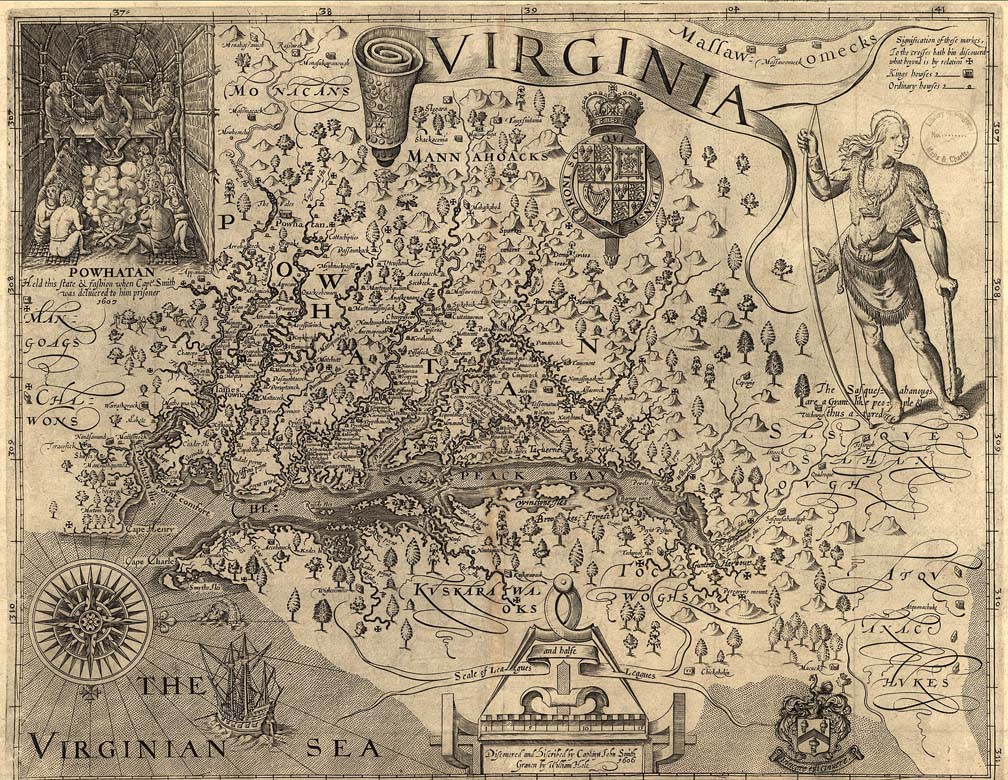
Captain John Smith’s Map of Virginia. Published 1612.

A Strange Land

Lawrence arrived in Virginia from England in May of 1621.  The number of settlers in Virginia at the time was quite small.  By that spring the London Company records stated that only 603 Europeans were living in Virginia.  Nearly, a third of the ones living there the year before had died.  It is estimated that only about 25% of the people that left England for Virginia survived the journey and the next few years that followed.

Lawrence was a lucky one.  He settled in Elizabeth Cittie.  Life was never easy.  The land, diseases, the weather, limited supplies, and more presented challenges for the colonists.  The Colonist’s version of ordering from Amazon and having something delivered was to send a request back to England with the Captain of a ship.  That request then had to be filled and shipped back to Virginia.


Indian Massacre

The Treaty

Several years before Lawrence’s arrival, the local Native Americans (Indians) in the area had agreed to a treaty with the Colonists.  The English wanted to be safe from attack and had agreed to defend the Native Americans from other hostile tribes.  The two groups became friendly with each other, visited, and moved unarmed amongst each other.


The Attack

In 1622, the King of England reminded the Native American tribe of their prior treaty.  Both sides stated that they were in full agreement.  However, that was about to change.  One day the Native Americans visited with the Colonists and they joined together in a meal, which was not uncommon.  Then suddenly, the Native Americans launched a large-scale attack on the settlers, killing men, women, and children.  It is also said that they flaunted and celebrated their killing spree.

The reason for the Native American’s attack isn’t known with people debating the motive.  It is possible it was revenge for a Native American being killed after the English believed he killed one of their own. Another theory was that they wanted to trade for weapons and the English were reluctant to do so.  No matter the reason, it greatly changed the relationship between the Colonists and the Native Americans.  The English were more wary of the Indians.  As soon as the King of England heard about the incident, he ordered the Native Americans’ crops and homes to be destroyed.  He also sent lots of weapons and ammunition so the Colonists could defend themselves.

Captain Tucker, who was in charge of Elizabeth Cittie and the adjoining plantation, received an order to account for the living and the dead following the massacre.  Lawrence was listed among the living.  However, 347 people were killed.  The number might have been an even larger had not an Indian who was close to one of the Colonists alerted him to what was happening.


The Royal Commission

In 1623, an investigation into the London Company’s finances was began.  The next year, the company lost its charter to colonize Virginia.  The King of England took control of Virginia.

In 1624-25, the Royal Commission under the king’s direction, took a “census” to determine who lived in the Virginia settlement.  Lawrence is listed in the census as “Larence Peale.”  He was 23 years-old and listed as the head of household having one house.  William Smith, age 30, who had arrived on the ship the Jacob in 1624, is living with him.  The provisions they had on hand included: 4 barrels of corn, 2 bushels of peas, 300 ct fish, 2 weapons, 6 pounds of powder, and 6 pounds of lead.

From the inventory, Lawrence’s role in the colonies was not clear.  However, being a servant can be eliminated as he is listed with having a house.  Plus, servants were indicated as a servant to a particular person.


The “Peelle” spelling is used here although various spellings were used in records.

Testimony

On December 30, 1625, Lawrence testified in General Court regarding statements made by Robert Leister regarding Captain Tucker.  In those comments, he stated that about 3 years earlier (1622) he heard Mr. Leister say that the Captain “had said harsh words to him which grieved him very much and he said he would be revenged of Captain Tucker if he lived.

This shows Lawrence’s closeness to Captain Tucker.  However, I did not find the details surrounding the need for such a statement.


As The Colonies Grow

As the Colonies grew, Lawrence become more established.  He settled in or near Elizabeth Citti.  He appears to have married an unknown woman and fathered at least one son by about 1635.  His son’s name was Robert, a name that was a family name for many generations. 


Afterward: Robert As Lawrence’s Son

The relationship between Lawrence and Robert is based  on location and timing.  Per Horace Peele, who extensively researched the family, no records have been found of an immigrant named “Robert Peele” until after 1700.  However, this Robert Peelle purchased land in the mid-1600s.  Additionally, he purchased land adjoining Captain Tucker’s land in Lower Norfolk County, Virginia.  This places him close to Captain Tucker and Lawrence clearly was in the same area that the captain lived.  It remains possible, however, that Robert came from England and no record of his arrival was made. 


Different people have different things that they are successful doing.  For some it is their job, for others it is raising their family, helping people, or becoming an expert gardener.  This story is a bit different.  It is about my mom and her success with fitting anything and everything into the house.


The Early Days


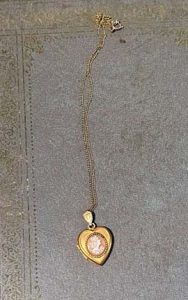
This is believed to be the necklace that Mom’s grandfather gave her for her 8th grade graduation.

Mom was born the year after the stock market crashed and when the Great Depression was beginning to hit.  Additionally, she was the third child in a small-time farming family.  So, money was definitely tight.  By the time she was eight or so, her father was in a VA hospital and her mom was raising the family on her own. 


The family didn’t have many things.  Her younger sister (Ruby) had a baby doll and a couple of siblings had baby albums.  However, the only thing as an adult that Mom had from her childhood was a necklace that her grandfather had given her for her 8th grade graduation.  She did have a few photos, her diplomas, and high school yearbooks.


As A Young Adult


As a young adult, Mom worked at the Western as did her sister Inez.  The family started to accumulate a few items, with salt and pepper shakers being some of the favorite nik-naks to collect.  When the family went somewhere, one or more of them would come home with a set of unique salt and pepper shakers.  Her sister Inez bought a large display case to display all the pretties.


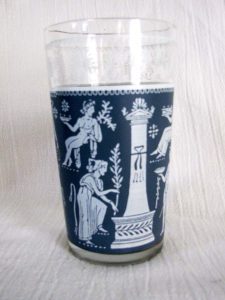
Mom’s Fancy Glasses. Not sure if they have ever used. I know that one time Uncle Don grabbed one out of the cabinet to use. Not sure if Mom caught him before it was used or not.

Getting Married


Still, Mom didn’t have a lot of things until she got married.  She didn’t get any china or crystal for her wedding.  However, she got plenty of useful items and a few items that she considered too good for every day.  The new canister set, rolling pin, cutting board, and other items filled her cupboards.  Her fancy glasses, cake plate, and other fancy dishes filled the built-in in the dining room.


Every time she got a new plate, bowl, set of cups, set of pans, etc., she fit them in.  She saw no reason to get rid of the old ones unless it was truly broken and unusable.  The same was true of the latest pretty bowl, pretty candle, cute stuffed animal, Christmas ornament, pillow case, and more.  The thing is that over the years she had plenty of time to collect a lot of items.  And, she found a place for every single one.


Dad always wanted to store things outside of the house, but that wasn’t Mom’s way.  I think it just motivated her to find that open spot for the latest item that she had acquired with most being gifts.


Mom’s Cake Plate

Kept Through The Years


Even years after she passed, the breadboard, rolling pin, cake plate, fancy glasses, and more were still in the house.  The Great Depression mentality of keeping things in case you need them or simply keeping them because you have something to keep had stayed with her throughout the years.  And, Mom had been very successful squeezing it all in!


I think she passed that gene down because I can pack more stuff in a suitcase, car or whatever container than you can imagine.  And, if I get stuck fitting everything in, I just ask my youngest as he is even better at it.  Mom would be impressed. 


It isn’t a skill most people even think about it, but it can really come in handy.  And, Mom used it to the fullest to ensure she could enjoy those things she accumulated through the years!