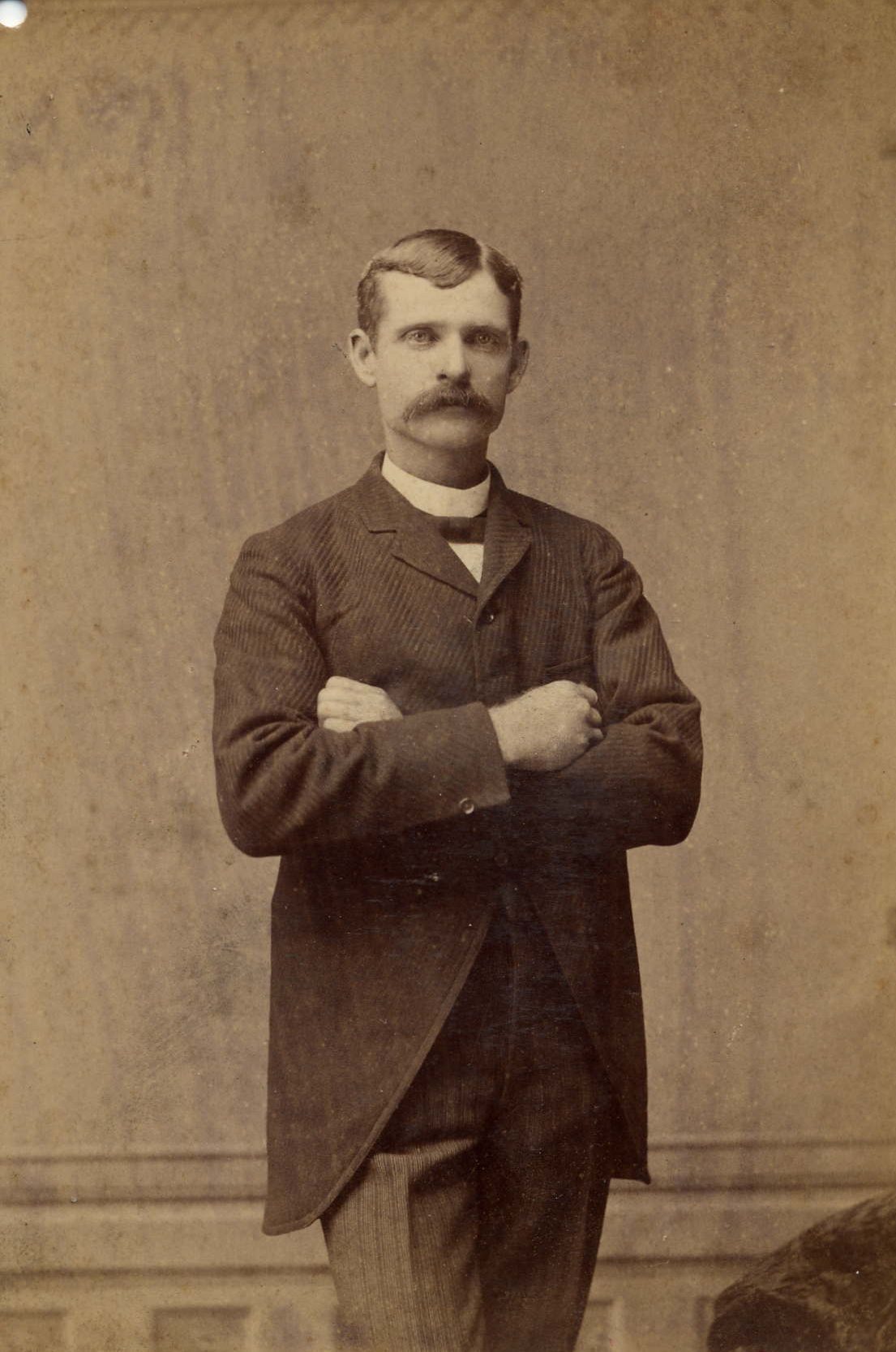
William Johnson Peelle was my great-grandfather.  He was also a carpenter, farmer, and all around jack of all trades.  He kept a journal from 1878 when he was 22 until 1894.  That journal primarily focused on his work and the places he went.  He spoke mostly of men, even referring to his brother-in-laws instead of his sisters.  He rarely wrote of personal family events.  Thus, this story will outline his life, focusing on his carpentry work.  The story also includes a special “surprise” that I learned while putting this article together.
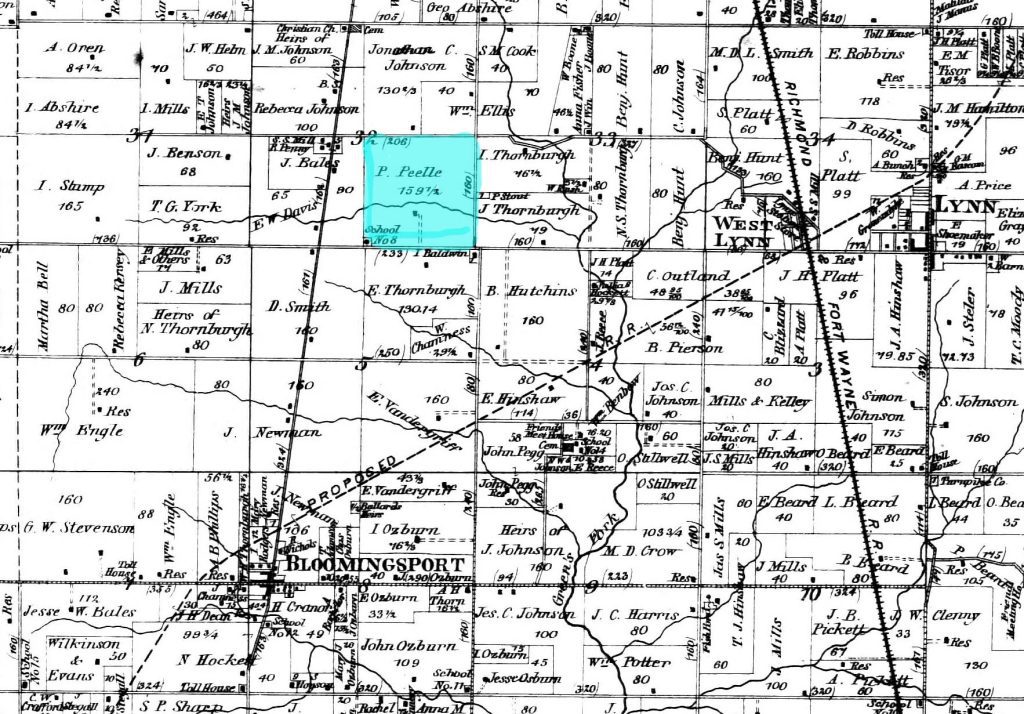
 

Passco Peelle’s Property in Indiana

The Early Years


William J, as I refer to him most often,  was born in 1856 in Wayne County, Indiana to Passco and Martha (Johnson) Peelle.  They had a school on the corner of their property where he most likely got his formal education. However, a good portion of the education that he used in his adult years came from working with his father, brothers-in-laws, and other men in the neighborhood.


By the time he was 22, he was helping various people farm and erect buildings on their property.  For example, in 1878, he helped his brother-in-law Wiley Benson (husband of Rachel) erect a stable on his property.


Moving to Kansas


It was late in 1878, when Passco, Martha, William J. and a couple of his sisters prepared to move to Kansas.  This was quite the undertaking as goods that were moving had to be taken to another county to be put on the train.  William J. drove the cattle to the same place, but it is unclear if they were shipped to Kansas or sold.  It seems that his father, and presumably his mother and sisters, spent some significant time in that county before leaving for Kansas.


William J. stayed in Indiana after his parents left.  He seemed to have some details to manage.  During the spring of 1879, he helped his brothers-in-laws plow, plant, do other farm work, and a bit of carpentry here and there.  One of the last things he did before he left was selling his horse.  After that, he had to walk.  He spent his last night in Indiana at his Uncle John Peelle’s house in Winchester.  On June 8, 1879 he boarded a train with the destination of Hiattville, Kansas.  


Settling In


William J.’s early days in Kansas were a mix of farming, sickness, and building on his father’s property.  It is unclear what made him sick on and off, but perhaps it was the change in the environment (e.g. water, allergies).  His carpenter skills were put to work building a stable for which he had to cut poles to be used in the project.  He also made a door for the kitchen, fixed the corn crib, and made a shed for the calves.  In the years that followed, he would add a new kitchen to the house, build a barn to replace the old one, etc.


By that fall, he was branching out and helping one of the neighbors fix his house.  Then, at the end of October, he went back to Indiana for the winter where he spent time visiting and helping various relatives and friends.

The Surprise


Olathe

When William J. returned to Kansas, he picked up where he left off farming and doing carpentry.  This went on until 1883 when suddenly, he went to Olathe (now part of the Greater Kansas City area) to work completing some houses.  After he finished, he worked for the water works and built a fence for a school.  He returned home on December 13 for a few days, but ended his work in Olathe in early January. 


The Railroad

Later that month, he went to work on the Ft. Scott-Wichita Railroad.  It is unclear what he did for the railroad as he simply recorded the days work and overnight shifts counted as two days pay.  He worked in this job until June 12, when he worked half a day and quit. (There is probably a story behind that, but we will never know.)


Again, he returned to his life as a farmer and carpenter.  But, working in Olathe and on the railroad are not something I grew up knowing. Although this was unknown, it’s not overly surprising.  However, in the process of writing this article, I uncovered a potentially “big” surprise related to William J. during this time period.  Read the Bonus Story for details.
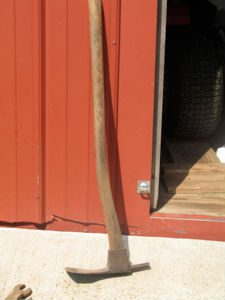
 

William J. Peelle’s Carpenter’s Adze

Becoming a Boss Carpenter

At this point in his life, William J. really started to focus on his carpentry.  Over the next several years, he would build, build, build. . .


Big Farm Projects

William J. built basically anything that a farmer would need on his property.  He built houses, barns, stables, corn cribs, straw sheds, calf sheds, smoke houses, wagon sheds, hen houses, coal houses, water tanks, and granaries.  In many cases, these projects took a few days to a few weeks.  A house was much easier to build without plumbing, electricity, building permits/requirements, and very few if any closets. 


He also made additions to buildings; put floors into existing buildings; roofed buildings; and built doors, door frames, and gates.  And, sometimes he tore down buildings instead of erecting them.


Besides pure carpentry, William J. plastered walls – sometimes in a house he was building and sometimes in house that had already been built.  He was even known to hang wall paper.


It appears that while working on large project, he often stayed away from home.  This was definitely the case when he went to work on a barn near Hepler, which was around 15 miles from his home.

Bonus Story


While pulling together facts for this article, I did a little searching. I found a marriage record for a man listed as “William Peell” in one document and  listed as “William Peale” in a transcription of another. His bride was an “Ida Johnson.”  They were both local to Bourbon County.  Could William J. have been married  before he married great-grandmother Matilda?


It turns out that both William J. and Ida lived in Marmaton Township and in 1880 they were listed a couple pages or so apart on the census.  So, we have a coincidence.  Additionally, no William Peell or any other William Peelle of any spelling can be found in Bourbon County in the years before or after that.  According to the record, they married September 3, 1883.  It just so happens that William J. went to Ft. Scott that afternoon and spent the night.  It was the next day that he left for his new job. 


Ida gave birth to a son William Guy Peele (his spelling of his name as an adult) either December 20, 1883 or December 20, 1884.  Records vary as to the year.  It seems that if the actual year was 1883, that Ida may have concealed the actual year to hide the fact that she would have been pregnant when she married.  As for how this aligns with William J.’s journal entries, he was home and not working for several days around both of these dates.


He does not mention this woman or her son in his journals, but then again, he does not mention my great-grandmother or any of their children either.


What is known is that in 1885, William J. is listed in the state census as married.  However, no wife or child are in the household.  At some point, Ida and her family had left Bourbon County and moved to Douglas County, Missouri.  In 1887, she married a Mr. Hall.  So, if it was another man that she married, something happened to him or their relationship before this date.


William G. lived with Ida and her husband’s family, but continued to use the name Peele.  He later lived in Oklahoma.  I have not found an indication that he ever had a wife or children.


Of interest is that the newspaper reported that William J. took a trip to southern Missouri in 1906 just before they moved to the Home Place.    Douglas County is in southern Missouri.  So, it begs the question, “Did he go see his son?”


Researchers indicate that her son was a Jr. and believe his father’s middle name was Guy, like the son.  However, I have found no records that indicate the father’s middle name.  I have also found no record of the son’s middle name until he was older.


Additionally, over the years I  heard stories that William J. had a son out of wedlock. However, the story said that occurred in Indiana and that was why they moved to Kansas. I have found nothing to substantiate a child in Indiana.  I also heard that a “man” came to the farm looking for him and that some of the McCracken girls thought he was William J.’s son.  I have no idea if there is a bit of truth in these stories or not.


At this point, we are left wondering. Was William J. really married before he married Matilda Jury? Or, is this just a coincidence? 


Schools, Churches, & More

William J. also repaired and/or built schools, churches, at least one store, and a warehouse.  Scofield School (less than a quarter mile from his house), Cold Springs School, and Hiattville School were among the schools where he utilized his skills.  Based on the length of projects, he must have built at least one school from scratch.  Other times he made new steps for the school, fixed desks, made bookcases, fixed the building, put glass in windows, and made blackboards.


He mentions working on “the church” and the Christian Church.  It is unclear if references to “the church” are to the Christian Church.  Hiattville also had a Catholic and Methodist Episcopal churches.  Meanwhile, to the northeast of his home was Pleasant Valley Church.


Small Projects


Not every project took days and weeks to complete.  Some of William J.’s smaller farm projects include:  tool boxes (the first was his own), milk troughs, water troughs, workbenches, sleds, bull rakes, wagon tongues, hay ladders, and beds for wagons.


For inside the home, he made flour chests, a desk, and wardrobes.  The desk was for his family and my dad remembers it.  He said that it was a bit rudimentary, but William J. didn’t have tools to make anything fancy.  Additionally, he made the Walkertown mailbox, the Hiattville Cheesehouse, and items for doctors, including crutches.


He also fixed lots of items, such as, binders, water tanks, wagons, corn planters, scales, cradles (farm equipment, not the baby kind), cultivators, hay rakes, and buggies.
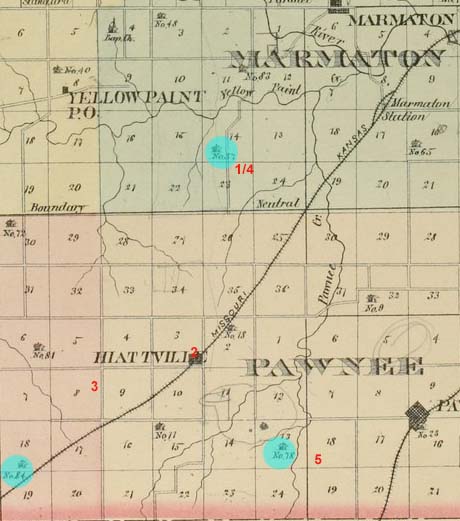
 

Peelle Properties in Kansas, Schools Attended by Peelle children are highlighted

Moving Into Town


On October 7, 1891, William J. and his parents moved into Hiattville where they had acquired lots in the northern part of the town and one lot along the east side of the railroad.  Prior to the move he had built a shop (presumably on the lot along the railroad), built a barn, and made other improvements to the properties.  He worked in the shop much of the time, but still did work outside the shop. Unfortunately, he did not detail the work that he did in his shop, but it is assumed to be building and fixing items.


The next year he married Matilda Jury, had a daughter, and added a blacksmith to his shop.  The newspaper said that his time was in such demand that he split it an hour for this man and the next for another.  It was during this interval that he became very active in Hiattville Camp No. 1364 of Modern Woodsman of America, where he served in multiple roles.


In 1893, some interesting quandaries arise.  He is working away as usual when at the end of June his journal indicates that he went to Indian Territory (Oklahoma) for over a month.  The question is, “Why?”  Did he leave his wife and 7-month old daughter at home?  Did he take them on a month long journey? 


Additional questions arise given that he is listed as an assistant marshall for Ft. Scott’s 4th of July celebration.  How could William J. be in the parade if he was in Indian Territory?


When he returned in early August, he went back to work like always.  Then around the beginning of September, he began working almost continually for the Routhe Brothers.  It is unclear if he was using his carpentry skills or working in their business.  However, in December, he started working at the mill.  It is assumed that his work at the mill at least was not carpentry work as he stated the next February that he gave up the mill to move to a farm.
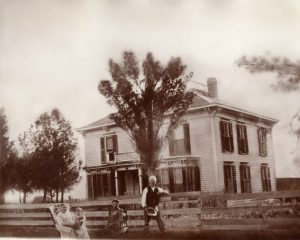
 

House in Walnut Township. Shown Passco, Martha, Matilda, and Lydia Peelle

Walnut Township


William J., his parents, and his growing family moved to a house southwest of Hiattville.  By the time his second daughter (my grandmother) was born in June, William J. had basically stopped writing in his journals.  How he split his time is unknown.  However, it is known that he continued to do both farming and carpentry.  In 1896, he took on a new role when he was elected Justice of the Peace for Walnut Township.  He was re-elected in 1898.


In the early 1900s, something happened that caused the family to give up this farm.  They lived briefly at a location nearby before returning to the property north of Hiattville where they had lived in their early days in Kansas.
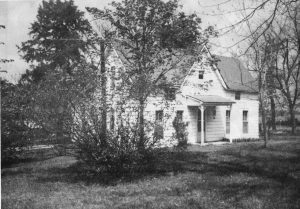
 

The Home Place. Owned by the family for 90 years.

Adding Another Kitchen


In February 1906, William J., Matilda, and his parents bought what is known as the Home Place, the home where Dad and his siblings grew up.  William J. put his carpentry skills to work and built a large kitchen on the back of the house.  Since the kitchen was also used for bathing, he slanted the floors so that water would run to the northwest corner of the room.  He also intentionally slanted the ceiling .  I don’t know the reason why, but perhaps the roof line and the ceiling were initially the same. None of the slanting caused too much trouble until Dad began building cabinets for the kitchen. With the floor and ceiling angled and a long window that wasn’t quite perfect, nothing was straight and it complicated things a bit.


His Last Load


In September 1911, he was again hauling lumber.  This time for a barn at the Home Place.  He never made it home with the lumber as he had a stroke on the way home from Hiattville.  He was only 55.
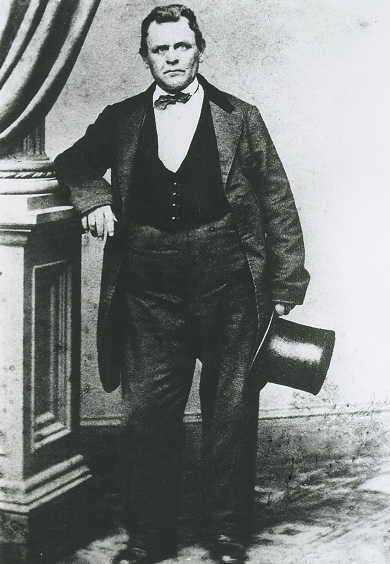


Rod’s 4th-great-grandfather Jesse Klinefelter and multiple of his brothers were steamboat pilots and captains.  Initially, they piloted boats on the Ohio River primarily between Pittsburgh, Pennsylvania and Cincinnati, Ohio.  


Jesse’s brother John became well-known as the captain and owner/co-owner of several different boats over the years.  One passenger described Captain John Klinefelter as a stout Pennsylvanian of German descent with a face that indicates it would be difficult to keep him from moving his boat forward.  He had the reputation as one of the most efficient and careful men on the river.


After many years on the Ohio, John began running boats on the Mississippi River.


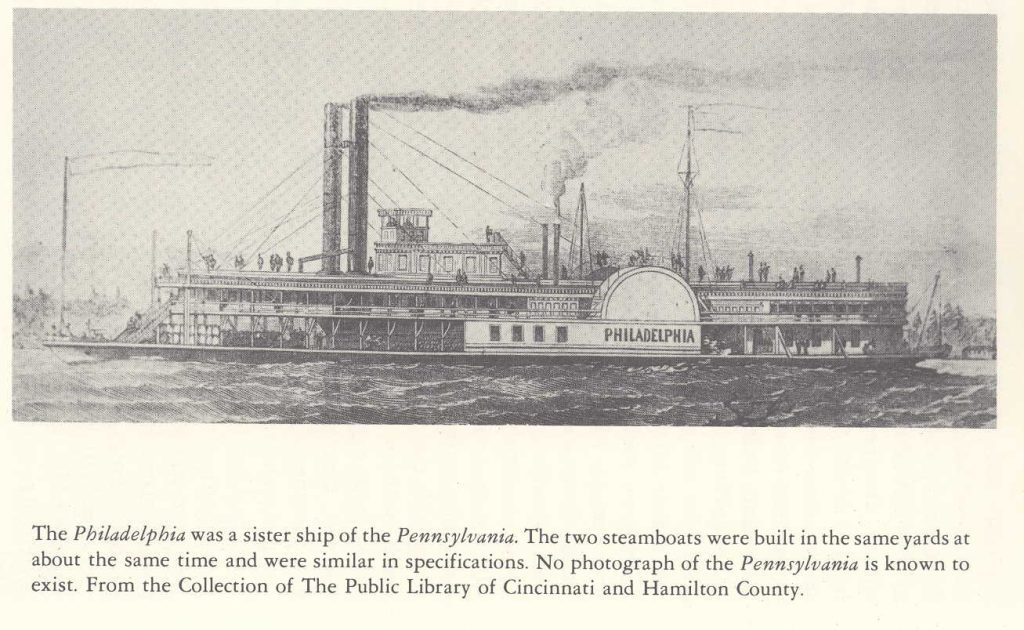
The Pennsylvania


The 486-ton Pennsylvania started operations in 1854.  A boat with the name Pennsylvania existed by at least 1848, but that appears to have been a different boat.  In any case, Captain Klinefelter became 50% owner in the Pennsylvania with the pilots and engineers owning most of the remaining 50%.


The Pennsylvania was 247 feet long and 32 feet wide.  She had fine furniture and was a “magnificent specimen” being “one of the largest, handsomest, and best officered, and in every way most desirable boats to travel on.”  She, with Captain John Klinefelter as master, was known “for speed, good living, [and] punctuality.”


Heading North


The Pennsylvania was loaded with cargo and passengers when it left New Orleans on June 9, 1858.  She would pick up others at Baton Rouge, Vicksburg and other locations along the route.  Including the passengers, officers, deck hands, and other crew, it was estimated that the Pennsylvania was carrying a full load of cargo, some $40,000 in its safe, and 380 to 450 people with some estimates as high as 500.  


On the ship were members of an opera troupe, German immigrants, William R. Harris Supreme Court Justice of Tennessee, a plantation owner, at least two priests, a couple Sisters of Mercy, and various people well-known in their local social circles.


The Explosion


By 6:00 the morning of the following Sunday, June 13, the Pennsylvania had reached Harrison’s Wood Yard, a point about 70 miles downriver from Memphis.  Most passengers were still sleeping or were just waking up for the day.  Captain Klinefelter was already up, dressed, and had gone to the barber on board for a shave.


Additionally, the second engineer had taken over from the first engineer.  The fire bed had been recently cleaned and the fire started.  He made sure everything was working and had tested the water in the boilers after he came on duty.  At that time the boat was only producing about 130-135 pounds of steam and the boat was moving very slowly up stream.


Suddenly, while Captain Klinefelter, having finished his shave, was speaking with Henry Spence in the saloon, they heard a horrific noise.  The room immediately started filling with steam.  They hurried through the water closet passage to the hurricane deck where they met up with the barber, who had also rushed outside.


The Situation


It was instantly clear that the boilers had exploded and that the damage was massive with the greatest impact forward of the wheelhouse. The smoke stacks were gone as was a portion of the deck.  The explosion had blown people and much debris off the boat into the waters of the Mississippi River.  Others had been blown to a location that provided no option for escape except to jump into the river.  At that point, some swam back to the boat and attempted to climb back aboard, others swam for the shore, and others grabbed onto debris hoping to stay afloat until they could be rescued.  Other people were instantly killed, were trapped, or were lucky and were flung out of harm’s way or were easily removed from the debris.


Jumping Into Action


The captain, barber, and a cabin boy launched a life boat.  Meanwhile Henry Spence broke a skylight to let the steam out of the area below so that people would not suffocate.


The boat started moving downstream with the current.  So, the men attempted to anchor it, but the current was swift and the water was deep.  The Pennsylvania kept drifting.  Captain Klinefelter and some men tried to take a line ashore with a yawl, but were unsuccessful.  


At this point, the captain sent the yawl downstream to get an empty wood boat that was along the water at Harrision’s Wood Yard.  About the same time, some men from the wood yard started moving the empty flat boat up stream.  It was hard to maneuver as they had no oars and were using a few boards as oars.  They met up with the yawl and they managed to get the flat boat along side the Pennsylvania.  The idea was to get as many people off the boat as possible.  Then come back for others or for possessions and goods.


The Fire


As the captain and any other crew members that were not severely injured attempted to get passengers to leave their worldly goods behind and get on the flat boat, a fire alarm rang out.  Almost immediately flames, believed to be fueled by barrels of turpentine in the cargo hold, were engulfing the Pennsylvania.


They quickly rushed to fill the flat boat with all the people they could before the fire reached them.  Meanwhile, one man claiming to have money, own a plantation, and have slaves offered to give it all to anyone who would rescue him from a mass of debris.  However, with the flames advancing, the crew had to make the hard choice to save as many passengers as they could.  They had to leave the man behind.


The Escape


Captain Klinefelter was the last to jump onto the boat.  They had a difficult time shoving away from the Pennsylvania.  The heavy load of people, limited trained crew members, and boards for oars made it challenging.  Finally, they turned the flat enough that the river current caught it and pulled them away from the Pennsylvania.  However, some of the passengers were badly burned as they made their escape.  It was believed that if they had been even a few moments later, the casualties would have been much greater.


After they pushed away, they saw people who had apparently been in their quarters rushing toward the boats edge with their trunks and boxes.  With the fire and limited control over their movement, Captain Klinefelter did not have the option to go back for them.  Sadly, the people who had tried to save their belongings likely ended up losing their lives.


About a mile or so downstream the flat came upon Ship Island and they tied up to some trees and waited for help.


The Rescue


Immediately following the explosion, people living along the river got into their boats and went to rescue those who were in the water. Meanwhile, those on the flat waited for a boat to come by.  They had no food, water, or significant shade.  They had no medical supplies to tend to the wounded.


The Imperial was the first big boat on the scene.  The captain and crew jumped into action tending to the injured and feeding and hydrating the passengers of the Pennsylvania.  Next on the scene was the Kate Frisbee that took many of the injured on board.  The injured had cuts, bruises, internal injuries, and burns. 


The Diana arrived about 6 hours after the explosion.  She did not take as many passengers as she was already overflowing.  However, passengers on the Diana, and likely the other boats, started taking up money to help pay for medical costs and to help those that had no money and nowhere to turn.


As the boats left carrying away the survivors, Captain Klinefelter headed to the Pennsylvania, which had lodged and sunk near the shore some two and a half miles downstream in hopes that some passengers had survived or some property could be salvaged.


Henry Clemens, Younger brother of Samuel Clemens/Mark Twain

Henry Clemens


Many of the injured were taken to Memphis for medical treatment.  Among them was Henry Clemens, an assistant clerk.  Henry was only 19 years old and was the younger brother of Samuel Clemens, better known as Mark Twain.  Although initially not thought to be badly injured, Henry had internal injuries dying a few days later.  Samuel wrote about Henry’s condition in a letter to their sister on June 18.  Later he wrote of the Pennsylvania’s demise in his book “Life on the Mississippi.”   That work includes his version of the story surrounding the explosions of the Pennsylvania and his brother’s death.  It also includes a sketch depicting him at the side of his brother as he lay dying in a hospital in Memphis, Tennessee.


It was said that he never got over losing his brother.  That may have been a bit of survivor’s guilt. Samuel had worked on the Pennsylvania as a pilot in training and was suppose to be on the boat that day.  However, he had gotten into an argument with the pilot Mr. Brown on the trip down from St. Louis to New Orleans and he said that he could not make the return trip on the same boat with the man.  Thus, five minutes before sailing, Samuel left the Pennsylvania.


  Confusion


As the news of the explosion spread, much confusion spread, including whether Henry Clemens was uninjured, injured, or had died. Confusion occurred over other specific passengers, the number of passengers, the number that had perished, and exactly what had happened.  


Confusion wasn’t unexpected given that the injured and surviving passengers and crews were spread across multiple boats.  A notable, who had confusing reports regarding his survival, was William Woolford, the son of the city clerk of Louisville, Kentucky.  The reports being mixed as to his status, the family had hoped for survival.  But, it was not to be.  One of the most notable to die was William R. Harris, Supreme Court Justice of Tennessee.  He was returning from a trip to New Orleans.  He succumbed to his injuries in Memphis.  His brother was governor at the time and was tasked with finding his replacement.  Additionally, the ship’s register had burnt in the fire rendering the captain unable to determine how many people were missing or dead.


As is common in the case of a disaster, everyone’s story varied.  Similarly, those who weren’t even present speculated just a bit too much. As such, I have tried to use as many first-hand details as possible.  For instance, many stories report that Captain Klinefelter was getting a shave.  However, Henry Spence detailed how he was with the captain at the time of the explosion; thus, his version is used for aspects related to himself and the captain while they were together.


The one thing that was for certain was that it had been lucky that the explosion occurred so early in the morning.  Otherwise, more people would have been in the forward sections of the boat where they congregated during the day.  Thus, more people would have been injured and died.


The Cause


So what caused the explosion?  John Campbell of J. H. Campbell & Co. of New Orleans, who had been a steamboat engineer in his younger years, was attributed with telling a story that he had been up by the boilers and that the engineer was not at his post until just prior to the explosion.  He supposedly learned that the engineer had been in the company of women.  Mr. Campbell died in Memphis; thus, all reports of his story were not first hand.


During the investigation into the cause of the explosion, statements were taken in an attempt to prove the validity of Mr. Campbell’s statements. The engineer’s associate stated that he was on duty as did the second mate.  The investigators did not find the statement attributed to Mr. Campbell to be strongly corroborated.  However, they decided that the engineer must have been neglecting his duties because they didn’t think such a disaster could possibly occur if an engineer was on duty.  As a result, the engineer lost his ability to be an engineer on any steamboat.


Accusations Against the Captain


Survivors reported that Captain Klinefelter had acted in exemplary fashion.  They said that he had done everything he could to save the passengers and contents of the Pennsylvania.  He had managed the disaster without many of his trusted crew, as many of the engineers, clerks, and deck hands were injured, missing, or killed. 


A Thief


All of that did not stop the Memphis Avalanche from printing accusations against the captain.  They called into question his character with many “stories,” focusing primarily on him being a thief and stealing the money of passengers.  It seemed to stem from a man named Vasser that was killed.  His wife claimed that he had given the clerk $10,000 to put in the safe.


The paper claimed that the safe was likely thrown to a place that it was barely touched by fire.  And, that it would have withstood the amount of fire it had received.  They went on to claim that he took it north with him and that he tried to get away as quickly as possible. When the safe was recovered, the paper argued that the safe purported to be that of the Pennsylvania could not possibly have been it. They felt the safe was in such poor shape that no one would have put valuables in it.  They speculated that there had been a different “real” safe and that people had been deceived.


Heartless

Additionally, the Avalache claimed that he had been near Memphis on numerous occasions and never stopped to see the suffers.  So basically, they accused Captain John Klinefelter of being a “heartless thief.”


Racing


The Avalanche also accused the officers of the Pennsylvania of wanting to stay ahead of the Diana.  They indicated that pressing the boat to move so quickly upstream had led to the explosion.  They went on to claim that necessary repairs that the chief engineer recommended to fix a fault with the pipe that carried steam from the boilers to the cylinders had not been done.  And, the ship had continued to make trips on the river.


The Motive


The motive of the newspaper is unclear.  They were new (or at least a new version of the newspaper) and perhaps they intended to make a name for themselves or simply liked sensational headlines.  Additionally, no one named Vassar is listed among those lost in the disaster, but that is not meaningful as the passenger list burnt and not every life lost was mentioned.  The lady with him was said to be at Aberdeen, Mississippi and destitute.  Families with the name Vasser did live in that area at that time and appear to have been wealthy.  Thus, having $10,000 with them as they traveled is not unreasonable.  However, I have not yet found any records supporting the death of one of them in the disaster.


The Response


With his good name and reputation at stake, Captain Klinefelter felt a need to respond.  Thus, he obtained sworn statements from people involved with raising the safe.  He published a detailed article that included the statement and outlined the agreement with the wrecking company.  There was also a statement on the amount of money taken from the safe.  The article specified that the money was in the possession of a separate company.  The money found was listed piece by piece (e.g. how many gold eagles, silver halves, Mexican dollars, etc.).  It even listed “imperfect coins found and melted silver.


Captain Lemuel C Nims


One important statement was from Lemuel C Nims, captain of the submarine working the wreckage for the wrecking company.  He detailed the instructions he had been given by the company, including to chain or band the safe closed if it was closed and such a step was feasible.  He stated that at the time the safe was found that it was so badly damage that there was no way to secure the contents.  Thus, the contents were removed. 


Captain Nims stated that at the time the contents were removed from the safe   14-15 people associated with the recovery were present.  Plus, there were other onlookers.  All the paper money and boat’s documents were destroyed.  The coins and some silver coins that had melted remained.  Capt. Nims and the engineer cleaned the money and melted silver. They gave $60 to Captain Klinefelter for the expenses associated with watching the wreckage.  They placed the remaining  silver coins and melted silver in a box and the gold in a bag. The box and bag were then secured.     He also indicated that based on the location of the safe before the explosion and the location it was found afterward that it likely took the wrath of the fire.


The Pilot


Sworn statement from the pilot of the wrecking sub supported Captain Nims statement.  He added that when they first started raising the safe that some coins had fallen out.  They had taken steps to prevent losing any additional coins.  In addition, he stated that he was responsible for taking the money to St. Louis and he detailed his journey there on two different boats and the railroad including never letting the money out of his possession.


These sworn statements along with accounts of passengers that praised his efforts and attested to the fact that the boat was moving slowly discredited most of the allegations against the captain.


The Retraction


Many newspapers that had picked up the story printed Captain Klinefelter’s article and/or a statement basically exonerating Captain John Klinefelter.  However, to date I have not found that the Advance, which appeared to have started and perpetuated the accusations ever retracted them.


By early September, Captain Klinefelter was again running a boat from St. Louis to New Orleans.  This time it was the Gladiator.

Eleanor (Willett) Jury

Genealogy is a great avenue to find new mysteries.  This is the case with my recent research into William Willett, Jr., the brother of 3rd-Great-Grandmother Eleanor “Ellen” Willett.  Ellen and William Jr. are two of the children of William Sr. and Harriet (Holden) Willett.


For context: Ellen married William Jury in Canada and is the mother of John Charles Jury.  Ellen, John, and two of John’s siblings immigrated to the United States living in Kansas, Missouri, and Michigan. John married Matilda White and they are the parents of Matilda Jury, who married William J. Peelle.


Now, to Ellen’s brother, Wiliam Jr. . . . .


Family Stories


According to family, William Jr., who was born in England and moved with the family to Canada, spent a significant portion of his adult years in Australia.  It was there, that he supposedly became a man of considerable wealth.  According to family stories, William Jr. made his money in the ship building industry.   However, all most nothing was known about his personal life. 


Ottawa County, Ontario, Canada.
Released into the public domain by the author.

The Property Dispute


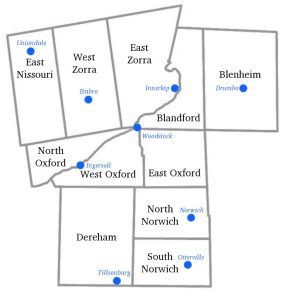
The first article I found in my recent research was regarding a dispute over the ownership of 500 acres of land in Blenheim and Blandford Townships in Ontario, Canada.  In 1848, William Jr.  had agreed to purchase the land from the Canadian government.  He made initial payments and improved the land.  Then he left for Australia. 


During William Jr.’s absence, his father, William Sr., lived on the property and continued payments on the property from rent made on portions of the property and from money William Jr. sent home.  When the payments were complete, his father got a patent on the land in the name William Willett of Blenheim without clarification of senior or junior.  After that, he had treated the property as his own, including taking out a mortgage and specifying what to do with it in his will.


When William Jr. returned from Australia 15 years later, he went to sell a portion of the property and found out he did not have title to the property.  And, his father’s will only provided for him to receive 50 acres of the land.  Clearly, before his death, his father had come to assume the property was his own.  Perhaps, he saw it as payment for overseeing the property for so many years or had a different understanding of the agreements regarding the property. 


The case ended up in court.  William Jr. pled his case and it appears that the other parties saw merit in his case.  Still, it left me wondering.  What had his father’s understanding been regarding the property?  Did William Jr. have to pay the mortgage?  Was the property simply removed from his father’s will?  Was there anything else of value in his father’s will?


Wealth & Occupation


When William Jr. died, he was referred to a gentleman, which is consistent with a man of means.  He was 90 and it stated that he was overseeing the building of houses when he caught a chill and ended up with pneumonia.  So, houses are not ships, but it aligns with someone in the building business.  Yet, it seems odd that a gentleman would be building houses at his age – even if he was simply overseeing the building. 


However, the very modest mention of his death in the newspapers stated that he had made his fortune in the gold fields of Australia.  So, the questions are:  How rich was he really?  Did he work in ship building, make money in the gold fields, or both? 


His will did not answer any of those questions as he simply made his wife Anne the executrix of his will and gave her everything.  Now, Canadian probate records might provide more detail, but so far all I have learned from Canada is that his estate paid $3250 in inheritance tax in 1905, the year after his death.  Based on the Succession Duty Act of 1892 and the fact that his wife was to inherit everything, taxes would not have applied if the estate did not exceed $100,000.  If the tax applied only to money exceeding $100,000, his estate would have exceeded $200,000, but I am not clear on the exact implementation of the law.  Thus, I estimate that his estate was somewhere between $130,000 and $215,000. Probate papers would likely provide clarification. (Based on a 1915 to 2023 calculation, this would be approximately $3.3million to $5.5 million Canadian dollars today. Note: I could not find a calculator that went back to 1905.)


Additionally, William’s wife acquired a lawyer in Newport, Australia (near Sydney) as he owned various properties there at the time of his death.  Those properties were eventually sold for several hundred pounds.  This portion of his estate was not settled for over 10 years after his death.


Anne Sexton, His Wife


His wife Anne, whom was over 40 years his junior and whom he had not married until 1894, died in 1917.  At the time of her death, she had an estate in Canada, presumably what William had left to her as she was born in Australia.  She also owned 3300 pounds of stock in Victoria Iron Rolling Company in Australia.


All this leaves me wondering why they hadn’t disposed of these properties and investments in Australia when they moved to Canada?  Did they plan to go back?  Did they move suddenly?  Who inherited the property after Anne died?  Did either of them have any children?   Did William have any other wives?  And, who was Ellen Dunn who handled Anne’s estate?


Clearly, more digging to do!


Featured Image by Gordon Johnson from Pixabay.

This is a follow on to my article “Last of His Generation.”  In that article, I touched on the physical and mental strength of my father.  Yet, when the topic of strength arose this week, I could not help but think of him again.  Thus, in this article, I will dig deeper into strengths of his character.


Learning, Growing, & Sharing


Dad had a love of learning.  He read extensively, which is why we ended up with an entire library of books after he passed.  Along with the topics he enjoyed, he read to learn about new things and to learn how to do things.  At other times, he learned simply by doing.  When he was young, his father told him that there wasn’t anything that he couldn’t do.  He took it to heart and lived by that philosophy his entire life.


He would step up and fill any position that needed filled (except he would pass if blood was involved as that was his kryptonite).  In his 90+ years, he became the resident electrician, starting with wiring the house for electricity when he was around 18 or 19 years of age.  He was also the plumber as he added a bathroom to both our house and Dewey’s house.  Dad was also a carpenter, adding onto the barn, making cabinets, building furniture, making jewelry boxes, and more  He was also a baker and a cook.  Of course, his semi-photographic memory was very helpful in many of these pursuits.


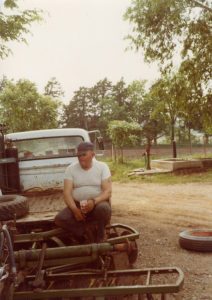
However, he was probably best known as a mechanic.  He worked on anything and everything: farm equipment, cars, motorcycles, boats, and even a semi on Christmas Eve.  He would rarely take any money for his work even when he worked late into the night to get something fixed so that someone could go back to work the next day.  At the office, he once quickly fixed something that the maintenance guys had been working on all day.  One of the men remarked, “God laid his hands on it.”  He liked to tell that story.  It wasn’t to brag, but more because he was proud that he could fix almost anything easily. 


Master Negotiator


Dad could also talk about almost any topic.  This came in handy when he was on the job as his boss would have him talk to the land owners that did not want the state employees to come onto their land to survey or who were upset about construction in front of their property.  After one conversation, he could usually get an agreement.  His trick was to be observant to their surroundings and to listen to what they said.  He noticed what appeared to be important to them and then talked to them about that topic.   One day it might be corn and the need for rain and another day it might be grandchildren or churning butter.  Soon, they had loosened up and were letting the men onto their property.


Doing It Right


In Dad’s later years of working, someone noted one day that he was the first guy on the job and the last to leave despite being the oldest guy on the job.  It was all about putting in the work to make sure that things were done right.  If anyone said that something wasn’t perfect with a job he was working on, he took it upon himself to seek out what was wrong and make sure that it was corrected.  I remember one weekend when someone had made a negative comment as he was leaving work about the workmanship of a job he was overseeing.  He went on his own time and in his own vehicle to the job site to check it out even though the site was many miles away from home and his time at home was very limited.


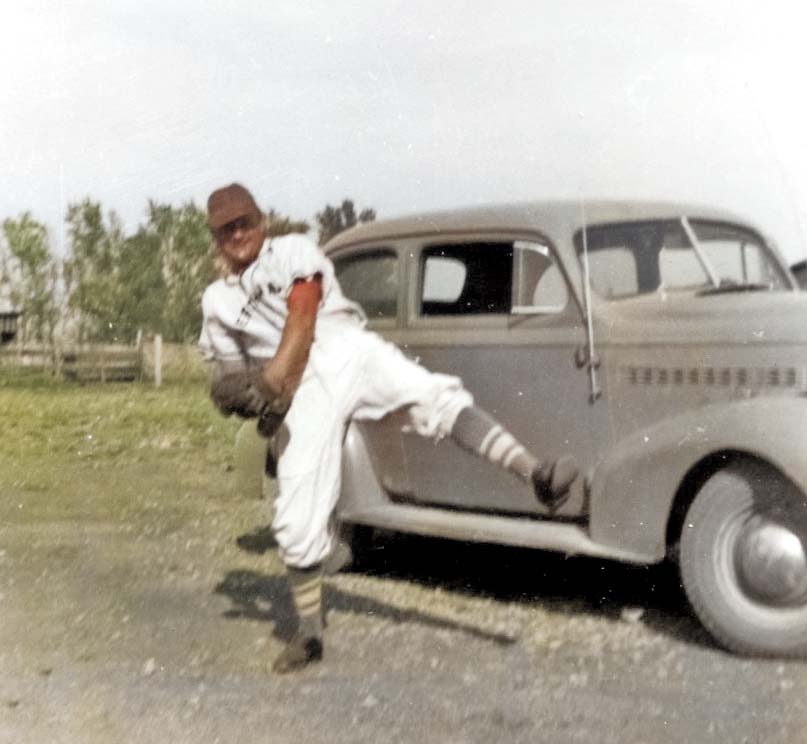
Photo has been colorized

Balls & Strikes 


Dad would often tell us stories of playing baseball, the McCracken family’s favorite pastime.  He played for several teams, but almost always pitched.  He did not like it if an umpire called a game in his favor.  Dad said that he would much rather have the close calls go against him.  He said that he might lose the game, but he would feel better about it.  He never thought you really won a game if you got help, even unintentionally, from the umpire.


Poking & Prodding


Now, most people might not think of him as a spiritual man as he didn’t see a need to be in church every Sunday and he didn’t talk much about his beliefs.  However, he was a man of strong conviction and one that was always busy helping others – family, friends, and strangers.  When he had his heart and cancer surgeries, he let the student nurses poke and prod on him whenever they asked.  After all, they had to learn by trying it on someone.


Close to God


As mentioned above, Dad didn’t feel the need for a church building.  Instead, his relationship was everywhere.  One day Dewey and I had baled hay.  We knew a storm was coming and we had gotten as much hay in the barns as we could.  When Dad got home, I helped him unload a wagon and we went back to the south field for more.  The storm was getting closer and he had me flying the tractor over the terraces in that field as he ran from bale to bale to throw them onto the wagon.  Then he would jump on every so often to stack them up.


After getting the hay picked up, we booked it home.  I don’t remember if we covered it or unloaded it, but by the time we were done the storm had hit.  In the process, the power had gone out and the house felt like a steam room.  So, we got in the car and went to see if we could get a cold drink somewhere and at a minimum we thought we could cool off.  That night lightening was flashing everywhere and lighting up the entire sky.  As we drove through the storm, he stated that it was on stormy nights that he felt the closest to God.


Holding Out Hope


Probably one of Dad’s strongest and longest enduring strengths was with regards to his brother Howard.  He held onto hope that his brother Howard, who was MIA in WWII, had somehow survived his injuries and would eventually make his way back home. He continued to hold out hope until the time that Howard would have been well into his nineties. Then, he simply said, “I guess it isn’t very likely now.”


Sharing Christmas


I remember one Christmas when I was very young.  That Christmas Dad told us about a family that was struggling.  We gave the family our Christmas tree and I think Dad gave them money for Christmas dinner.  This wasn’t a close friend, but someone that worked in a very low paying job and he wanted to help them out.


Father’s Day 2022

Working Through It All


Dad’s father also taught him that just because you encountered adversity in life, you didn’t need others to do things for you – you were a McCracken!  It was fine and a good thing to help others, but it just wasn’t necessary for you to stop working just because you lost a loved one or some other adversity occurred.


He learned to put others first and to persevere no matter how difficult the circumstance.  This led him to make some very difficult choices in his life.  Some of them even broke his heart, but he thought his decisions were best for people that he deeply cared about. 


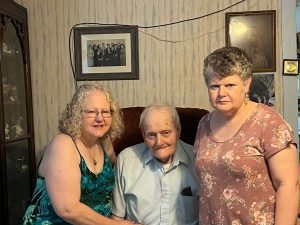
Even as his body was failing him, he had the strength to hold on until my husband and I could be where we could help.  He kept asking me how much longer it would be until we moved.  Once we arrived, we had a great Father’s Day together.  Within 10 days of that day, he could no longer stand.  Yet, he kept wanting to keep on trying.  Even in those last days, his grip on my hand was stronger than most people’s grip.


Sometimes things aren’t as they are portrayed – even when it comes to family.


Thomas & Ellen Hartnett Family

Jury-Hartnett Family


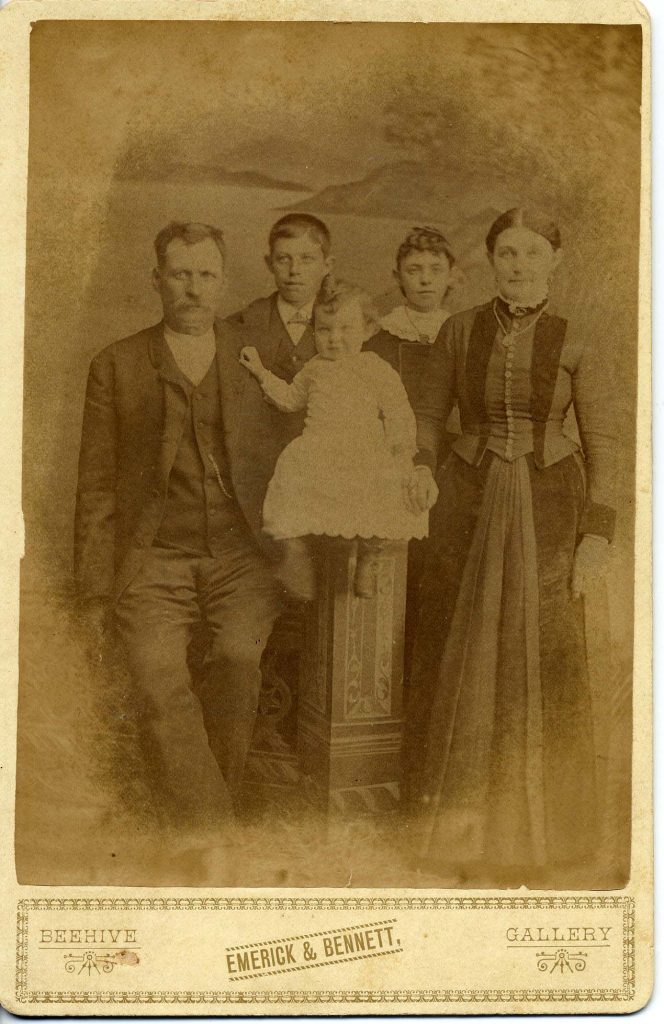
On February 12, 1873, great-great grandpa John C. Jury’s sister Eleanor “Ellen” married Thomas Hartnett in Hiattville , Kansas.  Ellen and Thomas initially lived in Hiattville and Thomas worked as a farmer and a section foreman for the MK&T Railroad. 


During the 1870s and 1880s, Ellen gave birth to three children,  two sons and a daughter with their oldest son John being the first child born in Hiattville.  Then in 1890, the family moved to a farm north of Hiattvile.  By 1905, that farm included 235 acres and had been greatly improved.


Long Lost Half-Brother


In the spring of 1908, a man about 60 years of age arrived in Hiattville claiming to be the half-brother of Thomas.  He seemed to know information on the family and knew that Thomas’ half-brother had disappeared over 20 years earlier. 


I believe this half-brother was Richard Hartnett.  Richard had lived with Thomas and Ellen early in their marriage. Richard was younger than Thomas and had been born in New York while Thomas was born in Ireland.  However, Richard soon married and moved away.


Despite the details the man provided, Thomas was skeptical that this man was really his half-brother. Still, Thomas allowed him to stay with the family. He seemed to be harmless.  However, sometimes he did not seem to be completely all together mentally and he often talked about starting a logging camp.


One day an address in Oregon was found in his pocket, which would tie in well with logging. Thus, an inquiry was made of officials in  that town. It was found that no one with the name Hartnett was known there.  However, a man had left that town in the spring that perfectly matched the description of Thomas’ visitor.  His name as they knew it was James Ward.


By mid-summer, James’ secret was out and his mental health had declined.  Thomas took him to Fort Scott and the old man was so frail that he had to be half-carried into the courthouse.  On that day, his mind was not good and he couldn’t (or wouldn’t) provide any details of his life, including who he really was.


The Real Half-Brother


At the time that the supposed half-brother arrived in Hiattville, Richard was living with his family in Seattle, Washington.  After he had married, he had worked with the railroad and moved to Parsons, Kansas.  Later, he did various jobs living in Stewartsville, Missouri (north of Kansas City) and Netawakce, Kansas (north of Topeka) before finally settling in Seattle in 1890.


Apparently, Richard didn’t keep in contact with Thomas over the years.  However, it appears that James, who had recently lived in a neighboring state, had come in contact with Richard and/or his family.  James had learned enough about the family to not be a complete obvious fraud.


The Reunion Ends


In the end, the judge sent James to the State Hospital.  But, why had he decided to impersonate Thomas’ half-brother?  And, why had he made a journey all the way to Kansas from the Pacific Northwest?  No one will ever know.