Some lives sound just like a movie script or a good book.  You can’t wait to find out what is going to happen next.  Such is the life of Rebecca. . . .


Death of Her Mother

Rebecca’s parents welcomed her in May of 1887. She was their first child. During Rebecca’s first year of life, however, her mother became ill.  Over several months, the local women cared for her mother. As Rebecca approached one year of age, her mother grew worse and gave up her fight, leaving tiny Rebecca to fend in the world without a mother to guide her.


By the time Rebecca turned three, her father had remarried. A half-brother and half-sister would be born in the years that followed.  Since her dad was a railroad man, was a member of several local organizations, and was involved in local politics, Rebecca spent quite a bit of time with her step-mother, grandfather, aunts & uncles, and others in the community. Some of these were good influences and others were less so.  And, it was known that her half-uncle, who was the apple of her step-grandmother’s eye was spoiled to the core.  No one else measured up in her step-grandmother’s eyes.  With step-siblings and step-aunts/uncles close to her in age, she had plenty of opportunities to be second fiddle.


At age six, Rebecca broke her collar bone while playing at school.  A couple of months later she would lose her half-aunt, who was a young teenager, to pneumonia. Other than that, little else remarkable appeared to have occurred during the remainder of her childhood.  However, as Rebecca matured, things began to change.


Marriage & Abandonment

On July 11, 1902, Rebecca returned home from visiting Drywood, where her grandfather and step-grandmother lived.  Just over a month later at age 15, Rebecca, with her father’s consent, married Harvey, who was seven years her senior.  Apparently, life together wasn’t a bed of roses. A month after their marriage  Harvey filed charges against Rebecca’s father for disturbing the peace and making threats against him.  Evidently, a month into their marriage Harvey had already abandoned the young bride and her father did not look fondly upon that action.  Her dad pleaded guilty to disturbing the peace and paid a small fine.


But, that was just the beginning of the  rocky relationship between the newlyweds.  The following summer Harvey sent Rebecca to Hiattville, a short distance away, to visit.  While she was gone, he proceeded to sell the cow, take all of the money from his paycheck, and skip town without telling anyone where he was going. 


With no money and no husband at home, Rebecca went to her father’s house, which was close by.  With their daughter-in-law out of the house, Harvey’s parents took it upon themselves to go to the home she had shared with Harvey and take their furnishings and household goods. 


Rebecca’s father saw a light at the house and investigated which led him to their home across the alley from Rebecca and Harvey’s home. There, he found some of the furniture, quilts, etc. that they had taken in Harvey’s parents home.  Other items had immediately been sold.


One thing led to another and either her father and/or her step-mother convinced Rebecca to press charges against Harvey’s parents for the theft of the items which they estimated to be valued at $19.50.  Thus, on July 22, 1903, 16-year-old Rebecca filed charges against her mother-in-law and father-in-law.


Dividing The Town

Now, being 16, being abandoned by your husband, and being in the middle of your parents and your in-laws might seem like a lot to handle.  However, when your father-in-law is the town marshall, your father a city councilman, and they are of opposite politics it gets a lot more complicated.  This is especially true when your father-in-law has made lots of enemies by strongly enforcing temperance rules while his sons are known to partake of the Devil’s drink.  And, rumor has it that they bootleg it, too.


Before long, the entire tiny town of Hepler had taken sides.  No one, it seemed, was neutral. 


On Trial

That August the trial took place a few miles away in the county seat.  There was no question that Harvey’s parents had taken the furnishings.  However, they contended that Rebecca said that they could take the furnishing and sell whatever they wanted. It was a sixteen-year-old’s word against that of the town marshall and his wife, as no one had witnessed any conversations between them.


Additionally, her in-laws argued that they had helped the young couple set up housekeeping so they were entitled to the belongings.  But, they still planned, according to their testimony, to send the money to Harvey as soon as they knew where he was.


Rebecca’s family argued that wasn’t the case.  It got more personal with arguments about Rebecca’s father forcing Harvey to marry her.  It wasn’t like their son wasn’t an adult when the marriage took place.  And, all reports were that it was a consensual arrangement.  However, Harvey  did work for Rebecca’s father which may have played a part in the argument.


 In the end, the jury was split on who to believe. And, the trial ended in a hung jury – twice!  After the second trial, the judge chose to dismiss the case.


The Preacher & His Wife

In January 1904, Rebecca was looking for work in Ft. Scott. A minister and his wife took her in and gave her a job helping the minster’s wife.  She claimed that her husband had secured work at a restaurant on the east side of town.  Now, whether Rebecca and Harvey were both in town and had come together is unclear.  However, it is clear that she was a couple of months pregnant at the time.


The arrangement with the preacher and his wife did not last long.  The exact circumstances are murky, but it had something to do with moral behavior.   The preacher’s wife soon asked Rebecca to leave and told her to return to Hepler.  Rebecca refused.  The police became involved in the situation. Initially, they started to look for a home for Rebecca.  However, soon Rebecca was given the choice of leaving town or going to jail.  Rebecca left town, apparently alone.


The Baby

By the time her baby was born in August, Rebecca was in Kansas City, Missouri.  She named the little girl Dorothy.  However, Rebecca was unable to care for her child.  Thus, she left Dorothy with the Evangelical Lutheran Kindergarten Society.  According to Rebecca, the agreement was that they would take care of Dorothy until Rebecca was able to do so.


Meanwhile, Harvey had lived in Ft. Scott and then returned to Iowa where he had gone when he skipped town.  It was there that on their third anniversary he finally filed for divorce.  He stated that Rebecca was the one who had abandoned him.


The Lawsuit

After Dorothy was born, Rebecca worked as a domestic and possibly in other jobs. Then, in June of 1907, Dorothy married Joseph.  The following January she returned to the Evangelical Lutheran Kindergarten Society to get Dorothy, who was now three years old.  They told her that Dorothy had been adopted and refused to give her the name of the adopting couple or the location of her daughter. Furious, Rebecca hired an attorney and stated that she intended to sue for the information. 


Flash forward to  April of 1910, the census listed Dorothy and two other children living with Rebecca and Joseph.  This seems more of a fantasy than a reality as the census also indicates all three are her children, but Rebecca and Joseph had no children.  However, Joseph had adopted two children in hopes of satisfying Rebecca. She openly pined for both Dorothy and Harvey from early in the marriage.  She made  no secret of the fact she still loved Harvey and felt no love for Joseph. However, adopting the children had not worked out well. And, by the time of the census, Joseph had returned the children.  Additionally,  other records indicate Dorothy was with her adoptive family at the time. 


The Suicide Attempt

On April 28 of that year, only a couple weeks after the census, Rebecca and Joseph separated.  Rebecca returned to Harvey, whose wife had recently died, to proclaim her love for him.  Apparently, he did not return her affection. 


So, around 4 a.m. Sunday June 5, 1910 Rebecca went to Harvey’s father’s house where in an attempt to poison herself, she ingested two ounces of laudanum.  Harvey’s father found her on the porch unconscious and moaning, while clutching Harvey’s photograph.  He immediately called for a doctor and Rebecca’s life was spared.


In September, Joseph filed for divorce.


Another Husband

In March 1912, Rebecca married again.  This time to Charles, who like her other husbands was several years older than her.  They married in the Kansas City area, lived for a time in Topeka, and finally settled in Abilene.


In February 1916, she took $2 of his pay, sold the chickens and took off for Topeka with $20 in hand.  Her husband, reportedly, was puzzled and surprised at her disappearance.  She proceeded to file for divorce stating that he treated her cruelly and neglected her.


The divorce must have never been finalized as Charles filed for divorce for abandonment of more than one year on November 18, 1920.  It was granted January 25, 1921.  In 1920, at least for a time, Rebecca was livingin Cheyenne, Wyoming and working as a waitress.  She reported at the time that she was divorced. 


I wondered why she might have been in Wyoming.  We will likely never know, but it seems possible that she was trying to make her way to Washington to where Dorothy lived.  Dorothy’s adoptive parents had died before she reached the age of maturity.  When some of their grown children had moved west, Dorothy had moved west with them.


Back to Harvey

March 1, 1921, Rebecca finally remarried Harvey in Des Moines, Iowa, but she did so using her middle name. Both claimed it was their second marriage. However, it was at least Rebecca’s  fourth and Harvey’s third. 


Her Death


February 24, 1923, Rebecca took her last breath.  She had undergone an operation at a hospital in Kansas City.  Harvey, along with her father,  accompanied her body to its final resting place at Hiattville, but it appears that they were once again divorced.  He was living in Iowa; she in Kansas City.  And, her death certificate stated that she was divorced.  Yet, Harvey and Dorothy were both acknowledged as her survivors in her obituary.


Rebecca’s official cause of death was listed as status lymphaticus.  But, in reality she died a broken woman with a heart that had been broken far too long.  Rebecca was only 35.


Afterward


Although this story is about Rebecca and her troubled life, it seems Harvey  possibly played a bigger role in keeping Rebecca infatuated with him than is documented.  It just appears that their paths kept crossing and if Dorothy is in fact his child, that would imply that he came back to her in the fall of 1903 around the time of one of the trials.  Additionally, some years after Rebecca died, Harvey was sued by another man for having an ongoing relationship with his wife, including taking her on a vacation and finally stealing her away.


Image: pixabay.com  Free to use under the Content License .


When I go to cemeteries, which I do more than most people, I generally notice two types of graves in particular – the graves of soldiers and single gravestones that are surrounded by seemingly unused plots.  The latter break my heart because I know that in many cases the person died and the family bought plots, but then decided later to move on.  These single graves are particularly heart-wrenching when they are the graves of children.  Sometimes I wonder if descendants of the family know about these people, especially those that died very young.


Until recently, I hadn’t thought about single graves of members of my own family.  Most of the cemeteries for my family have at least several members of the family buried in them.  And, in a several cases, many people in the cemetery are related to me.  Yet, there are family members that are the only one of the family to be buried in a cemetery. 


Below are the stories of how a few members of my family came to lie alone without other family.


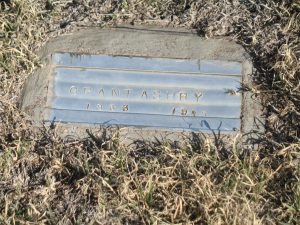
Grant Ashby

One of the first people that came to mind when I thought of people that weren’t buried with the rest of the family was my great-great grandfather Grant Ashby.  We spent quite a bit of time one day looking for his grave near Holly, Colorado.   The tiny cemetery was several miles away from town and was completely barren except for a few gravestones.   Not a single tree stood to shade in the small isolated cemetery.


Grant had been born in Indiana, married in Iowa, and then settled for a bit in Bourbon County, Kansas.  In 1910, he had sold out and moved to this desolate location. I don’t know why the family left eastern Kansas, where he had grown corn stalks 14 feet tall for this lonesome place. He was able to homestead 1280 acres. However, in order to meet the requirements for homesteading, Grant and his sons had to take long trips to the foot of the Rockies for wood for fence posts.  Additionally, they had to till considerable land for crops.  But, these weren’t the only challenges for the family.  Until they dug a well, they had to haul water 25 miles from Holly.  And, their closest neighbor lived five miles away with the closest doctor residing in Holly. They were pretty much on their own in the middle of nowhere.


A mere five years after they arrived in Colorado, Grant died of a stroke.  With difficult living conditions and the family’s main provider gone, it wasn’t long before the family pulled up roots and moved to California. 

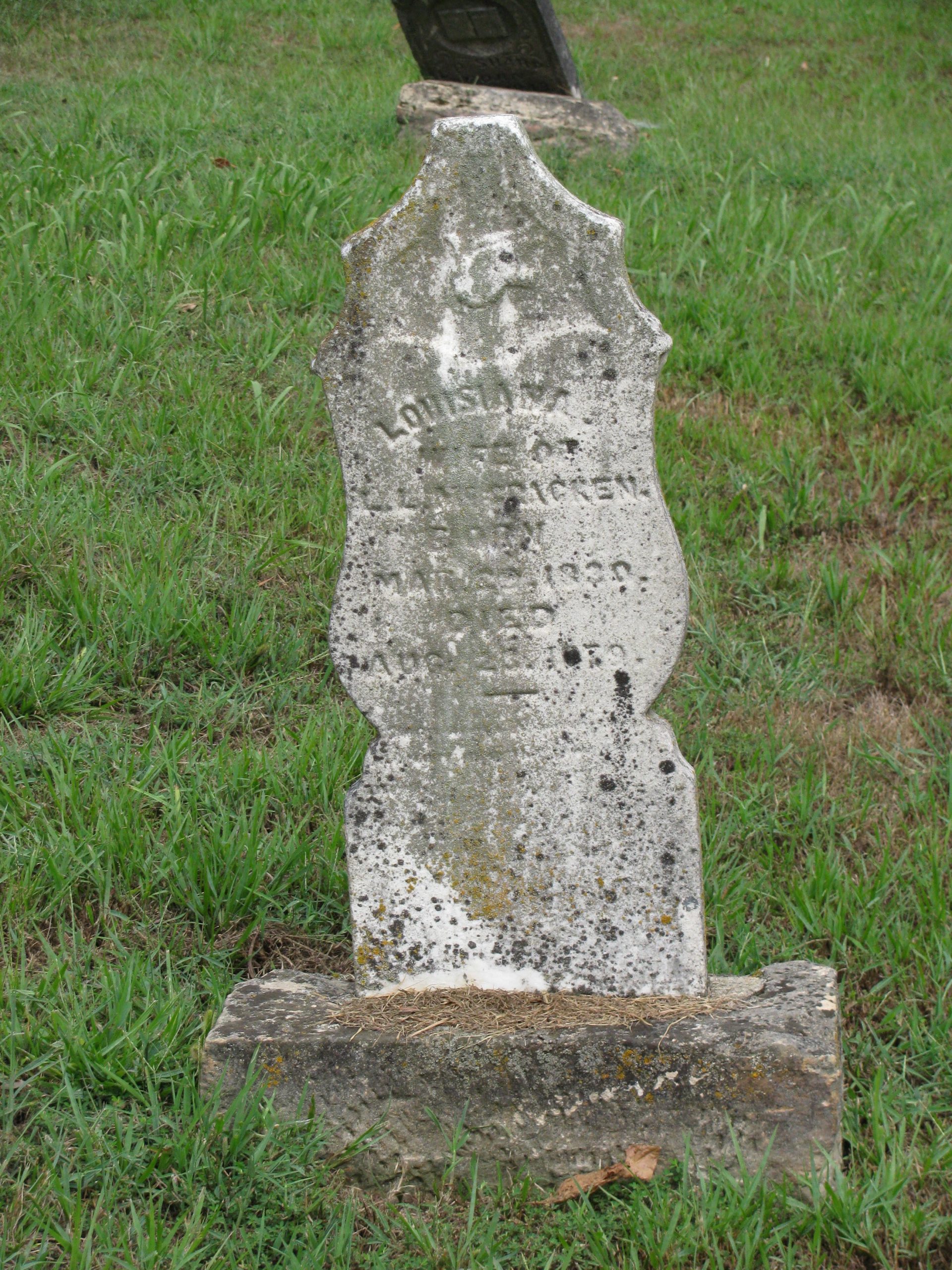
Louisiana Mateer Badgley McCracken
Louisiana (my great-great grandmother) was living with Lemuel and their kids in Crawford County, Kansas when she became ill.  The story, according to Dad, is that they were headed to family when she died.  For many years we believed that she was probably buried along a trail somewhere.  Dad thought that he heard they were headed to Peoria, Illinois.  However, no tie to Peoria has been found.  Since Louisiana’s oldest daughter with her first husband James Badgley lived near Quincy, Illinois, it is possible that is where they were headed.


In any case, several years ago, I discovered that she was buried at Morris Cemetery in Bates County, Missouri, northeast of where they had lived.  Perhaps they had some family at this place that had helped care for Louisiana or perhaps she died in route to their final destination.  In either case, she ended up being buried in this small, secluded cemetery that sits at the end of a road  across from the only house on the road.  No other family members are known to have been buried there.


After Louisiana’s death, Lemuel remained in Bates County.  In 1881, three months shy of two years after Louisiana’s death, Lemuel remarried to Melissa Eviline Donley. Lemuel and Eviline stayed in the area for about ten years before moving to Chautauqua County, Kansas.  


Lemuel McCracken

As Lemuel (my great-great grandfather) and this third wife Melissa (Eviline) Donley aged, they eventually moved back to Crawford County, settling with or near Lemuel’s son Andrew.  About a month before Lemuel died, he was sent to the state hospital in Osawatomie, as he had become difficult to handle.  I don’t know exactly what that meant.  It could be that he had dementia, Parkinsons, or a host of other issues.  Unfortunately, the probate court could not find any records associated with his case.


When Lemuel died, he was buried at the cemetery at the institution. Not only is he buried without family,  the gravestones in this cemetery  look so mundane.  Just row after row of ugly, plain gravestones.  They don’t even have names on them, only numbers.  So sad. And, it is the eeriest cemetery I have ever encountered.


Eviline was buried in Texas near one of her children.


John Van Allen

My husband’s great-great grandfather John Van Allen died at Vicksburg while serving in the Civil War.  He was with Company B, Wisconsin 33rd Infantry Regiment when he became ill.  He is buried at Vicksburg National Military Park, hundreds of miles from Wisconsin, where his family lived.


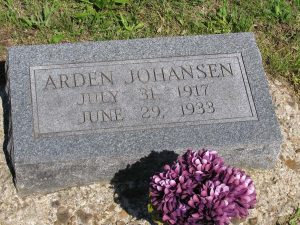
Bonus Story:  Arden Johansen

Arden was not related to our families.  He was a friend of my Uncle Dewey.  He died a month before his 16th birthday. After his family left the area, the McCracken family adopted him in a way.  They always make sure he has flowers on his grave when they put flowers on the graves of family members.  This task has passed from Dewey and his wife to Mom and Dad to our generation.


The smallest piece of information generally is the one that gets me involved in a crazy genealogy hunt.  And, sometimes they lead to the biggest discoveries.  In this case, it was a photo with a name that I found unusual that started it all.


The Photo

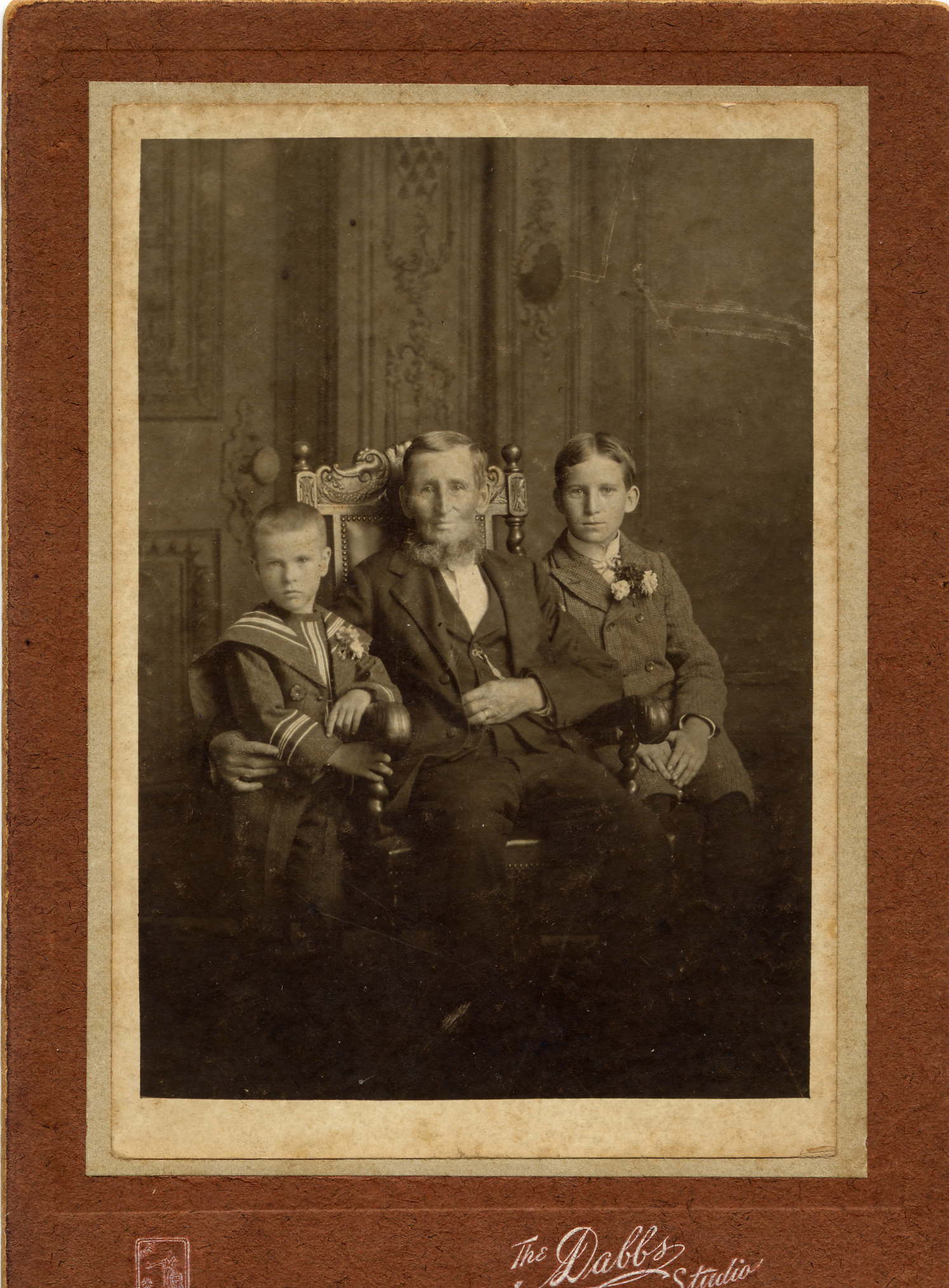
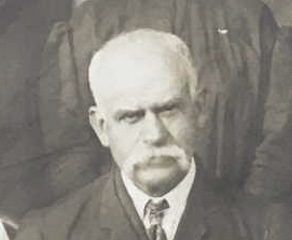
The photo had been taken at a long defunct studio in Ft. Scott and included two boys with an older gentleman.  The boys were identified on the photo as Clate Farmer and Willie Potter.  Given their birth years, I could determine that the photo was taken around 1900.  Additionally, I knew the gentleman must be related to the Peelle family since Clate and Willie were cousins in that family.  However, the photo only identified the man as “Ail” followed by an indication that he was a Civil War veteran.


The Search


The Name “Ail”

I began searching family records and records in the areas where the Peelle family lived.  However, I had no luck finding anyone named Ail.  Then, I began searching various names that could have “Ail” as a nickname.  I found that Ail was a nickname for quite a few different names. Still, I found nothing that seemed to be a match to anyone in my tree.  So, I moved on to other research.


Totally Unrelated Research

One day, when researching some information regarding Martha Johnson Peelle’s family, I found that her grandfather was Eleazer Smith.   I began researching and I found an Eleazer Johnson. Now, this was very interesting because Martha’s mother was a Smith and her father was a Johnson.  I wondered if Eleazer Johnson might be her brother or cousin.


Since Martha’s parents (William Johnson and Rachel Smith) had died very young,  little was known about the family.  However, her obituary had said that she was the last of eight siblings.  None of the names were known as her parents had died in the days where census records only recorded the name of the head of the household.  By the next census, Martha had married Passco Peelle and any siblings that existed were lost in the “Sea of Johnsons.”


Answers, Finally

Suddenly, the answer dropped out of the sky.  Since Eleazer isn’t a name that had come up in my genealogy.  I researched it to learn where it might have originated.  Lo and behold, “Ail” can be a nickname for Eleazer.  Two plus two led to the theory that the gentleman in the picture was Eleazer Johnson. 


Now, to prove it.  Mostly, it required being lucky and finding the right pieces of information at the right time.  I will spare you all the details, but it included identifying Martha’s youngest sibling Lydia Johnson Harris, someone posting a letter online that Lydia had written to a cousin asking about information on her parents, an old business card that my grandmother had kept, Civil War records, census records, and some newspaper articles.  In the end, I was able to conclude that conclusively that Eleazer W. Johnson was Martha Johnson Peelle’s brother.  I never found absolute proof that  “Ail” was the same person as Eleazer, but in all likelihood it appears that they were the same person.


Who Was Ail?

Assuming that we accept that Ail is Eleazer W. Johnson, he would be Martha’s older brother.  Eleazer was born in Wayne County, Indiana 9 months after his parents marriage with the name Eleazer W. Johnson.  His middle name is yet to be discovered, but it may be William as his father and grandfather in the Johnson family were named William. 


It is not known what he initially did after his father died.  However, he would have been almost 17.  Thus, he likely went in search of work.  By 1850, Ail was living in Jackson County, Indiana to the southwest of where he was born. He is listed as a laborer and was living with a family where the head of the household was a miller.  By 1860, he had made his way westward and was living in Warren County, Illinois, west of Peoria and about 25-30 miles east of the Mississippi River.  At this time, he is living with the Holeman family.  No occupation is listed for Eleazer, but Mr. Holeman was a farmer.


Civil War

Eleazer enlisted in the Union Army in December 1861 in Richland County, Illinois.  At Jonesboro, Illinois on April 1 (or 10, records vary) of the following year, he mustered into service.  He served as a private in Company A of the 63rd Illinois Infantry until October 12, 1862 when he was discharged for “disease of the throat.”


His Marriage

On February 7, 1875, Eleazer married Elizabeth Bennett Walker in Coles County, Illinois.  Elizabeth had been widowed a year earlier.  No indication of a previous marriage for Eleazer has been found.  Nearing 50, Eleazer and Elizabeth never had any children.


After their marriage, Eleazer and Elizabeth moved to Cherokee in Cherokee County, Iowa, where Eleazer finally settled.  He would farm and become the postmaster in Cherokee.  Eleazer also joined the local chapter of the Grand Army of the Republic (G.A.R.).


Eleazer remained in Cherokee until Elizabeth died.  After she died, he moved in with his sister Lydia and her husband James A. Harris in Cass County, Iowa.  Eleazer died in 1902 of old age.


Afterward

The prompt this week was to write about someone or some place that begins with a vowel.  The first instance of names and locations that begin with a vowel are highlighted in red.


https://pixabay.com/photos/candle-light-candlelight-flame-2038736/

 World War II brought the threat of attacks from the skies.  As such, the coasts began blackout practice, which entailed extinguishing or covering anything that could emit light.  The  idea was that enemy pilots would not know where to attack if there were no lights along the coast.  By the end of 1942, the practice had moved inland to the center of the U.S. mainland, where most of our relatives lived.


The Rules


The rules of the blackout were simple, but disruptive to people’s lives.  From the time the signal sounded until the all clear signal was given, everything was to go dark.  All lights of any kind, electric, gas, candles, and even cigarettes were to be completely obscured from anyone looking from anywhere outside. Not the tiniest bit of light was to escape.  Officials believed that the light from a single candle could be seen from twelve miles away if the pilots eyes were well adjusted to total darkness.


In The Buildings


If someone was home, they were to extinguish all lights of all types.  If a light was absolutely required for some reason (birthing a baby was an acceptable reason), the occupants were required to  use  the most minimal light possible and to cover the windows so that no light – not even a small sliver shown.   This same rule applied to businesses and any other buildings.  The only exception was  factories creating war goods, which had been running 24/7 since before the United Stated entered the war. The government did not demand that these businesses  go dark for tests, but would be in a real emergency.  Boeing, where dad’s sister O’Ella worked in Wichita, chose to have an abbreviated test lasting 5 minutes.  This allowed them  to show that they could go dark if necessary. Yet, it limited the down time to a minimum.


If individuals and business owners were going to be away from their home or business, they were to  extinguish all lights prior to leaving.  Once the signal was given, it was too late for the people to return and extinguish them.


On The Streets

Only air raid wardens or others assisting with the blackout enforcement were allowed on the streets during a blackout.  If the signal was given while some was outside, the person was to take shelter in the nearest open building.


Automobiles and other vehicles were also required to go dark.  If someone was  driving down the street when the signal was given, they were required to pull to the curb and turn off all lights for the duration.  They were also supposed to leave the key in the ignition (why I am not sure).   People were strongly encouraged not to be on the highway for planned blackouts.  However, if they were, they were to pull on the shoulder or a side road.   People then were to extinguished all their lights just like if they were in town. 


These rules applied to public transportation as well with the exception of trains.  They were not required to participate in the blackout practice.  However, most drew their curtains and dimmed their headlights to the minimum required for them to navigate. 


The Telephone


Southwest Bell advertised to not use the telephone during or for 30 minutes after the blackout except in an emergency.  Although restricted telephone usage wasn’t required for a test, they wanted people to become accustomed to the rule should a real blackout occur. 


The Signal


Each city and town determined how to signal a blackout in their community. Each signal was unique to the particular community.  The towns used fire signals, train whistles, church bells, school bells, or air raid sirens.  Generally, the alert was given in some pattern, such as, two long whistles/sounds or a long followed by a short.  From the time the signal sounded until the all clear signal was given, everything was to go dark – every house, car, store, restaurant, and more. 


People in rural areas couldn’t hear these signals.  So, in many cases, they used emergency rings of the telephone system to alert residents of the test.


The First Local Blackout Practice


The first blackout practice that impacted a majority of our family was the Army Seventh Service Command’s  9 state test covering over 700,000 square miles. It covered Minnesota, Iowa, Missouri, Kansas, Nebraska, Colorado, Wyoming, North Dakota, South Dakota, and a few counties in Illinois near St. Louis.  People across the area were given advance notice  through the newspaper and radio of the blackout practice at 10:00 p.m. on December 14, 1942 (Monday). 


That night many people prepared by shutting off as many lights as possible ahead of the appointed time.  Photographs from Wichita, Kansas showed a major street almost completely dark five minutes before the  signal was to be given.  However, most of our families were farmers and they were almost always in bed at this time of night.  So, this first test had little impact on them.


Once the signal was given the air raid wardens and others who had been signed up to assist in blackouts, leapt into action  looking for the glimmer of light anywhere.  Additionally, officials flew overhead to see if light could be seen from the skies.  As a result of enforcement and threats of penalties, almost every light went out.  It was estimated that communities had 95-100% participation. Any lights that found on were, in most cases, quickly extinguished.  Likewise, any cars found driving on the streets or highways were asked to immediately pull to the side of the road and extinguish their lights.


Consequences


Compliance was encouraged by the penalties assessed for lights that were shining.  In Wichita, for example, leaving a light on could cost you up to $500 and time in jail.  For the first test, they only gave warnings to people who had unintentionally violated the rules.  However, they assured people that a second violation would cost them.  Other places were not so lenient fining people small fines for even minor infractions.

Leaving a light on when you weren’t home, could be even more expensive.  Besides the fine, “Block wardens” and others supporting enforcement had the authority to break a window to get in your house and turn off your lights.   Thus, inadvertently leaving a light on could also cost the price of replacing a pane of glass.


Unintended Consequences


The men manning the streets watched to minimize any criminal behavior.  However, no one could think of all the possible consequences of the blackout.  At McPherson College, when the lights went out, the “boys” rushed from their dorm to the “girl’s” dorm.  The matron couldn’t keep them out on her own and had to call for help.  Just shows that people will make a good thing out of anything OR take advantage of any situation.  It all depends on your perspective.


Another interesting unintended consequence was that when the signal was given, the people started talking in whispers.  It was not required, but it was observed in many locations.


Ongoing Blackout  Practice


Future blackout practices came with little or no warning. Thus, much of the preparation of the first test, could not be performed.  Lights couldn’t be turned out in advance and people couldn’t plan not to be on the roads.  Although tiresome, these subsequent tests were much more representative of a real surprise attack.


Targets


Our family regularly participated in these practices as required.  Some family members were much closer to potential enemy targets than others.  The McCracken and Pellett farms were over 40 nautical miles from an ammunition plant near Parsons. The plant was likely the closest potential target to them. 


The Thomson and Helm families were about 10 nautical miles closer to a potential target, as a B-26 bomber factory had been built at Offutt Field outside Omaha.  However, Dad’s sisters  lived in Wichita were in a much more vulnerable area, not only because it was a city, but because it was the air capital of the world.  What enemy wouldn’t want to take out a series of airplane manufacturing plants?


Rural Enforcement


Enforcement of blackouts in the rural areas where most of our families lived could not be done on foot.  In those areas men would drive cars would drive down the country roads to ensure they saw no lights.  Dad said that in their household they would extinguish the kerosene lamp in the kitchen and the gas lamp in the living room.  He didn’t think either lamp gave off enough light to see with if you were next to them.  Thus, he didn’t quite buy into the belief of the power of a single candle to be seen from far away.  He thought that a bomber would have to be flying mighty low to see the faint glow coming from their house.  And, that the same would be true if the family lit every lamp they owned.


Safer Than the Coast

Despite the repeated tests and strong enforcement, it was doubtful that anyone really thought the enemy could reach the interior of the country unscathed.  The chance of an attack from the air in Kansas and Nebraska was really low.  Therefore, collections of sculptures and paintings by famous artists, including Renoir, Van Gogh, and Rembrandt were moved from galleries and museums  in more vulnerable areas of the country to the Nelson Art Gallery in Kansas City for safekeeping until the war was over.


Image:  Pixabay.com


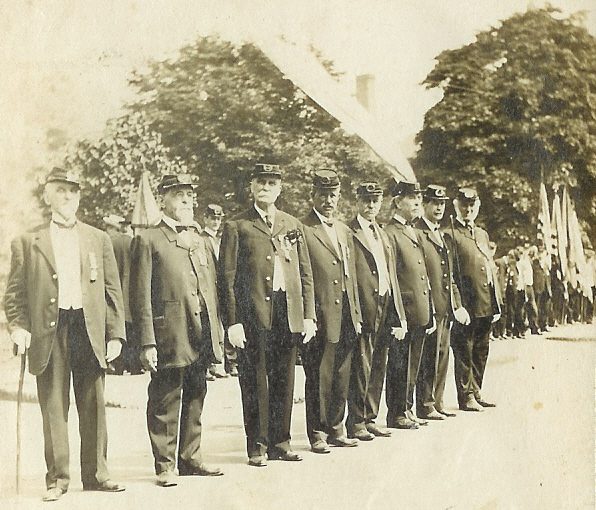
The Grand Army of The Republic (G.A.R.) was an organization for veterans of the Civil War that fought for the Union.  It existed from 1866 to 1956, when it was dissolved due to the natural course of life.  There was no requirement for veterans to join the organization, but many who had served chose to become members.   Numerous direct ancestors and other relatives were eligible for G.A.R.  This article focuses on two specific ancestors that were very active with G.A.R.  To learn more about GAR click here (after reading the article of course).


Joseph Gazzan Klinefelter

(Thomson family line)


Civil War Service


Joseph served as a private in the Union Army during the Civil War.  He served from August 27, 1862 to June 14, 1865 as an “artificer” in Company E of Knap’s Independent Battery of Pittsburgh, Pennsylvania, which was a light artillery unit.  Just a few weeks later on September 17, he was  wounded and captured at the battle of Antietam, near Sharpsburgh, Maryland.  He was taken to Libby Prison  in Richmond, Virginia.  He was “paroled”  from the prison likely as a part of a prisoner exchange.


In 1863, Joseph participated in battles at Chancellorsville, Gettysburg, and Wauhatchie, Tennessee.  In the latter battle, Joseph received a wound to his left arm, which resulted in him being hospitalized in Nashville.  The following year Joseph’s unit participated in the many battles that ensued as part of Sherman’s March to Atlanta and the Sea.  After that it was time for the Grand Review on May 24, 1865.   The battery mustered out on June 14, 1865 at Pittsburgh, Pennsylvania.


After The War


After the war, Joseph joined  J.B. McPherson Post #177 of the Grand Army of the Republic in Pittsburgh, Pennsylvania.   He enjoyed visiting different G.A.R. encampments across the country. In 1899, Joseph and his wife Caroline attended a week-long national encampment and convention in Philadelphia.  The Philadelphia Inquirer provided extensive multi-page coverage of the event.  Business of the organization included the election of offices, deciding on Chicago for the 1900 encampment, a vigorous discussion of military pensions, a discussion of allowing veterans of the Spanish American War join, various parades, and many meetings and reunions of specific units.  Joseph most likely joined the meeting and parade of the ex-prisoners of war, along with the meeting of his unit.


The G.A.R. members enjoyed many other fun activities as well.   In one day, nearly 1900 people visited City Hall and took the elevator ride up the tower. Meanwhile, others visited the Philadelphia Mint, Independence Hall, and the warships on the Delaware River. Atlantic City was also a fun destination, which the Pennsylvania Railroad advertised as an excursion for $1. The Philadelphia Inquirer also provided the G.A.R. members and their spouses with rides in in the most luxurious horseless carriages in the city.  Joseph and Caroline were among the G.A.R. couples that opted to be chauffeured through the streets of Philadelphia in one of the $3600 carriages. (Were they made of gold?)


In 1905, on a trip to the National Encampment in Denver, Joseph took his wife and his granddaughter Blanche, whom he and Caroline had raised.  It was on that trip that Blanche met Herbert Thomson, a farmer from Nebraska and her future husband, which most likely was the biggest way G.A.R. impacted Joseph’s life as she moved to Nebraska.


Over the following years, Joseph continued his membership in several societies, including G.A.R. and the Union Veteran Legion #1. For Memorial Day in 1910, details of the local G.A.R. visited the public schools and the school children collected plants to be planted on the graves of soldiers.  On that day, Joseph visited Garfield School, a short distance from his home.  The next year, as commander of the post, Joseph gave a Memorial Day address.  It was later that year that he died while still holding the office of commander.


Willis Alexander Conner

(Pellett Family Line)


Civil War Service

Willis had multiple stints in the Union Army during the Civil War starting when he was only 14 years of age.  On May 31, 1864, he enlisted in the 133rd  Regiment, Illinois Infantry commanded by Colonel Thaddeus Phillips.  The unit organized at Camp Butler with a 100 day commitment to the war effort. Willis served as a private in Company C , guarding prisoners of war. He was discharged, along with many other men,  by Lt. Sumner at Springfield, Illinois on September 24, 1864.  Willis also reported that measles had settled in his lungs during his service.


By February 15, 1865, Willis was back to the war effort  when he enlisted in the 152nd Regiment, Illinois Infantry for one year.  The unit organized at Camp Butler before moving into Tennessee. Their main role was to protect the Nashville & Chattanooga Railroad.  Willis’ service, however, was cut short as the war ended.  He mustered out of  Company I on September 11th of that year at Memphis, Tennessee. 


After The War


By 1868,  Willis had moved to Kansas.  When the 19th Kansas Volunteer Calvary was called into service to address issues in the west with “hostile Indians.”  Colonel Crawford (namesake of Crawford County) who was the governor of Kansas,  resigned and led the regiment.  Willis signed up to serve the six month term on October 18, 1868 – only 8 days after a proclamation stating the need for a regiment had been made.  


Between 1200 and 1500 men gathered at Topeka before the regiment set out to the southwest.  Over the next six months they would venture into Indian Territory.  It was a very difficult journey as the winter was very harsh and supplies were extremely limited.  Many horses were also lost leaving the men to march through the cold and deep snow.  During the time they faced no fierce fighting with the Native Americans.  And, peace was achieved with some.  The entire regiment mustered out at Fort Hays on April 18, 1869.

In 1887, Willis joined the W.H. Lytle Post #32 of the Grand Army of the Republic (G.A.R.) at Fort Scott, Kansas.  Although G.A.R. started shortly after the war, It didn’t really get started in Kansas until 1880.  The post in Fort Scott mustered on December 12, 1881.  Willis was the 317th patriot to apply and be accepted by the local organization.  It appears that he served in an official role with the organization around 1900.  In addition, in the 1890s, he was an assistant to the Grand Marshall for the Memorial Day Parade, which were elaborate events with multiple GAR units, the Kansas National Guard, various civic organizations, schools, and local officials participating.  Ex-slaves and Native Americans also participated.


The W. H. Lytle Post recommended and actively supported the creation of a soldier’s home for veterans.  Interestingly, Willis ended up spending the last months of his life at the Soldiers Home in Dodge City.  It had been established in 1890 and is still in use today.


Afterward:  The encampment in Philadelphia could be an entire article.  It was fascinating with so much written about it.