The Johnsons & The Smiths

When I found out that my great-great grandmother Martha (Johnson) Peelle’s parents were William Johnson and Rachel Smith, I figured that I would never know anything about their family lines given their common names.  The only way it could have been more common was if her mother had been named Mary.


Anyway, it turned out that with lots of research and some luck that I have been able to find William’s parents, including finding part of his mother’s line back to 1650.  And, I have been able to trace the Smith family back to 1710.  I am still researching, but I believe even more details will be found on these families.  What I didn’t expect was to encounter a brick wall with regards to finding Martha’s siblings.

The Family

William and Rachel married in 1824 in Wayne County, Indiana.  They appeared to start a family immediately, with their family quickly expanding.  By 1830, they had two sons (one was 5-9 and one was < 5) and a daughter (<5). However, in 1839, it came to a sudden halt when Rachel died.  She was only 34 years old.


Two years later, William died, leaving their children without parents.


The Children

Since all of this took place before 1850, no census records exist to show the names of William and Rachel’s children.  Additionally, no will has been found. However, according to Martha’s obituary, there were eight children in the family, with Martha being the oldest daughter.


I didn’t initially know who any of Martha’s siblings were or what had happened to them.  Over time, I uncovered two of them,   But the other five remain a mystery.


Lydia
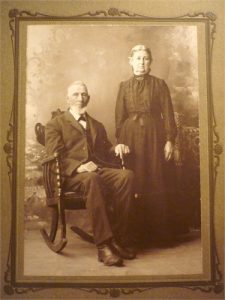
 

James A. & Lydia (Johnson) Harris

Lydia D. Johnson was  was born in 1836 and was only two and a half when her mother died.  She was raised by her father’s sister Anne (Johnson) Lykens and her husband Jonas in the Randolph County/Wayne County area in Indiana.


Marriages

On December 23, 1852, Lydia married Joshua F. Harris in Randolph County, Indiana, which was adjacent to Wayne County.  Just under three years later Joshua died.  They had no children.


The next year, Lydia married Joshua’s older brother James A. Harris, who had also lost his first spouse.  They made their home in Cass County, Iowa.  James’ son from his first marriage lived with them as did their adopted (not sure if this was formal or informal) daughter Matilda. In one census a boy Edward Bradley was also listed in the household.  His connection to them is not known.
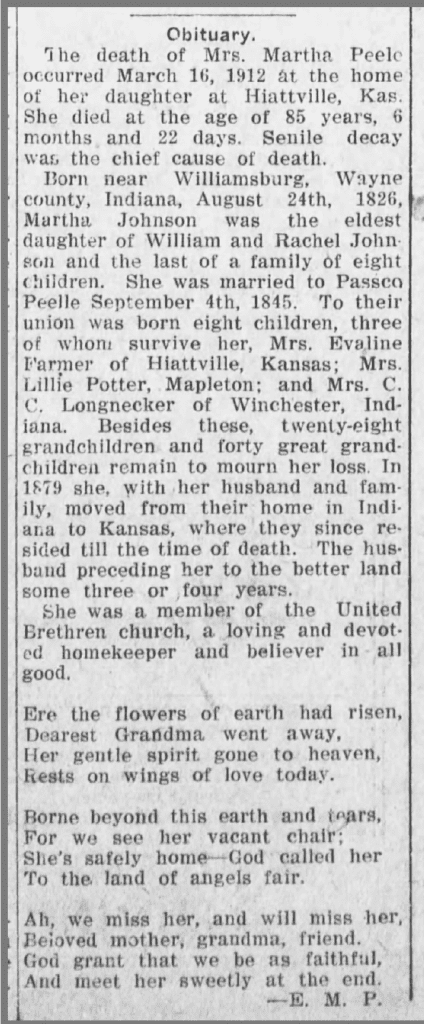


Source: The Fort Scott Tribune and The Fort Scott Monitor, March 29, 1912

The Research

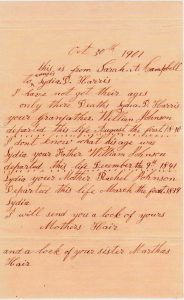
Lydia’s connection was discovered through photographs with her and her husband’s names on them, research into those names, and a note that was posted online.  That note  written by Sarah (Johnson) Campbell, who was the daughter of Anne(Johnson) Lykens and whose husband John Campbell was a first cousin to Lydia’s husband.    It appears that Lydia had asked about her parents and grandparents.  Interestingly, the note contains a reference to her sister Martha.
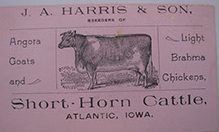
 

Later a business card for her husband’s business was found among my grandma’s postcards and calling cards.


Since Lydia had no biological children, her trail ends. 


The Civil War Veteran
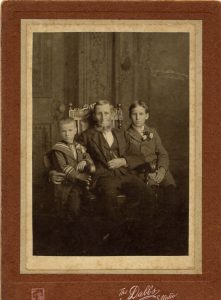
Eleazer Johnson, named after his Grandfather Smith, was Martha’s older brother and William and Sarah (Smith) Johnson’s first child.  He was born nine months and eight days after his parents married and a mere 16 months prior to Martha’s birth.


Ail, as he was apparently called, is found living with the Youtsey family in Jackson County, Indiana in 1850.  By 1860, he was living in Warren County, Illinois with the Holeman family. No ties have been found to these families except that Mrs. Holeman is said to have been born in Wayne County, Indiana. Ail most likely was visiting or traveled to wherever he could get work.


Military Service

In 1861, Ail enlisted in the Union Army.  He mustered in on April 10, 1862.  He served in Company A of the 63rd Illinois Infantry.  However, his service only lasted a few months and he was discharged on October 12 of the same year for disability due to disease of the throat.  He later became a member of the Grand Army of the Republic, an organization for Civil War veterans.


Marriage

It wasn’t until 1875 that at age 50 Ail married Elizabeth (Bennett) Walker, a recent widow.  If he married prior to this date, I have not found a record of such event.  They settled into life in Cass County, Iowa.  Elizabeth died in 1897 and Ail died five years later.  He is not known to have had any children.


The Research

Finding Eleazer hinged on the photograph shown, which was found amongst my grandmother’s photos. The only clues to his identity were the words “Ail” and “Civil War Veteran” which were written on the back. It also stated the names of the young boys, which  helped to date the photo and to identify that it was associated with the Peelle family (Martha’s husband was Passco Peelle).  Read Mystery Man to learn more about how I uncovered Eleazer as Martha’s older brother.

The Other Children

Looking for the children in this family has been quite the challenge.  All the significant events that are known occurred before 1850 when records were quite sparse.  Additionally, the names Johnson and Smith in an area where both families, who had relatively large families, had settled is challenging at best.   In addition, I do not know the exact ages, gender, or any names for the missing children.  I do not even know if they were living when their parents died.  So, in all, very few clues.


What Has Been Done

I have done a lot of research looking in the 1850 census for children and young adults born between 1827 and 1839 with the name Johnson that appear out of place (e.g. living with a family with a different name or where they simply don’t appear to be a child of the head of the household).  I have looked at marriage records for the area for Johnsons.  I, also, have scanned DNA matches for obvious connections.


Many people have been ruled out.  However, many other options exist when I expand the scope of the search.  Unfortunately, with common names that type of search becomes unwieldy. 


I do have a few candidate children.  However, not nearly enough and no proof for any of them.


Juliette Johnson

In 1850, Juliette was 16 and was living in the Benjamin and Martha Hutchins household.  Martha was the sister of William Johnson.  By 1860, she had married Daniel Miller and they had a daughter.  They are living at WIlliamsburg, Indiana, which is a small town William Johnson’s father had founded. However, after 1860 records on them just seem to disappear.


Juliette could very well be Martha’s sister.  However, not enough information has been found on Juliette to determine if she is in fact one of William and Rachel’s daughters or not.


Future Searching

I really need to go to Wayne County and Randolph County in Indiana to do some local research. It seems  that local research is most likely to provide key information.  For instance, if probate records can be found that are not online, they could provide information on the children.  Likewise, there might be additional cemetery records.


Additionally, I need to do a more thorough DNA  analysis.  Descendants of Martha’s siblings, if any exist, would be at best 3rd cousins.  Most would likely be 4th-6th cousins and it is possible that the descendants have no knowledge of their Johnson line.  None of this makes for an easy discovery.


Beards are something that come into style and then go out of style.  Some men can grow them and some can’t. Neither my dad nor any of my uncles had beards.  Of course, some of them may have been influenced by my Grandpa Mc.  He believed that having a beard meant that you were too lazy to shave.  And, lazy wasn’t something that was allowed in his household.


Despite his view, his grandfather, had a beard, as did several other ancestors.  Here is a brief look at some ancestors/family members of old and their beards. 

Make sure you scroll to the end to see all the photos.

Neat And Trim

Joseph Gazzan Klinefelter

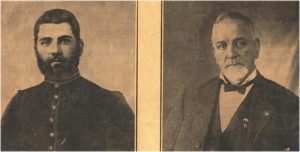
Joseph Klinefelter was born in 1842.  The first photo is in his Civil War uniform and the latter is near 1900.  He appears to have kept his beard trim both as a soldier and as an older gentleman.


Joseph Lewis Ellis

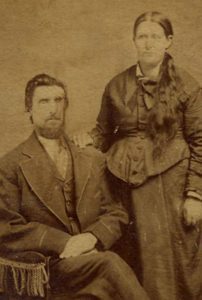
Joseph, shown with his wife Cynthia, appears to have a well groomed beard.  He was born around 1835.  This photo may have been taken in Illinois, a stop on their way from Indiana to Kansas.


Michael Ackermann

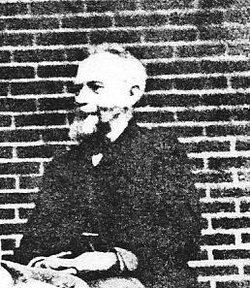
Micheal’s beard seems somewhat neat and trim.  It is hard to tell 100% given the photograph. He was born in Germany in 1832.


Wild and Woolley

Lemuel Lawrence McCracken

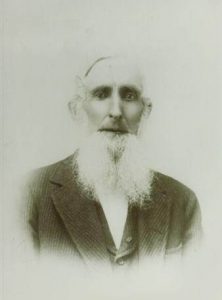
Lemuel was born in 1831 and this photograph was taken after he married his third wife in 1881.  Based on information about a photographer in his area, I believe it was likely taken in Sedan, KS in the 1890s.  Dad always said that you could tell he had red hair even in a black and white photograph.  However, his beard seems to be mostly absent of color leaning toward gray or white.  Oddly, his hair and mustache have not grayed.


Arthur Reid Thomson & John Ronald

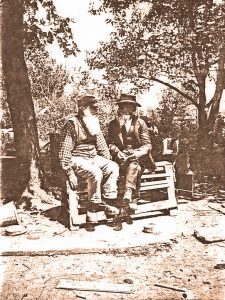
Both men have beards and they are lengthy.  However, Arthur Reid Thomson’s white beard takes the cake for the most hair hanging from a face.  It is wild, woolly, and long!


Hugh Portwood


Hugh’s beard was woolly and a bit rough around the edges.  Such was life on the frontier for a man who was born in 1845 and moved to an area of Kansas  where Indian Territory was just a hop, skip, and a jump away.


Long and Lanky

John Charles Jury

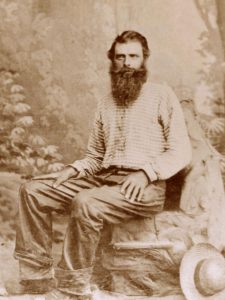
John was born in 1836 in Canada.  According to this photograph, which appears to have been taken sometime after he moved to the United States. John sported a quite lengthy beard.  His height is unknown.  However, he appears to be lanky and his beard matches his body.


George Thomas

George was born in 1854 on the Missouri frontier. His beard was also lengthy.  He was thin and tall making a good match for his beard.


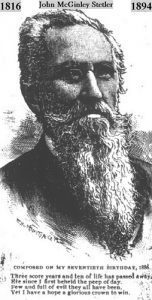
John McGinley Stetler

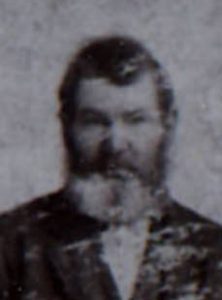
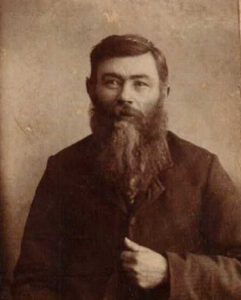
John’s beard was quite long and shapely.  However, I don’t know anything about his stature.  However, his face is thin and long making it reasonable to assume his beard matched his body.


And The Crazy Ones!

Henry Thomas


The photograph shows Henry and his wife Elizabeth Brown Donaldson.  Henry was born in 1814 and died in 1892.  Based on the type of photo, I would guess that it was taken sometimes in the 1880s.  Henry’s beard is so huge that it seems fake.  It is completely out of place given it is as large as his head.  His head and beard combined form an hour glass shape.  He seems like he is a person who should have shaved or at least shortened his beard to match his facial shape and size.


Salathiel Chadwick

Salathiel is shown with his wife Catherine.  He was born in 1806, supposedly in Ohio, which had only become a state three years earlier.  I am not sure if his beard is as wild as his hair, but it definitely was interesting.


Lorenzo Dow Pellett

Lorenzo was born in 1818.  He seems to have a combo beard between neat and trim and wild and woolly. It might be the most unique beard of many I have seen.


Little Pawnee Creek runs through our family’s property.  To the south, it crosses the road at what is affectionately called “The Crooked Bridge.”  The bridge, built in 1910 isn’t crooked, but the approach from each side requires turns and it is a part of a hill as well.  It isn’t easy driving a larger vehicle over it, although I have navigated it with a tractor, older style baler, and wagon all attached.


To the west of the bridge is one of the bigger bodies of water along this section of the creek. It is at this location over 50 years ago that my sister, our neighbors, and I had great fun one cool, crisp winter day.


Check The Ice

The sun was shining and everyone wanted to get out of the house.  It had been quite cold and the rivers, creeks, and ponds, had frozen over. So, we headed to The Crooked Bridge for a fun adventure. Despite the lengthy cold weather,  Dad checked the ice to make sure it was solid enough to hold everyone’s weight.  I remember him jumping on it and pounding his foot up and down to make sure that there wasn’t any give.  Then, we all carefully stepped off the bank onto the ice.


Playing Ball

We all started sliding around. None of us had ice skates and there wasn’t a huge amount of space.  But, there was enough room for sliding, falling, and having  a genuinely good time.  I am not sure how we came to have a rubber ball with us, but we started bouncing it on the ice. We chased it as it bounded down the creek and under the bridge bouncing off the sides.  I remember that when it hit the concrete bridge it would send the ball a different direction and everyone would go sliding after it.


Going Bald

By the end of the day, the ball was completely bald, having lost all of its rubber coating.  It had no bounce and would just fall flat.  We may have lost a bouncing ball, but we had so much fun and gained a unique memory that it was totally worth it! 


Afterward


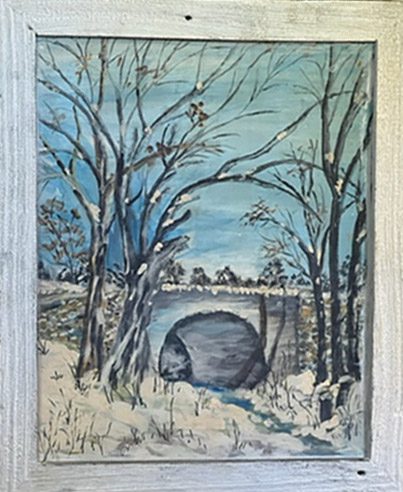
The featured image is a painting of The Crooked Bridge by Opal Ricketts, who lived nearby.


Dewey 1986

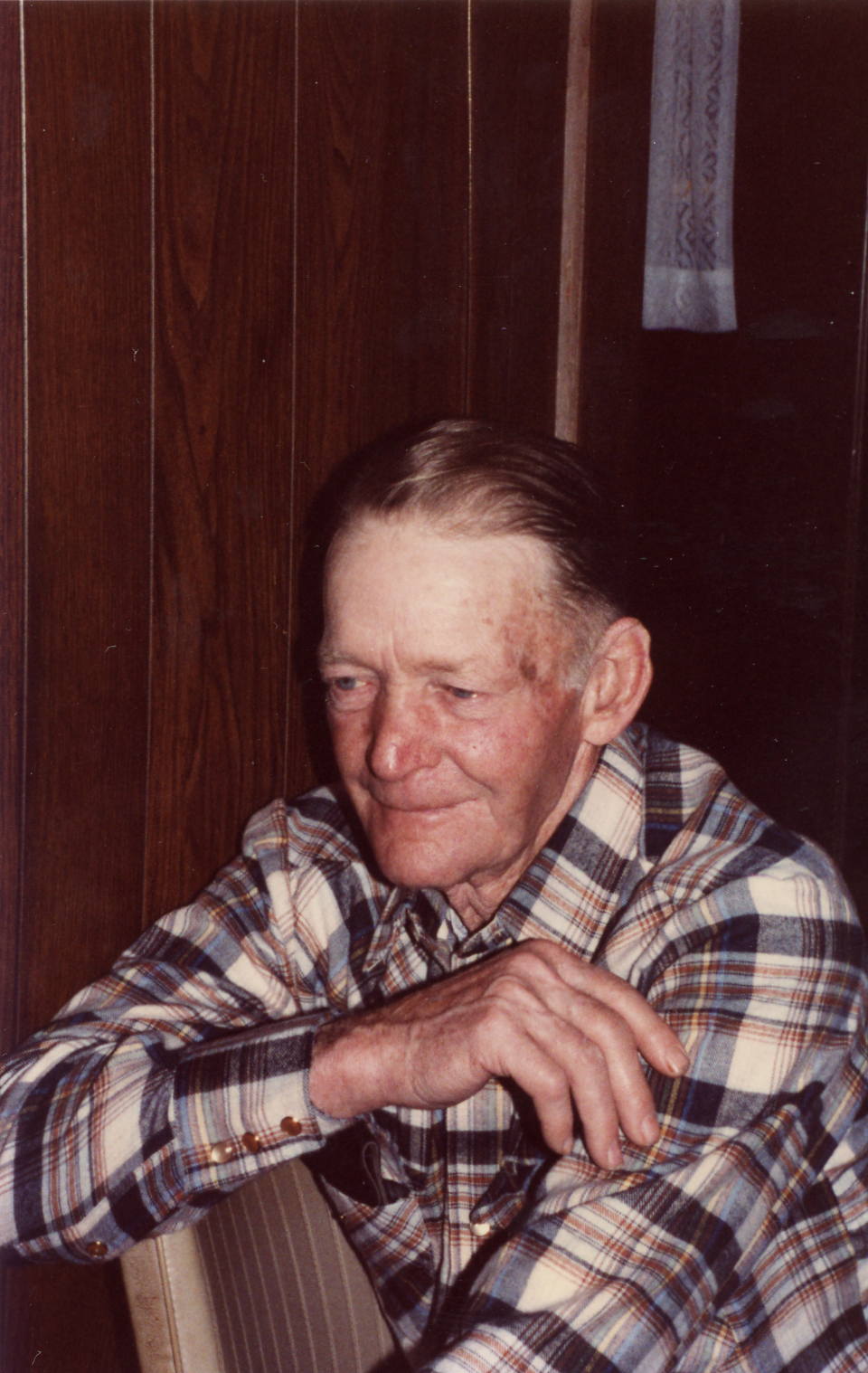
I don’t really think of my Uncle Dewey as having a lot of pets.  However, I do remember him as someone who liked animals.  And, someone whom animals liked.  He enjoyed having them around and seemed to be able to do things with them that others couldn’t. According to Dad, Dewey had been that way for as long as he could remember.  Most likely it was Dewey’s calm, quiet demeanor that attracted animals to him.  He may have also learned/inherited some of it from his parents as his mom loved her horse Beauty and his dad was saddened when they had to give up their horses for a tractor.


Some stories about Dewey and animals . . .


In School

I am not sure how Dewey got a dog to do this, but . . . One day when Dewey was attending Rocky Vale (a one room school house), Dewey snuck a dog into the school.  He got the dog to sit up in one of the student’s desks. Then, he sat a book up in front of the dog like the dog was reading.  How he got the dog to sit there upon his request is a mystery.  However, it was apparently some time before the teacher realized that one of the pupils had four legs and a tail.


Around the Farm

Being good with animals is very useful when you raise cows, pigs, and other farm animals.  Some have a mind of their own or are uncomfortable with most humans.  It is helpful if they will cooperate with you.  One story I remember is about some kittens at the barn that hadn’t been tamed.  No one could touch them.  But, Dewey was able to pick them up.


Dewey also played with the domesticated animals around the farm.  When he would wait for Dad who was getting a  load of hay, the dogs (and maybe cats) would hang out with him.  He would gently play with them.  Sometimes he would take a blade of grass or whatever he could find nearby and tease them a little with it. 


Old Age

As Dewey got older, his skin got thin and he would easily bleed if an animal scratched him.  So, when he would go to visit Dad, whose dogs Dewey loved, Dewey would always take a pair of leather gloves with him.  That allowed him to pet the dogs and enjoy their company without needing to be bandaged up.


I use DNA almost every day.  I use it to research distant ancestors where research has hit the brick wall, to help people who have been adopted or have other mysteries in their family, and to generally enhance my research.  Yet, I really struggled with what to write about DNA.  I could write about a given case, interesting finds, etc.  Finally, I decided to share an overview of my approach to digging deep into DNA when I am looking for someone several generations back with a brief look at each step using my research to find my great-great-grandfather Lemuel McCracken’s parents. 


Define The Questions

I find that it is important to define very specifically what I am trying to find.  And, writing it down is useful to keep the research on track.  It might seem like an unnecessary step, but it is easy to get distracted following many different tangents.


Lemuel Case Study: 

The search for the parents of my Great-Great-Grandfather Lemuel McCracken has been going on for decades.  When I started working on finding Lemuel’s parents, all I had were family stories and a handful of records.  Through research I learned many more pieces of information, but I still didn’t know who Lemuel’s parents were or even where he was born.  He had simply shown up around 1850, seemingly alone, as a young man in Lee County, Iowa.  From there, more of the story of his marriages and children have been discovered using traditional genealogy.  That left me with two questions: Who were his parents?  Where was he born?


Logic Problem

I approach genealogy brick walls as logic problems.  I write down the facts that I know about the person, what I don’t know, and any reasonable assumptions.  When beginning a case, this is based on traditional genealogy research and family stories.  Thus, I include items, such as, “The family believes . . . ”  I find it important to give ownership to each item since family stories aren’t facts, but can be hints. And, records can be wrong. As I move through the process and learn more, I add (and sometimes remove) statements.


Lemuel Case Study: 

I started my DNA search with the following data and assumptions:

    • Records indicate Lemuel was born in 1831.
    • According to records, Lemuel married in Lee County, Iowa in 1854.
    • Records imply Lemuel was in Lee County, Iowa as early as 1850.
    • Records indicate Lemuel was born in either Ohio or Pennsylvania.
    • Family stories indicate Lemuel was a Campbellite (Christian Church).
    • Etc.


Testing, Testing, Testing

Depending on the situation, who and where you test may be different. 

Y-DNA

When looking for a male ancestor following an all male line, so doing Y-DNA testing is a logical step. Even when I am looking for both parents, I will follow this step if it applies as learning the father is one part of the question.


Lemuel Case Study:

From Lemuel to  my dad is an all-male line.  Thus, Y-DNA testing was an option for determining Lemuel father.   So, both my dad and the son of one of his brothers did Y-DNA tests with FamilyTree.  Each joined the McCracken project as well as other projects related’s to Ireland and Scotland, where the family is believed to have lived prior to the United States.  The projects agreed that my cousin and my dad are of the same family.  But, they did NOT match any other McCrackens.


This implies several possibilities:

    • No one in our branch had taken the test. 
    • Perhaps Lemuel’s father was not a McCracken.  Did he make up that name?  Was that his mother’s name?
    • Assuming that his father was a McCracken, it eliminated several major McCracken families from consideration. 


Autosomal DNA

Most of my work with DNA relies on autosomal DNA (e.g. Ancestry, 23andme), which provides a lot of flexibility for testing and analysis (e.g. both males and females can test and match any family line). 


When trying to find people back several generations, I prefer to test multiple people if possible.  Since DNA inherits unevenly each person will have some different DNA matches.  Additionally, they will match them at different levels, which gives a range for the match to the person, which can be very helpful. When possible I try to have people that descend from multiple of the earliest known person’s descendants. This allows me to narrow down matches more quickly and also increases the possibility of people inheriting different pieces of DNA. However, it is possible to find a distant ancestor using  only matches from one of their children. 


For this type of analysis where you are working with known persons, I have found Ancestry to be the most useful, followed by 23andme, MyHeritage, and Gedmatch.  When starting with a known person and looking for their ancestors, shared matches are the best place to  start.   Chromosome browers, what are the odds,  and other tools can be useful for detailed work.


 Lemuel Case Study: 

I have access to 24 different people’s DNA tests on Ancestry, 23andme, MyHeritage, FamilyTree, and Gedmatch with the largest number on Ancestry,   Basically, I kept asking anyone of my generation or my dad’s generation to test and asked people who had tested if they would share their DNA results with me.  Those 24 people descend from four of Lemuel’s seven children.


The Analysis

  Once I have even one test in hand, I go to work analyzing DNA matches. Some of the techniques that I use include:

  • I make sure each person that tests matches to the family in the expected manner.  If a person matches with DNA that is out of bounds for their relationship, this must be investigated before their DNA can be used in the analysis.
  • I create clusters of people that are related to the specific line of research.  I manually plot relationships as tools for clustering that I have seen to date aren’t designed to work for solving this type of problem where you are looking some distance back and want only certain people, but where relationships may need to be manually analyzed..  Additionally, since I never seem to find simple clusters that are completely independent, I often change how the people are clustered to be able to analyze things differently.
  • Within clusters, I first look to see if I can determine relationships between any of the people in the cluster.  Second, I use the Leeds Method, visual scans, and other techniques to look for a name that connects the people.  Sometimes I add them to my tree and do more research on them to connect them.  If no connection emerges from the group, I re-evaluate the group and look in detail at the connections between different people in the group.  When the groups don’t yield answers, I do special deep dives as if they were the puzzle I am solving.
  • I make lists of names that show up frequently where I haven’t been able to fit them into the puzzle.  Having the lists gives me a reminder that I have seen them before and notes about them can help me connect the dots.
  • I record all descendants of the person in question who have done DNA testing.  I show the direct line back to the person of interest.  This allows me a quick visual of how the descendant DNA matches fit together.
  • I record the groups of people showing the direct line back along the line where they connect (e.g. if I am looking for a Smith connection and they connect to a Smith, I will record that direct line).  Occasionally, I have disconnected groups where I can connect several people back to an earlier ancestor, but where I haven’t yet been able to connect them to any other group.  I do this in a visual chart so that I can see everyone together.  I find this more effective for seeing gaps and possible connections than simply having these people in a tree.
  • When I have a lot of information, I create summary charts to pull pieces of the information together in a compact way to share with others or for additional analysis.
  • When I am not seeing anything new, I do what I call “turning it on its side and upside down.”  What this means is that I revisit information. I review the facts and assumptions, the DNA matches, and other notes. I may even take work that I have done and set it aside and do it again to see if looking at it with a fresh perspective helps.  I will also consider if there is a different angle for analyzing the data.  I also ask myself if there is some additional traditional research or additional genetic genealogy tools that  I can apply.


Lemuel Case Study: 

Direct Descendants

I have found  nearly 80 descendants of Lemuel, many that I didn’t know about, through this process. In addition, it led me to 10 descendants of his wife Louisiana and her first husband.  This includes some surprises, such as, a pair of siblings that had no idea that they descend from our family line.


McCracken

I determined that Lemuel’s descendants are related to 32 descendants of James McCracken and Rachel Kelly. Additionally, my family matches 35 additional people tied to the McCracken family that I have reasonable evidence to believe descend from the same couple, but where it is not  yet proven. I also have multiple large groups of people who, based on DNA, appear to be related, but whom don’t have enough data to tie them to the McCracken family.  One of these groups is huge with well over 100 people in it.


Peppard

In addition, I determined the other primary name associated with Lemuel is Peppard.  Likely McCracken is one parent and Peppard is the other.  I determined that member of our family that tested are related to over 100  identified descendants of Jonathan Peppard and Elizabeth Gilmore. It seems likely that these are Lemuel’s grandparents or great-grandparents.  I have not yet decided which is his paternal family and which is his maternal family. However, I have analyzed all of their children and grandchildren to determine who could possibly be his parents.  The list is very small.

I have also determined that these two families lived very close to each other in Wayne County, Ohio.  Thus, this seems to be the likely place that his parents paths crossed. These pieces of information are now part of the assumptions.

It should also be noted that this information is the result of years of work.  It did not happen overnight.

Complications

Complications typically arise when there connections between families. Generally, the further back the more connects that exist.   For communities with lots of intermarrying (e.g. Quaker, Jewish, certain localities), it can be really complicated.  I have worked some cases where it seemed like everyone was related to everyone else.   The more inter-related families are, the more adjustments that may be needed in thinking about relationships indicated by DNA.


Lemuel Case Study:

I have encountered a limited number of connections between families.  In some cases, two people who tested are related two different ways.  In other cases, DNA matches are related to the family line I am researching plus another key family line.  Fortunately, no significant intermarrying has been found on this project.  Thus,   the multiple connections have had a limited impact on my analysis.


Additional Reading


Note: For any of you that do a quick search on Ancestry or Family Search and see that people show John and Mary McCracken as Lemuel’s parents.  I believe this to be incorrect information.  I have explained to many people the flaw with this theory.