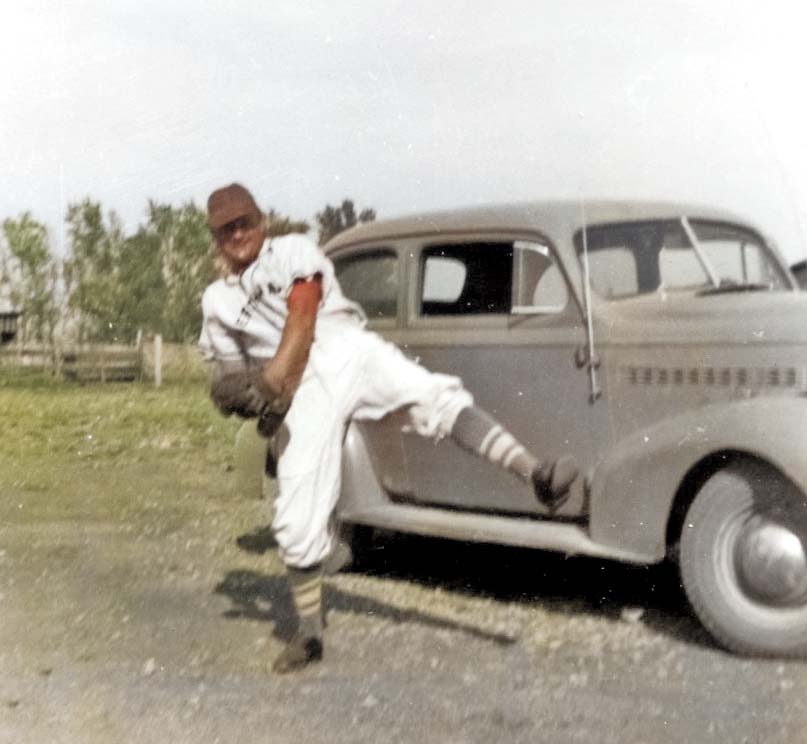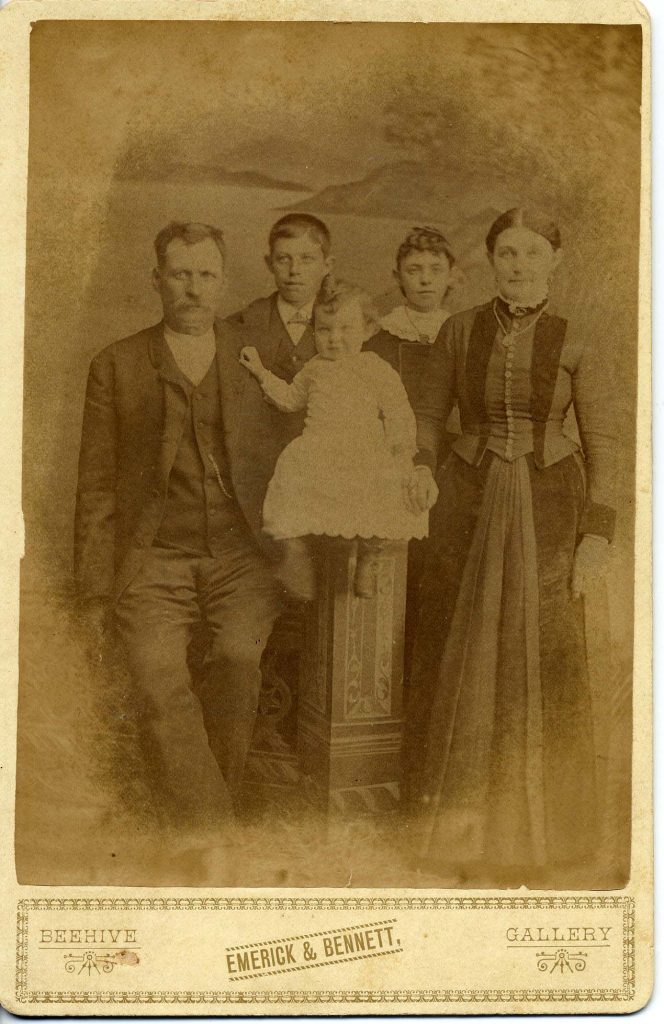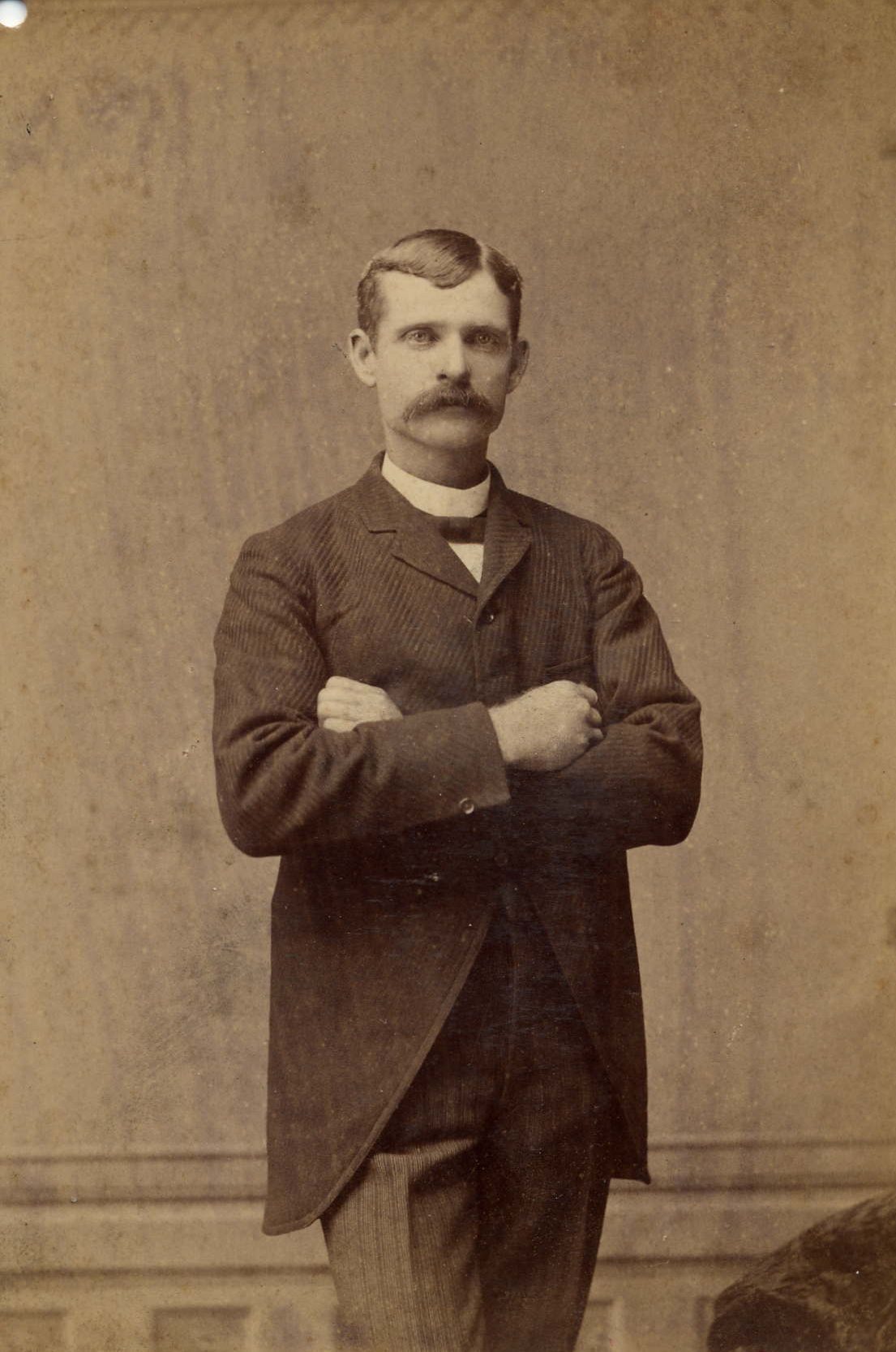
William Johnson Peelle was my great-grandfather. He was also a carpenter, farmer, and all around jack of all trades. He kept a journal from 1878 when he was 22 until 1894. That journal primarily focused on his work and the places he went. He spoke mostly of men, even referring to his brother-in-laws instead of his sisters. He rarely wrote of personal family events. Thus, this story will outline his life, focusing on his carpentry work. The story also includes a special “surprise” that I learned while putting this article together.
The Early Years
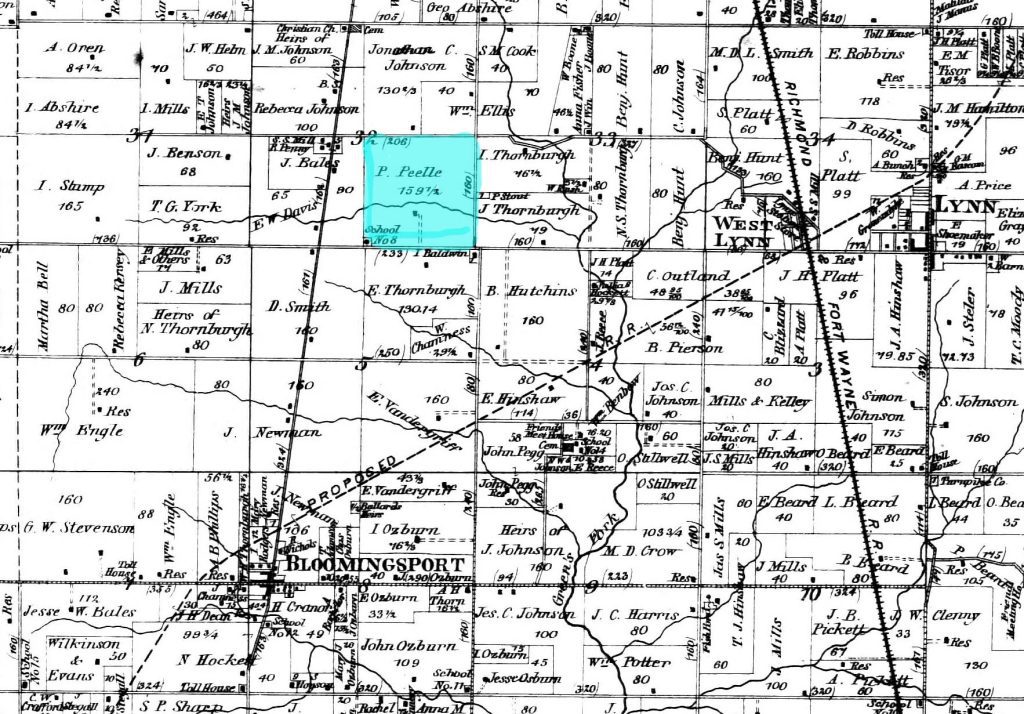
William J, as I refer to him most often, was born in 1856 in Wayne County, Indiana to Passco and Martha (Johnson) Peelle. They had a school on the corner of their property where he most likely got his formal education. However, a good portion of the education that he used in his adult years came from working with his father, brothers-in-laws, and other men in the neighborhood.
By the time he was 22, he was helping various people farm and erect buildings on their property. For example, in 1878, he helped his brother-in-law Wiley Benson (husband of Rachel) erect a stable on his property.
Moving to Kansas
It was late in 1878, when Passco, Martha, William J. and a couple of his sisters prepared to move to Kansas. This was quite the undertaking as goods that were moving had to be taken to another county to be put on the train. William J. drove the cattle to the same place, but it is unclear if they were shipped to Kansas or sold. It seems that his father, and presumably his mother and sisters, spent some significant time in that county before leaving for Kansas.
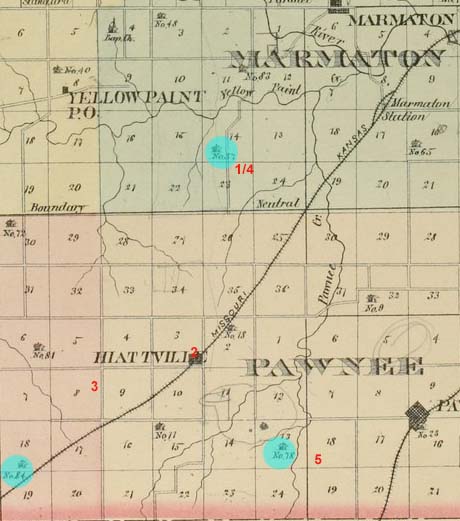
William J. stayed in Indiana after his parents left. He seemed to have some details to manage. During the spring of 1879, he helped his brothers-in-laws plow, plant, do other farm work, and a bit of carpentry here and there. One of the last things he did before he left was selling his horse. After that, he had to walk. He spent his last night in Indiana at his Uncle John Peelle’s house in Winchester. On June 8, 1879 he boarded a train with the destination of Hiattville, Kansas.
Settling In
William J.’s early days in Kansas were a mix of farming, sickness, and building on his father’s property. It is unclear what made him sick on and off, but perhaps it was the change in the environment (e.g. water, allergies). His carpenter skills were put to work building a stable for which he had to cut poles to be used in the project. He also made a door for the kitchen, fixed the corn crib, and made a shed for the calves. In the years that followed, he would add a new kitchen to the house, build a barn to replace the old one, etc.
By that fall, he was branching out and helping one of the neighbors fix his house. Then, at the end of October, he went back to Indiana for the winter where he spent time visiting and helping various relatives and friends.
The Surprise
Olathe
When William J. returned to Kansas, he picked up where he left off farming and doing carpentry. This went on until 1883 when suddenly, he went to Olathe (now part of the Greater Kansas City area) to work completing some houses. After he finished, he worked for the water works and built a fence for a school. He returned home on December 13 for a few days, but ended his work in Olathe in early January.
The Railroad
Later that month, he went to work on the Ft. Scott-Wichita Railroad. It is unclear what he did for the railroad as he simply recorded the days work and overnight shifts counted as two days pay. He worked in this job until June 12, when he worked half a day and quit. (There is probably a story behind that, but we will never know.)
Again, he returned to his life as a farmer and carpenter. But, working in Olathe and on the railroad are not something I grew up knowing. Although this was unknown, it’s not overly surprising. However, in the process of writing this article, I uncovered a potentially “big” surprise related to William J. during this time period. Read the Bonus Story for details.
Becoming a Boss Carpenter
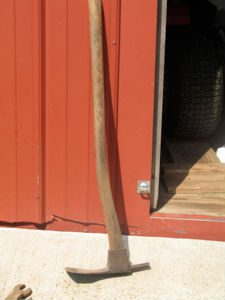
At this point in his life, William J. really started to focus on his carpentry. Over the next several years, he would build, build, build. . .
Big Farm Projects
William J. built basically anything that a farmer would need on his property. He built houses, barns, stables, corn cribs, straw sheds, calf sheds, smoke houses, wagon sheds, hen houses, coal houses, water tanks, and granaries. In many cases, these projects took a few days to a few weeks. A house was much easier to build without plumbing, electricity, building permits/requirements, and very few if any closets.
He also made additions to buildings; put floors into existing buildings; roofed buildings; and built doors, door frames, and gates. And, sometimes he tore down buildings instead of erecting them.
Besides pure carpentry, William J. plastered walls – sometimes in a house he was building and sometimes in house that had already been built. He was even known to hang wall paper.
It appears that while working on large project, he often stayed away from home. This was definitely the case when he went to work on a barn near Hepler, which was around 15 miles from his home.
Bonus Story
While pulling together facts for this article, I did a little searching. I found a marriage record for a man listed as “William Peell” in one document and listed as “William Peale” in a transcription of another. His bride was an “Ida Johnson.” They were both local to Bourbon County. Could William J. have been married before he married great-grandmother Matilda?
It turns out that both William J. and Ida lived in Marmaton Township and in 1880 they were listed a couple pages or so apart on the census. So, we have a coincidence. Additionally, no William Peell or any other William Peelle of any spelling can be found in Bourbon County in the years before or after that. According to the record, they married September 3, 1883. It just so happens that William J. went to Ft. Scott that afternoon and spent the night. It was the next day that he left for his new job.
Ida gave birth to a son William Guy Peele (his spelling of his name as an adult) either December 20, 1883 or December 20, 1884. Records vary as to the year. It seems that if the actual year was 1883, that Ida may have concealed the actual year to hide the fact that she would have been pregnant when she married. As for how this aligns with William J.’s journal entries, he was home and not working for several days around both of these dates.
He does not mention this woman or her son in his journals, but then again, he does not mention my great-grandmother or any of their children either.
What is known is that in 1885, William J. is listed in the state census as married. However, no wife or child are in the household. At some point, Ida and her family had left Bourbon County and moved to Douglas County, Missouri. In 1887, she married a Mr. Hall. So, if it was another man that she married, something happened to him or their relationship before this date.
William G. lived with Ida and her husband’s family, but continued to use the name Peele. He later lived in Oklahoma. I have not found an indication that he ever had a wife or children.
Of interest is that the newspaper reported that William J. took a trip to southern Missouri in 1906 just before they moved to the Home Place. Douglas County is in southern Missouri. So, it begs the question, “Did he go see his son?”
Researchers indicate that her son was a Jr. and believe his father’s middle name was Guy, like the son. However, I have found no records that indicate the father’s middle name. I have also found no record of the son’s middle name until he was older.
Additionally, over the years I heard stories that William J. had a son out of wedlock. However, the story said that occurred in Indiana and that was why they moved to Kansas. I have found nothing to substantiate a child in Indiana. I also heard that a “man” came to the farm looking for him and that some of the McCracken girls thought he was William J.’s son. I have no idea if there is a bit of truth in these stories or not.
At this point, we are left wondering. Was William J. really married before he married Matilda Jury? Or, is this just a coincidence?
 Schools, Churches, & More
 Schools, Churches, & More
William J. also repaired and/or built schools, churches, at least one store, and a warehouse. Scofield School (less than a quarter mile from his house), Cold Springs School, and Hiattville School were among the schools where he utilized his skills. Based on the length of projects, he must have built at least one school from scratch. Other times he made new steps for the school, fixed desks, made bookcases, fixed the building, put glass in windows, and made blackboards.
He mentions working on “the church” and the Christian Church. It is unclear if references to “the church” are to the Christian Church. Hiattville also had a Catholic and Methodist Episcopal churches. Meanwhile, to the northeast of his home was Pleasant Valley Church.
Small Projects
Not every project took days and weeks to complete. Some of William J.’s smaller farm projects include: tool boxes (the first was his own), milk troughs, water troughs, workbenches, sleds, bull rakes, wagon tongues, hay ladders, and beds for wagons.
For inside the home, he made flour chests, a desk, and wardrobes. The desk was for his family and my dad remembers it. He said that it was a bit rudimentary, but William J. didn’t have tools to make anything fancy. Additionally, he made the Walkertown mailbox, the Hiattville Cheesehouse, and items for doctors, including crutches.
He also fixed lots of items, such as, binders, water tanks, wagons, corn planters, scales, cradles (farm equipment, not the baby kind), cultivators, hay rakes, and buggies.
Moving Into Town
On October 7, 1891, William J. and his parents moved into Hiattville where they had acquired lots in the northern part of the town and one lot along the east side of the railroad. Prior to the move he had built a shop (presumably on the lot along the railroad), built a barn, and made other improvements to the properties. He worked in the shop much of the time, but still did work outside the shop. Unfortunately, he did not detail the work that he did in his shop, but it is assumed to be building and fixing items.
The next year he married Matilda Jury, had a daughter, and added a blacksmith to his shop. The newspaper said that his time was in such demand that he split it an hour for this man and the next for another. It was during this interval that he became very active in Hiattville Camp No. 1364 of Modern Woodsman of America, where he served in multiple roles.
In 1893, some interesting quandaries arise. He is working away as usual when at the end of June his journal indicates that he went to Indian Territory (Oklahoma) for over a month. The question is, “Why?” Did he leave his wife and 7-month old daughter at home? Did he take them on a month long journey?
Additional questions arise given that he is listed as an assistant marshall for Ft. Scott’s 4th of July celebration. How could William J. be in the parade if he was in Indian Territory?
When he returned in early August, he went back to work like always. Then around the beginning of September, he began working almost continually for the Routhe Brothers. It is unclear if he was using his carpentry skills or working in their business. However, in December, he started working at the mill. It is assumed that his work at the mill at least was not carpentry work as he stated the next February that he gave up the mill to move to a farm.
Walnut Township
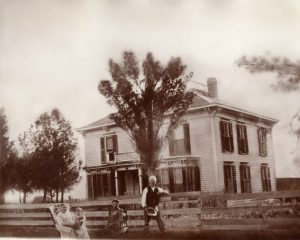
William J., his parents, and his growing family moved to a house southwest of Hiattville. By the time his second daughter (my grandmother) was born in June, William J. had basically stopped writing in his journals. How he split his time is unknown. However, it is known that he continued to do both farming and carpentry. In 1896, he took on a new role when he was elected Justice of the Peace for Walnut Township. He was re-elected in 1898.
In the early 1900s, something happened that caused the family to give up this farm. They lived briefly at a location nearby before returning to the property north of Hiattville where they had lived in their early days in Kansas.
Adding Another Kitchen
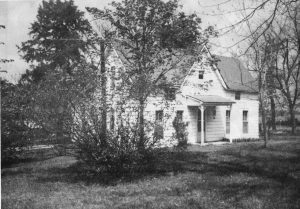
In February 1906, William J., Matilda, and his parents bought what is known as the Home Place, the home where Dad and his siblings grew up. William J. put his carpentry skills to work and built a large kitchen on the back of the house. Since the kitchen was also used for bathing, he slanted the floors so that water would run to the northwest corner of the room. He also intentionally slanted the ceiling . I don’t know the reason why, but perhaps the roof line and the ceiling were initially the same. None of the slanting caused too much trouble until Dad began building cabinets for the kitchen. With the floor and ceiling angled and a long window that wasn’t quite perfect, nothing was straight and it complicated things a bit.
His Last Load
In September 1911, he was again hauling lumber. This time for a barn at the Home Place. He never made it home with the lumber as he had a stroke on the way home from Hiattville. He was only 55.


 Learning, Growing, & Sharing