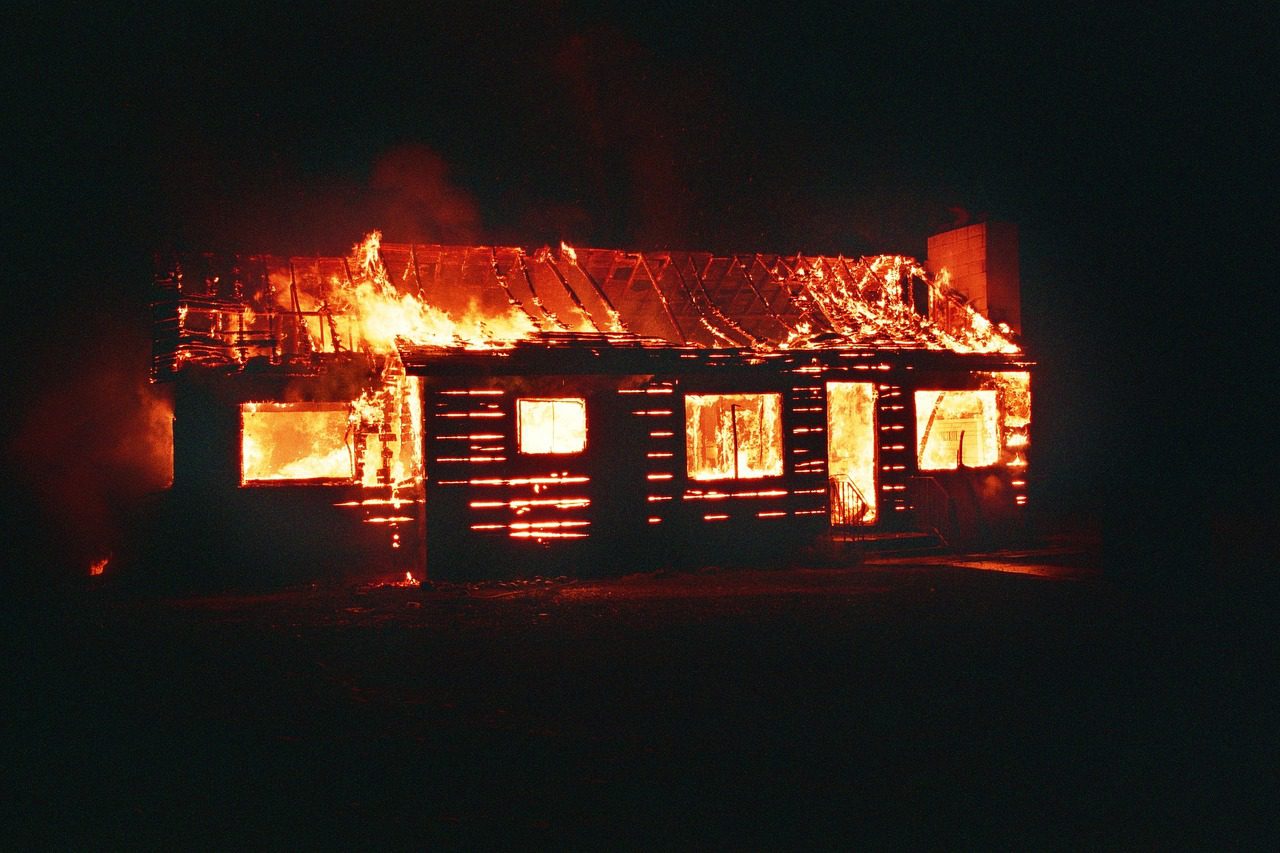
pixabay free to use image no attribution required

I never knew how close I came to not existing until I heard the family story of  Archibald Crawford Jr., who nearly died at the hands of the British when he was just a young boy. 


Support For the Revolution


Young Archibald’s father Archibald Sr., who had been born on a ship while his parents crossed the Atlantic, was a strong supporter of the American Revolution.  However, he was unable to join the men fighting for independence due to a deformity of his hand.   Yet, his support for America did not go unnoticed by the British Army.


The Fire


In  the fall of 1779 the war was being fought near Archibald Sr.’s property in Pound Ridge, New York. It was then that the British soldiers brought the war to Archibald’s home. Early one morning, they came and lit his home on fire as a penalty for his support for America.  The story as passed down through the family is that they spread fire throughout the house even putting burning sticks in amongst the families’ clothes.


The event happened quickly and the family fled the house.  In the confusion, his young son Archibald was accidentally left inside. Fortunately, a British soldier saw the young boy through a window  in the upper level and exclaimed, “For God’s sake, don’t burn the man’s children.”


Archibald Sr. rushed into the house going  through smoke and flames to reach his young son.  Wrapping Archibald Jr. in a quilt, he ran back outside, saving his son.. The family lost nearly all their belonging, but they all survived the attack.


After The Fire


The family moved into their barn to live through the cold winter.  Archibald Sr.’s wife was pregnant during this time and life must have been very challenging.  When it was time for the baby to come, she went to the nearby home of John Wood to have the baby.   It is said the John joked that the baby boy (Robert) was his son.  That later became true as Robert, along with Archibald Jr., would later marry daughters of John Wood. 


Archibald  Jr. and his wife Mary are my 4th great grandparents in my Pellett line as their granddaughter Aseneth  Crawford married Seth Pellett.  Had he not been noticed and the soldier not cared enough to call out, many lives would have been erased.  His survival is just one reason his many descendants should feel lucky!


Most things that I encounter in genealogy require some level of translation or interpretation.  The obvious is when a record is in German or French.  However, there are other things in genealogy research that require translating and interpreting. One of the most challenging is translating “old speak” into something understandable by  the general public today.


Old Speak?


What do I mean by “old speak?”  This is a term that I use for words and phraseology that are very rarely used today if at all, but which occur in old documents.  Old speak is most likely to become an issue when reading old free form documents, such as wills and church records.  Newspapers also may contain words or phrases unfamiliar to most people today. On the other hand, census records and other things that are standardized at the state or federal level are less likely to contain unfamiliar language, but are not immune to such language.


General Terms


One will that caught my attention was that of Christian Stetler Sr. (Klinefelter line).  In his will, he indicated what was to happen to his plantation.  This raised questions to me because he lived in Montgomery County Pennsylvania only a short distance from Philadelphia.  Not only did I not associate plantations with Pennsylvania, I hadn’t found him to be overly wealthy.  One record indicated that he had 125 acres, but many men in the area owned more land.  With research, I found that at that time  (early 1800s), a plantation was simply another name for farm.  It did not necessarily imply wealth, or acreage.


Another word that shows up a lot in old records is “instant.”  It basically means “next” except that it comes after the word it modifies in sentences.  For example, “Thursday instant” means “next Thursday.”  Similarly, instead of saying, “last August,” back in the day they would have used “August last.”


Now, this one may make you scratch your head. 4-great grandfather William Bassett’s records of  his service were lost (that is a whole other story) and he had to provide an account of his service along with other evidence to receive a pension. In those records, he refers to the term “skiner” This term referred to the British using the end of their bayonets to injure the people fighting for America’s independence.


Medical Terms


The first words that come to mind as old speak are medical terms.  Many old death records that included a cause of death use terms that are unfamiliar to most people.  For example, Joseph P. Ellis, son of Joseph Andrew Ellis (great-grandma Rosa’s brother) died of consumption.  Today, we would say that he died of Tuberculosis.  In this case, the information appeared in a newspaper article and said enough that without a medical dictionary or the internet, it wouldn’t be too hard to figure out that it was at a minimum a chronic disease that would have resulted in someone moving in hopes of improved health.


Another example that can’t be as easily determined as to the exact cause of death is the case of great-great-great Grandmother Sally (Cox) Peelle.  She died at age 56 of bilious fever, which is a term no longer used by medical professionals.  Research shows that this was often associated with what we would consider Malaria, but some cases may have been from a form of hepatitis or from sepsis. 


Interesting Meanings


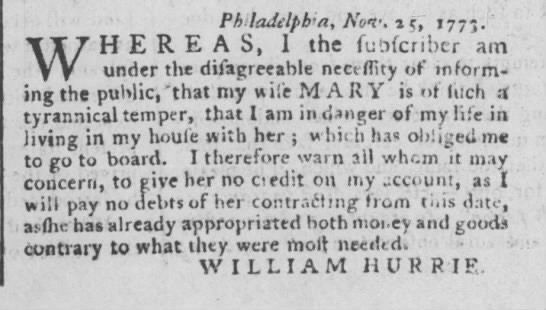
A newspaper from the 1700’s mentions that William Hurrie would not be responsible for the debts of his wife.  At first I did not realize the social and legal consequences of such a statement.  It didn’t simply mean that he thought she was spending irresponsibly or that she had separate finances.  Stating publicly that he would not be financially responsible constituted what is called self-divorce.  He was basically stating that their marriage was over.  No paper work needed to be filed as it had been openly stated.


Of course, before you can even interpret the old words, you have to be able to read the handwriting and get passed the nuances of handwriting at various times.


Image Source: Newspapers.com


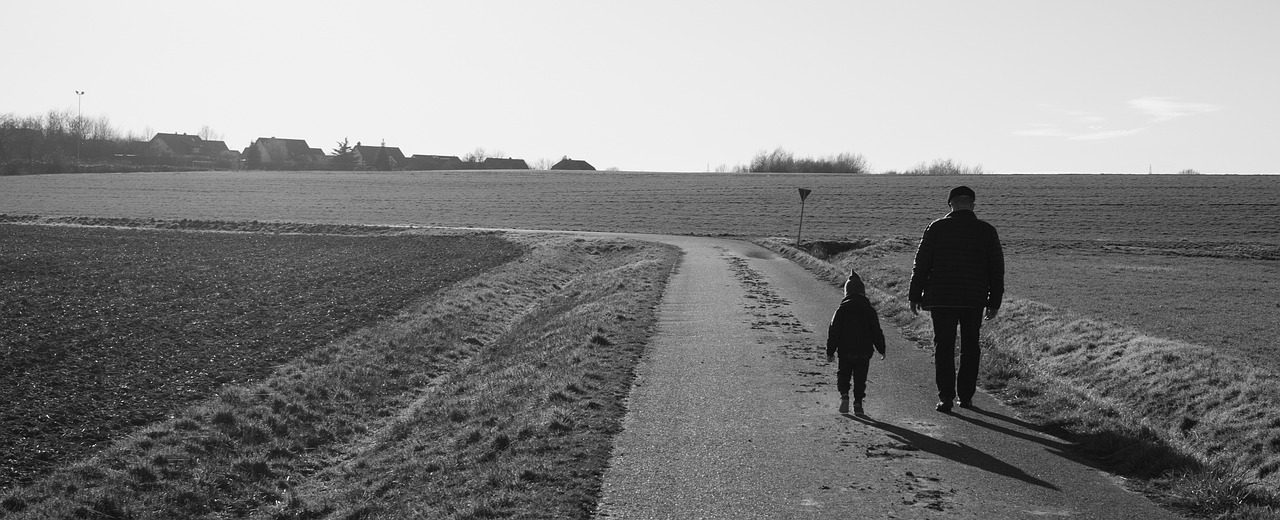
Grandpa Together-we-are-strong pixabay.com

I never knew either of my grandfathers.  Similarly, my dad didn’t know his grandfathers and my mom didn’t know her grandmothers.  It is like a piece of your life is missing when you don’t have the opportunity to know a parent or a grandparent.  All I know is what I learned from family, primarily from my parents, about them.


Grandpa McCracken


Grandpa McCracken died when I was about a month old. From things I have heard about him, I know he  was very intelligent, had high expectations for his children,  did not put up with anyone saying “can’t,” and was loved by his kids and grandkids. 

A few quick stories . . .

  • Joe McCracken
  • Grandpa Joe didn’t think his kids needed to do homework.  He thought school work was very important, but he believed school was for school work and homework was things like feeding chickens, doing dishes, etc.
  • He didn’t think people needed a lot of paper as he could “figure” things in his head.  One night he sat down and was quiet.  After some time, he had Dad get a paper and pencil.  He proceeded to give him a list of lumber to buy along with how much it would cost.  He had designed the building in his head.  Determined how much of each type of board was needed. And, then calculated the cost without writing down anything.
  • He  gave orders to each of his sets of boys by telling the oldest one of the set and then expecting the younger one to do what the older one told them to do.
  • He was semi-ambidextrous.  He did somethings right-handed and some things left-handed.  Therefore, he had some right-handed tools and some left-handed tools.  But, he couldn’t just switch back and forth doing the same task.  And, he didn’t understand why other people couldn’t use both their hands like he could.  He was proud of Ruby for being left-handed.
  • He once shot a rat that was outside the house from inside right through the screen door.
  • Grandpa liked his coffee very, very strong.  His daughters teased him about it and even got a spoon that melted in hot liquid as a joke.
  • Although Grandpa trained to do mechanical work, he didn’t have the patience to do it.
  • Dad always said that Dewey was like Grandpa and Dewey always said that Dad was like Grandpa.


I have been told at times that I am like Grandpa, but that is only when I was doing something that likely annoyed my dad (e.g. I wasn’t being patient). 

Grandpa Pellett


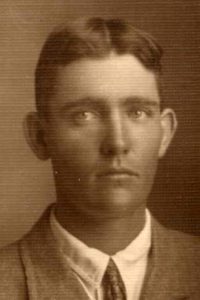
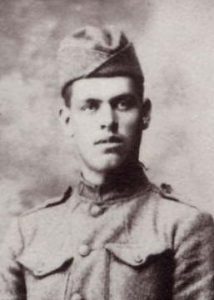
I was six when Grandpa Pellett passed away.  However, he had been in a VA hospital in Iowa for a very long time.  Thus, I had never met him.  He is more of a mystery to me than Grandpa McCracken as Mom didn’t spend very many years with him herself and Grandma never told me about him either.  The little I know about him is as follows . . .

  • Grandpa Pellett served in the Kansas 353rd Infantry Regiment  in WWI in France.  Seventy-five people welcomed him home.
  • He had perfect attendance multiple times when in grammar school.
  • When he was a teenager, he was seriously injured when kicked by a mule.
  • He was baptized in Buck Run Creek in 1916 (he would have been about 21).
  • When picking pecans, he fell and was injured.  His injury combined with what was likely PTSD  landed him in the VA hospital starting in the early 1940s through the rest of his life.


Writing this makes me realize just how little I know about Grandpa Pellett. It really makes me wonder how my life would have been different if my grandpas would have been a part of it.


Identifying a person’s ancestors isn’t always easy even with records and DNA.  I have worked a quite a few confusing lines in my own families and other people’s families where family information, records, and DNA didn’t all align.  And, in some cases, almost no information seemed to exist.


Louisiana


One of those cases was my great-great grandmother Louisiana Matteer.  My part of the family always believed that her name was Louisiana Johnson and I spent many years researching that name without success.  One day I came in contact with a researcher that said that another researcher that he had a lot of confidence in had found that her name was Louisiana Mattser.  Well, there was no one with that last name in any record in the area where she lived leading up to the time she married.  However, it got me looking at records differently. 


With some digging I found the record that the person read as Mattser.  Based on the handwriting, that appeared to be the name.  Yet, Mattser did not match anyone.  Eventually,  I found more records and determined that her name was really Louisiana (or Louisanna) Matteer.  Once I searched with this name, I was able to piece together more of her story and find DNA matches to people in that family line.


Adoptions & More


Despite the research on Louisiana taking several years, it isn’t the most complex cases of identity that I have worked.  Helping people who have been adopted or do not know an ancestor for some reason has presented me with far more challenging circumstances to research.  Imagine people that don’t know who their parents are and no paperwork was ever filed on their under the table adoption.  Imagine cases that take you coast to coast and even to multiple continents.  And, others are at a known locale, but there is lots of intermarrying in the area and separating family lines becomes difficult.


The Extreme


I am still working on an extremely difficult case.  In this case, not only is the person adopted, but so is the father.  Add to that at least two other  close ancestors whose birth was the result of an affair.  The case Includes multiple countries, multiple languages, and many of the families intermarried over and over.  Now, that makes identifying ancestors a challenge!


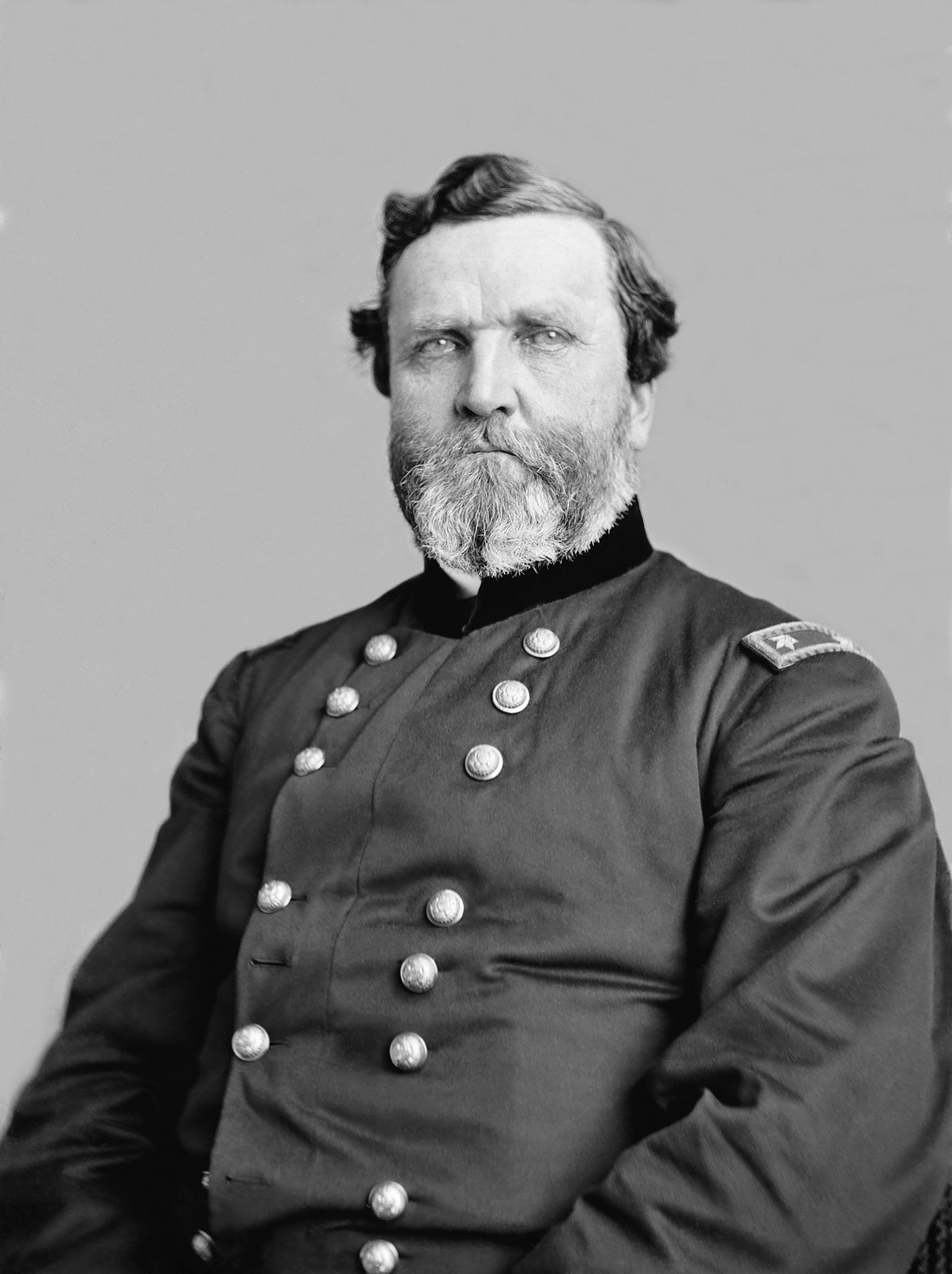
Some year ago, my uncle sent my family an article about General George Henry Thomas.  He was a well known and well respected general for the North in the Civil War.  Thus, my uncle really wanted him to be a member of our family.  After all, the names George and Henry both show up in our ancestry.


North Or South


George was from Virginia.  He had trained at West Point and  was against slavery.  When the Civil War was imminent, he decided that he would fight for the North.  His family back in Virginia was very upset by this decision as they felt he was turning his back on his home state.  Therefore, the article claimed that his family turned his photo to the wall.  They continued to be upset with him after the war.  When he died, it was said that a member of his family stated that he had died when he decided to fight for the North!


Relation or Not?


Although he was born only a few miles from the Virginia-North Carolina border, no evidence has been found tying the general to our Thomas family in North Carolina, .  However, when we heard the story, we thought it was definitely possible that his family was related to us as our Thomas family was  strong in their beliefs and they stuck  together. We could  see the Thomas family turning their back on someone that they thought had turned their back on them.