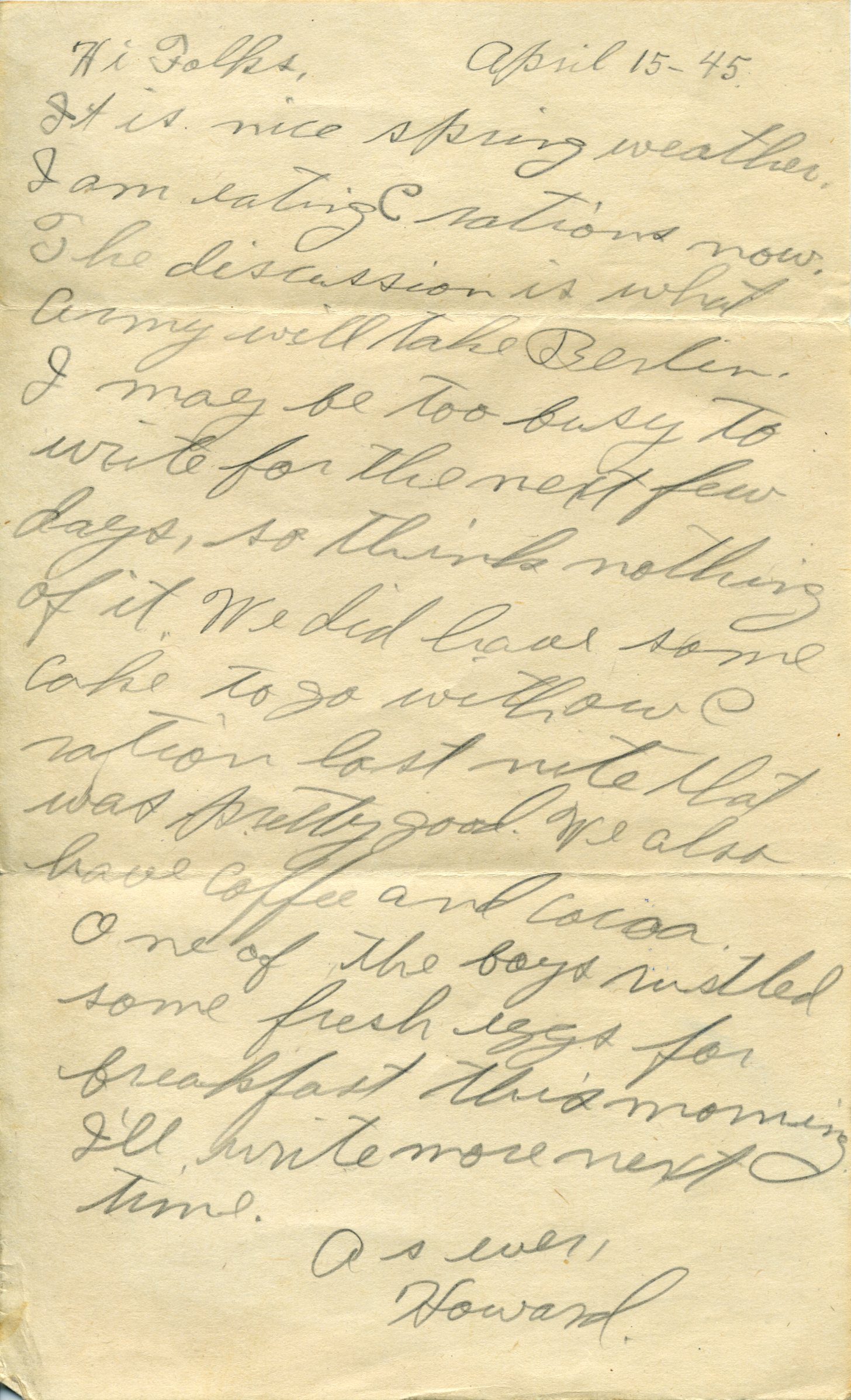
My Uncle Howard, who was serving in Italy during WWII, wrote a letter home on April 15, 1945. The family would never hear from him again.
The Letter
Howard’s letter of April 15, 1945 was written on stationary, which was something that wasn’t always available to soldiers in Italy during World War II.
The letter was short as was typical. Howard couldn’t say where he was, where he had been, or anything that was happening. That limited the conversation a great deal. Generally, his letters were about the weather, food, farming, or what was happening back home.
Unlike most letters, this letter seemed to hint that he was going to be in a battle. The mention of “C” rations was one hint. When the men were eating rations instead of meals, it usually meant that they were close to the fighting.
Even more ominous was a short statement nestled in the middle of the letter, which stated, “I may be too busy to write for the next few days so think nothing of it.”
He ends with “I’ll write more next time.” Next time never came.
A Brief Back Story
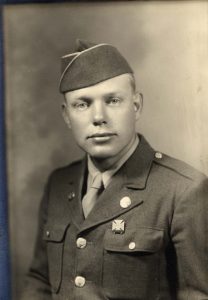
William (Howard) McCracken was the second oldest son and fourth oldest child of Joseph Andrew “Joe” and Nellie (Peelle) McCracken. He was born February 19, 1919. So, when the United States became involved in World War II, he was of the perfect demographic to serve – a young, unmarried, male.
Howard had, however, initially gotten a deferral because he was working at Solar Aircraft in San Diego. Airplane manufacturing was considered a high priority for the war effort. Thus, they had allowed him to remain at his job. By the time the deferral expired, however, things had changed. He knew that this time he would be required to serve.
Howard was inducted into the Army on October 16, 1943. He did his basic training at Camp Wolters near Ft. Worth, Texas. After basic training, he was given a short leave to go home and visit family. Soon he was on a train headed for the east coast. It was his first stop on his journey overseas. The Army initially sent Howard to North Africa. Shortly after the Allies freed Rome, Howard joined Company “C” of the 350th regiment of the 88th Division (the Blue Devils) as a replacement.
After joining the unit, Howard had endured battles, terrible weather, and sores on his feet. He had also had times of rest and had gotten to enjoy some of the sights Italy had to offer. Now, it appeared that he was preparing for another battle.
April 15, 1945
“The night . . . was partly cloudy and dull, a mist of smoke and dust hung low over the enemy positions, lending a fearful atmosphere for the men quietly awaiting the attack.”[[Danley]
Throughout the day, planes buzzed overhead. Bombs from nearly 1,000 airplanes were dropped on key targets behind enemy lines. Then, “at 2200 hours . . . the front erupted with a flaming roar. Artillery, tanks, tank destroyers and all available weapons poured thousands upon thousands of shells into enemy positions.” Even the kitchen staff manned weapons during the assault. It was one of the most powerful bursts of gunfire that the Germans had ever faced.
Quest for Monterumici Hill

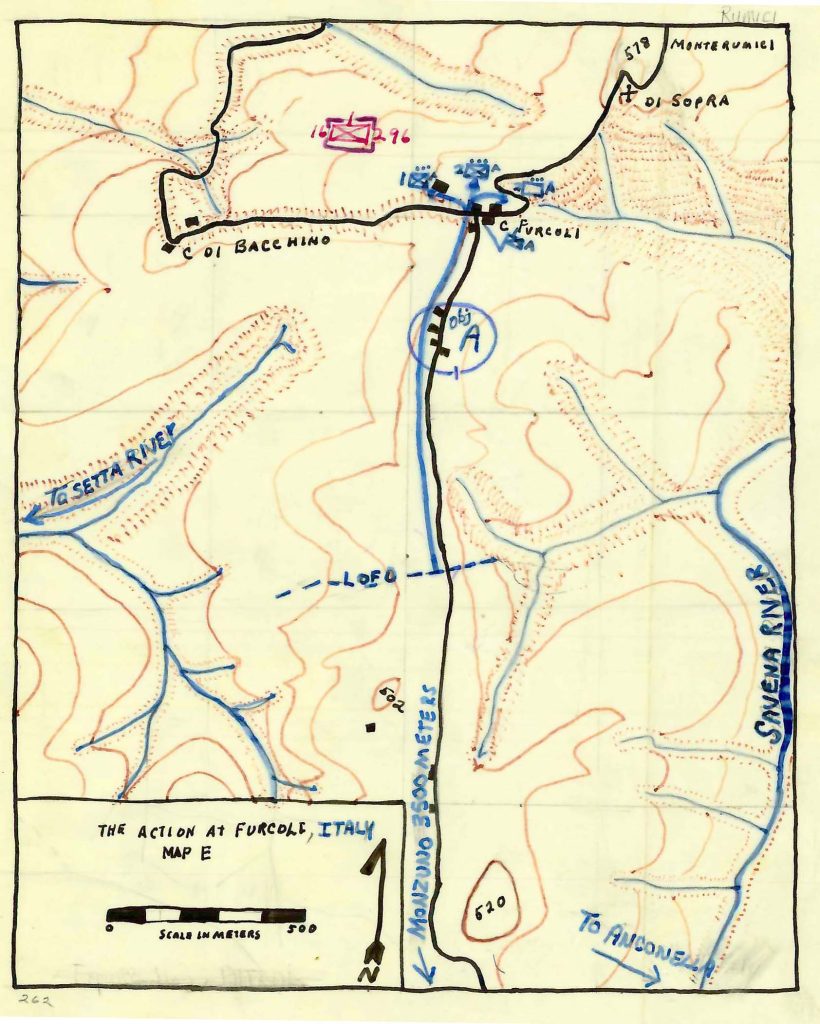
Howard’s company received orders to hold their position near La Valle. Meanwhile, under the cover of darkness, the men of the 350th began their quest of Monterumici Hill, a steep “hill” squeezed between Mt. Adone to the east and Mt. Sole to the west. It was their first major objective of Operation Craftsman, which was intended to break through the mountains north of Florence.
The regiment was supported by an artillery battalion, most of one company of a tank battalion, a platoon of a tank destroyer battalion, and one platoon of a chemical battalion. Immediately to the 350th’s right was the 91st Division, who were assigned to take Mt. Adone and the town of Pianoro. To the regiment’s left was the 349th regiment of the 88th Division. That regiment was to approach Furcoli Ridge.
Four divisions, including some of Germany’s best units in Italy, were in position to fight the 88th with the 350th directly facing the 296th and 297th regiments of the German 15th Mountain Division. Howard’s battalion advanced along a trail to La Tombe to create a diversion while the third battalion, followed by the second battalion, came from behind and attacked.
Landmines
No matter what direction they turned, the soldiers approaching Monterumici, Mt. Adone and Furcoli Ridge encountered landmines. Tanks exploded on roads that the engineers thought were clear of mines. So many mines were exploding, that the engineers switched from using mine detectors, which had limited effectiveness, to probing the ground for landmines. They worked ever so slowly across the landscape.
Just when the Americans thought they had figured out a way to find the German mines, they encountered a new German trick. The Germans had placed a group of four to six tellermines 4 to 6 feet underground and had used a long piece of wood to transfer the weight of vehicles to the mines. By clustering the mines deep in the ground, the Germans had hidden the mines from typical detection methods and were able to create a large explosion.
The soldiers came up with a new probing method and again started covering the land inch by inch. Within a few hours, 71 clusters of tellermines were found and one by one the mines were cleared.
Strong Resistance
After crossing the Savena River, the attacking units began to move up the slopes of Monterumici, which was pocked with natural caves and the scars of previous battles. The rough terrain on Monterumici necessitated that the combat teams climb narrow, twisting trails and cross narrow ridges to advance on the enemy.
Before reaching their first objective, the 350th met strong resistance, including mortar and machine gun fire. This caught them a bit off-guard as the Allies had believed the shelling of enemy positions would weaken the enemy at least initially. However, many of the German units had escaped the initial strike essentially unscathed.
The continual bombing missions during the day had alerted the Germans that an attack was likely. Additionally, the Germans observed some of the Allied soldiers moving to new positions, which they believed indicated that an attack was imminent. In anticipation of the barrage, the enemy had scrambled to take cover.
Determined to hold this strategic location, the Germans fought intensely. Casualties ensued. One company was forced into a minefield to escape direct fire and others were forced to take up defensive positions.
Dawn
Not-Fooled
As the day dawned and the sun illuminated the mountain peaks, Monterumici, Monte Adone, and Furcoli Ridge remained in the hands of the German army. The diversionary tactics the 88th had employed over the past few weeks had not fooled the Germans into concentrating their military strength in other sectors. Although individual German soldiers indicated that until the offensive began they had been completely baffled regarding the location of the Blue Devils, German leaders near Furcoli had guessed correctly that the 88th Division was assigned to the area after finding a helmet from the division.
Enemy intelligence had deduced based on the helmet that the main effort of the 5th Army would come in the Monterumici area since they expected the Blue Devils to lead the Fifth Army’s offensive. Therefore, the Kraut commanders had prepared to take a stand against the Blue Devils. Ironically, the helmet had been lost when the 88th had previously moved through the area – long before the offensive was planned.
Bomb And Go Again
With a heavy concentration of German troops in locations that made it very difficult for the American troops to gain ground, the Fifth Army called in bombers to attack Mt. Adone. The attack resumed. This time the 350th met less resistance from the Germans and was able to take control of the villages of Di Sotto and La Torre with ease.
Although all of the units met heavy resistance, one of the companies made a serious mistake. They did not do a thorough check of Di Sotto before continuing the advance. After moving forward, the Germans, who had been hiding in cellars, tunnels connecting the villages, and among the rubble of the bombed out village, attacked.
Now, the company was trapped with fire coming from three directions. The company found little cover in the area except booby-trapped foxholes and no escape routes aside from mine fields. Twenty men were killed, forty wounded, and nine had an unknown fate. They weren’t the only unit to be ambushed. Company “A” fell into a similar trap.
With casualties mounting and fears the offensive was bogging down, the Blue Devils modified their plan of attack to address their fierce resistance. The new battle plan called for Howard’s battalion to join with another battalion to take Monterumici. Replacements also arrived to replenish the companies battered by the fighting of the past twenty-four hours.
Howard’s Unit Moves Out
At 2200 hours on April 16, Howard’s unit moved out. Howard’s company (“C”), faced machine gun and other fire as they advanced toward Di Sopra, a tiny village on the high ground that was more rubble than village. The darkness allowed Company “C” to scale the bluffs of Monterumici to secured the village of Di Sopra and the nearby high ground.
Meanwhile, other companies used the cover of darkness to move into position. Company “A” edged their way along a narrow cliff toward Di Sotto. One of the companies of the 349th regiment had to move through a minefield, which forced them to probe for mines and they inched their way across. With dawn upon them, they gave up the effort and retraced their steps out of the minefield, but not without casualties.
Other units made slow or no progress overnight. One battalion pulled back as they didn’t want to be without cover when the sun rose. Likewise, Company “A” had a change in plans when officers determined that a direct attack would require the unit to attack up a 30-degree slope while moving through an exposed vineyard.
The Injury
At the crack of dawn, the men in Howard’s company moved out from their position near the area referred to as Di Sopra to assault the cemetery north of the village. As the men moved forward, the stubborn Germans showed no indication of weakening. Shielded by gravestones and utilizing automatic weapons, the enemy soldiers continually sprayed bullets across the approaches to the cemetery. As the company crossed a narrow ridge, the men were caught in the crossfire with shots coming from the Di Sotto area and the cemetery.
Still under fire, Company “C” cautiously crept toward the cemetery moving slowly through an area laced with anti-personnel mines. Without warning, the charge of a landmine detonated sending a wave of energy upward through the ground and into Howard’s foot.
The Foxhole
Some of the men in Howard’s company helped him to a foxhole near the road to await medics. There they believed he would be less noticeable to the watchful eye of the Germans.
Howard, along with a deluge of other soldiers, were headed to Army hospitals. His likely destination was the 8th Evacuation Hospital which had been located near Pietremala since the previous winter. The hospital was only a few miles behind the lines and was directly south of Monterumici Hill on Highway 65.
While Howard awaited assistance for his severely injured foot, the other men continued the battle. By mid-morning Monterumici was in the hands of the Allies. However, the day was costly for Company “C” with ten men killed, including their captain, and thirty-one wounded.
The combination of The Blue Devils’ determination and the German’s desperation had made April 17 the day of the most intense fighting of the Spring Campaign.
The Telegram
On Sunday, May 6, 1945, shortly after 10 a.m., the Hiattville postmaster hand-delivered a telegram to the McCracken home. A telegram – hand delivered – on a Sunday morning could not be good news.
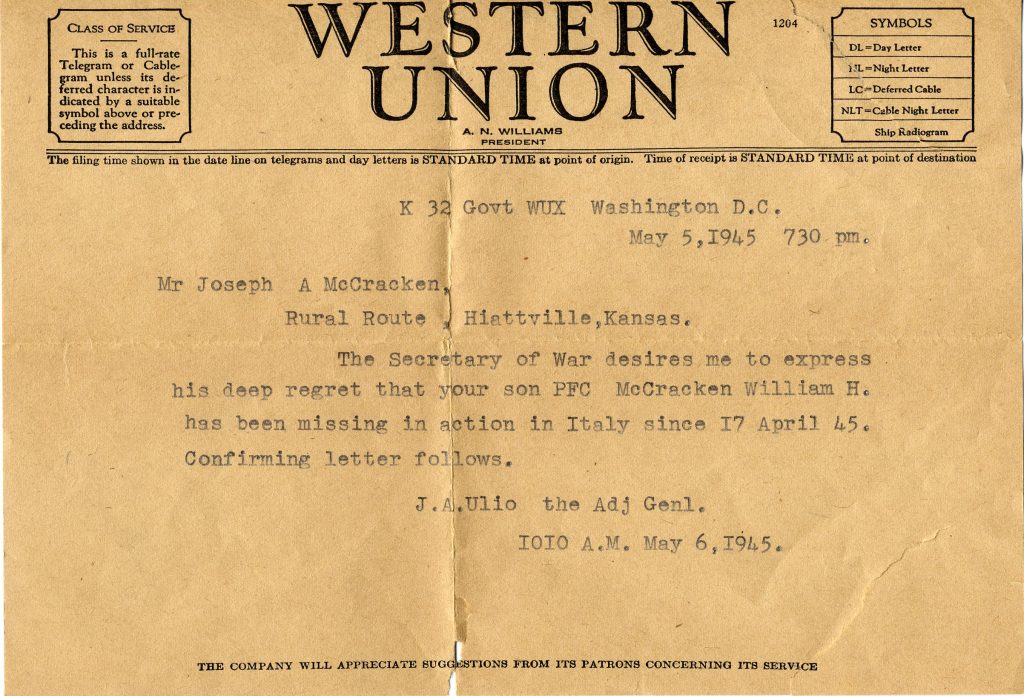
Hearts stopped. Each member of the family had their own reaction – sadness, disbelief, and questioning. More than anything the family wanted to know what had happened. Since it didn’t say he was killed, their was hope, but also intense worry.
The Search for Howard
A Hint
The first hint of what happened to Howard came eight days after the telegram arrived. Howard’s sister Ruthe received a letter from Richard Fields, one of Howard’s friends from his outfit. Richard asked Ruthe for Howard’s address so that he could write to Howard while Howard was hospitalized. Hospitalized?
The family only knew what was in the telegram, which said nothing about Howard being injured or hospitalized. It raised the question, “Was Howard injured or missing?”
Ruthe learned that Richard and Howard had both been injured the same day. Richard explained that although his wound had sent him to the hospital for treatment, it hadn’t been serious. He was doing well and would be returning to his unit in a few days. He went on to say that the day after he was injured, he had searched bed by bed through the hospital for Howard. However, he had been unable to locate him. He assumed that Howard had been transferred to another hospital for treatment. He believed Howard’s injury to his foot – Another new piece of information – would require significant time to heal.
 Sharing Information
 Sharing Information
After the family let Richard know that Howard had been identified as Missing In Action (MIA), Richard went to officers in his unit with the information he knew about Howard’s location. A regiment that was not far from Howard’s last known location went looking for any sign of Howard. None was found.
Grandma and Grandpa wrote letters and tried to learn something of Howard’s situation. No one knew anything more. Additionally, none of his personal affects were found. This went on until all avenues were exhausted.
My Research
I researched Howard’s unit’s movements, a small portion which are included herein. Then I had my dad send in a request for Howard’s military records as he was considered a “close relative.” We received a response, but it contained very little information.
I also attended a briefing with Defense POW/MIA Accounting Agency, which is a government organization that looks for missing service members. They provided me with a file of all the information that they had on Howard directly. Many of the records on soldiers in this era were lost in the fire at the records center in St. Louis in 1973. No significant new information came to light.
The organization requested that one or more of Howard’s siblings do DNA tests in the hopes that they could match their DNA to existing remains or any new remains that were found. Thus, my dad and his brother Don (Kenneth Donald McCracken) did DNA tests for the organization. They later asked me if we had any of Howard’s DNA as an exact match would be even faster and easier to process. Thus, I sent them two envelops that Howard sent home and which were still sealed. Thus, if he licked the seal, his DNA was preserved. No match has been found.
I also gave information on his disappearance to an independent group that looks for missing soldiers. In addition, I shared information on his location with a professor in Bologna who indicated a special interest in WWII. He was going to be searching in that area for artifacts.
Despite these efforts spanning eighty years, not a trace of what happened to Howard has been found!
Howard’s Military Honor Wall Page
Adapted from a draft of my book regarding the McCracken family during WWII.
Prompt: Missing
#52ancestors52weeks