
My family name with the longest lineage in America is the Peelle/Peele/Peel family. There are still people with the last name that descended from Lawrence Peele, who immigrated from England. However, In my family line the Peele name ended with my grandmother’s generation. Her and her siblings were the 10th generation of people with the name Peelle that had walked on this continent.
 Generation 1
 Generation 1
Lawrence born in England around the turn of the 17th century. He immigrated to America in 1621, sailing on the Margaret & John. Thus, he was a very early English settler in Virginia.
Life in those early years were tough and many of the settlers died. Lawrence was young and apparently healthy enough to survive the many challenges of living in untamed territory.
In 1624, Lawrence (spelled Larence Peale in London Company Records) remained unmarried. Another man, who was a few years his senior and who had recently arrived, was staying with him in Elizabeth Cittie, Virginia Colony. The household inventory included four barrels of corn, two bushels of peas, 300 fish, 1 house, 2 arms, 6 pounds of powder and 6 pounds of lead.
Lawrence established his household on the western Branch of the Elizabeth River in Elizabeth Cittiee County. At some point, he married and had at least one son, who he named Robert.
Lawrence survived times of sickness, famine, and attacks by Native Americans. It is believed he lived until at least 1664.
Read more about Lawrence Peele as an early colonist.
Generation 2
Robert Peelle is believed to be the son of Lawrence and to have been born by around 1635 in Elizabeth Cittie County, Virginia. Proof that his father was Lawrence is a bit circumstantial, which is not surprising given the early date. Lawrence was the only Peelle in the immediate vicinity with only one other Peale being recorded in Virginia by that date. One researcher claimed Robert immigrated, but no evidence supports that claim. In addition, he purchased land from Richard Jones that adjoined Captain Tucker’s land. This is significant as both are documented as being in Elizabeth Cittiie in 1622 when the population was very small and Lawrence had testified on Captain Tucker’s behalf in a trial in 1625. Thus, it is believed that Robert is Lawrence’s son.
In 1656, Robert purchased property on the Western Branch of the Elizabeth River from Richard Jones. He was likely married by this time or married shortly after. Robert had to be at least 21 years of age at the time because that was the legal age to purchase land. His payment for the land would be considered quite unusual today, as he paid for it with tobacco. He was to make payments of varying amounts over several years until he had paid 8000 pounds/units.
In 1663, Robert was granted 350 acres of land in Carolina Territory. This was “payment” for paying for passage of seven people to come to the colonies. However, he did not keep this property. Instead, he sold it to Dr. Thomas Rolfe, son of John Rolfe and Pacahontas.
He also sold his land on the Elizabeth River and moved to Nansemond County, Virginia. He settled on 100 acres on Mill Run, which was part of Bennett’s Creek. He later purchased additional land.
Robert was the Justice of the Peace in Nansemond County, Virginia. Some of his land was adjacent to Governor Bennett’s land. He was listed in the governor’s will as the governor’s overseer.
When George Fox brought the Quaker beliefs to Virginia, Robert joined with the Society of Friends, along with his son Robert. Robert witnessed several weddings of the Belson family members. Robert’s wife’s name is unknown, but this makes me wonder if they could have been his wife’s relatives. However, he might have just attended to the weddings since he lived nearby and the wife of one of the Belson men was one of the women whose passage to the colonies he had paid.
Generation 3
 Generation 3
Robert Peelle II was born about 1657 in Elizabeth Cittie County, Virginia. In 1678, Robert II married Sarah Jarrett, widow of Thomas Jarrett. After his marriage, he moved to the property his wife had inherited, which was about two miles from his father’s plantation (farm).
This property was near Sleepy Hole on the bank of the Nansemond River. A ferry across the river existed from his property to Coffield Point. It is assumed that he was the operator. The Virginia General Assembly set the price for crossing the river at six pence per person. However, it cost a shilling if the person had a horse.
Robert and Sarah appeared to remain on this property the remainder of their lives. They raised their children on the property and belonged to the Society of Friends (Quakers).
Their known children include William, Robert, Ephrain, and Joseph.
Generation 4
Robert Peelle III was born about 1681 to Robert Peelle II and his wife Sarah. He grew up in a Quaker family, living on his father’s plantation at Sleepy Hole.
Robert married Judith Edwards, about 1708. They raised their family in Nansemond County, Virginia.
Both of them died in 1756 with Robert dying first. Afterward, Judith went to live with her daughter Mary in North Carolina. She died shortly thereafter. Judith left a will. It is likely that Robert also had a will. However, the Nansemond County Courthouse was burnt in the Revolutionary War and the new courthouse burnt during the Civil War. Thus, any will would have been destroyed.
As adults, their children spread out in to several counties in North Carolina. Their children included: Robert, Edmund, Sarah, Joseph, John, Joshua, James, Josiah, Elizabeth, John Jellary, and Mary.
Generation 5
Robert Peelle IV was born in1709 in Nansemond County, Virginia. In 1709, he married Elizabeth Edgerton. They were the parents to Robert, Passco, Elizabeth, Mary, and Sarah.
In 1741, Robert and Elizabeth moved to Northampton County, North Carolina where Robert purchased 500 acres of land for 40 pounds of Virginia currency. There he was one of three trustees that built the Rich Square Monthly Meeting House where he was an elder. He was also overseer of the Quakers in the county.
After Elizabeth died in 1749, Robert married Charity Dickinson in Perquimans County, North Carolina. They were the parents of David, Judith, Jeremiah, Anna, Charity, Abagail “Abba,” Betsy, Rachel and Celia.
Robert, as a Quaker, could not fight in the Revolutionary War as the Society of Friends were pacifists. They weren’t really suppose to support the war in any way. However, Robert gave financial support to the Revolution. I am guessing he was able to do so because of his high standing within the local Quakers.
PATRIOT: Robert is registered as a patriot by the Sons of the American Revolution, and the Daughters of the American Revolution for his financial support of the war.
Robert died in 1782 at his home, which was about three miles from the Rich Square Meeting House. At that time, he was a slave owner. However, he stated in his will that all of those enslaved to him were all to “have their freedom if ever the Laws of the Land should [?] of their having that privilege.”
Note:Robert IV was the last Robert in my family line. However, he was definitely not the last Robert Peelle/Peele/Peel.
Generation 6
Passco “Isaac” Peelle
Passco Peelle, son of Robert IV and Elizabeth (Edgerton) Peelle, was born in 1733 in Virginia (Some claim North Carolina. However, his family did not move to North Carolina until 1741.) The reason the name Isaac is mentioned is that his father’s early will lists him as Isaac. It was changed to Passco in a later versions of the will. Some people took this to mean that his name was Isaac and that he preferred Passco for some reason and that people knew him by that name. Thus, the name was changed. Personally, I believe the original writing of the will was simply in error.
He was born into the Quaker faith with his birth being recorded by the Rich Square Monthly Meeting.
On Dec 18, 1759, Passco signed a petition, along with other citizens of Northampton County, North Carolina, requesting the formation of Hertford County. Then in 1779, he signed the petition to form Wayne County, North Carolina.
In 1775, Passco married Tabitha Dunigan in Dobbs County, North Carolina. Read about the family lore about Tabitha. Passco and Tabitha’s children included: Sarah, Nancy, Anna, Robert, Huldah, William, Charlotte “Charity”, John, Achsah, and Celia.
Then, in 1782, Passco was granted 640 acres in Dobbs County. He had apparently lived on the land for several years and met the requirements for purchasing the property outright. The cost was 50 shillings per 100 acres. As counties were created and borders changed, Passco’s property was later in Wayne County near the border with Wilson County. A swamp in the area was named after him. The Edward Bass family, the John King family, and the William Newsom family were close neighbors. The description of his property would make your head spin. It was defined by a huckleberry tree, red oak trees, pine trees, and a random stake in the ground.
Passco died in 1807.
Read more about Passco Peelle.
Judith Peelle
 Judith Peelle
Judith Peelle was born in 1754 in Wayne County, North Carolina.
Judith is also an ancestor in the same generation as Passco. She is his half-sister as she is the daughter of Robert IV and Charity Dickinson. One of her descendants married one of Passco’s descendants.
In this family line, the Peelle name ends with Judith as she married Josiah Cox in 1777 at the Rich Square Monthly Meeting. Therefore, her children all have the surname Cox.
Generation 7
William Peelle was born January 30, 1786 in North Carolina.
William married Sarah “Sally” Cox in 1808 in North Carolina. Sally was the daughter of Josiah Cox and Judith Peelle. Thus, they were half-first cousins.
Around Christmas 1820, William moved from Wayne County, North Carolina to Wayne County, Indiana. His brother John and sisters Achsah and Anna also moved to Indiana with John being the first to move.
William and Sally’s youngest children are John Cox, William Adams, and Passco Peelle. Since John, the oldest of the three, was born in 1817 and his parents married in 1808, it seems likely that there were older children. The 1830 census seems to support this theory as it lists a male child between 5 and 9 (Passco), two males 10 to 14 (John and William), a male 15 to 19 (Unknown) and a female 10 to 14 (Unknown). This would imply that there were two additional children. Even then it would seem that they might have had additional children who might have already left the household.
Two possible children are Tabitha who was born in 1810 and died in 1825 in Wayne County, Indiana. Another was Robert Peelle who was born in 1814 and died in 1840 in Wayne County, Indiana.
In 1825, William acquired the SE 1/4 of Section 24 Range 014E in township 018n.
For 20 years, William was Justice of the Peace in New Garden Township, Wayne County, Indiana.
Sally died in 1839 or 1840 of bilious fever (possibly something similar to malaria). William died about twenty years later of dropsy (a build up of fluids in the body often from congestive heart failure or kidney disease).
Generation 8
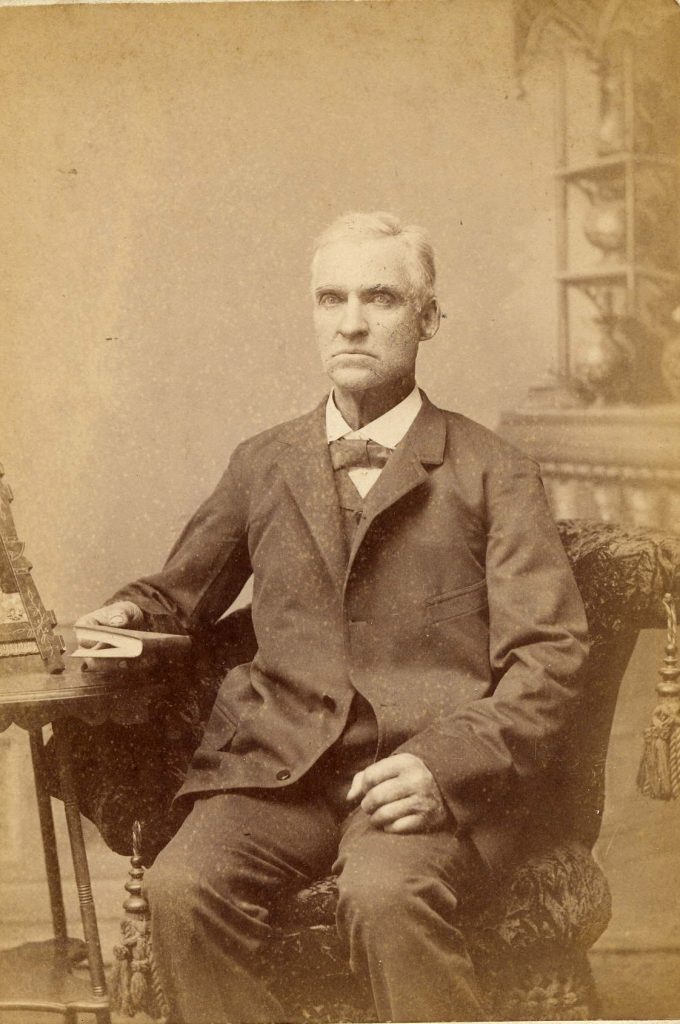
Passco Peelle is the son of William and Sally (Cox) Peelle. He was born September 15, 1822 in Indiana.
On September 4, 1845, Passco married Martha Johnson in Wayne County, Indiana. They became the parents of Rachel, Evaline, Carolina, Elzena “Jennie,” William Johnson, Sarah Ann “Sallie,” Emaline D. “Lillie,” and Mossie Lea.
At some point, the family moved across the county line to Randolph County, Indiana. The family lived near Lynn, Indiana. Passco owned 159.5 acres, as a half-acre of the 160-acre quarter section was used for school grounds
Over the winter of 1878-1879, Passco and Martha, along with their youngest children, made a big move, leaving Indiana for Bourbon County, Kansas. In Kansas, they first lived north of Hiattville near where the Scofield School once stood.
The family later moved to Hiattville. After a few years, they moved west of Hiattville to where Don and Kay Davis later lived. Then, they moved back to their original Kansas home. It is assumed that the person buying it had failed to continue payments. After this they moved to the Fish Farm, which locals today will know as Dewey and Jackie McCracken’s farm. There were a couple of temporary moves in between, but these are the most significant. However, once they were in Kansas, they never lived more than approximately four to five miles from Hiattville.
Passco and Martha both lived to be in their mid-80s, dying in 1908 and 1912, respectively.
Generation 9
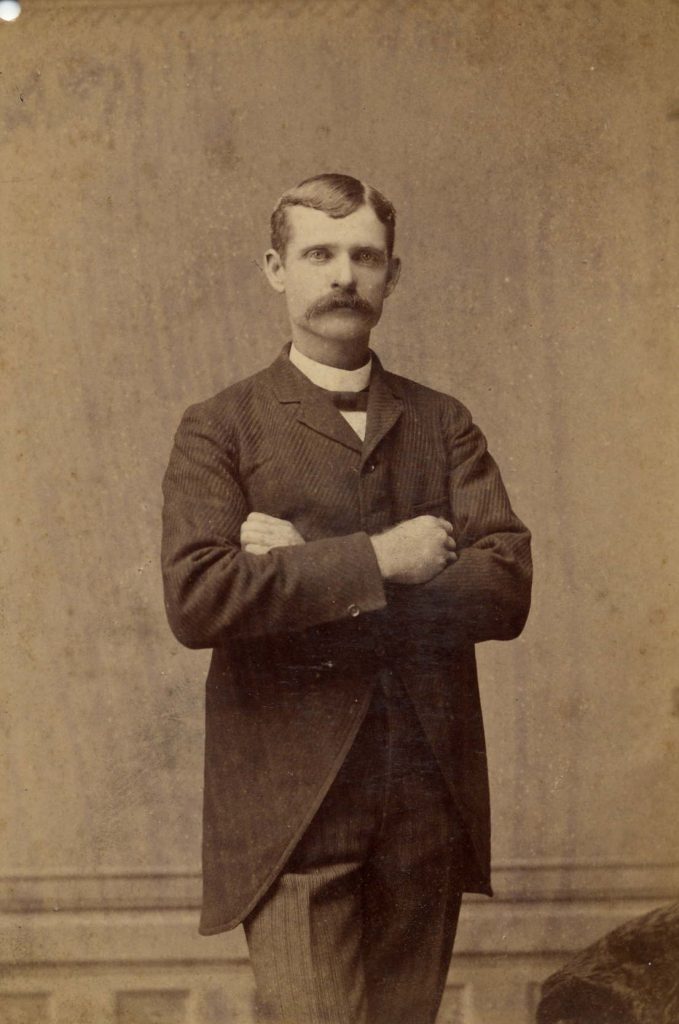
William Johnson Peelle was born January 1, 1856 in Randolph or Wayne County, Indiana to Passco and Martha (Johnson) Peelle. He was their fifth child of eight and their only son.
As a young man, he worked doing farming, carpentry, and any other jobs that family and neighbors needed to have done. However, he also took an interest in local affairs including legal matters.
When the family moved to Kansas, William J. stayed behind in Indiana to close out matters there. He oversaw the family’s goods being placed on the train for the move, sold some remaining items, and even sold his horse.
He made the trip to Kansas via train. Read about the move from Illinois to Kansas.
In Kansas, he worked as a carpenter and a farmer. He lived with his parents (or they lived with him) for the remainder of his life except when newly married and living in Hiattville. It appears at that time that his parents lived adjacent to his home. Thus, they were never far away.
Each of the homes was quite crowded. After he married Matilda Jury in 1892, there were four in the household. Then William J. and Matilda’s children came along – Lydia, Nellie, and Passco “Pat.” I don’t know all of the houses, but I do know the last one that they lived in. It was the same house that my dad grew up in and where his brother Dewey McCracken later lived.
The house had three bedrooms with one of them being quite small. It seems likely that Passco and Martha slept downstairs as they were elderly by the time they moved to that property. William J & Matilda would have gotten one of the upstairs bedrooms and the girls the other. I believe I heard that Pat had to sleep in the loft/hallway upstairs.
William J. was only 55 when he had a stroke and died while on his way home from Hiattville with a load of lumber.
Read more about William J Peelle’s life as a farmer and a carpenter.
Generation 10
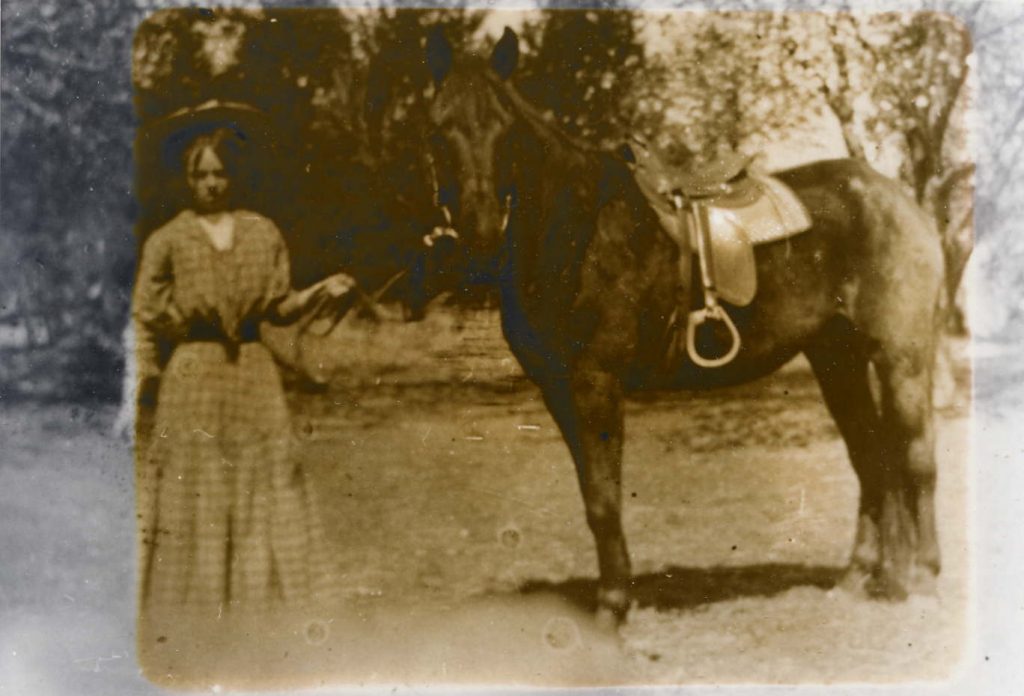
Nellie Peelle, whose name was really Eleanor although her name was never officially recorded as such, was the second child of William J. and Matilda (Jury) Peelle.
She was the end of the line for the Peelle name in my family line, as she married Joseph Andrew McCracken on March 4, 1914. Her name change actually ended the Peelle family name for the descendants of Passco and Martha (Johnson) Peelle’s entire family line as grandma’s father was the only boy in the family and her brother Passco “Pat” Peelle’s only son died as a child.
My Connection
Although the name Peelle/Peele/Peel faded from my family line with my grandmother’s generation, I am the 12th generation of this family in America. Other family lines may not have the same name in my line for so many generations, but in many cases I am many, many generations American. With so many generations in America, I find it difficult to identify as anything other than an American. I recognize my English, Scottish, and other roots (all European), but I am an American through and through.
Quaker images created using Gemini AI
Prompt: Long-lasting
#52ancestors52weeks