Part II: Paisley, Nebraska
The First Arrivals
Captain James H. Blethen brought the ship Jamestown safely to America on March 11, 1850 with members of the Ronald family, Thomas Shaw, and Thomas’ wife Isabella on board. The Ronalds stayed in the east for several months to a year before moving westward. However, Thomas and Isabella stayed on the East Coast and he continued to work in the fabric business for several years.
The Ronalds headed to Poy Sippi, Wisconsin, which opened a post office that same year. What took them to that specific location is unknown. However, it is likely that it was a relatively easy location to reach and land there was cheap while also having a landscape similar to that around their old home.
The following year, Thomas Ronald (the second son Thomas of Thomas Ronald II – yes, really!) died in Wisconsin in a farming accident. Thus, handing the family their first loss in their new land.
More Arrivals
Thomas, Mary, and their children who had not immigrated to the United States in the earlier sailing arrived in New York June 26, 1856.
Onboard the Franklin King as they journeyed to America, Thomas and Mary’s daughter Mary had met and become quite attached to Joe Wallace, a sailor. Since the family was only spending a few days on the coast before joining the rest of the family in Poy Sippi, Wisconsin, a wedding occurred in short-order. However, Mary and Joe’s life together was cut short when Joseph drowned the following year when returning to sail at the Great Lakes.
Around 1858 or 1859, a young Scot, who had been off exploring the prairies of Nebraska, somehow landed in Wisconsin. One thing led to another and on May 9, 1859, Margaret Ronald married Arthur Reid Thomson in Berlin, Wisconsin.
 Nebraska
 Nebraska
After their marriage, they immediately returned to Nebraska City and ran the Western House Hotel and Cafe.
A few years later, they moved out on the prairie west of Nebraska City. The grass was so high in places that a man could ride a horse through it and not be seen. Wild animals and Native Americans were abundant. However, not much else was out there except challenges, such as, droughts, hail and prairie fires. Palmyra, Unadilla, Syracuse, and Lincoln hadn’t been founded yet.
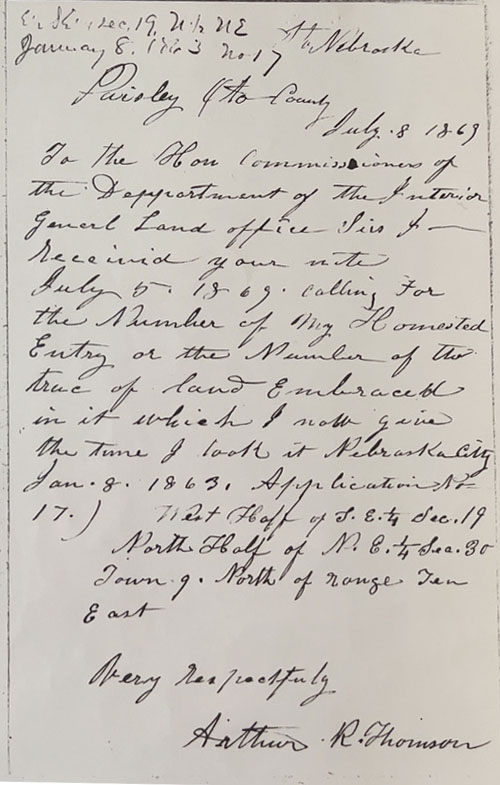
They lived in a dugout for several years and Arthur filed claim for a homestead. It was the seventeenth claim filed in Nebraska City. And, it wasn’t easy for him to get it. Besides all of the work he did on the property, it took letters to the government in order to get them to finally deed him the property.
In the 1860s, William Bunten Ronald and John Ronald pulled up stakes and headed for Nebraska, settling in the area where their sister Margaret and her husband Arthur lived.
Soon, Mary Ronald decided she wanted to live near all her children. So, Mary, her two youngest children. and her granddaughter Mary Barbara Wallace (daughter of Mary’s daughter Mary and her first husband Joseph Wallace) prepared to move. On August 24 1864. the group left Berlin, Wisconsin in a covered wagon headed to eastern Nebraska to Margaret Thomson’s home. Read more about their journey to Nebraska in The Business of Western Expansion.
Then in 1866, Reverend Wake led a group of English families to the area. They were described as forming a colony of approximately 70 families who lived in the area between Palmyra and Unadilla. Thus, quickly increasing the population. The following year Nebraska would become a state and more people would move into the area.
The Birth of Paisley
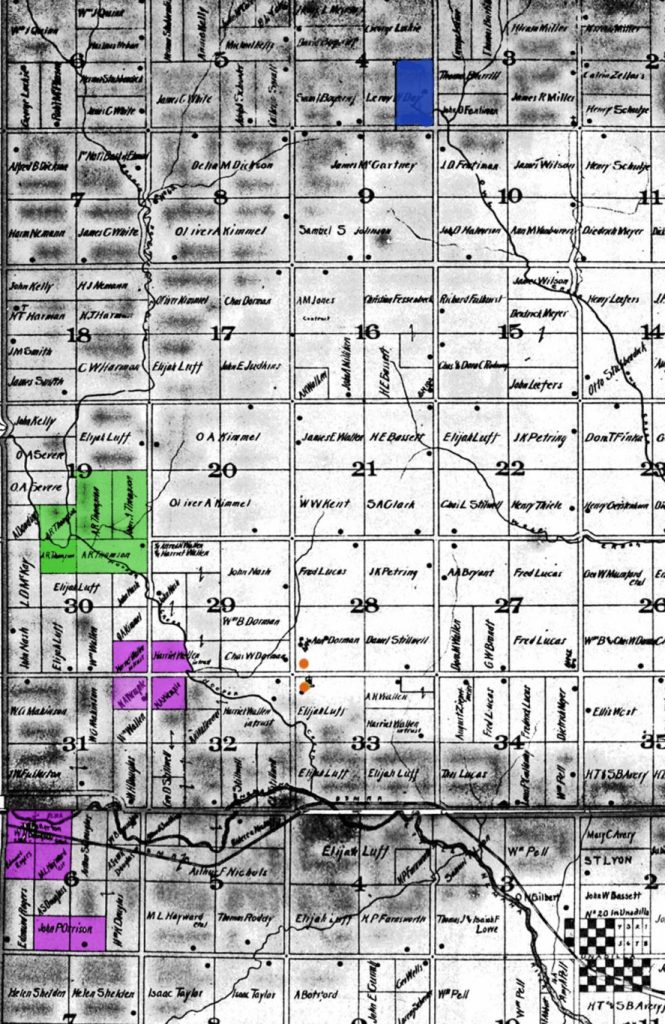
By 1868, the Ronalds were thinking that the people in the area needed a post office. Robert Ronald submitted the request and on January 26, 1869, the Paisley, Nebraska post office was established at Gus Flatman’s store (Wallen place).
Robert had named the post office after his hometown in the old country. Naming a new place after your old home, whether in another state or across the ocean was very common practice. Using the same name gave settlers a sense of continuity, made their new home seem more familiar, and created a memorial of their old home.
The Ronald family, however, didn’t really need a post office with the name Paisley to remind them of the old country. Newspaper ads were plentiful for paisley shawls and paisley prints. In addition, J. and P. Coats and Clarks thread (later Coats & Clark) could be found anywhere thread was sold. Although the Ronald family wasn’t known to have directly worked for either company, both companies traced their origins to the Ronald family’s old hometown, where thread had been made since 1722.
Reminders of home would continue for years to come. Although no longer made in Paisley, Scotland, designs based on paisley prints can still be found in fabric stores, along with Coats & Clark thread.
Note: If your family was an early settler in a town or county, it can be a huge clue as to where they may have previously lived.
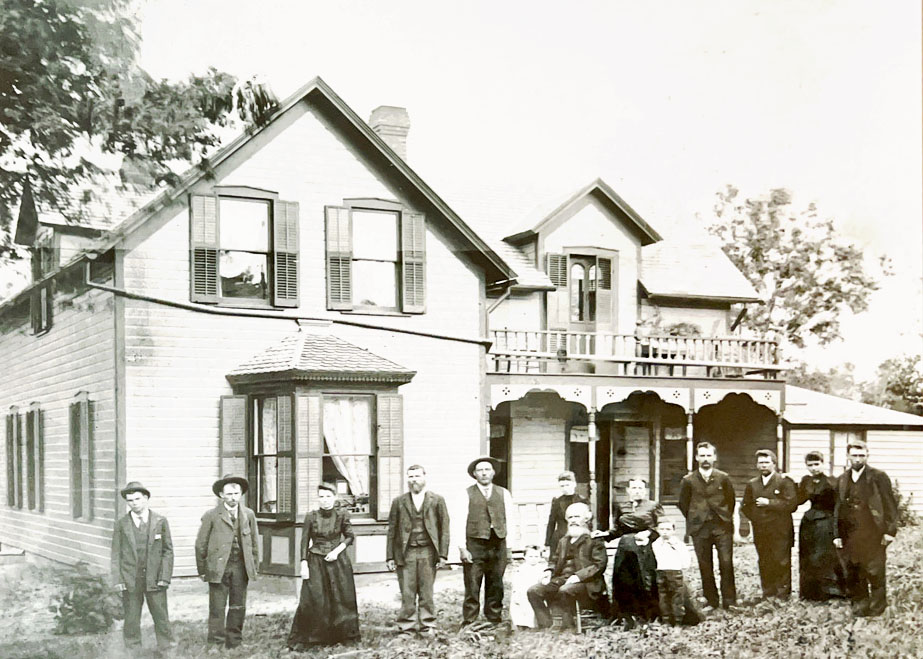
the Beginning of a Town
That same year (1869), the Paisley schoolhouse was built. And, they advertised for someone to build a mill stating that they believed they would soon have a train station on the Midland Pacific Railroad.
In early February 1872, Mr. Wallen and Mr. Luff closed a deal with the railway on a specific location for the train station. It was about three quarters of a mile from the post office. That spring, they laid out the town of Paisley, which they were expecting to grow into a significant trading point.
On September 17, 1872, the Paisley post office was discontinued. However, the name lived on. In 1880, Paisley Stock Company was formed to manage the shipping of animals raised in the the area to other locations for sale.
Not everything went smoothly for the trusting people of Paisley. In 1882, a man called Prof. Killebrew apparently got money from local men for something to enhance the “town.” However, he took off with the money and was never seen again. Only a few months later, a local newspaper reported that a man “of Paisley” had stated that he was going to start a store. It wasn’t clear if it was to be opened in Paisley or in Unadilla. However, no trace of the man stated can be found.
In addition, their dream of a railroad station in Paisley died in 1887. In 1886, the Midland Pacific R.R. had surveyed the Thomson property for a rail line between Eagle and Syracuse. They came back in 1887. However, that summer they decided on a route that bypassed both the Thomson farm and Paisley.
Still, in 1892, Paisley had “plans for a new creamery, store, and other institutions and organizations that go to help make a rich and prosperous city . . . “
School Notes
In those early years, the Paisley School covered a large area and students included: Arthur Reid and Margaret (Ronald) Thomson’s children. William and Jane (Ronald) Bunten’s children may also have attended Paisley School although they lived quite a distance away.
In those days, the school year was often shorter than to what we are accustomed. For instance, in 1879, the school year did not start until early October and ended in March. Additionally, there were times when quite a few of the students were absent on account of farm work.
In the fall of 1879, the Thomson kids’ teacher at Paisley School was F. W. Crandall. He reported that the number of students in attendance had increased to 29 by December 12 and they were expecting many more soon. Before the school closed in the spring, attendance had began dropping off as work in the fields began. Still, the students and visitors enjoyed the last day of school with a noon meal and a program by the students.
At that time, the people in the area were hoping for a new school. The district superintendent observed that the teaching was good, but the school was in bad condition.
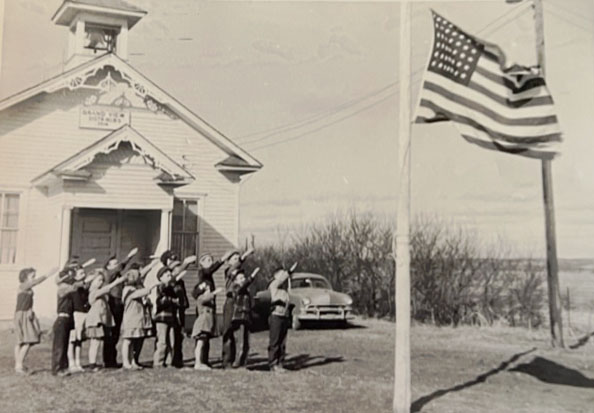
The community soon voted to build a new 26 ft. by 40 ft. schoolhouse. Ten years or so later, Miss Bunten was teaching at the Paisley School, which was getting a new coat of paint.
In the evenings and on weekends, the school was used for community events. For example, they had a literary society, spelling schools, lectures, a vocal music class, and what was known as the Paisley Lyceum. The lyceum included music, literary readings, and a lecture. One lecture (1892) was “The Influence of Sweet Cider and similar Liquids on the Human Stomach.”
Before the end of the century Paisley School (District #6) grew so much that it was divided into Paisley #6, Sunnyside District #63, Mt. Zion District #65, Grandview District #85, and Orchard Hill District #102.
Community Activities
Some of the activities in the community arose out of necessity. Coyote hunting for example was a necessity, but became a community event. One day twenty or so men and boys went hunting. Well, Herbert Stilwell missed his target and hit Mr. Brown in the leg. This caused much excitement and a pledge not to have a similar hunt anytime in the near future. But the desire to remove the trouble-causing coyotes was too great. Another hunt was soon organized.
The Vigilance Society
One of the other problems for farmers in those early days were horse thieves. Like many other communities on the frontier, Paisley residents formed a group to watch for thieves and pursue them if they tried to get away with horses belonging to any member of the group.
“The Farmer’s club for mutual protection against horse thieves” was less formally known as the Horse Club. It was formed in the fall of 1879. And was put into use the following May when a horse was stolen from a local farmer. Soon, twenty men were on the thief’s tail. They tracked him well and caught him before he reached Lincoln. They took him to the authorities. Afterward, they estimated that it cost them $25 and that it would probably cost the state $500. They implied that overall it would be much cheaper if they just spent an extra 50 cents on rope and skipped the authorities.
There was a business known as Paisley Farmer’s Insurance Company and/or the Farmer’s Protective Association that insured horses. It is very likely this company was formed out of the Horse Club. They felt it was better to go together to insure their horses than to buy an insurance policy from some company.
The Horse Club lasted long beyond the days that horse thieves were a significant problem. Each year, they continued to have a business meeting and elect officers for the club. They even continued to add members to the club long after the horse thieves were gone.
The meeting and a big dinner were held in late December or early January. The dinners started at least by 1888 and typically included oysters, along with side dishes and desserts. The dinners were a major event in the community. In 1908, approximately 100 people attended the dinner. There were several new members and the Palmyra newspaper joked that with those numbers the people of Paisley must be expecting more horse thieves.
At their dinner December 28, 1912, the club reported serving 12 gallons of oysters at the annual event. When asked two years later how many gallons of oysters had been served, the reply was that they had no idea as they had lost count. No mention of the dinners was made after that year. Perhaps, they ate too many oysters.
The Lodge
Later in the Fall of 1879, the Independent Order of Good Templars Lodge was set to start a group, which would meet at the Paisley School. Many people indicated an interest in the organization as it supported abstaining from alcohol. The initial attempt to organize failed. However, the next attempt was a success and Paisley Lodge No. 218 got off the ground with 25 members and more expected to join in the near future.
Officers were soon selected with Mary Thomson elected Vice Templar and A (Arthur R. or Arthur T. R.) Thomson elected Guard. In 1880, they had a rousing debate “There is more pleasure in pursuit than possession.” However, in 1881, word was that the lodge was going to reorganize. And, at that point, it appeared to go the way of the post office – opening to great enthusiasm only to close a short time later.
Other Gatherings & Parties
Occasionally, parties and gatherings were held at the school or the home of one of the members of the community. For instance, in 1880, a candy party was held at Robert Ronald’s house. He provided the space, but others made up the committee planning the event. Another interesting party took place in 1882. It was a masquerade party held, not near Halloween, but in February.
In 1888, Paisley held an ice cream and strawberry festival, which like many activities drew people, particularly the younger folks. It was said to be a great event except that they couldn’t make ice cream as fast as the people could eat it.
When the World’s Columbian Exposition (Chicago’s World’s Fair) was held in Chicago from May 1 to October 30, 1893 celebrating the 400th anniversary of Christopher Columbus’ 1492 voyage. Paisley sent a group to the event. Twelve people, including John and Arthur Thomson, made the trip to Chicago.
The Church
Sunday School and Church services had been prevalent in the neighborhood since at least the late 1870s. In 1879, the M. E. Sunday School at Paisley received a donation of 300 used books from William Hamilton of Philadelphia. It was considered an extremely valuable gift to the program.
That same year, a large group of people filled the schoolhouse and overflowed outdoors. It wasn’t for their regular Sunday School or church service, which had been happening for some time. Instead, it was to discuss building a church. However, the condition of the school made a new school a higher priority.
It would be over ten years before the the church was officially organized. In the meantime, Sunday School continued with church services on occasion. The church held two major events every year. Everyone looked forward to the Christmas tree. Even in years where money was extra tight, they tried to have small gifts for the young kids. The other major event was Children’s Day at Sunday School, which typically took place in June. On Children’s Day the children of the church showed off their talents singing, reading, and reciting with flowers or greenery often decorating the space.
A New Church
In September 1892, the church at Paisley was officially organized. The charter members included: Mrs. Eleanor Pell, Mr. and Mrs. William Rotton, Mr. and Mrs. E. Luff, Mr. and Mrs. W. Stevenson, Mr. and Mrs. S. B. Avery, Sr., Mrs. W. H. Johnson, Mr. and Mrs. Wemple, Mr. and Mrs. Thomas Bell (pastor), Mrs. D. Stilwell, Mrs. A. P. Seymour, and Miss Edma Freeze. The first deacons of the church were S.B.Avery and W.H. Johnson. W. Stevenson served as the first clerk and E. Luff served as the first treasurer.
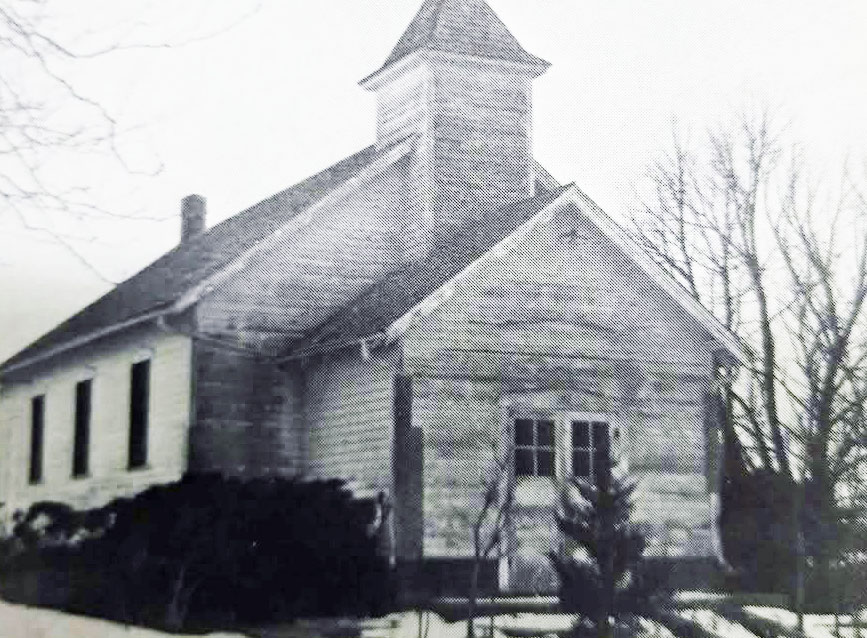
After waiting so long, they wanted a church that would hold a crowd. Elijah Luff, one of the men who came to the area with Rev. Wake, donated land at the crest of a hill for the church. He only had one condition. At least one church service had to be held there each year or the land would revert to his heirs. The community donated money and time to build the 48 ft. by 32 ft. building with a seating capacity of 135 people
When the church was nearing completion, a newspaper noted that the church really added to the landscape. What they probably didn’t realize was that it would become a landmark and reference point for years to come.
On February 4, 1894, Paisley Church was dedicated. It was officially “The Paisley First Congregational Church of Christ.” The name was later officially changed to “The First Congregational Church of Paisley.” However, it was informally called Paisley Congregational Church or simply Paisley Church.
Rev. Thomas Bell was considered the first pastor of the church having been officially named as pastor in June 1893. However, he and others had been doing services for the people of Paisley for many years.
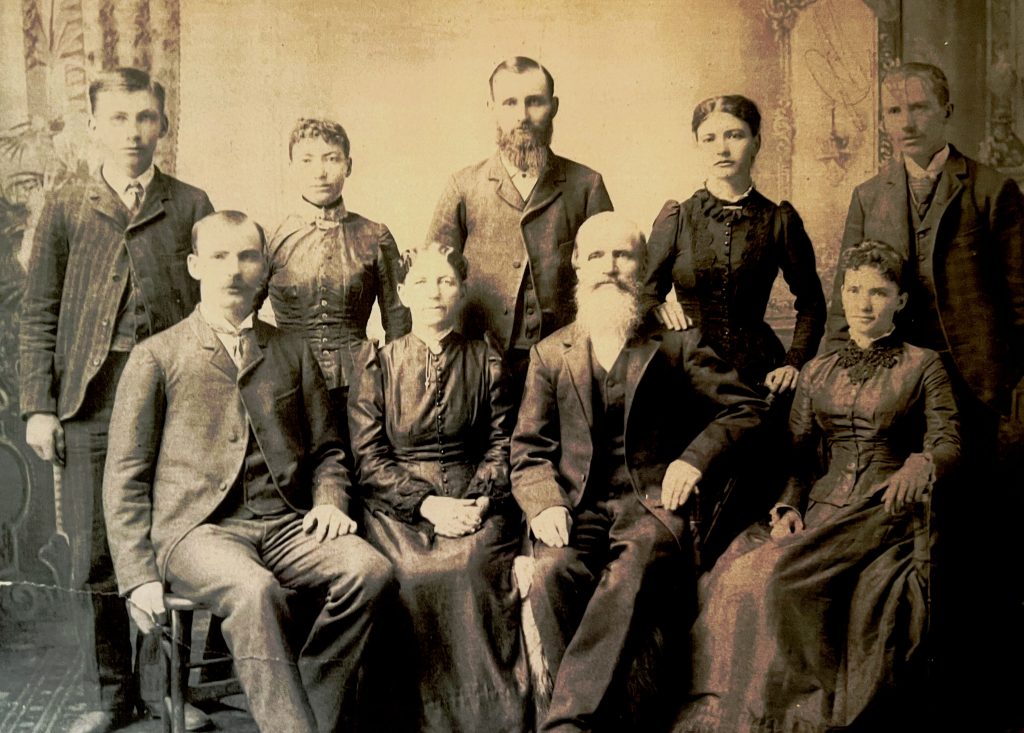
By the time the church was built, the only one of the Ronald family still living in the Paisley area was Margaret (Ronald) Thomson. Read about the The Ronald Brothers In Business.
Although the Ronalds were no longer in Paisley, the Thomsons were still referred to as the Thomson branch of the Ronald Clan, particularly when holding their yearly family gatherings (January 1), which would be held at Margaret (Ronald) Thomson’s home for 65 years. Despite the Ronald reference, over time the family gatherings included mostly members of the Thomson family. However, letters from relatives in the Ronald family and others were sometimes read at the festivities.
Margaret and her husband Arthur Reid Thomson did not join the Paisley Church as they had long ago become charter members of the Palmyra Presbyterian Church.
Three years after the church was built, it was papered and it was already requiring a few repairs. One of the repairs was to one of the church doors. On Children’s Day, part of one of the doors had come loose and struck one of the ladies and knocked her unconscious.
Around that same time, the people were working to get a road from Paisley to Palmyra. Arthur Thomson was likely in favor of the new road since in 1885 he had purchased a brand new phaeton, an open-air, four-wheeled horse-drawn carriage. They got their wish and a road was built.
Turn Of the Century
Known For their Generosity
The Paisley community was known for its generosity, whether it was a family in need, repairs for the church or school, or for someone they didn’t even know. The church sent about $60 one year to the Syrians and Armenians. Another time, they gave $400 to the Red Cross. And, on one occasion they sent 40 dozen eggs to a hospital in Omaha. No matter the cause, the Ladies Aid Society was usually the driving force behind gathering items or money.
 Paisley Ladies Aid Society
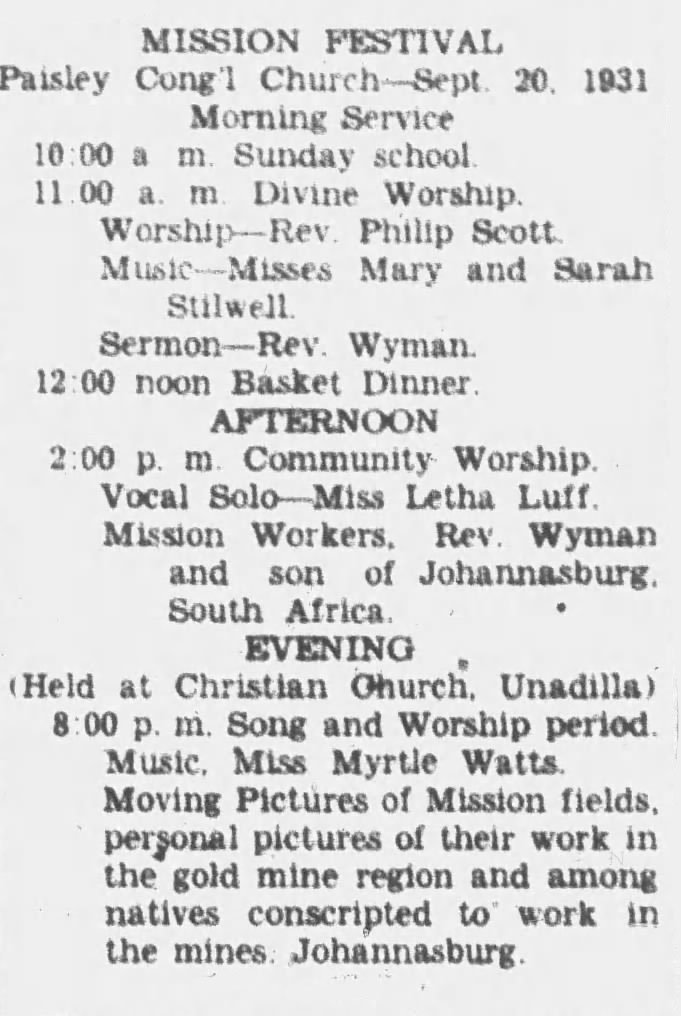 Paisley Ladies Aid Society
 Sept 1912, the women of Paisley Church organized Paisley Ladies Aid Society. There had been a similar group in earlier years that had cooked for the less fortunate. The earlier group was said to have been very busy during the blizzard of 1888.
Although it was a church group, they did not exclude others from attending their meetings. This made for a larger group that could accomplish more for the community. Margaret (Ronald) Thomson was among those who attended throughout the years. In 1927, Margaret invited the Ladies of the Aid Society to visit her at her home in Palmyra. The following month, Nellie Stilwell (President of the Ladies Aid Society) and her daughter Mary brought Margaret a guestbook with the names of 50 ladies that had visited her home earlier that summer. The book was said to be very special to her as were the people of Paisley.
The Ladies Aid Society was always busy doing something to help someone. When disaster struck, they were there. When a family’s home burnt, they collected goods and made quilts for the family. Likewise, they put together packages for tornado victims and sent clothes to flood victims.
During what came to be known as World War I, the group sent 10 bed shirts, 1 helmet, 3 pair of socks, and 5 sweaters to the Red Cross. The school also got in on the action of supporting the war with 32 people joining the Paisley School War Savings Society.
They were also instrumental in raising money for various church projects, missions, and more.
The Paisley Ladies Aid Society funded some of their projects with their annual Thanksgiving supper and bazaar. Others were funded with bake sales, selling dinner at sales, and socials.
The Socials
In the later 19th century, fundraisers called “socials’ began popping up. However, became regular events after the turn of the century. They were common in Paisley. The community used them to raise money for a library, hymnals, and other needs of the church, school, or club.
Various types of socials were held, such as, box/pie suppers, necktie socials, shadow socials, dime socials, ice cream socials, and hardtimes socials.
Box Supper/Pie Supper
Box Suppers (sometimes called Pie Suppers) were the most common type of social. They were a combination of potluck, charity, and matchmaking all rolled into one event.
The girls, young ladies, and women would decorate boxes or baskets containing dinner or dessert for two people. The males at the event would bid on the boxes without (or supposedly without) knowing whose box they were bidding on.
The winner of each box got the right to (or really was required to) eat dinner with the female that had prepared the box. The ladies often gave hints about their box to their beau or a guy of interest. Of course, if other guys got wind of which box belonged to a certain woman and they knew one of their friends really wanted that woman’s box, they would bid it up with every intention of letting him have it, but making him pay more to get the box.
Now, I suspect there was some colluding between moms or other women in the neighborhood. I vaguely remember one such social when I was quite young – far too young for dating. Anyway, I know there was conversation between my mom and the neighbor lady. They planned for the neighbor’s son, who was around my age, to buy my box.
Necktie Socials
The Necktie Socials that were held were similar, in that they were a combination of charity and matchmaking. Food was also typically involved.
For Necktie Socials, the girls, young ladies, and women would make a necktie and another item using the same fabric. The neckties were put up for auction or blindly drawn by the males in attendance for a fixed fee. The men then had to wear the necktie all evening. The first thing they had to do was to find the female who was wearing an apron, ribbon, or other item that was made with the same cloth.
It is unclear what happened if multiple neckties were made of the same cloth as could easily happen in a rural area with access to a limited stock of fabric. Likely, it would be up to the women to figure out who made which necktie.
Once the couple was matched, they would then be partners for the evening. Depending on the event, they might eat supper together or might just have dessert together. They would also be partners for any games that were held and would be dance partners if dancing was part of the evening’s event. Of course, there were lots of attempts by the guys to sneak a peak at the fabric of the fabric worn by the girl they liked. And, you can be sure that the females were not innocent. They likely gestured to a hair ribbon or other item when the guy they liked looked their direction.
Dime Social
Dime socials were often for women and girls only. However, the women of Paisley may have invited the men to join the group. Money was raised by charging a dime to attend.
The group enjoyed activities, entertainment, refreshments, and fellowship. Activities often included games such as: charades, Bible trivia, and “Who has the button.” Sometimes the women and girls entertained the others with poetry, readings, music, or skits. The food was also simple, focusing on homemade goods, such as, cookies, biscuits, or pie.
Ice Cream Social/Ice Cream Supper
Ice Cream Socials were similar to Dime Socials. as they combined fundraising, entertainment, and food. And, food apparently was something that the women of Paisley were known for as the newspapers made mention on several occasions regarding the cooking of the women of Paisley. In 1924, the ladies of Paisley’s 200 page cookbook “The Best By Test” was released.
For the Ice Cream Social, however, the women limited their cooking to ice cream and homemade cakes, pies, and cookies. Like the Dime Socials, people would pay a fixed amount or perhaps give a donation that would go to the cause of the day.
It was a family friendly event that included music, recitations, actives, and fellowship. Ice Cream Socials held by the church leaned more toward hymns and religious activities. It was an opportunity to bring the community together as people often attended who didn’t belong to the Paisley Church, Paisley School, or club holding the social. As such, it was also a good opportunity for supervised courtship.
Shadow Socials
A shadow social followed the same themes of fundraising, matchmaking, and food. At the shadow social, the males bid on the shadow of a female.
The girls, young ladies, and women, who were behind a sheet with light casting their shadow onto it, tried to hide their identity. Some wore big hats and/or held props. They would also change their natural posture and add extra poof to their hair and dresses.
The females loved trying to trick the males. And, everyone got a good laugh when a guy would bid high only to find out that he had just purchased the opportunity to spend time with his own sister.
The female was revealed to the winning bidder. The two of them then shared supper/dessert or a dance.
Hardtimes Socials
Hardtimes socials were a bit of a twist compared to most socials. Instead of getting dressed in your Sunday best, or at least one of your better outfits, attendees wore worn out, torn, tattered, and patched clothing.
To encourage participation, a prize was sometimes given for the bet costume and finery was strictly forbidden. Inspectors were assigned and anyone whose costume was not considered old enough or tattered enough was fined a very small amount.
The theme of the evening was not limited to attire. The school or church hosting the event was decorated with plain, old things, such as, old crates. Likewise, the supper or desserts served were plain items, such as, beans and cornbread.
Money was raised for the night’s cause, not only from the fines, but also from a small admissions cost or cost to participate in activities.
The idea for these social rose out of hard times when people didn’t have money (e.g. 1893). It allowed everyone to be equal (or at least more equal) as poorer and richer families all were wearing old things. It also relieved tension in hard times and still gave a good laugh in the good times.
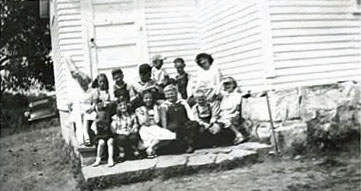
Paisley School
A majority of the socials were held at the school with the others generally held at the church. However, there were many other activities associated with the school or where the school was used when classes weren’t in session.
School Activities
Christmas Program
At Christmas, the school would have a program with treats. In 1931, the children read stories and showed their work to their mothers and other visitors in the afternoon. Then, they got a visit from Santa who brought candy and nuts. There were also presents around the Christmas tree.
Santa, however, couldn’t stay long as he had to hurry to get ready for the program and Christmas tree at the Paisley Church that evening. The teacher, Miss Stilwell, gave each of the students a piece of fruitcake and a banana before they hurried off toward their homes. After all, they also had to get re in ady for the church program that evening.
End of School
At the end of school, parents and visitors coming to the school. The day was one of celebration. The students often performed a program or showed off their work. Everyone enjoyed a basket lunch. Baseball often followed with the men playing the boys or the married men playing the unmarried boys and men.
Sports
Paisley was large enough to raise a baseball team and both boys and girls’ basketball teams. The Boys usually played baseball against the boys from Unadilla or Palmyra. It was said that the Paisley baseball field was one of the best around.
Boys basketball was typically against the other towns or neighborhoods. However, the girls game was a bit more social. For that game the girls met the other team at the church. They all had dinner together. Then they played basketball, which was followed by going horseback riding.
Evening Activities
The school was used for a variety of activities outside the school day. Literary societies, debate, lectures, and even a moving picture show used the school as their venue.
The Orchestra
The Paisley Orchestra gave recitals and likely practiced at the school. Now, when you think of neighborhoods in a rural farming community, the first thing that comes to your mind probably isn’t the presence of an orchestra. However, Paisley had an orchestra that seemed to be quite well received. They played at the Otoe County Fair, the Unadilla M. E. Church homecoming, the Palmyra Presbyterian Church and at other events.
Then in 1929 they formed the Paisley-Palmyra Orchestra with between 25 and 30 members. That year they played at the Old Settlers celebration at Palmyra. The following year they formed a children’s orchestra with students from Paisley, Unadilla, and Palmyra. That orchestra was huge for the location as it consisted of 10 violins, 7 saxophone, 7 clarinet, 3 trombone, 6 cornet, 2 bass, 1 drum, and 2 piano players.
Women’s Groups
The Paisley Project Club (a.k.a. the Never Idle Project Club) was a women’s group, sometimes met at the school. Other times, they met in people’s homes. They learned new sewing techniques, how to make a hook rug, wall papering techniques, landscaping, care of furniture, refinishing furniture, and more. They put on a program consisting of plays and music by the orchestra. They also had their sewing on display. Like many events, refreshments were served.
Women also got together for quilting circles and in 1931, the group Early Hour Cooks was started. As the name says, it was a cooking group. Another group in the area was the Jolly Neighbor’s Club.
4-H
A portion of the 4H club meetings were held at the school. Others were held in members or leaders’ homes. In 1928, the Paisley Jolly Workers, who were also known as the Paisley Cloth Club, had 18 members for their first meeting with 6 visitors. The meeting included sewing (or learning about it), singing, games, and dessert. Later on, they stopped having refreshments because they felt that it took too much time away from working on their projects and learning new skills. They were very achievement oriented.
Another group was called the Hopper Creek Hoppers Calf Club. As you might imagine, this 4-H group was focused on raising calves.
4-H groups continued with the Peppy Paisley Pats, which included Janet and Deanna Lamb, still meeting at the Paisley School in 1963.
The Grounds
School at Paisley was like many country schools. It was a place of community and it always seemed to need something updated.
In December 1905, they built a shed on the school grounds. Then, in 1911, the coal house (possibly the same building) needed reshingled. The next year brought the need to refloor the school, although it is curious that they did it in January in the middle of the school year.
A new roof was required in 1918. And, of course, the school needed plastering and painting, too. In 1923, a cyclone cave was built at the school to protect the students and teacher if a storm arose.
In 1931, instead of adding to the school grounds, they removed the aging cottonwood trees that had stood on the playground for 50 years.
The Church
Like the school, it always seemed that the church was in need of something being fixed or updated.
In 1912, the stoves were renovated. The following year the church was repainted and gas lighting was installed in the church.
In 1914, with a new full-time pastor, the people of the church and broader community scraped together money to build a parsonage next to the church. It would be used by the church’s ministers over the years. However, the church only had three full-time ministers. The remainder of the time, a pastor at another church in the area would provide services at Paisley. When not in use by the pastor, the parsonage was used for club meetings and other activities.
1917 was a busy year for updates as the church was papered, screens were added to the church windows, and a piano was purchased for the church. The Ladies Aid Society was instrumental in financing and getting these updates made. The following year the roof was reshingled.
1919 brought an update that was out of the ordinary. That year, instead of painting, papering, or repairs, the hedge along the church was cut down. People seemed to think that the removal of the hedge was an improvement to the church grounds.
Hub of Activity
The church was often a hub of activity. At times, multiple church services were held on Sunday with services and Sunday School in the morning and a program in the evening. Several of the Thomson’s attended at least one evening church service at Paisley. It did not state the topic of the sermon for that evening. However, it was parents day at the church and although they weren’t the parents of any members, that might have driven their attendance.
Other times, only one church service was held on Sunday. Depending on the schedule of the pastor who was speaking, the service was sometimes held in the morning and other times held in the afternoon.
There were other times when the church services were more sparse. In those times, the church still held Sunday School. They had a superintendent of the Sunday School that managed the program. Nellie Thomson’s husband Ora Baker was the superintendent for the 1919-1920 year.
Other regular church activities included prayer meetings and choir rehearsal. And, of course, the annual church picnic always drew a crowd.
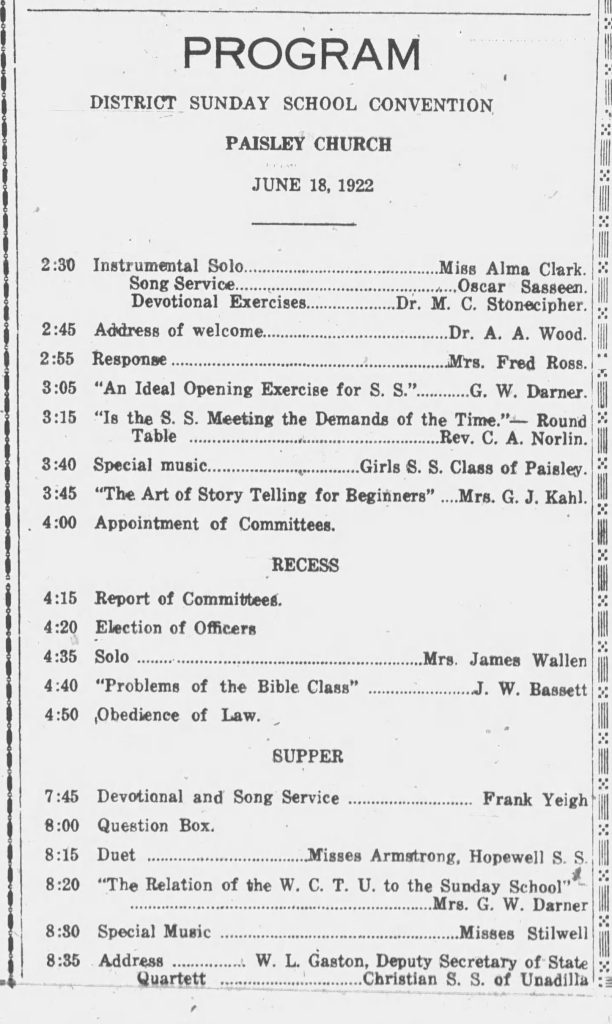
On the third Sunday in June 1922, the District Sunday School Convention was held at Paisley Church. The convention had a full agenda lasting from mid-afternoon til late evening. Thus, Paisley Church did not hold a regular church service or Sunday School that day.
The church was also the scene of revivals, patriotic meetings during WWI, temperance rallies, presentations by missionaries, and even a home canning demonstration.
On July 31, 1925, Paisley Ladies Aid Society invited former Paisley residents to a picnic at the parsonage. People invited were now living in Minnesota, Indiana, California, and all across Nebraska. Approximately 90 people gathered that day to renew friendships. Several of the Thomson family attended including Margaret, John, and Herbert.
One of the biggest celebrations at the church was held in February 1929 when the congregation celebrated the 35th anniversary of the church. The celebration included members of the church and friends in the community. Four ministers participated in the celebration with one giving an address. Charlotte Stilwell provided a reading of the church history. Music was also a big part of the celebration and the ladies quartet sang.
By 1930, the church had 70 members. The Easter service that year was followed by a picnic dinner. The following year, members remarked that they couldn’t do a lot because of the depression, but at least they could still have church services.
The Lightening Strike
The Fire
Around 4:30 a.m. on July 29, 1940, lightening sizzled from the sky striking the ground. It was so loud that a woman a half-mile or so from the strike looked out to see if she could see where it hit. She saw nothing, but a short time later, she smelled smoke. She knew the lightening had started a fire. So, she called the Unadilla phone operator who then put out an alert.
The lightening had hit the Paisley Church Steeple. The fire had spread throughout the church and even to the church parsonage. It was one of three churches in Nebraska hit by lightening that week!
There was very little that could be done to save the buildings. The churches well was between the two buildings and chemicals brought from Unadilla did little to slow the inferno.
There seemed to be some debate as to what, if anything, was able to be saved from the church. Some reports said that the piano and some other items had been saved and others said that nothing was saved. The building and contents were covered by $1700 insurance with the structure valued at $1500 and the contents valued at $1000.
To Rebuild or not to Rebuild
At the time of the fire, regular Sunday School had been being held at the church. However, they hadn’t had a regular minister since the previous year. Also, the person who had held the role of secretary and as Sunday School superintendent had retired after eighteen years. The president of the Ladies Aid Society had also been serving for many years. Thus, it would seem ripe for a decision to just let the church go.
That, however, was not the decision. The church meant a lot to the community and to the people who had previously lived there. Thus, By mid-October, a decision had been made to rebuild the church. However, they decided not to rebuild the parsonage.
Soon after the decision was made, the congregation held a service outdoors near the ruins of the church. Within a week of the service, they began clearing away the debris and preparing to build.
The new church was to be 24 ft. by 36 ft., which was smaller than the original church. However, it was to have several new features. The plan included a 9 ft. by 15 ft. vestibule, a full basement, and electricity. A contractor did the primary building with the people of the community assisting where practical. For example, the women varnished the floors and the woodwork.
The Dedication
By August 31, 1941, the church was ready to be dedicated. An earlier pastor presided over the event. And, the 100 attendees sang “Abide with me,” the same hymn that was sang at the dedication of the church in 1894. Following the dedication, a dinner was held in the basement.
By Thanksgiving, the church ladies were back to their regular routine, holding a supper and a bazaar at the church.
And, in an instant
Bye, Bye Paisley School
By the early 1960s transportation was improving, families were getting smaller, and schools were consolidating. The last mention of Paisley School was in November 1963. It is assumed that it closed at the end of the school year. Dale Lamb was one of the members of the school board at this time.
Similarly, Grandview School, which had spun off from Paisley School and which some of the next generation of Thomsons had attended, had closed after the 1957-1958 school year. At the time that it closed, Grandview had 16 students. George Thomson was one of the last school board members of the school.
Then, on July 1, 1965, tornadoes broke out in eastern Nebraska. They dipped out of the sky and hit a home, several barns, and several outbuildings. By the time the weather calmed, Paisley School was gone, the victim of one of the cyclones.
Unsolved Mysteries
The last service mentioned at Paisley Church was held on September 3, 1964. By the end of the year, the church had gifted dishes and silverware to the Methodist Church in Unadilla. It is assumed that the church ceased operations about this time.
In the mid-1960s, Emaline Stilwell purchased the Paisley Church. She thought it could be converted to a nice home. However, the years went by and the church sat empty. She just never got around to remodeling it.
Then in 1989, Emaline was approached about using the church for the TV show “Unsolved Mysteries.” She really didn’t want to accept the offer as it meant that the church would be blown up. However, her attorney convinced her that the proposed widening of Highway 2 would likely require demolishing the church anyway. Thus, she agreed to the shows request.
Emaline decided that at least the church would have a good story that would allow it to be remembered.
The Explosion
The story that was being re-created was about the natural gas explosion that rocked West Side Baptist Church in Beatrice, Nebraska on March 1, 1950.
The pastor came to the church in the afternoon. Everything seemed normal. He lit the furnace so that it would be warm for choir practice that evening. Then he left.
At precisely 7:27 p.m. that evening, the church exploded. People in the area reported that it sounded like a bomb. Not only had the church exploded, but there was damage for several hundred feet around the church.
The Miracle
They mystery wasn’t why the church exploded or even how a special artifact survived. Instead, the question posed by the TV show was if it was coincidence or divine intervention that led to all the choir members to survive by being late to practice.
As it is told, the choir director was a stickler for everyone being on time. Choir practice started at 7:25 p.m. and everyone was expected to arrive by 7:20 to get ready for practice. Members of the choir were very punctual and usually started arriving around 7:15 p.m.
However, on March 1, 1950, ALL fifteen member of the choir were late – including the choir director and the preacher. So, at 7:27 p.m when the church exploded, no one was inside the church.
People were crying and digging through the rubble of the church looking for survivors when the choir members started arriving!
Speculation
There was a lot of speculation about divine intervention versus coincidence. Some people argued each side.
One article did a calculation based on the likelihood of this happening given the choir members were generally always on time. They decided that for estimating the scenario that the odds for one person being late would be 10%. Their calculation wasn’t accurate. However, the author’s point was 100% on target. The odds were so small that it couldn’t possibly be a coincidence.
The Recreation
For the recreation, staff for the show wanted to show and tell the story as similar to what had happened 40 years earlier as possible. Thus, they talked to all the choir members that they could regarding why they were late, filmed around Beatrice, and they looked for a church that resembled West Side Baptist Church. Paisley Church was a white wood-frame church of a similar style. Thus, it was perfect.
On November 21, 1989, crews prepared the church, adding some new white paint, dynamite, gasoline, etc. Then at 8:50 p.m., after shutting down Highway 2, they blew up the Paisley Church. The blast was supposed to destroy the south and east sides of the building, but they over did it a bit and it destroyed everything. Even the bushes nearby looked like they had been torched.
One newspaper mentioned how the church had held many funerals and now it was going to hold its own. In reality, it wasn’t just holding its own funeral, it was holding the funeral of a once vibrant community!
Note: The show was aired January 3, 1990. Check out: https://www.youtube.com/watch?v=buhQ7Tf12Nw
Afterward
Things That Made Me Wonder
Several things that I found in newspaper articles really made me wonder. The first was references to different regions of Paisley, such as, north Paisley, west Paisley, etc. And, of course, in Paisley.
Another thing that raised questions in my mind was when the newspaper reported in 1921 that Frank Wallen was elected mayor of Paisley. Really? They had a mayor? Who got to vote?
Publications
Supposedly, in 1939 the WPA wrote a history of the church. If anyone knows where a copy exists, please let me know.
I am also very interested in seeing a copy of the Ladies Aid cookbook “The Best By Test.”
#52ancestors52wee