Figuring out all the names, nicknames, ordering of names, and initials for a person is one of the great challenges in genealogy.  Sometimes the answer is obvious with research and sometimes it isn’t. 


The Debate

My Grandmother Dessie May (Thomas) Pellett and her youngest brother “Bud” Thomas always argued about their mother’s real name.  Was her real name Sadie Ella or was it Sadie Ellen and Ella was a nickname?


They couldn’t ask her directly since she died due to hemorrhaging and myocarditis related to childbirth.  Her baby was stillborn or died within hours of birth.  He was the third of nine pregnancies to come to a tragic end.  She died two days later.


Dessie was 15, however, at the time of her mother’s death.  So, she actually knew her mother and had some opportunity to know her mother’s name.  However, Bud was a toddler when his mother died and probably remembered little if anything about his mother.  So, his information would have come from their father or other relatives. 


The Real Name

Still, according to her delayed birth record and her marriage record, both of them were incorrect.  Their mother’s name was Sarah Ellen (Ashby) Thomas.  The name Sadie appears in some records, but it appears that most often she was simply referred to as Ella.  She had been born August 13, 1884 in Fayette County, Iowa and died November 2, 1918 in the hospital at Fort Scott, Kansas.


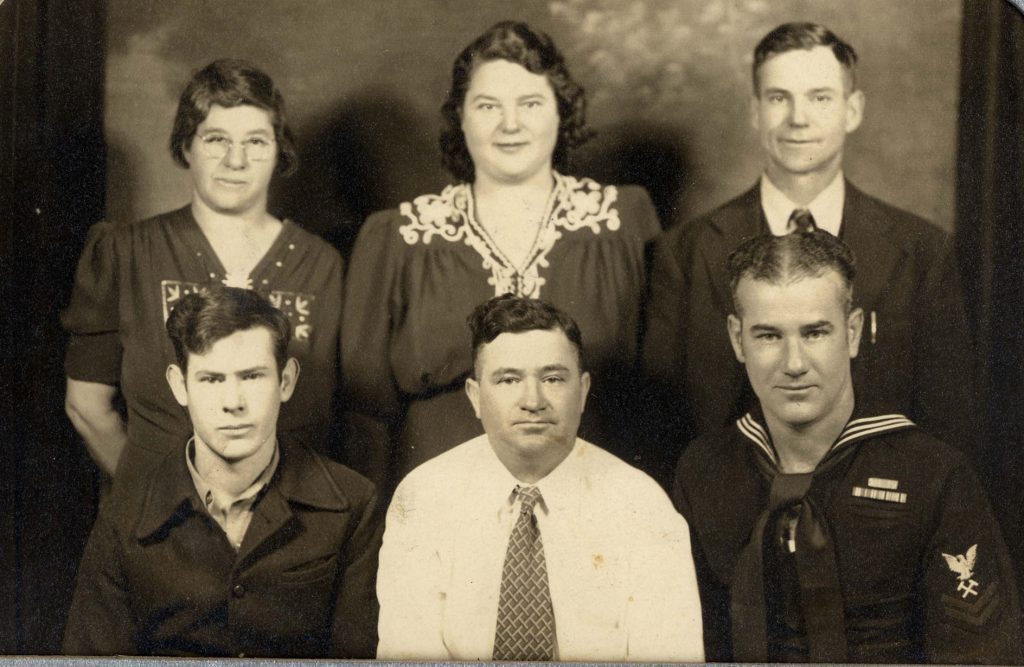
Children of James William “Will” and Sarah Ellen “Sadie Ella” Thomas – Front: Bud, Oren, Leland (a.k.a. Leonard and Tom); Back: Dessie, Verdie, Delbert

Life After Ella

Dessie was the oldest child and for the next several years she helped her father, James William “Will” Thomas, raise her younger siblings.  I remember her being especially close to her youngest two siblings.  “Verdie,” who was actually Verda Leola Thomas was five when their mother died and Theo Melvin “Bud” Thomas was only two at the time of their mother’s death. 


Verdie is an obvious nickname for Verda.  However, I have no idea how Theo became Bud.  He used his initials in most business dealings and Bud the remainder of the time.  He was the postmaster at Hiattville; thus, known by many people in the area.  Yet, I imagine there were plenty of people in the neighborhood that never had any idea that his real name was Theo.


Theo Confusion

Theo is an obvious nickname for Theodore.  However, it seemed that his name was officially Theo with the exception of the Social Security Administration and an article about his marriage to Ida (Louise) Hanson, that stated his name was Theodore.  Now, I would believe a social security record over the census and other records.  However, his draft registration for WWII lists his official name as Theo.  So, which was it?


He went by Bud, his wife used her middle name of Louise, his son James went by Jimmie and his daughter Leola Mae was called Tillie.  Again, I have no idea how Leola Mae became Tillie.

In the next generation, all of the children of Jimmie Lee and his wife Sandy, another nickname, had nicknames.  One who lived only about a month was nicknamed “Buddy.”  Can’t guess where they got that name!


This family sure liked nicknames!


When we think about people who settled along the trails westward, we often think about the hardships that they encountered.  We may wonder if they were traveling west and simply gave up and decided to settle in that location or if the location was their original destination. However, we often don’t consider the business they did catering to . . . or in some cases taking advantage of . . . people moving west.  In fact, the westward expansion business was responsible for the establishment of cities like St. Joseph, Missouri, Kansas City, and Denver.


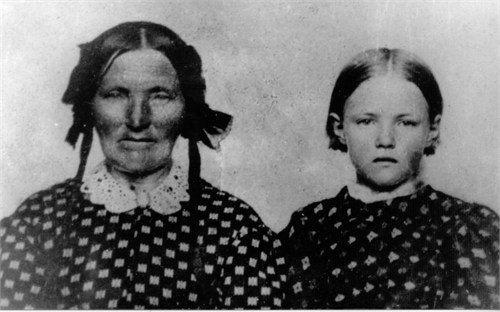
Mary French (Gourley) Ronald and her granddaughter Mary Barbara Wallace

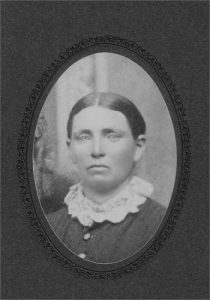
Mary French (Gourley) Ronald

Mary French Gourley (Rod’s great-great-great grandmother) was born February 18, 1803 in Paisley, Renfrewshire, Scotland.  It was there that she married Thomas Ronald II on June 6, 1820.  As their children became adults, some of them immigrated to the United States, settling in Wisconsin.

In 1856, Thomas, Mary, and their children that remained in Scotland set sail for the United States.  They joined their children in Wisconsin.  On April 19, 1860, Thomas died.  By 1864, Mary’s sons William and John and her daughter Margaret, who had married Arthur Reid Thomson, all made their home in Nebraska.  It had become a separate territory in 1854, but would not become a state until 1867.


Jane Ronald

The Diary

With a majority of her children settled in Nebraska, Mary decided to make the move to Nebraska.  On August 24, 1864, Mary, her two youngest children, and her granddaughter Mary Barbara Wallace (daughter of Mary’s daughter Mary and her first husband Joseph Wallace) left Berlin, Wisconsin in a covered wagon headed to eastern Nebraska to Margaret Thomson’s home. 

Her daughter Jane, who was 22 at the time, kept a diary of their journey.  She noted where they traveled, how long they traveled, the difficulties they encountered, and interesting things they saw along the way.  One of the things she mentioned were expenses of their travel and other things they bought. 


Tolls

Plank Road

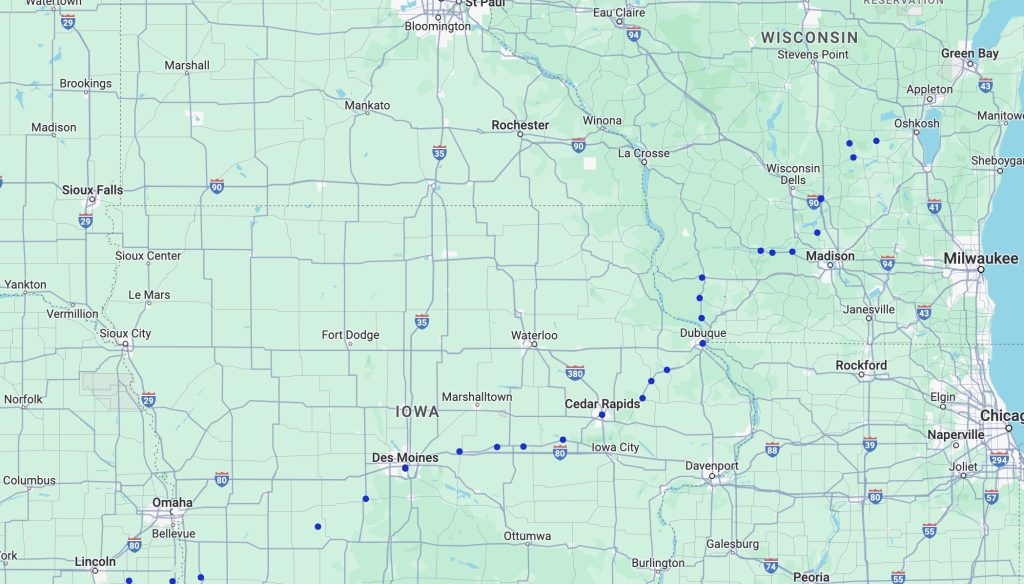
Various people that they met along the way gave the travelers advice on the best way to travel through the local area on the way to their destination.  The first that she noted was a gentleman that directed them to save 9 miles traveling through Wisconsin by going to Lodi, Mazomanie(the diary has a different name, but this is the closest sounding town along that portion of the route), Arena, and Prairie du Chien.  When they reached the area of Portage, they encountered a plank road that required a toll.  It was 1 ½ miles in length and had a toll of 16¢. 

Before they reached Prairie Du Chien, they encountered a sign with the wrong mileage to the town.  They continued on the route for a few miles learning that it was actually 30 miles to the town instead of 3 miles as was stated on the sign.  By following this route, they had already gone 4 to 5 miles out of their way.


River Crossings

The largest toll they had to pay was $1.80 to take a ferry across the Mississippi River.  There were tolls for ferries and bridges to cross other rivers, such as, the Missouri River.  At the Cedar River, they paid a 60¢ toll to use the bridge to cross the river that she estimated to be about 30 rods wide.  However, after they crossed, they learned that they could have forded the river and saved their money. 

There were other rivers and streams that they forded.  Among them were the Raccoon River and the Des Moines River.  Each of them had a toll for using the bridge.  However, the rivers were low, allowing the family to cross without the use of the bridge.

To this day, there are bridges that cost to use them IF you are traveling west.  However, there is no cost when traveling eastward.  Clearly, a leftover system from the days of westward expansion.


Accommodations

Good Nights Sleep

It rained and stormed a lot during their journey.  They didn’t always get a good night’s sleep.  On many nights, they just attempted to sleep in their wagon.  One night they laid under the wagon in the mud when the cover blew off.  However, sometimes they visited a house to get out of the rain.  One night during a rain storm, a man charged them two bits to sleep on the floor in his filthy house.  And, in Cascade, Iowa, they paid to spend the night in an actual hotel.

Of course, worry and concern also cost Jane a good night’s sleep.  This was especially true after they met men coming from Idaho that stated that it was very dangerous where they were going.  The worry became amplified when they met a Potawatomie Indian while camping and he told them that they should not go to Nebraska.  He said that the Indians were going to work together to drive all the white people out.  He managed to scare Jane, but not stop the trip.


Rough Map of The Journey from Berlin, WI to Paisley, NE; Background map is from maps.google.com

Livestock

They also had to find accommodations along the way for their cows and oxen.  It was not always easy.  There were nights when finding good pasture and water for them was quite difficult.  On a few nights that meant paying to use pasture land.  The night they spent in a hotel, they had to pay for feed for the oxen at 5 cents per head.

Not all the livestock expenses were for accommodations.  On two occasions the cows and oxen got into someone’s fields.  The first time they damaged the corn field, buckwheat, and cabbage.  This cost the family 50¢.  The second time, less damage occurred.  In addition, only the hired hand was home.  So, they gave him some fresh milk.  He was from Scotland, like them, and he not only accepted the milk for the damage, but also gave them melons in return.

They met a family along the way, whose horse had been injured.  They had been charged $50 for a new horse that was no better than the injured one.  Fortunately, the family did not encounter a need for additional oxen during their journey.


Gains & Losses

The family did, however, have other losses.  When bathing in the Wisconsin River, Robert lost his hat.  They also lost his new boots along the way, Mary’s reader, and a powder flask.  Matter of fact, the diary itself was lost, but they went back and recovered it.

One day when Robert was ill, they traveled only a short time before setting up camp.  That afternoon while Robert rested, the ladies walked to the top of a high hill.  When they returned, the ox had eaten all of their bread and two pounds of crackers.  This led to more baking.  When possible, they borrowed someone’s kitchen to make biscuits.  However, on at least one occasion, Mary made biscuits over an open fire.

When they stopped at the McAlister family’s home, they were treated to biscuits and given a loaf of bread.  The family was from Scotland and likely considered them home folk. 


Other Expenses

To bake, the family purchased flour multiple times.  One time they purchased 50 pounds at $4.50 cwt.  Later, they purchased 25 pounds of flour at $4.00 cwt.

It seemed that when they bought flour, they bought matches (10¢).  Likely, the need for multiple boxes of matches was all the rain.  At times it was too wet to start a fire.

They bought other routine items:  soap, candles, powder, and shot.  There were other unforeseen expenses as well.  For instance, Robert had to replace his hat.  They also had to buy a chain because the cattle kept breaking the ropes.

They did gain a little money to help pay for purchases when they sold a pound of butter for 35¢.


Land

Although they weren’t in the market for any land, as they traveled they inquired about the local price of land.  They found that land near Dubuque, Iowa was selling for $25 per acre.  Near Marengo on the Iowa River, land was going for $10 to $40 per acre depending on the specific property.  And, later on they found an area where land would only cost them $15 to $20 per acre.


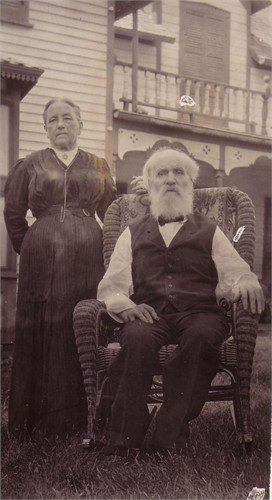
Arthur Reid and Margaret (Ronald) Thomson

Wrapping Up The Journey

After listening to people giving them directions earlier in their journey, the family was not so quick to follow other’s directions.  One person recommended they go to Potosi to Iowa City, and on to Council Bluffs, where they would cross into Nebraska.  They decided to ignore that advice.  Instead, they went further south and crossed the Missouri River at Nebraska City, which was a thriving city of about 2,000 people.  That went well and they continued westward.  They stopped at a log house about 20 miles before their destination.  The next morning, they pressed onward despite the rain.  By nightfall on October 4, 1864, they arrived at the Thomson’s home near Paisley, Nebraska.

Mary would live the rest of her life in the Paisley area.  She lived for a time with her son John who was a bachelor.  Afterward, she lived in a dugout before having a home built.  Her granddaughter Mary Barbara Wallace, who had made the trip from Wisconsin with Mary, stayed with her until she reached age 15.  Later, Mary sold her farm to her grandson Arthur T. Thomson and built a small house near her daughter Margaret Thomson’s home.  She lived there until the last year of her life, which she spent with her daughter Margaret.  She died in 1893 at age 90.


When you are clearing out a house, you might be inclined to just dump old papers that don’t look like they have been touched for decades.  However, before you just dump that box, bag, or drawer of old receipts, newspaper clippings and other papers, take a look at them.  You might be surprised what general history, local history, and family history they hold.  You might even find yourself fascinated by them.


Preserving Everything

My parents preserved many things, but today’s article takes a look at the “paper” they preserved.  Mom was the Newspaper Clipping Queen.  She cut out articles about the family, neighbors, the neighborhood, historic events, and more.  Meanwhile, neither of them got rid of receipts for key items, memorial cards from funerals, invitations, or announcements.  And, they didn’t touch any papers that they inherited.  Thus, I have been going through “paper” for years and for every stack I go through, I only inch closer to being done.

This article touches on a few examples of the things they kept, focusing on local and family history.


Births, Marriages, Deaths, and Interesting Stories

My parents had hundreds, if not thousands, of newspaper clippings.  If you are related to people in Fort Scott, Drywood Township, or Pawnee Township in Bourbon County, Kansas, Mom just may have cut out an article about your family. The challenge with these clippings, in many cases, is to figure out if the people are related to us or not.  This is particularly true of people in mom’s family and the neighborhood where she grew up (Drywood Township), as it seems like most everybody is related in some way.  Even after doing genealogy for nearly 30 years, I still haven’t untangled all of the people that lived in that area.

Newspaper articles are wonderful.  I enjoy them and they have provided facts or clues when I was researching someone.  In some cases, I couldn’t have figured out who someone was without them.  But, what I like most about them is that they bring my ancestors and the people they knew to life.  For instance, the story in the article from 1946 adds so much to the story of the Pellett family.  Like all other families, they were so much more than vital statistics. 


Note: Rufus Pellett was not a direct ancestor.  However, like all the Pelletts in Bourbon County, he was a relative.


Church Records


Church records among the many papers that were in my parents’ home include membership records, church directories, attendance records, and church bulletins. 

My mom’s membership card at what is now the United Methodist Church in Fort Scott is shown.  It appears that she was a member at the church in 1955, if I am reading the date correctly.  That leads to another fun challenge with all the records – reading the handwriting. 

HINT:  If you have a paper record and cannot  read the handwriting, take a photo and enlarge it on your phone/computing device.  Often enlarging it makes it more readable.


Licenses

Hunting & Fishing Licenses

Grandpa Joseph Andrew McCracken’s fishing license tells us that at age 47, he was 5’9” tall, weighed 180 pounds, had blue eyes, and brown hair.  If we didn’t know his date of birth, this license would tell us that he was born about 1894.  His hunting and driver’s licenses tell us similar information, although for some reason his weight, hair color, and height all seem to be variable from license to license.  Still, we get the general idea.


Driver’s License

Grandma Nellie (Peelle) McCracken got a driver’s license in 1931. It is unclear how much it really got used as she much preferred to ride a horse or drive a team of horses than to drive a car.  In any case, it is similar to grandpa’s fishing license in that it tells us similar information about her.  She was  5’4”,  had blue eyes, and light colored hair.  A woman, however, never admits her age or weight.  She did on the license, but I won’t disclose it here.  Her driver’s license also shows her address and gives her signature.

HINT: Licenses and military records are good places to find descriptions of ancestors.


Hardware Receipts

I.E. Morrison

This receipt is especially interesting because it lists both Hiattville and Pawnee as business locations.  There never were many that did business in both towns and receipts from them are few and far between.   In addition, Ester (McCracken) Fisher, Lydia Peelle, and possibly other family members worked at Morrison’s store.


Williams Hardware

This Williams Hardware receipt was written for Baldwin Barker.  It was likely in my parent’s possession because my grandfather was the administrator of Baldwin’s estate.  Also included in my parents papers is a newspaper showing a long list of items to be sold at a sale after Baldwin’s death in 1928.

Of note to the family, Baldwin, his wife, and children lived in the house that I grew up in.


Hills Brother Lumber

The interesting thing about this receipt for lumber is that the lumber company was on the plaza in Fort Scott.  That area was so very interesting. Although I don’t remember this particular business, I do remember going into businesses on the plaza when I was young.

I do not know why the name is McPheron.  That is a total mystery to me.  There were people with that name that lived in Bourbon County at one time.  I don’t know if this purchase was  for someone in that family or if an error was made in the name.”


Banks

Hiattville State Bank

The Hiattville State Bank was formed in 1907 with $10,000 in capital. One of the original stockholders was John Hartnett, who was a first cousin to my great grandmother, Matilda (Jury) Peelle.  John was also the first child born in Hiattville.

The document from Hiattville State Bank is intriguing because it states that the bank is crediting  the account; however, it has no name or account number on the document.


Farlington State Bank


This bank document was from less than three years after the bank was formed on October 25, 1915 by members of the Martin family.  The bank initially had $10,000 in capital, a new brick building, a burglar-proof safe, and a large vault.  However, the bank closed  July 24, 1924, less than ten years after it was  formed.  Elmer Poole, cashier at the bank, was sent to jail for accepting deposits when he knew the bank was insolvent.  However, he was cleared of embezzling funds.

The document is particularly interesting from a family history perspective because it is signed by Grandpa Joseph Andrew McCracken, his father Andrew Johnson McCracken, and his mother-in-law Matilda Peelle, which is a rare combination of signatures.  Also, the interest rate was 8%, which was very common in that era.

Cars

The automobile registration receipts (and there are quite a number of them) tell the story of the vehicles that the family owned over the years.

This example shows that they owned a 1935 Studebaker sedan in 1952.  One thing that was generally consistent is that they tended to own older cars. When Dad was 21, he was driving a 1928 Ford Coupe.  It was as old as he was.

In 1943, Grandpa Jsoseph Andrew McCracken owned a 1933 Plymouth Sedan.  This car had bad tires and Grandpa went to buy a new set. However, before the sale was final the United States entered World War II and the sale of new tires was restricted.  So, the family didn’t get a set of new tires until after the war.


Tax Statements

The tax statement shows the real estate property Joe McCracken owned in 1951, including the acreage and tax.  What surprised me, but shouldn’t have, was that it had the school district listed on the form.  From this tax form, it appears that Rocky Vale ceased to exist, at least ceased to exist as a separate school district, prior to 1951.


So Much More

These records don’t begin to scratch the surface of the many documents that my parents stored for decades.  Other types of  paper documents they kept include photographs, letters, greeting cards (so many of them), various  mortgage and insurance documents, certificates, school records, and legal records.

Among the many receipts are the receipt for the birth of one of Dad’s siblings, the receipt for my mother’s wedding rings, and even for the 1954 Ford tractor.

One of the most interesting is a Jury summons, as it is embossed with a seal.  It is far fancier than the postcards I have gotten.

Last, but not least, an old mimeographed copy of a list of heirs for the probate case of Minnie Alameda (McCracken) Munroe, sister to Andrew Johnson McCracken, may have been the most helpful document of all.  It contained names that I did not know and led me to find that Lemuel Lawrence McCracken, my great-great grandfather, had been married before he married Louisiana Matteer, my great-great grandmother.  I also discovered through that document that Louisiana had also been married prior to their marriage.  Thus, one document from decades ago led me to two branches of family.

So, if you wonder how I know so much about family and local history, it is in part due to my parents and the fact that they never threw out “important” papers!


Sources:  The 50 year ago clipping is from the Fort Scott Tribune.  The one for Kay’s wedding is likely from the same newspaper.


Today, marriages come in many forms from the brief ceremony at the justice of the peace to elaborate events that go well beyond the ceremony.  In the case of my grandmothers, one was married by the probate judge and the other by a member of the clergy.  Both came away with a husband and a beautiful record of their marriage.

Courtship and a wedding


Courtship

Originally named Eleanor, my Grandma McCracken hated that name and to my knowledge no documents were ever issued with that name.  Thus, she officially became known by her nickname, Nellie.  She was a young woman of 18 when she started courting with Joseph Andrew McCracken. 

One of the postcards that they sent each other.

The particulars of Nellie and Joe’s first meeting are unknown.  Nellie lived in Bourbon County and primarily would have attended events at Rocky Vale, Pawnee or Hiattville.  Joe lived in Crawford County with ties to Farlington.  However, they didn’t live too many miles apart.

While courting, they attended events together, but also sent postcards back and forth.  In October of 1912, Nellie sent Joe a postcard reminding him of a party and making sure that he knew she would be there.

Their courting became all at a distance when Joe went out of state to work in the fields.  Based on the letters they wrote to each other, they were very much in love.  Read more about their story in the blog The Locket.


The photo was taken about the time they married.  The dress shown is likely Nellie’s wedding dress.

Marriage

On February 24, 1914, Probate Judge Russell issued a marriage license to them.  Then, at 5 p.m. on March 4, 1914, Rev. E. A. Brown of Pawnee married them at his home.  The Reverend’s wife was the witness.  It is interesting that Rev. Brown married them as he was a Baptist minister and neither of them were Baptist.  Perhaps no Methodist minister was around the area at the time or they were friends with him as he was a young man of about 30 years of age.


Nellie and Joe received the beautiful certificate commemorating their marriage.  It is approximately 18″ by 20″.


Married Life

After their marriage Nellie and Joe set up housekeeping at a house four miles south of Hiattville.  Nine and a half months later Nellie would give birth to the first of their eleven children.

Nellie and Joe were married 46 years before Joe died of heart issues. 


Wedding And a Celebration


Courtship

Dessie was born in Kansas.  However, the family lived both in Kansas and Missouri, mostly very close to Garland, Kansas.  The exception is during a short interval surrounding 1913 when the family went by covered wagon and moved to Oklahoma.  However, they soon returned to Kansas. 

Clifford Claney “Cliff” Pellett was in Scott Township in 1900, but was in Drywood Township by 1905.  He wasn’t, however, a close neighbor of Dessie.

After Dessie’s mother, Sarah (Ashby) Thomas died in 1918, Dessie, being the oldest, spent the next four and a half years raising her younger siblings.  It is unknown how much time she had for courting.  In addition, Cliff was serving in WWI between the fall of 1917 and the summer of 1919. So, unless they were writing letters to each other, they definitely weren’t courting during that time.

However, Dessie definitely new Cliff by October 27, 1921 when Dessie hosted a wiener roast at her Uncle John Ashby’s home, as Cliff was among the large guest list.  That evening included dancing and old fashioned games for entertainment.


Marriage

Clifford & Dessie (Thomas) Pellett and Their Son Marvin

On Saturday, June 2, 1923, Dessie wore a navy blue canton crepe dress with shadow lace when Cliff and her stood before Judge Crider to exchange their wedding vows.  Dessie’s brothers Leland and Delbert were witnesses.


They received the certificate shown above.  It is not as large as the one   my other grandparents received.  Yet, it is still good-size (shown in a 18″ by 20″ frame) and is just as lovely.


They ventured from their home one-half mile south of the Diamond School to Fort Scott on business the following Monday.  One might guess that they needed a few things in order to set up housekeeping.

A couple of weeks later, the Clarksburg Country Club (a.k.a. the Clarksburg Club) gave Dessie a wedding shower at their regular meeting.  The presents were placed in a deep window and the shade drawn to hide them.  Dessie was subject to a rhyming game that led her to the window.  Each gift also had rhymes, which she read out loud to the ladies of the club.  It was said to be enjoyable by all.


Married Life

Eleven and a half-months later, Dessie gave birth to a son. Unfortunately, he died before or shortly after birth.  She would, however, go on to have another son and three daughters.

Dessie and Cliff were married 43 years before Cliff died of heart issues.  However, Dessie would tell you that they were married 18 years.  The reason being that Cliff was in a VA hospital for the remaining years.  Therefore, she didn’t view that they were married since they didn’t live as man and wife during that time.


In earlier years of our country, the call to serve the country often was given to groups of men in various locations.  Thus, it was not uncommon for neighbors and even family members to serve together.  In this case, two brothers served in the same company.


The Brothers

It was September 9, 1861 when William M. Matteer and his younger brother Francis Marien Matteer, brothers of my great-great grandmother Louisiana (Matteer) McCracken, enlisted in the Union Army.  William was not quite 22 and Francis was 20. 

Although living in the southeast corner of Iowa in Lee County, the Matteer brothers signed up with the Missouri Calvary at Warsaw, Illinois, a distance of about 20 miles from their home.  By December 31, the brothers were at Hudson City in Captain Hackney’s Company in the Black Hawk Cavalry.


Service

The Black Hawk Cavalry had been organized between November 14 and December 31, with many of the men from southeast Missouri.  They saw action at Spring Hill on October 27 and did an expedition in mid-December. Early in 1862, units merged and the brothers were both privates in Company D of the 7th Missouri Cavalry.

In May and June, William and Francis were not with their unit as they were on a scouting mission.  When an accounting of the soldiers was done in July, the brothers had returned to their unit.  That month, the 7th Regiment did an expedition in Cass County, Missouri July 9 – July 11.  By July 23, some members of the regiment were engaged in a skirmish at Columbus near Warrensburg, Missouri.  By early August, the regiment was in Independence.


Preparation For Battle

In August 1862, the leaders of the Union Army in Independence, Missouri knew that the Confederates were nearby.  Lt. Col. Buel sent a patrol to locate the Confederates, which were at Lee Summit, in preparation for an attack on the rebels.  Now, if they had taken a look from the top of the Independence Court House, they would have known exactly where the enemy was located, as the Confederates had hoisted their flag up on a pole and it could easily be seen.  However, it is unclear the extent of information the Union soldiers collected about the Confederates. 

The rebels, worried that if they didn’t quickly attack Independence that the Union soldiers would get the upper hand by attacking them, started their own preparations for attack.  Thanks to Quantrill and his guerrillas, the Confederate forces were quite successful in learning about the Union forces in Independence.  Dressed as civilians, they came into the town, walked around freely, and learned the location of all the Union forces.


Surprise Attack At Independence

Despite warnings by locals that the Confederate forces were going to attack, on the evening of August 10, 1862, the Union leaders did not see the need to post mounted pickets to watch the enemy and give warning of an attack.  This proved to be a mistake of huge proportions.

In the pre-dawn hours of August 11, while many of the Union soldiers were asleep in their tents, a multi-pronged attack was launched on Independence.  The union officers were, not only caught completely by surprise, but also had located their headquarters, primary quarters for soldiers, and many of the weapons in a way that made a quick response difficult. 

For instance, Lt. Col. Buell’s headquarters were in the Southern Bank building,  ½ – ¾ a mile from the main soldiers’ quarters.  The Provost Marshal was headquartered in the jail some blocks away. Other leaders were also spread out, such that communication during the attack became nearly impossible.  In addition, the location itself did not offer protection except buildings, trees, and a half-mile long stone fence..


The Fight for Independence

Some of the men were killed and wounded in the initial attack on the sleeping soldiers.  However, while the Confederate soldiers looted the camp, one of the captains pulled his men together behind the stone fence and began to put up a fight. 

Another group of rebels were in the center of town near Lt. Col. Buel’s headquarters before sentries opened fire on them.  Their captain pulled his men together and began to fight.  Still, the enemy forces were able to repeatedly attack the bank building.

Within a few hours, the Confederate forces had trapped Lt. Col. Buel in the bank building and captured the jail where the Provost Marshal was headquartered.  How exactly the  latter location was taken isn’t clear, but one account stated that the rebels used deception and men claimed loyalty to the Union cause to gain access to the building.

At this point, the Confederate troops made multiple attempts to make progress against the Union soldiers.  However, each attempt failed.  One of the Captains was planning to move his men closer to the Lt. Col. to try to free him.  However, the Quantrill threatened to burn the building next to the bank to force Lt. Col. Buel and those with him out into the open.  With this threat and the knowledge that he would not hesitate in doing so even if the Confederate leaders objected, the Lt. Col. Began negotiating a surrender. 

The deal included the surrender of all the Union forces in Independence.  They would be prisoners of war, but would not be handed over to Quantrill and his men, who were known for violence against Union sympathizers.


Surrender

Thus, the Union commander gave the signal to surrender.  About 150 Union soldiers surrendered.  One company avoided capture by breaking through and escaping.  Others also managed to escape capture by hiding or fleeing the area.  Most of the captured soldiers were very quickly paroled by giving their word that they would not fight any more.

The exact number of dead and wounded on each side seems to be a matter of debate.  However, somewhere around 30 – 40 men on each side were killed, including William Matteer. Around 75 of the Union troops were injured during the attack.  Francis Matteer was taken as a prisoner of war after receiving a gunshot wound in his arm.

The biggest win for the rebels was that they filled 20 wagons with arms, 200,000 rounds of ammunition, and other goods.  They also took possession of 300 horses and 65 mules.


Defenses Up!

Meanwhile in Wyandotte County, Kansas, the news of the battle in Independence arrived.  Businesses closed, even saloons, allowing men to prepare to defend the area.  Upon the news, the mayor asked all the able-bodied men to meet at the post office with their weapons.

General Lane even came to speak, creating one of the largest gatherings in the county at that time.  He spoke for almost two hours about the danger the area faced from the rebels.  He reinforced the idea that the local people were going to have to defend the area as they could not count on the government to be able to do it.

The mayor also called for reinforcements from Leavenworth.  Lt. Col. Burris brought four infantry companies and three cavalry companies to assist the locals in defending the area.  Major Ransom also brought his troops.

At the same time that people in Wyandotte County were taking arms to protect themselves, the commander at Kansas City, Missouri was asking them to come to Missouri to help protect the city.  Some men were sent to Kansas City, Missouri.  Others were posted as guards at various locations, particularly near river crossings.  And, everyone was informed that the alarm signal was the ringing of the Congressional Church Bells.

It was two years, however, before a big battle came knocking on their door.  The Battle of Westport (now a neighborhood in Kansas City, Missouri) was a big one.  It is sometimes called the Gettysburg of the West.  And, it led to the Battle of Mine Creek.

Life After The Battle

Suffering from his wound, Francis was discharged at St. Louis, Missouri on September 30, 1862 per special order 88 dated August 25, 1862.  On June 17 of the following year,  Francis filed for a pension with the government over his disability.

In 1864, Francis married Cordelia (Gorgas) Dufer.  Cordelia’s first husband Charles F. Dufer had also been in the Civil War, having served with the 15th Regiment.  He had been wounded in the shoulder at Shiloh, Tennessee on April 6, 1862.  He was discharged a few days later due to his injury.  However, he appears to have died within a matter of months.  Interestingly, Charles Dufer was a brother to Sarah Dufer, who was Lemuel McCracken’s first wife.

Francis and Cordelia had five children, with three surviving infancy, before Francis died at age 33.  Subsequent filings for a pension were made by Cordelia and by Francis’ father Mathias Matteer, who was guardian of Francis and Cordelia’s children.

I do not know if Francis’ death on September 16, 1874 was related to his injury at Independence or not.  The location of Francis and William’s burials is unknown.


Image of the jail: Public Domain, Photographer ecjmartin1,  July 26,  2008