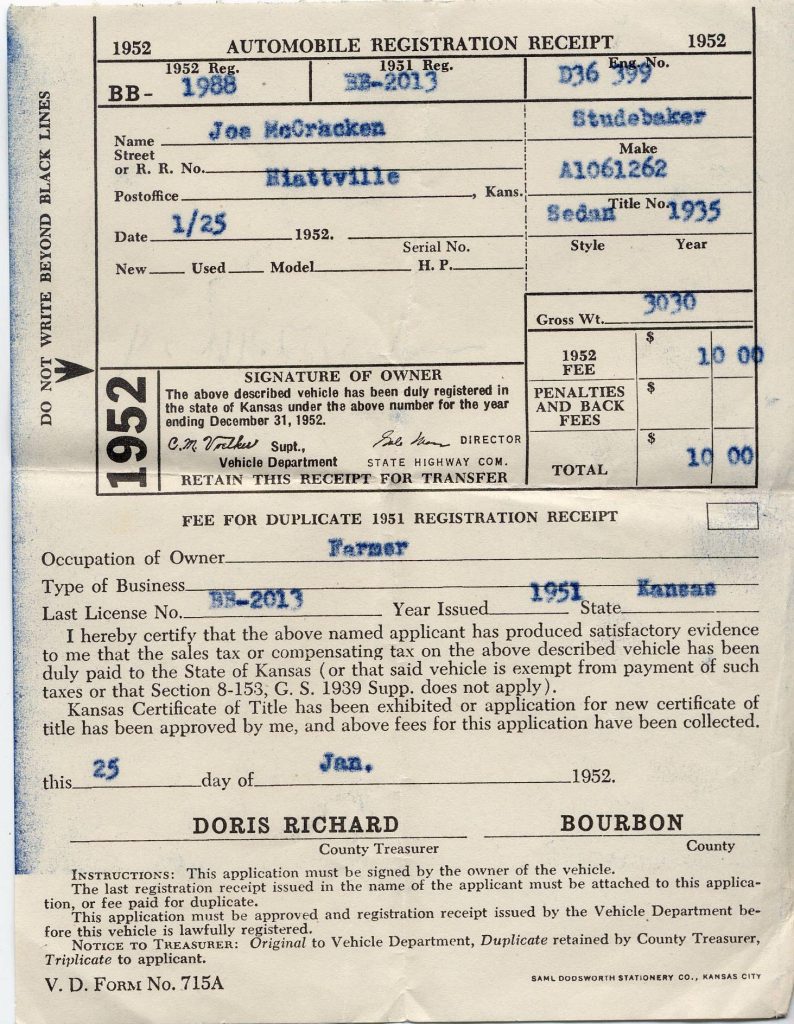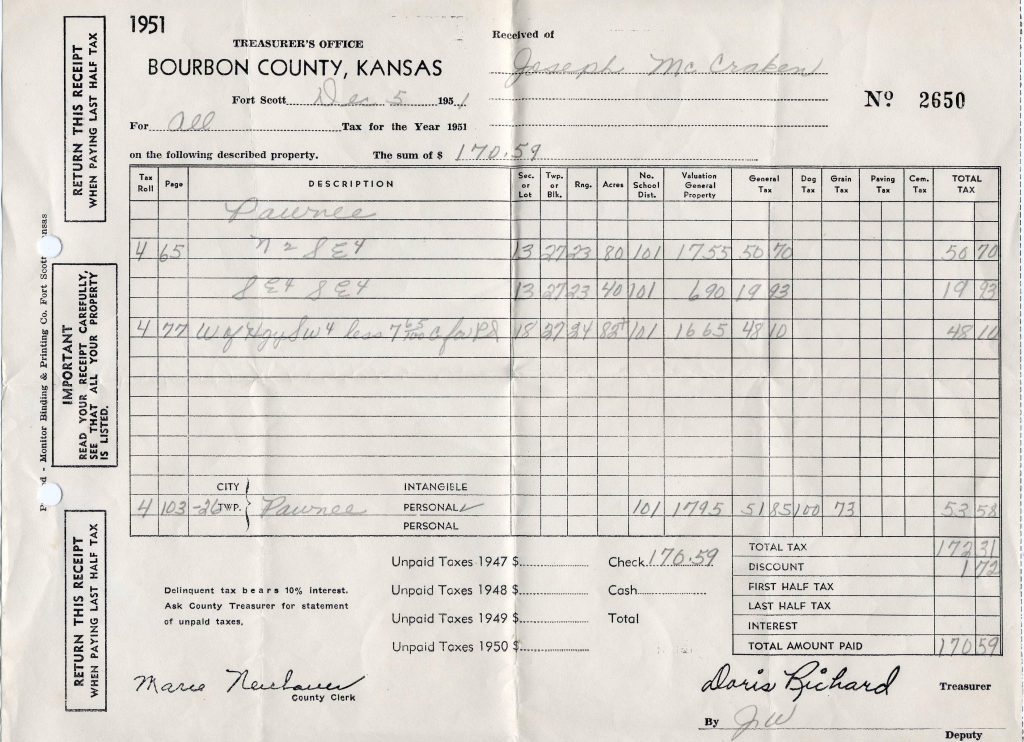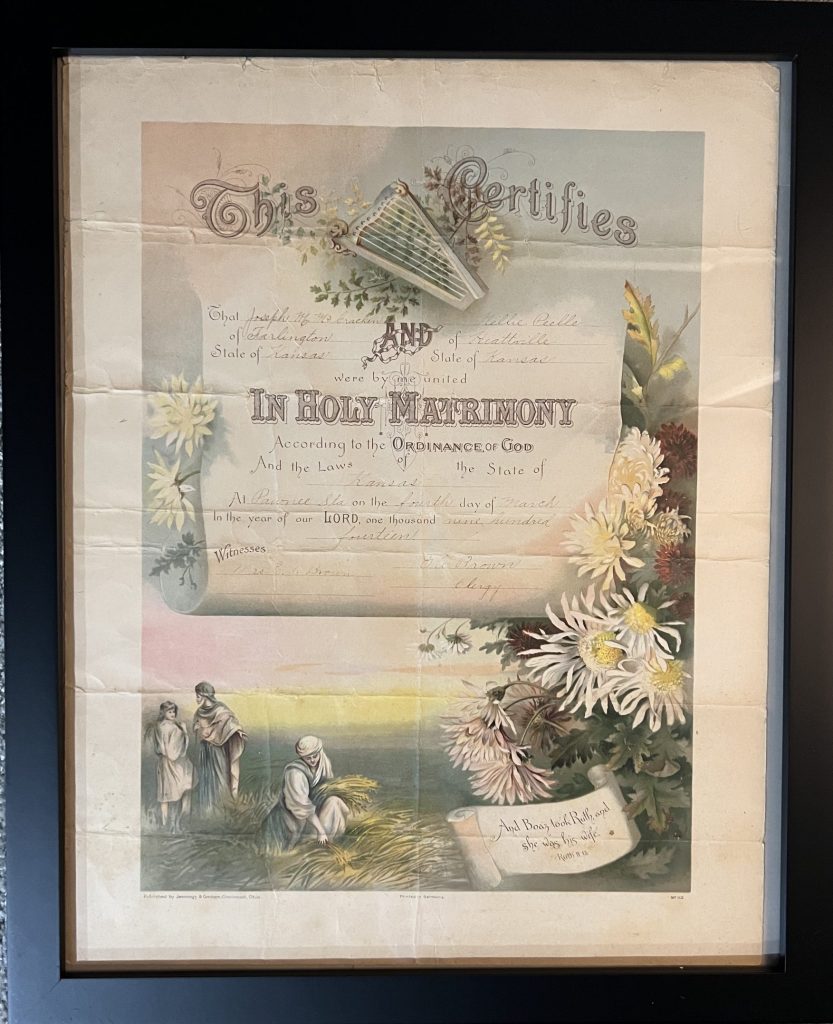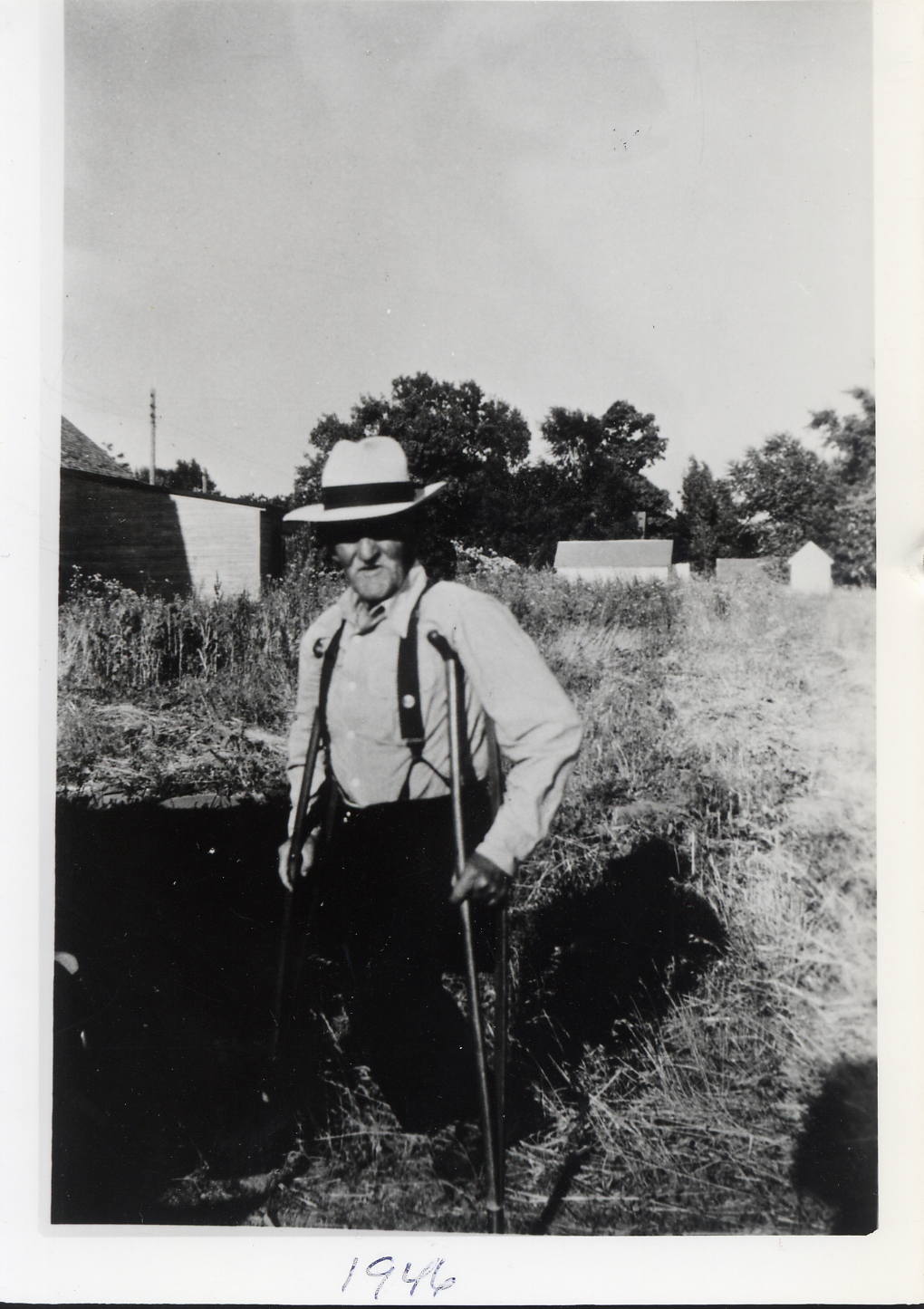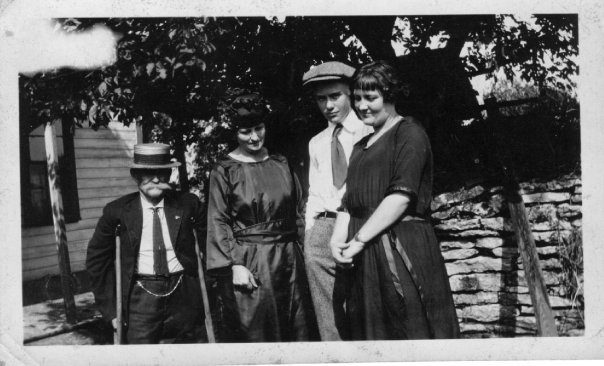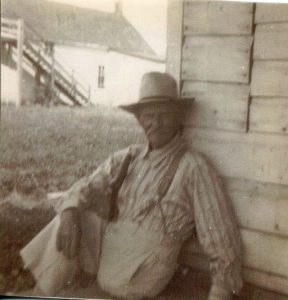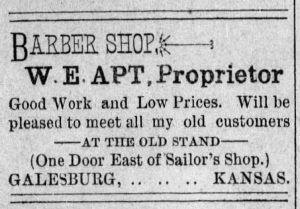
It isn’t unusual for a grandfather to be absent from their grandchildren’s lives.  But, it is rare for a special man to step into his shoes and be adored by his step-grandchildren.


Special Memories

After Andrew Johnson McCracken died at age 53 of a heart attack, Andrew and Rosa (Ellis) McCracken’s grandchildren were left without a grandfather.  Although Andrew and Rosa’s youngest child, Ray Eugene McCracken, was only 10 years old, they already had several grandchildren.  The oldest of the grandchildren were Cora Salyer (daughter of Cynthia McCracken & Vernie Salyer) and O’Ella McCracken (daughter of Joe and Nellie Peelle McCracken). 

Being around five years of age, Cora and O’Ella hadn’t had an opportunity to create a lot of memories with their grandfather.  O’Ella told me that all she really remembered about her “official” grandfather was that one time he took her to his store, which also had counter service, and she got an ice cream cone.  That was quite a treat for a country girl in the late 1910s.


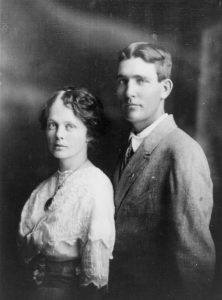
Will Apt, Rosa Ellis McCracken Apt, Ray McCracken, Bell McCracken when Will and Rosa married.

Filling The Grandpa Shoes

It wasn’t until September 22, 1924, four and a half years after Andrew died, that Rosa remarried to William Ellsworth Apt.  Rosa had known Will, as she called him, for years as he had boarded with her sister Martha “Mattie” and her husband Abe Francis since the early to mid-1880s.  They initially lived in Galesburg, Kansas, which Will had lived for many years.  However, they ended up moving to Farlington, Kansas near several of Rosa’s children. 

That move gave many of Andrew and Rosa’s grandchildren the opportunity to get to know their step-grandfather.  Unlike many men thrust into that role, he cherished and enjoyed it.  The grandkids called him “Grandpa Apt” and considered him more than grandma’s husband.  He was grandpa and for most of them, he was the only grandpa that they had ever known.


Fish Stories

Multiple of the grandkids reported that Grandpa Apt was tons of fun.  He would tell the best stories and Grandma Rosa would often say, “Oh, Will!” when overhearing his tales.  He had plenty of practice telling stories as he liked to fish – a lot.  Sometimes the fishing was successful and sometimes it wasn’t.  On May 3, 1901, the Galesburg Enterprise wrote that Will and several other men went to the river to “manufacture fish stories.”

One of the stories he told occurred about a year before Will married Rosa.  Apparently, that day he had two spare hooks baited with grasshoppers attached to his hat.  Somehow he tangled with a tree and the tree caught his hat and pulled it from his head.  Before it could be retrieved, it was dropped into the river and swept away.  Another of the men was fishing further downstream and lo and behold he caught a cat fish wearing Will’s hat!  The fish had got caught on one of the hooks on Will’s hat.  Now, that’s a fish tale! (Adapted from the Chanute Weekly Tribune, August 23, 1923)


The Dentist

Even a trip to the dentist could be a good story if Grandpa Apt was involved.  One time he had a tooth bothering him, but did he say that he had a tooth ache?  No, instead, he said that it “kept him doing a tango on one foot.”  The dentist decided against pulling it and put in a filling.  Apparently, Will found this process quite painful and said that he wanted to kick the furniture out of the dentist’s office.


Travels

However, many of Grandpa Apt’s stories likely came from his travels around Southeast Kansas and beyond.  He was always on the go, typically with friends.  Included were many fishing trips, a little hunting, and lots of events.  One of Grandpa Apt’s favorite things to do was to get a bunch of guys together to go to a baseball game in another town.  However, he also went to races, wrestling matches and more.

In the evening, he attended shows, the opera, and productions, such as, Ben Hur.  In addition, he joined organizations around the region, such as, Modern Woodmen of America and the Eagles, which met in other towns. 

Will was often seen in Erie, Parsons, and Chanute.  However, he would fairly regularly venture to more distant locations, including Ft. Scott, Walnut, Farlington, Kansas City, Rich Hill, Yates Center, Cherryvale, and Baxter Springs.  In 1904, he, along with 11 of his closest friends, packed their bags and hopped a train to the World’s Fair in St. Louis.  Some years later, he vacationed with friends in Galveston, Texas, which he determined was a good place to visit, but he did not want to live there.

In his hometown, Will was a part of the city council, the election board, and helped plan Decoration Day (Memorial Day) and 4th of July celebrations.  All of this kept him busy and on the go.


The Bearded Woman

Among the events Grandpa Apt attended were circuses put on by several different companies.  When the Ringling Brothers were in the area.  He was faced with a decision that could have changed his life.  They offered him a position as the head canvasman where he would have been in charge of putting up and taking down the tents. 

Officially, he turned down the job over a misunderstanding over how much he would be paid.  However, rumor had it that they had just offered him this job as ruse to get him with the circus so that they could convince him to perform as the bearded woman.

You see, Grandpa Apt was handsome, sported facial hair, and was quite diminutive in stature.  It was the perfect combination for the role.


Floating

Another thing that amazed Will’s step-grandchildren was his ability to lay on his back and float with a beer sitting steadily balanced upon his stomach.  Now, this is quite a feat for anyone, but it was especially impressive since Grandpa Apt had only one leg.  Thus, he had to balance his body without the use of two legs to counter-balance each other.


The Illness

I don’t know the entire story of how Will came to lose a leg.  I do know that Will, along with his siblings and his parents Samuel and Elizabeth Apt, moved from Ohio to Kansas about 1871.  A couple of years later when Will was around 11, he was stricken with some illness and was bedridden for around six years.  His illness likely contributed to Will being very short as his body did not get any exercise or sunshine.  In addition, his body was using the fuel it had to fight his illness rather than for growth.


Cemetery Plot

It was during this time that Mount Hope Cemetery (a.k.a. Galesburg Cemetery) was laid out.  Will was in such low condition that a man remarked to Will’s father, “Your son will probably be the first to be buried in it.”  Whether this man’s statement made a difference or not to Samuel is unknown.  However, he purchased one of the first cemetery plots for Will.

Years later when Dad and his brother Don were at Mount Hope looking for Grandpa Apt’s grave, Don mentioned this story.  Dad responded that in that case, they were looking in the wrong place.  They needed to go up to the entrance to the cemetery.


Survival

A doctor, however, decided that his issue had something to do with blood poisoning and that amputating his leg was the only way to possibly save him.  Thus, Will lost his leg, but his life was saved.  Through it all, his personality, positive outlook, and good humor survived.  It was stated that in May 1878 when they loaded the couch he was laying on into a wagon and took him to his brother-in-law’s home that “his joy would nearly equal that of a blind man receiving sight.” (The Head-Light, Thayer, Kansas May 8, 1878)

The illness left Grandpa Apt as a well-functioning addict who still needed the morphine he had taken for years.  He would go to the junk piles looking for old morphine bottles.  Grandpa Apt would then add water to them and swirl it around in hopes that traces of the drug remained in the bottle.

His recovery must have been long.  He had to gain his strength back.  Then he had to learn to walk and do daily activities while using crutches.  Still, he somehow managed  to learn to get around well enough to become the croquet champion of Galesburg.


Making A Living

A Barber

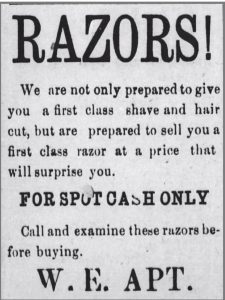
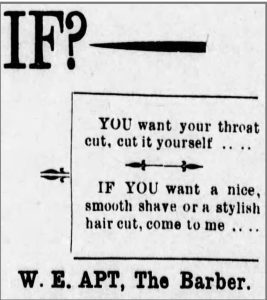
Will, despite being a semi-biped, was a barber for around 45 years.  I am unaware of how Will decided to become a barber, but it seems interesting that he chose a profession where he had to stand on one leg all day.  Of course, he only had a 7th grade education and being a farmer like his father was not an option.

He got around using crutches and there was excitement when he got a set with “rubber wheels.”.  When working in his barber shop he put his “stump” up on a stool, freeing him from the crutches.  He became well-known and was referred to as the resident tonsorial artist, the genial knight of the “razor,” and the painless whisker extractor.


Proprietor

He started barbering sometime prior to 1888 when he opened his own shop on Main Street.  Business must have been slow nine years later when he reduced the price for a shave to 5 cents with a special of 22 for a dollar. 

However, it wasn’t long before he was dressing up his shop.  In July 1901, he got a new chair for his shop.  Then in 1903, he moved his shop to near the Francis home and moved a new building that he bought from a doctor to the lot on Main Street.  The new building was larger and offered more opportunity for business.  That December he added new signage on the door and window.

At the beginning of 1904, he offered a haircut for 20 cents, a shave for 10 cents, a neck shave for 2 cents, sea foam for 15 cents and hair tonic for 10 cents.   In 1905, he also started selling barber related products.  His income allowed him to add new carpet in November 1905 and a new hydraulic chair the following spring.

In May 1911, Will was again renovating his shop.  It was said that with the updates and new fixtures that customers would feel like they were in a big city barbershop.  Yet, he wasn’t done.  The following summer he had the exterior painted with wallpaper and other decorations updated on the interior.  


Landmark

It was a small town and his barber shop was so well known that Will didn’t need to advertise the location.  Matter of fact, the barbershop became a landmark for describing other locations and events in town.  It was also likely a place the men hung out and stories were told.  Given Will’s jolly personality and his story telling to his grandchildren, it seems likely that he was a major contributor to stories told in the barbershop in Galesburg.

Will, himself, was also well-known and considered a top-notch barber.  At least three aspiring barbers apprenticed with him.  In 1915, Will took on a partner, which was likely needed because he was performing barbering services in at least one other town.  It was that same year that he took the barber examination – after being a barber for around 30 years.


Taxi & Auto Livery

For several years Will had a taxi service.  He would take people or things to other towns.  It is unclear how he could be away from the barbershop so often, but it was a small town and he probably just hung up a sign when he was gone.

What was really surprising was that he was driving people around after he got his Ford car in 1914.   Assuming it was a Model T, it would have had three pedals – one for first/neutral/top gear, one for reverse, and one for braking.  Based on the description of how one started to move the car, which included pressing on the gear pedal and the brake simultaneously, it is unclear how he managed to drive with one leg.  It is possible that he had some modification that assisted him in this process.  However, it would have had to have been something other people were comfortable driving, as he also rented out his car.  

Due to extensive business, Will purchased another car a mere two years later.


Not All Care Free

Life as an adult wasn’t all care free for Will.  It seemed that when he became ill that he was out of commission for a week or two.  His ability to fight off illness was likely inhibited by his earlier illness.

Then, in July of 1912, he became very ill and was considered in critical condition.  A couple doctors consulted and decided that a blood vessel/blood vessels had burst.  It was a close call, but Will’s resilience came through and again he recovered.  Another time he had a stomach hemorrhage.  He just seemed to be susceptible to those types of issues.

On a lighter note, he was 62 before he caught himself a lady.  It wasn’t that he wasn’t interested or hadn’t tried.  He went to dances, went a courting, and it was said that he had ladies that had caught his eye.  One time the newspaper even reported that he “goes with Mame Hurt. And they do say that he is Apt to get Hurt.”


Best Substitute Grandpa

When Grandpa Apt stayed with Dad’s family, Dad said that his grandpa would get up really early and hack for what seemed like eternity.  Then when everyone was awakened, he went back to bed.  He was fast asleep by the time they drug themselves out of bed.  Still, Dad said that he couldn’t imagine a better grandpa. 

The man who doctors thought would never see the age of majority, lived to be 85 years, 9 months and 10 days.  And, despite not taking an actual step after age 11, he sure did get around.


I never went to a one room school, but I did attend grade school at a very small town school.  Here is a look at some of the one-room schools in southern Bourbon County and northern Crawford County, Kansas.  The schools included were somehow connected to my family. In addition to the one-room schools, I included a couple of bonus schools with two classrooms instead of one.

Arlington School

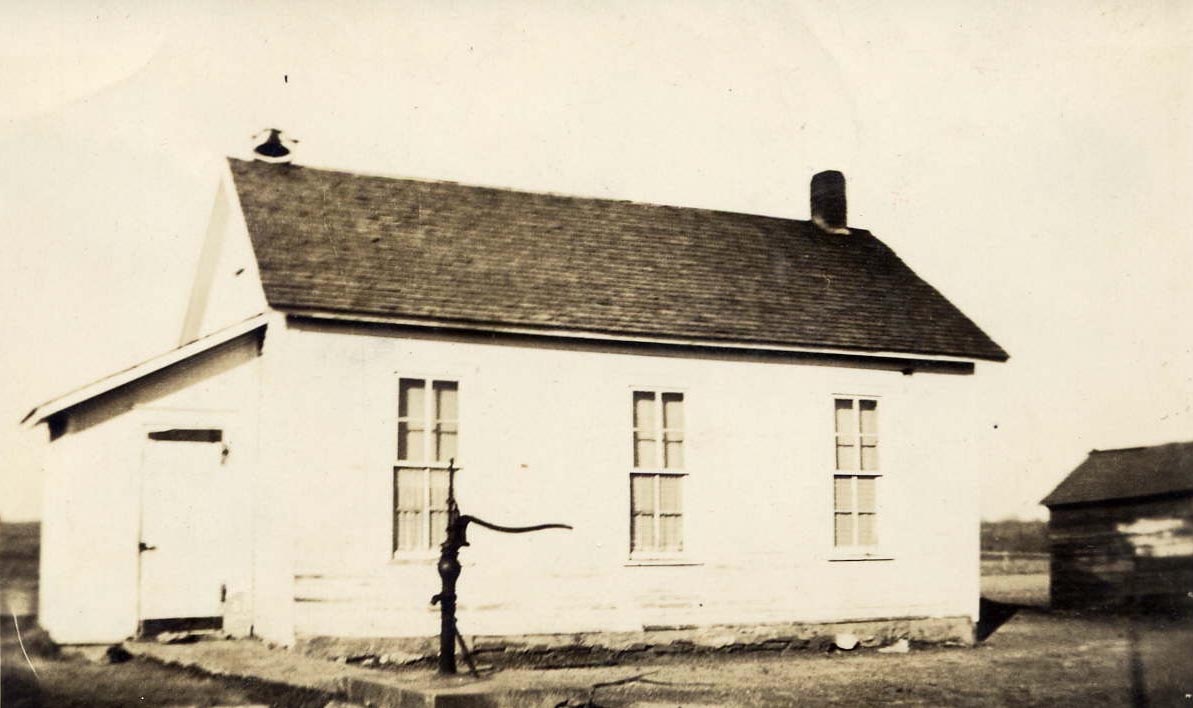
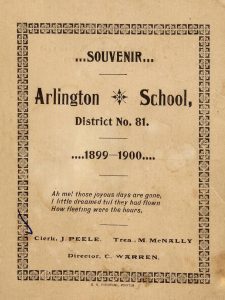
Arlington School, located in Walnut Township, Bourbon County, Kansas was officially school #81.

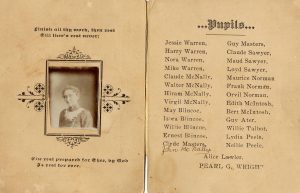
Grandma Nellie and her sister Lydia are listed as pupils in the 1899-1900 school year. The clerk is listed as J. Peele.  We are not aware of a J. Peele that would have been in that area.  Thus, my guess is that it was their father W. J. Peelle.


Bell School


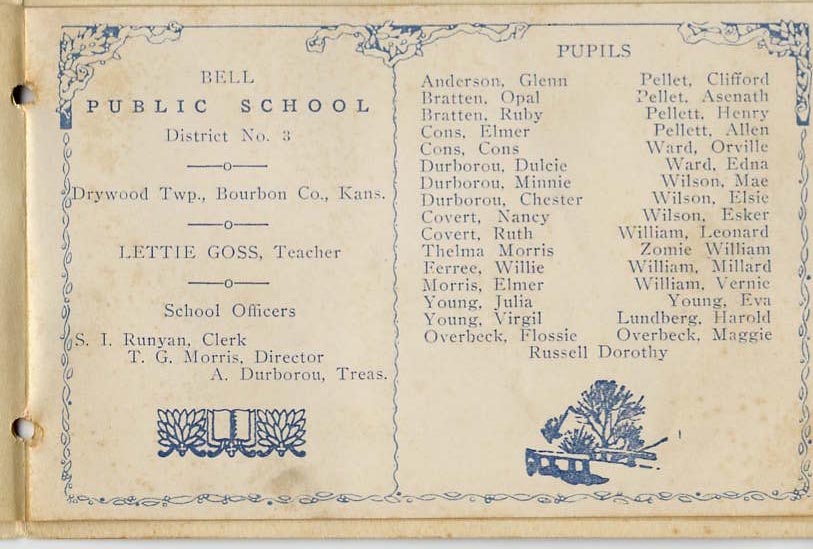
Bell School, District #3,  was named Bell because it had a large bell in the belfry.  It was in Drywood Township in Bourbon County, Kansas.  It originally was located near Appleton along the state line with Missouri. Appleton was absorbed by Memphis and Memphis later became Garland. 

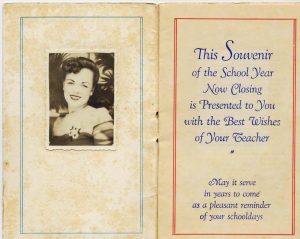
The school souvenir shows that the Pellett family attended this school.

Farlington School


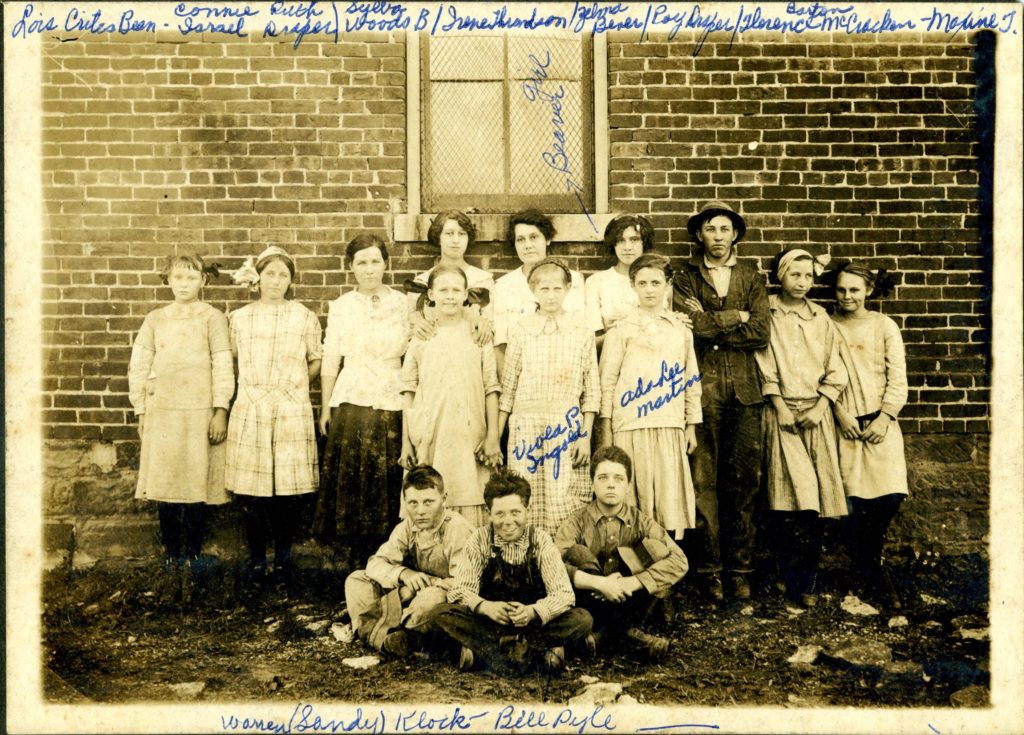
Farlington School wasn’t a single room schoolhouse, but it was a small town school. This is the upper grades. The picture includes Florence McCracken, Andrew McCracken’s niece, and Roy Draper, who married Grandpa Joe McCracken’s sister Bell.


Guinn School

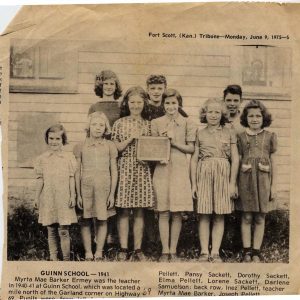
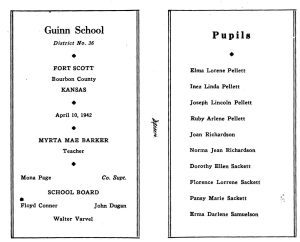
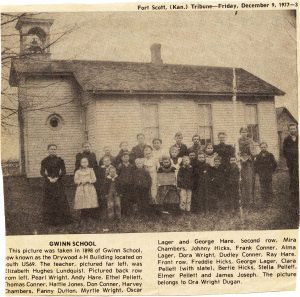
Guinn School is school #36 in Bourbon County, Kansas.  Located in Drywood Township, Guinn was attended by many of mom’s family. The last year for the school was 1942-1943.

Generally, all of the small schools had big end of the year functions.  One year Guinn had a big dinner where everyone brought dishes to share with the crowd.  The students of the school presented a program with singing, dancing, playing of musical instruments, and recitations.  My Uncle Marvin Pellett was among the students performing. 

Additionally, the teacher gave out prizes for spelling, reciting Bible verses, and attendance.  My mom and her two older siblings were among the winners of prizes.  My Uncle Marvin won the award for most improved penmanship.


Floyd Conner listed as a part of the school board was a relative.  The Conner children  had attended Guinn.

Photo is from 1898.  I am likely related to most of the people shown, but am definitely related to the Pellett and Conner families.

Hiattville School

Hiattville School #101 wasn’t technically a one room school as there was an upper room and a lower room.  However, it was a small town school.  Clate Farmer, Grandma Nellie (Peelle) McCracken’s cousin, attended Hiattville School. 


William J. Peelle, my great-grandfather worked on the Hiattville School.  I believe that was the newer school and not Old Hiattville, which is described below.


Old Hiattville District #18  was located north of Hiattville in Pawnee Township, Bourbon County, Kansas.  The school had 25 students in 1896.  Nora Hartnett, Grandma Nellie (Peelle) McCracken’s cousin, received marks of 90 or above  in all subjects for the month ending in February 1896.


Johnson School

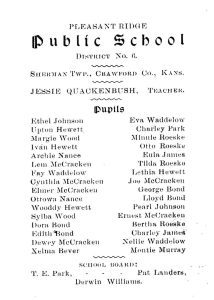
Johnson School, District #6, was in Sherman Township in Crawford County, just south of the Bourbon County line.  Andrew McCracken was the director of Johnson School for several years.


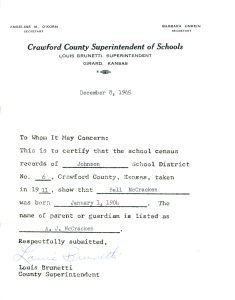
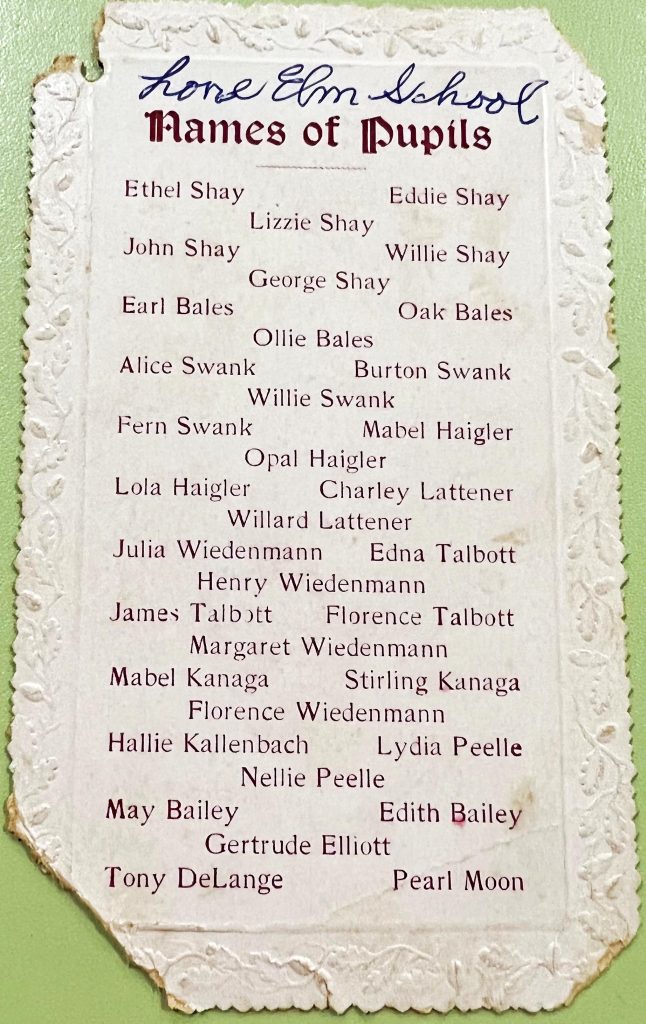
Joe McCracken and his siblings attended District #6.  As you can see, the souvenir booklet  states that this is Pleasant Ridge School.  The letter shows the same school district with the name Johnson School.  Now, I know that they attended more than one school over the years. However, since it gives the same school district in both documents, I believe it is referring to the same school. 


For one period in 1908, Ernest, Doc, and Oella McCracken were all above 90% in personal conduct, attendance, and studies. 


Grandpa Joe likely did not meet the attendance criteria as in the following school year, he attended a few full days and many half days because of farm work.   He missed every day one month because of the harvest.


However, Joe’s conduct was listed as nearly perfect and all his grades except one were in the excellent category 95  to 100.  Those subjects included spelling, reading, writing, arithmetic, physiology,  geography, U.S. history, and Kansas history. His lowest grade was a 94 in Civil Government. 

Lone Elm School

Lone Elm School, District #84, was located in Walnut Township in Bourbon County.  It was a couple miles south and a mile west of where the Peelle family lived and where Don and Kay Davis later lived.
Lone Elm must have been named because there was a single elm tree at the location as in 1891, The Fort Scott Lantern talked about how the district was cultivating some pine trees.

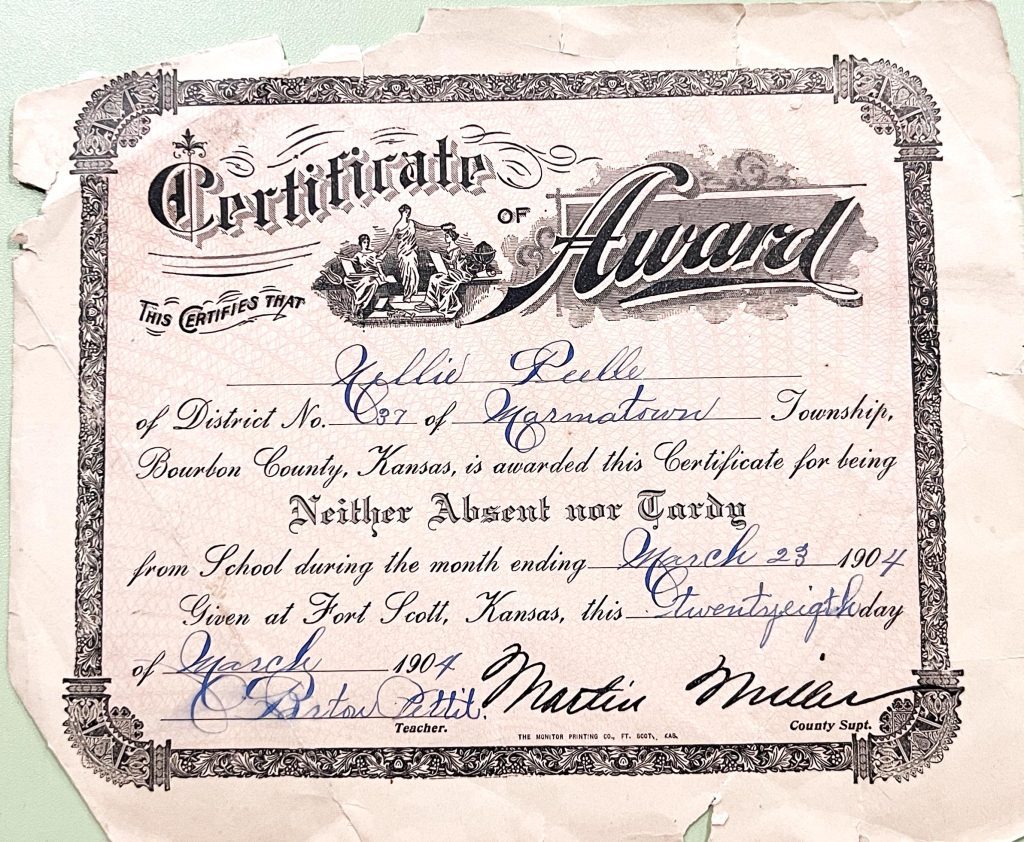
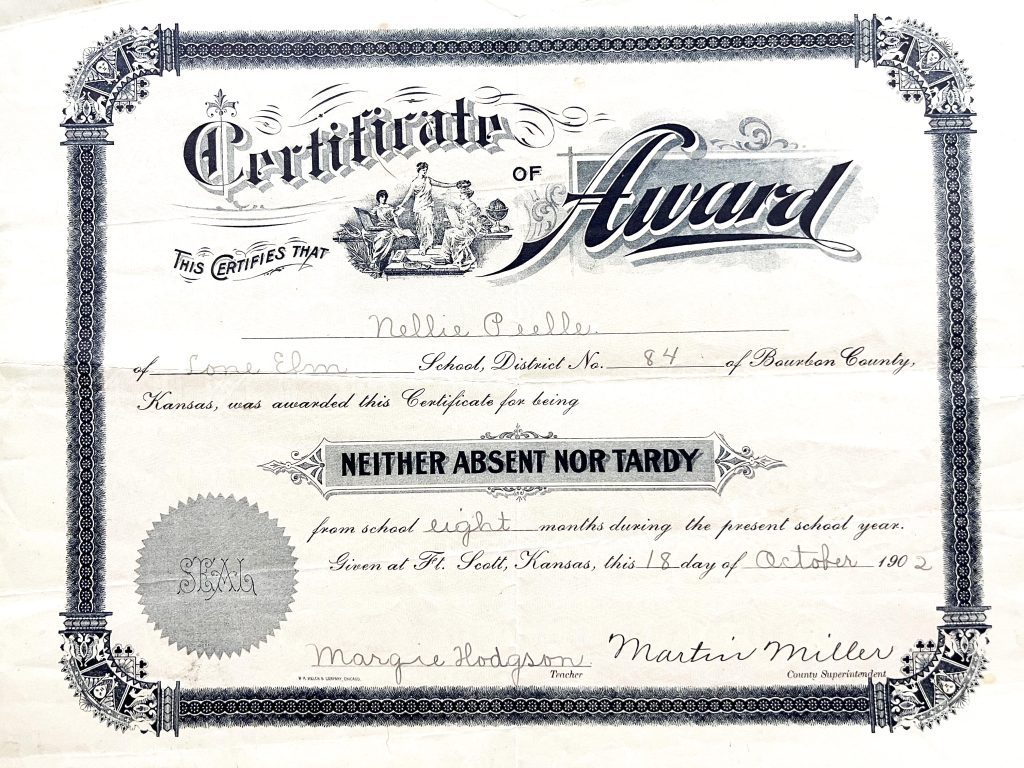
In the 1902-1903 school year, Grandma Nellie (Peelle) McCracken and her sister Lydia Peelle were not tardy or absent during a 6 month period.  Passco Peelle was a visitor at the school.  It is assumed that this is Grandma’s grandfather, but it could have been Grandma’s brother Passco “Pat” Peelle as he would have turned 4 before the end of the school year.


Pawnee

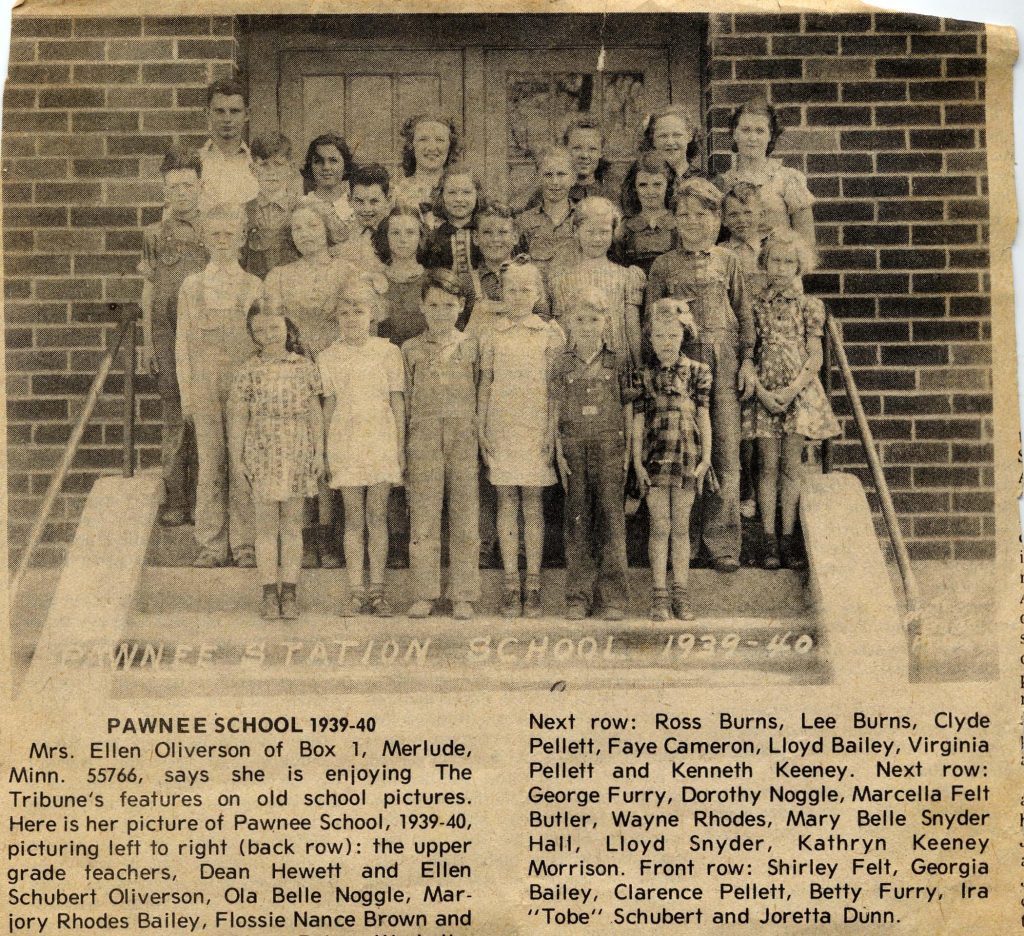
Pawnee School was in what is known as Pawnee, Pawnee Station, or Anna in Pawnee Township, Bourbon County, Kansas.

O’Ella McCracken taught school at Pawnee for two years (1941-1942, 1942-1943).  The photo is from before she  taught at the school.  However, it includes Pellett relatives and the McCrackens’ good friends the Keeney kids.


Pleasant Valley

Pleasant Valley School District #9 was located in Pawnee Township, Bourbon County, Kansas.  It was due north of Pawnee.

In 1891, The Fort Scott Lantern described Pleasant Valley as small, but having “all the characteristics of a wide-awake progressive school.” (I wonder what that meant.)

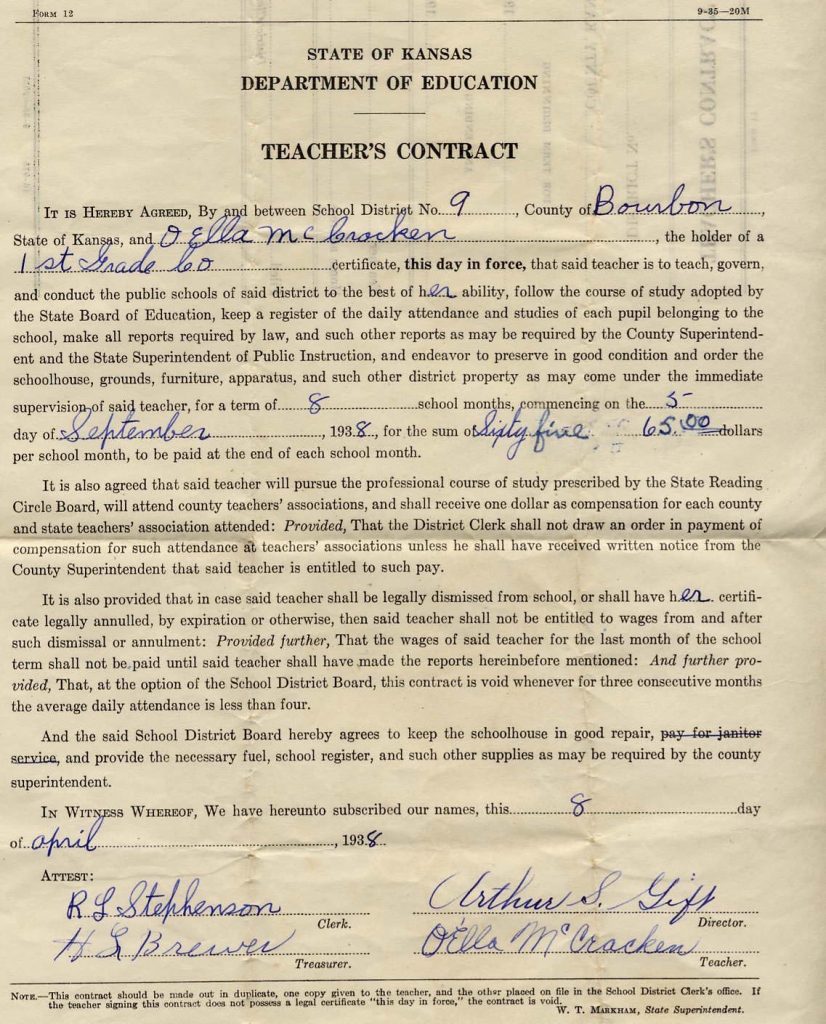
O’Ella (McCracken) Ross taught school  at Pleasant Valley for 4 years (1937-1938, 1938-1939, 1939-1940, 1940-1941).  The contract shown indicates that for the upcoming school year (1938-1939) that she will make $65.00 per school month.


Possum Trot School

I had heard about Possum Trot, but I didn’t think it was a real place.  However, in 1916 Uncle Pat and R. E. Lozier were working on the Possum Trot Schoolhouse.  Later it was Lem McCracken who was working with R. E. Lozier.


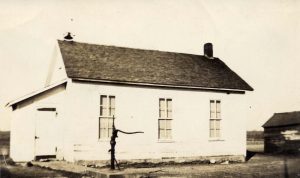
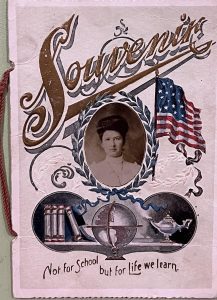
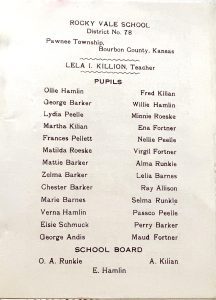
Rocky Vale School


Rocky Vale School #78 was located just north of my dad’s property line in Pawnee Township, Bourbon County, Kansas. 

In 1891, The Fort Scott Lantern describe the Rocky Vale School as small, but “full of life and energy.”

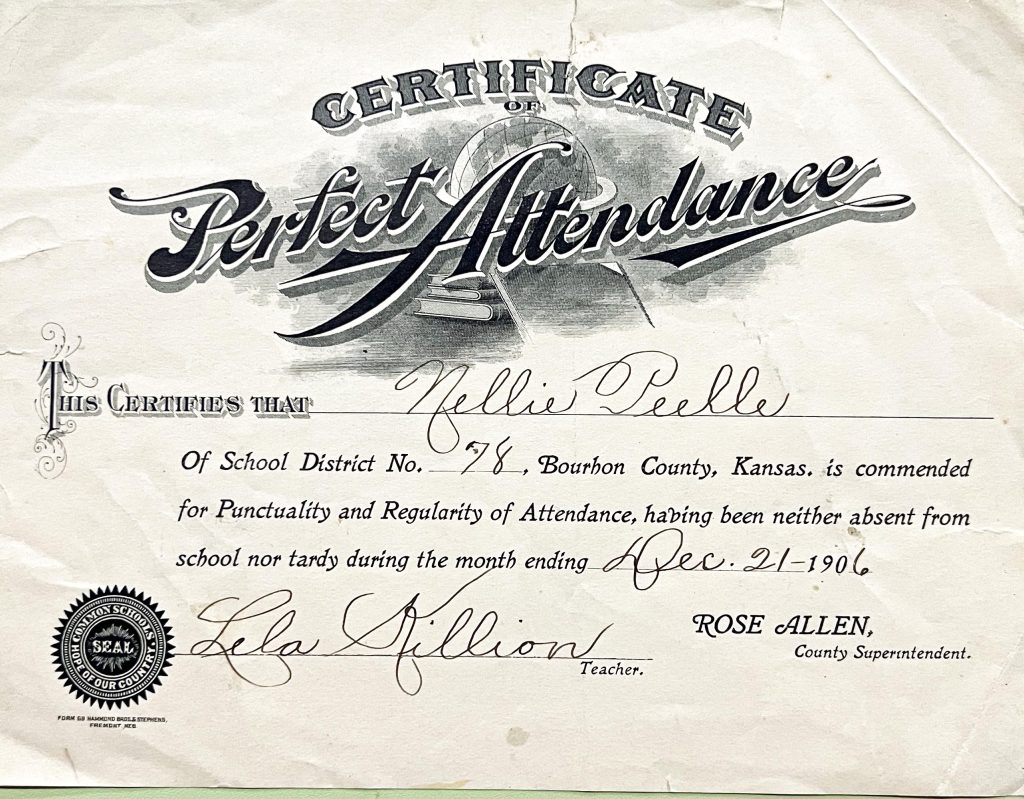
Grandpa Joe McCracken was the director of the school for many years  (20+-) and all his and Grandma Nellie (Peelle) McCracken’s children graduated from there with their 8th grade diploma.


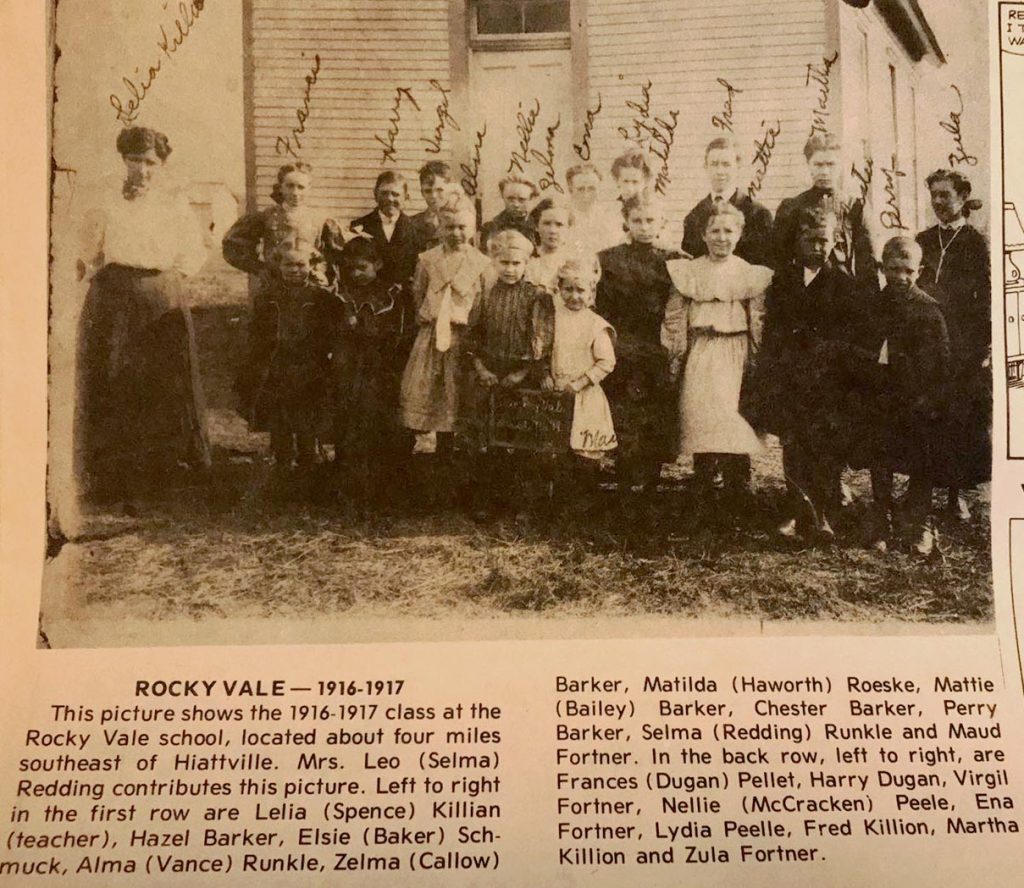
This newspaper clipping states it is the 1916-1917 school year. That is incorrect. It is likely 1906-1907 as Nellie and Lydia Peelle are among the students.
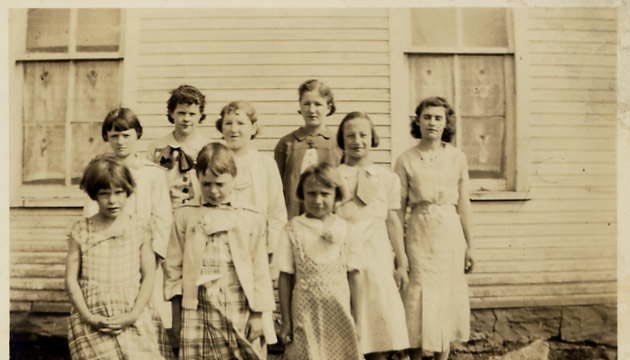
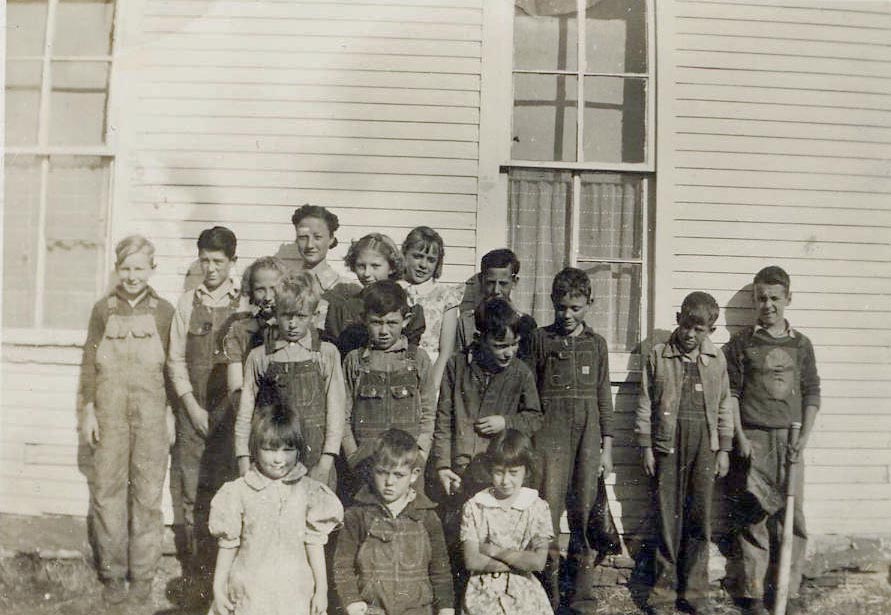
Girls of Rocky Vale. Ruby, Dee, and Ruthe McCracken are among the girls.
Students of Rocky Vale including Ed and Don McCracken.


Teachers at Rocky Vale

  1891-1892 Millie Coffern

  1895-1896 Miltie Preston

  1900-1901 Mr. Owens (Did not finish the year, illness)

  1901-1902 Maud Coghill

   1903-1904 Stella Emmitt

1904-1905 Florence Wiedenman (of Hepler)

1906-1908 Lela Killion

1908-1909 Mabel Boyd

1909-1911 Minnie Roeske

1911-1912 William Bentley

1912-1913 Verna Perry

1916-1917 Nellie Armstrong

1917-1919 Clara Roland

1920-1921 Sarah Runkle

1921-1922 Eugene Kelley

1922-1923 Viola Park

1923-1924 Roy O. Soellner (of Pittsburg)

1924-1925 Pearl Johnson


Later, O’Ella (McCracken) Ross, Dee (McCracken) Burnam, and Don McCracken all taught at Rocky Vale.  O’Ella taught at the school 1933-1935.  Dee only taught there one year in the 1940s.
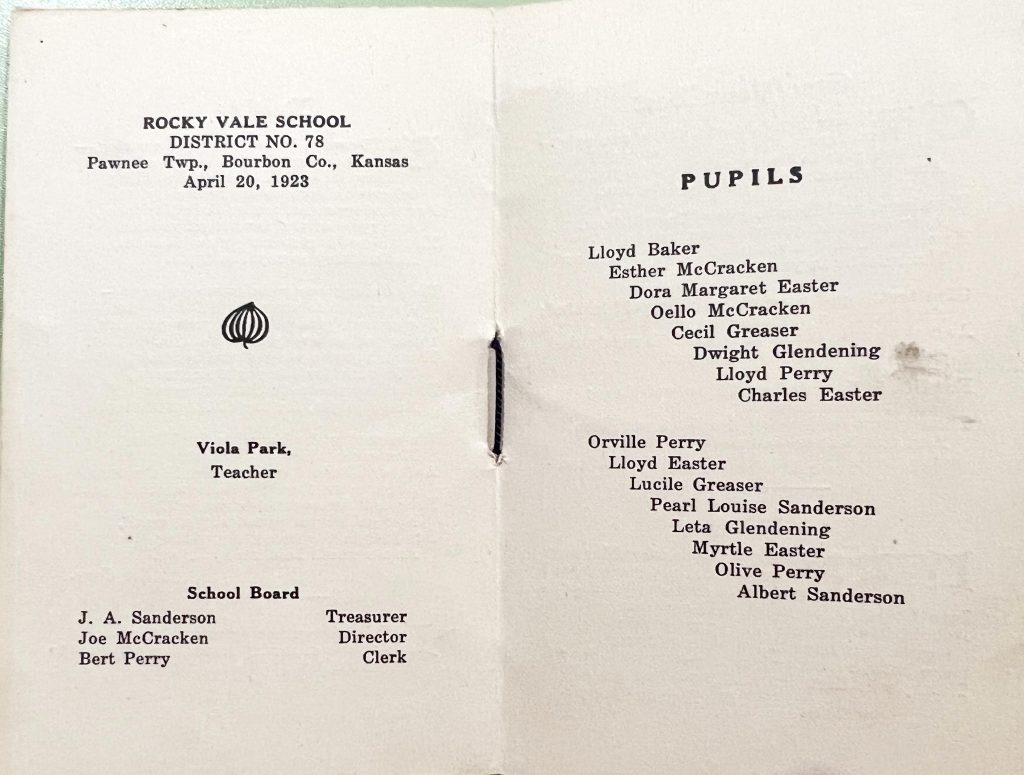
Rocky Vale was the center of their community as were most schoolhouses.  They were more of a community center.  Besides school, the buildings were used for community events, lectures, political groups, elections, preaching, organizations, and more.  Rocky Vale became so much more than a school that the neighborhood had its own items in the newspapers under the name Rocky Vale.  The school and maybe you could say the schoolhouse became the catalyst for creating a community.


Schofield School


Schofield School, District #37, was in Marmaton Township, Bourbon County, Kansas.  It was located almost due north of Hiattville on old Highway 39 just after the highway curved eastward.   The Peelle family lived just down the road from the school after they first moved to Kansas.  In 1883, great-grandpa William J. Peelle’s sister Mossie was one of the favorite performers during an evening of entertainment at the school.

Great-Grandpa W. J. Peelle indicated in his journal that he worked on this school (along with numerous other schools).  The family moved to Hiattville and then west of Hiattville before moving back to this home.

In 1908, the school was a bustling place with Maggie Gift charged with 31 students split almost evenly.  However, the Peelle family had moved to what became known as the Homeplace at what is now Highway 7 & Birch Road.  However, Lydia, Nellie, and Pat Peelle (grandma and her siblings) came to visit on the last day of school.

Years later, O’Ella (McCracken) Ross taught at Schofield School for two years (1935-1936, 1936-1937).


So, what do you do when the guys are haying and they request homemade cookies, but you are out of chocolate chips, nuts, cocoa, and several other cookie making staples?


Hot Summer Day


One hot summer day sometime around 1976 or 1977, Dad, his brother Dewey, and Dewey’s son-in-law Dennis were putting up hay.  At some point, Dad said that they would need some cookies for a snack later in the afternoon and if we didn’t have any, we should make some.


The Cupboard Is Bare


Since we didn’t have any cookies in the house, we looked for ingredients to make cookies.  We didn’t have any chocolate chips, nuts, or oatmeal.  In addition, we had very little or none of several staples needed to make cookies.


The Store Is Bare


We didn’t have time to run to Ft. Scott to get a bunch of ingredients. So, we decided to go to the little store in Hiattville.  It didn’t have a large inventory in those years, but we thought that we might find some packaged cookies that were acceptable or find the ingredients we needed to make some type of cookie. 


Well, that was a bust.  I am not sure if they had any cookies at all, but they definitely didn’t have any that Dad liked.  And, they didn’t have the most needed ingredients.  We did pick up an item or two that we thought we might be able to use.


The Recipe Search


When we got home, we started scouring cookbooks and recipes that mom had clipped from the newspaper and other sources.  We reviewed the recipes to see if there was one where we had all the ingredients or if it could be modified to work with the ingredients we had.  Most recipes could be quickly dismissed.   Finally, we happened upon a recipe from the Ft. Scott Tribune that had been submitted by Mrs. Harry Stites for Brown Sugar Cookies.


Making Hay Day DDDs


The recipe had one key difference from others.  It contained cornflakes and that was something we had in the cupboard.  It contained oatmeal, but we figured that we could cut the recipe in half and leave it out as the recipe made 9 ½ dozen cookies.  Although we knew they would need some energy, we figured that many cookies would be a tad too many.


I don’t remember all the modifications we made to the recipe other than leaving out the oats, one of the sugars, and the nuts.  And, by cutting the recipe in half, it required only a cup of flour and a small amount of other items.  Thus, we finally had a recipe for the ingredients on hand.


A Hit


The cookies were hot out of the oven when the guys were ready for a break.  And, we didn’t have a single complaint about our newly concocted recipe.


Image from pixabay.com


Image: Public domain; Source New York State Archives


Sometime people who were strong believers in God had a hard time practicing their faith even in the land of “freedom of religion.”  Mary and John Tilton, my 9th great grandparents, constantly fought to practice their religion.


Salem, Massachusetts

The Tilton family’s first religious conflict in the Colonies occurred in 1642 when John Tilton, born about 1613 in England, and his wife Mary were living at Lynn, Massachusetts just outside Salem.  Apparently, Mary, Lady Deborah Moody, and another woman stated that they did not believe in the baptizing of infants.  Instead, they believed that people should only be baptized when they were old enough to confess their faith.

This was not in alignment with the views of the Puritans and the Church of Salem.  Thus, the minister that lived next door to Lady Deborah Moody did not approve of their views.  Despite coming to America for religious freedom, the minister and members of the Puritan community still wanted one and only one set of religious beliefs.  They just wanted the accepted beliefs to be their beliefs.

Therefore, the women were charged in court.  The minister saw Lady Moody as the leader in spreading dissenting religious beliefs.  One of the Puritan leaders said that Lady Moody was “a dangerous woman.”  Like others who beliefs were contrary to the Puritan beliefs, Lady Moody was told to change her beliefs or be excommunicated.

Well, being women of strong religious convictions, neither Mary or Lady Deborah Moody changed their beliefs.  They did, however change their location.


New Netherland plus surrounding areas 1685 reprint of 1656 map; Public domain; Via Wikipedia

Gravesend, Long Island, New York

As a result of trouble with the Puritans, John moved his family to New Netherland.  The area later became New York.  Lady Moody and others with similar beliefs made the same move.  The location appeared to be a good option as the Netherlands tolerated different religious beliefs.

As a woman with money and influence, Lady Deborah Moody was the founder of the new area, which she named Gravesend.  It was on Long Island and is in the area known today as Brooklyn.

Gravesend, with John Tilton as town clerk, prospered and so did Lady Moody’s influence, which became very beneficial to Mary and John Tilton, as well as others who shared their beliefs.


Arrival of the Friends

The Friends (a.k.a. Quakers) arrived in New York in the 1650s.  However, before Friends arrived in America, some of the Colonies banned them.  They were disliked for being outspoken about their views and preaching loudly anywhere and everywhere.  Their views of equality for women, refusing to take oaths, etc. were disturbing to those who came before them.  They were considered both too radical and too zealous.  Yet, the Friends just viewed it as being free to practice their beliefs.

Originally, it seems that only Friends who were too open about their beliefs were persecuted; thus, public preaching by ministers that were unapproved or holding conventicles (illegal or unapproved religious meetings) were considered crimes.  However, Governor Stuyvesant soon cracked down on Quakerism, making it illegal to house a Quaker.  It also encouraged the residents to rat on Quaker activities.  The penalties could be downright cruel, including fines, imprisonment, lashings, and hard labor.  At one point, he even proclaimed a day of prayer as he was fearful of God’s judgement if the Quakers converted people to their beliefs.

This wasn’t a new approach for the governor as he strongly supported existing religious law.  He, along with others thought that uniformity was important.  Additionally, many believed that heresy and diversity of thought would result in the wrath of God.  Thus, the governor had previously taken steps to prevent other groups from flourishing in New Amsterdam.  It seems that Governor Stuyvesant, at least, did not live up to the reputation of the Dutch regarding religious tolerance.


More Religious Persecution

Harboring a Quaker

On January 8, 1658, John Tilton was arrested for harboring a female Quaker minister, who had been banished from New Netherland, along with some of her followers.  Two days later, he was sentenced to a 12 pound Flemish fine plus legal fees.  This was one-half the fine of attending a conventicle.  The reason for leniency was that it was his first offense, he was an upstanding resident, and the fact that he claimed the Quaker minister and the others came to his house while he was absent.


The First Banishment

In January 1661, both Mary and John were charged with attending conventicles.  Mary does not seem to have been prosecuted.  However, John was called before the governor and council of New Amsterdam (New York City) because of his support of the Quakers.  He was ordered banished from the area or receive corporal punishment.

However, the banishment never took place.  It has been speculated that John’s standing in the community combined with efforts of a friend who was in good favor with the governor led to this relief.

The sentence of banishment did not deter John and Mary, who continued to align themselves with the Quakers.


The Arrest

On September 19, 1662, complaints were made against John and Mary Tilton, who had both attended and hosted Quaker meetings.  They weren’t arrested, however, until October 5.  At that time,  they were imprisoned at Ft. Amsterdam.


John’s Crime

John was charged with continuing to attend the Quaker meetings and for harboring Quakers and permitting them to quake at his house. By quaking, they meant that the Friends would quiver and quake as they worshiped as a part of fearing God.

The complaint pointed out his earlier offenses, his continued support for the sect, and that he should be made an example since apparently the Quakers easily forgot.  His sentence was a fine of 100 pounds Dutch money.  Plus, he was to stay in prison until his fine and court costs were paid.


Mary’s Punishment

Mary, John’s wife, was charged with being a sorceress, luring and seducing people to join the Friends (Quakers).  Worse, than seducing adults into the faith, they believed she tried to convert young girls.

They claimed that Mary had “dared not only to assist at all the meetings of that abominable sect who are named Quakers, but even has presumed to provide them with lodgings and victuals, and has endeavored to go from house to house, and from one place to the other, and to lure the people, yea, even young girls, to join the Quakers, and already with several succeeded, encouraging and supporting them.” (From the statement to the Director-General and Council of New Netherland.) 

Again, it was believed that she should be made an example in order to prevent others from convincing colonists to move away from what they believed was the “true Church.”  This was viewed as critical.  Otherwise, they believed God would punish the entire colony.  She was also fined 100 pounds plus costs.  In addition, she was to be banished from New Netherland.

Mary’s punishment was harsher than John’s.  It is believed that those in charge were especially harsh on female offenders of any law or rule.  One article told of a woman where they recommended prison for her petticoat simply being too high to be respectable. 


Banishment

Mary’s banishment was delayed until spring of the next year because of winter weather.  An inventory of their belongings was taken and then they were removed from New Amsterdam.

During their banishment, they stayed with friends at Oyster Bay on the other side of Long Island.  Although not far away, Oyster Bay was outside the jurisdiction of the governor of New Amsterdam. 


New York

In 1664, the English gained control of the area and it became New York.  Interestingly, the agreement included that the Dutch were guaranteed freedom of religion.  The very people that had so harshly treated people of other religions now wanted freedom to worship as they chose given that someone else was in control.

Three years after the English took control, John and Mary were back at Gravesend and John returned to his position as town clerk, which he kept until 1681.  John or his son John Jr. became Justice of the Peace.  A bit of an issue occurred when he refused to take the oath of office because it was against his religion.

John and Mary continued to strongly support the Friends and practice their faith.  John signed a letter to the Governor of New York explaining why he and other Quakers did not want to provide funds to repair a fort.  The simple reason was that they were against war.  Later, he gave land for what appears to have been a Friends burial ground.

Mary died in 1683 and John in 1688, both at Gravesend.


Future Generations

Although John and Mary mostly had trouble with their religion not fitting other people’s idea of an acceptable religion, other members of the family sometimes had trouble even following the rules of their own religion.  They were very independent minded and that trait seems to have been passed down through the generations

For example, although their son John Jr. moved to New Jersey, that did not stop him from being arrested for “subscribing to a seditious paper.”  Years later, their great-great granddaughter Patience was disowned (or faced being disowned) because she married out of unity.  She wrote an apology to the Monthly Meeting condemning her actions and requesting to reconcile with the Friends.  Her apology apparently was accepted.

Many others had issues of not doing exactly what the their faith required.  Interestingly, what brought the family to the Quaker faith was differing beliefs.  And, that was what caused them the most trouble with the Quaker faith.

And, this is not the only family in my tree that had a love-hate relationship with religion!


Above Image: Xavier and George Wittmer


What do ice elevators, recording devices for fluid meters, gas meters, and a device for turning bolts and screws have in common?


The Simple Answer


All of these devices were either invented by or had novel enhancements made by the Wittmer family of Pittsburgh, Pennsylvania.  The inventor listed on the patents for these devices were the brothers and nephews of Rod’s 3rd great-grandmother, Elizabeth (Wittmer) Ackerman.


Why such diverse inventions?


Before they came to America, their father Franz Xavier Wittmer had tried his hand at multiple occupations.  He had been a farmer, miner, and a tailor.  He found none of these occupations to be very profitable.  His sons, George and Xavier, carried on in his tradition of searching for profitable business ventures.  Their business focus led the Wittmer family to own and invest in several businesses operating in and around Pittsburgh, Pennsylvania.  Each of these businesses had specific needs and, in all cases, the Wittmer family desired efficiency.


The Companies

Wittmer Ice Company

The first significant company that George and Xavier Wittmer created was the Wittmer Ice Company.  They started their business in 1872 by renting an ice house that was already in existence.  The business was profitable and the brothers purchased a large tract of land.


On that land they made large ponds and built 11 large ice houses.  It was estimated that 20,000 pounds of ice were gathered and stored there each year.


Xavier invented enhancements to ice elevators.  His ice elevator used one continuous chain instead of two and could have a variable number of hooks as needed.  He made four specific claims of invention in his patent granted December 23, 1875.


Wittmer Brick Company 


In 1884, the Wittmers established the Wittmer Brick Company seven miles outside the city.  The hillside had extensive clay deposits, perfect for making bricks.  And, the Pittsburgh and Western Railway ran through the area, perfect for shipping bricks.  The location became known as Wittmer, or sometimes referred to as Wittmer Station.


In 1897, The Clay Worker, the Official Organ of the National Brick Manufacturers’ Association of the United States of America, highlighted Wittmer Brick Company’s brick making process.  It was quite complicated with numerous steps.  They used gas to heat the kilns.  It wasn’t common in the United States, but it was used in Germany, where the Wittmer family originated, for finer pieces, such as terra cotta. 


Wittmer Brick Company – Incline Railway; Adapted from the Clay Worker December 1897.

The Wittmer works also had a novel incline railroad to move the bricks from the kiln to the railroad freight cars, some 25 feet lower.  It was designed so that as a car loaded with bricks comes down to the railroad platform, an empty car is pulled up from the platform to the kiln.  This process was very efficient and greatly decreased the effort required to move the bricks from the kiln to the freight car.


The business was incorporated January 1, 1901.  At the time, the Wittmer Brick Company was all in the family with Xavier, his son, and his brother George’s 3 sons all involved in the business.  George, who was much older than Xavier, was retired.


At the time of incorporation, the company was described as makers of brick, tile, terra cotta, and other similar products.  It was a reorganization of the company as it had stood and had its headquarters in Pittsburgh with the “works” at Wittmer Station.  The primary reason for reorganization was for it to issue stock.


American Natural Gas Company

In 1889, the Wittmers and some of their associates formed the American Natural Gas Company, with the Wittmers having a controlling interest.  The founders all used large amounts of gas in their other businesses that they owned.  They believed it would cost less and be more efficient to go together and create their own gas company rather than their current situation.  The plan was to pay the company to supply themselves, sell gas to others, and profit from it as shareholders.


They started out with 700 acres of land in an area about 10 miles north of Wittmer Station.  They hit their first gusher in July and planned to have pipe laid and operational by the end of the fall.


Xavier’s son George X. Wittmer became the secretary/treasure of the company.  He also invented several devices for use in the gas business.  One of those inventions was a recording apparatus for fluid meters granted December 30, 1902.  It measured both pressure and volume flowing throw it.


In 1925, Xavier’s brother George’s son Henry was running the company and it was valued at $14,000,000 (nearly $250m in today’s dollars).  The following year Wittmer Oil & Gas Properties was formed with Henry as president.   American Natural Gas Company was reorganized and some properties sold off.  It became a subsidiary of Wittmer Oil & Gas Properties.  By this time the Wittmers had or had previously had interests in Pennsylvania, Illinois, Ohio, Kentucky, New York, and Michigan under multiple company names. 


The family sold controlling interest in the company in 1942.


American Telephone Company


The American Telephone Company was chartered in 1897.  Xavier and Henry Wittmer were two of the directors of the company.  Their interest in having a telephone company was to provide communication to their business interests.  Since they had gas right of ways, they could lay the telephone lines in the same area.  Thus, no additional land needed to be acquired or set aside.  Thus, this venture required minimal capital.


The Big Fire


Out of necessity, the Wittmer’s businesses were situated along the Pittsburgh & Western Railway.  Their location provided them ease of shipping their goods, but it would also cause the end to some of their businesses.


On May 19, 1903, a train went down the tracks and a spark flew into a freight car of oats that was near the glass works on the Wittmer property .  Very quickly the fire spread to the glass works.  Before the local people were able to knock the fire down, half of Wittmer had burned.  The Wittmers lost  their brick manufacturing facility and their ice storage houses. 


Profitable


When Xavier died in 1921, he left a $630,000 estate (over $11.5 million in today’s dollars), including a summer home in Atlantic City.  He had invested in his family’s businesses and served as president of their gas and brick companies.  Additionally, Xavier had been a member of the board and a vice-president of North American Savings Company.  It was formed in 1901 and grew from $350,000 in capital to $2,000,000 in a couple of years.  Similarly, he had become a member of the board and vice-president of Merchants Savings & Trust when it was formed in 1903.


Xavier and George had achieved their father’s vision of a successful business by creating new businesses, creating new technology to support those businesses, and by grooming their sons to work with them and carry on those businesses.