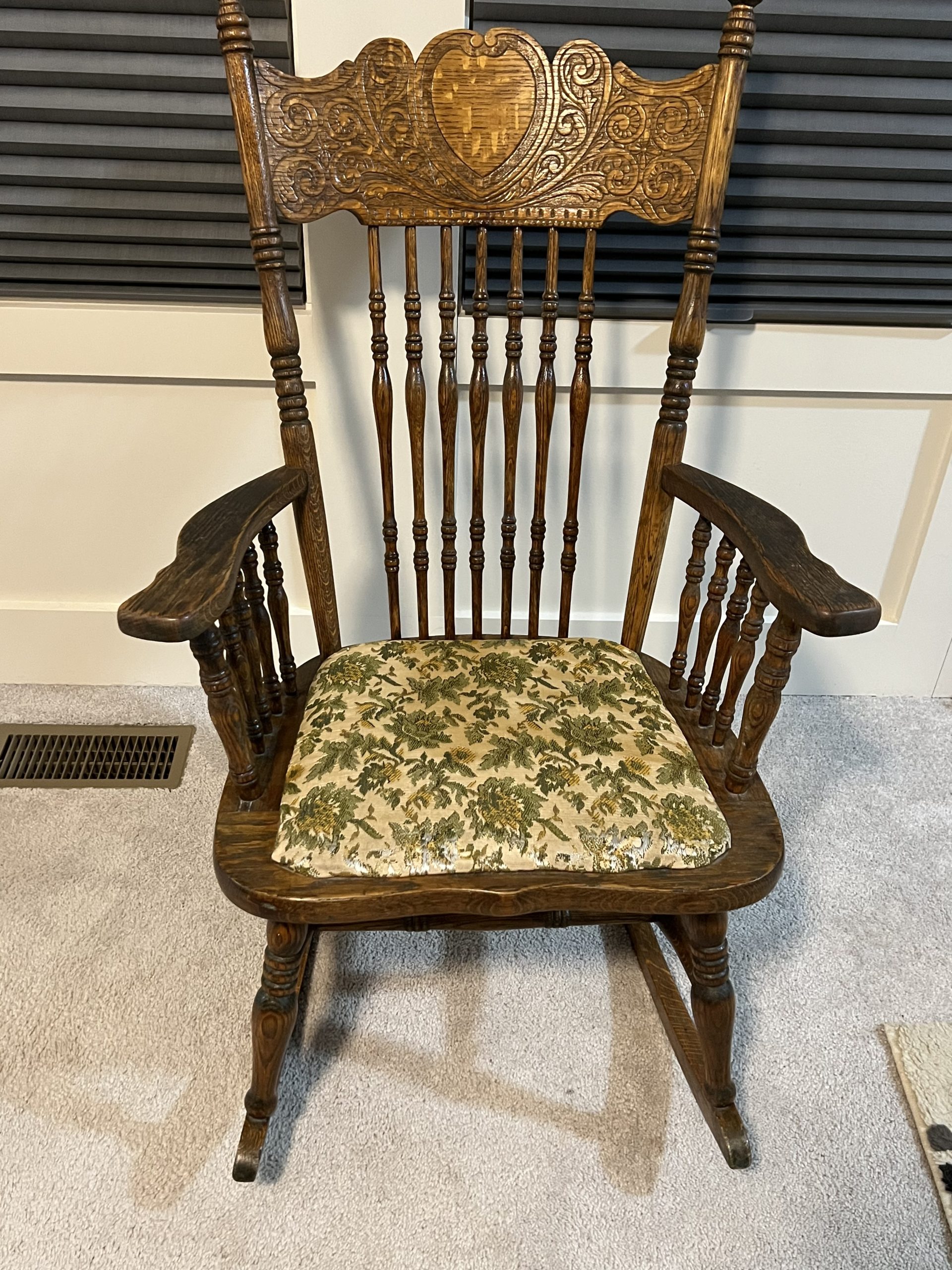
My Grandma Dessie May (Thomas) Pellett’s rocking chair is likely my oldest piece of furniture. If the conclusion by grok (AI) is accurate, it is “a classic Victorian-era Eastlake-style spindle rocker” made by New York Wire and Spring Company in 1888.
Memories
Always There
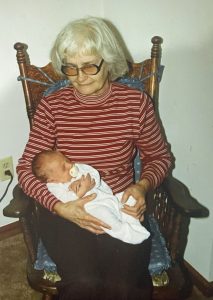
Grandma had an old wooden rocking chair. It seems like she always had that chair and I definitely don’t remember it suddenly arriving in her home. That said, I don’t know when she got the chair. It is possible that it was her mother’s rocker or that it belonged to her husband Clifford Claney Pellett’s family. Other possibilities are that she bought it at a sale or it was given to her by a neighbor or family member.
If I had realized the age of the rocker, I would have asked about its history. As it was, it just seemed like and old rocking chair and I liked sitting in it when I visited.
How did it survive
Most rockers of this age haven’t survived and it is amazing that this one did. For a time, it was painted blue-green. Afterwards, it was refinished, but not by an expert. Traces of paint are still visible, especially in the less obvious locations. Probably around the time it was refinished, a new seat was put in.
In addition, the rocker wasn’t always in the house. For a period of the time it sat on my grandma’s back porch. Kansas weather, even when sheltered by a roof, is really hard on wood furniture. However, it survived it all.
My Rocker
My grandmother gave her old rocker to me many years ago. I used it when each of my sons were born and it has traveled with me from house to house. In our move to Kansas City, I was heart-broken when one of the rockers broke. Based on where and how it broke, I didn’t think there was any way that it could be fixed without the “fix” being obvious. However, the moving company hired an amazing company that restores antique wood items. They fixed the rocker and most people would ever know. Today, it has the perfect spot in our home. And, no, I have never sat it outside.
Identifying The Rocker
Since I was going to write about the rocker, I thought I would try to learn more about it. I didn’t know if anything could be learned about it, but I thought it was worth a try. So, I started exploring using three different AI tools: Chatgpt, Gemini, and grok. I provided photos and asked questions. For this specific task, grok seemed to dig into the details the quickest. Thus, the results shown below are based primarily on its responses.
Initial Assessment.
It was initially determined to be “a classic Victorian-era Eastlake-style spindle rocker” and a wide range of years was given. However, various characteristics of the rocking chair helped narrow down the date of production to 1888. In some instances, a series of questions and/or photos were used to ensure we had the right time period.
 The Maker
 The Maker
In general, the design of rockers changed over time and a general timeline could be created based on those attributes. However, the most critical attribute to determine a specific year of the rocker was identifying the company that made it.
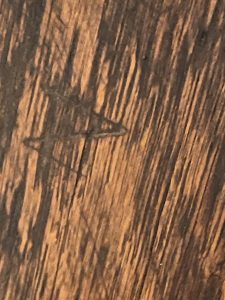
Grok gave guidance on locations where a maker’s mark might have been place. One location was on the underneath of the seat. This is where a one-inch high “N” was found. This was the mark of the New York Wire and Spring Company. They had used “NYW&S” and a single “N.” However, they soon opted for a smaller “NYW&S” as their maker’s mark. This change in their makers mark helped narrow down the years that it might have been manufactured.
 Heart design
 Heart design
The heart design on the back of the chair is actually quite elaborate with floral type swirls in addition to the heart. Many manufacturers made heart designs. NYW&S made multiple designs with hearts. One had a single heart and another had a heart with simple geometric patterns.
Wood
Rocking chairs of this general type were often made of oak or maple. The wood grain helped determine that the chair was made of quarter-sawn white oak. Not all of NYW & S rockers were made of this specific wood. Many were made of a mix of oaks. Again, this factored into determining the specific year and model of the chair.
The grain of the wood was critical in determining that it isn’t a cheap copy. Imitations typically use pine, which appears completely different.
Rush Notches
The original seat is long gone. It has been replaced by a padded seat covered in fabric. However, the under side of the seat provides enough information to determine the type of seat that the rocking chair originally had.
On the underside of the rocker next to the hole that contained the original seat are two notches. Those indicate that it originally had a “rush seat.” This type of seat was made from “dried stems of the Junucus effusus plant.” They were woven in a “seven-strand envelope weave.” It would have been in a clockwise spiral with no knots visible on the upper side, creating a herringbone pattern with distinctive diagonal ridges.
Shape of the rocker
 Shape of the rocker
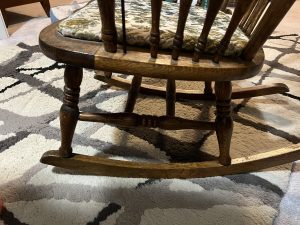
One very important attributes is dating the rocking chair was the shape of the rockers under the chair. The rockers turn upward at each end. They are described as having ski-tips.
Attributes of the arm posts
The arm posts of NYW&S’ rocking chairs varied. Some were plain, some bulbous, and others “acorn” shaped. Grok felt that this chair fell into the latter category. This was also critical in determining the age of the rocker.
Spindles on back
The shape of the spindles that create the back of the chair helps determine the date and model of the chair. However, the number of spindles are also very important because NYW&S Co. only made rocking chairs with seven spindles of this type in 1888 and 1889.
Determining the Year and Model
When the time period of all the attributes were considered, 1888 was the only year that the NYW&S Co. made a style of rocking chair that included all of the attributes of Grandma’s rocker:
- Ski tip rockers
- Seven spindles
- A heart design with floral swirls
- Acorn supports
- Rush notches (Rush seat)
- “N” makers mark
- White oak
Fortunately, a catalog from 1888 survived. From the catalog, grok learned that was a Model 88-H (Fancy/No. 1) that sold for $7. It was an expensive rocking chair costing $1.50 more than the most expensive option from 1887 and 75¢ more than the 1889 option.
My Thoughts
I treasured the rocker before I researched it and I am glad to know more about its history. Based on the fact the rocker was considered a high-end model and cost more than others at that time, I think it is most likely that Grandma bought it used. I just don’t see either family spending any significant amount of money on a rocking chair.
If it had the original finish, was fully restored, and was in perfect condition (which it isn’t), grok claims it could be valued as high as $2900. As is, it is not monetarily valuable. Instead, it is what it has always been, a chair that I like to sit in.