What does a signature have to say about you? I started saving signatures of relatives several years ago. This article explores the signatures of some direct ancestors of my husband and myself.
Just Initials
In bygone days, it was common for men’s signatures to include only the initials of their given names and their surname. Many documents and news articles were written also without the man’s first name, which can make researching families with similar initials difficult.
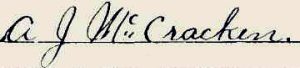
Both of the following men used their initials at times. Occasionally, Andrew is found with is name as Andy. The way he wrote McCracken is sometimes misunderstood by transcribers. Thus, the name sometimes becomes Cracken in indexes.
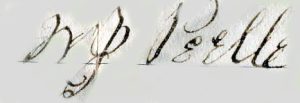
William was known as William, W J, and Will. His signature is also interesting because it contains both cursive and fancy print.
Andrew Johnson “Andy” McCracken
William Johnson Peelle
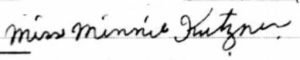
The following signatures of women show how they often defined themselves by their marriage or lack there of. Both Blanche and Donna signed with their husband’s name while Minnie indicated that she was not married.
Blanche (Klinefelter) Thomson

Donna (Van Allen) Thomson
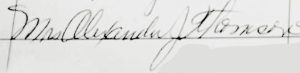
Minnie (Kutzner) Helm
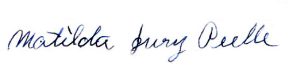
Not all women identified their marital status in their signature. Interestingly, however, in the examples below, Matilda signed with her maiden name as a middle name.
Nellie signed with the name she was always called. However, it wasn’t her birth name. Her name at birth was Eleanor. It was the name of her great-grandmother and her great-aunt. Both of those women had been major influences in her mother’s life and she likely wanted to honor them. However, Nellie did not like the name Eleanor. And, since she was called Nellie when she was young, the name stuck. To my knowledge no documentation exists that uses her birth name.
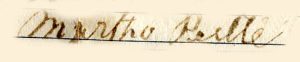
Martha was born in 1826 and I believe she signed the source document after 1900.
Matilda (Jury) Peelle
Nellie (Peelle) McCracken

Martha (Johnson) Peelle
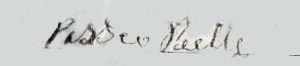
The following signatures show three different styles of signature. One with a first name only, one with a first name and middle initial, and one with the full name. Those with a full name are typically found on draft registrations, although not all draft registrations are signed with the full name.
Passco Peelle
Willis Alexander Conner

Clifford Claney Pellett
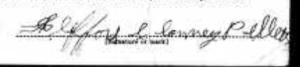
The following are additional signatures where the men signed their full name on draft registrations. It is likely that this was not their standard signature.
Alexander Joseph Thomson

James William “Will” Thomas

Herbert James Thomson

The following examples show how different a given person’s signatures can be. In both cases, the first signature had an abbreviated form of their the first name. The second signature is a full signature with all three names.
The odd thing in the case of Jake Helm is that when he signed his full name, he still used Jake instead of Jacob. In addition, he wrote his name as “Jake Phillip Helm.” However, his name as recorded on his baptism record was “Phillip Jacob Helm.”
It was tradition in Germany, the Helm family’s homeland, to call people by their middle name. In many cases, the boys all had the same first name and all the girls had the same first name. Each being named after their father or mother according to gender. This family did not go so far as to name all the children that way. However, they did have multiple sons named Johann. And, Jake couldn’t be Phillip because he had an older brother Johann Phillip, who later went by Phillip John. And, yes, German traditions are confusing, but they are much more so when intermixed with American traditions.
With regards to Joe McCracken, he generally signed his name as “Joe McCracken.” Thus, signing with the full name would not have been natural for him. That is likely the case for most people.
Phillip Jacob “Jake” Helm
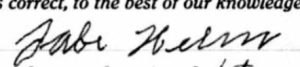

Joseph Andrew McCracken


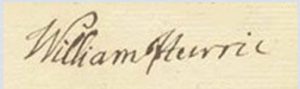
And, last, but not least, the oldest signature of a direct ancestor that I have collected. It is the signature from William Hurrie, the ringer of the Liberty Bell. It is on a document acknowledging receipt of a payment authorized by John Bayard, speaker of the Pennsylvania Assembly.
Another interesting thing about William’s signature is that unlike the others, he most likely learned to write in Scotland or England before immigrating to the United States. He spells his name “Hurrie.” Meanwhile, others that appear to be related or associated with him spelled their name “Hurry.” Records intermix the spellings and his gravestone spells it as “Hurry.” However, this shows the spelling that he used.
William Hurrie
Featured Image: Credit to StockSnap via pixabay.com
Prompt: Written
#52ancestors52weeks