Susannah Johnson’s 1819 will is quite lengthy and quite interesting, detailing every dress and providing for several slaves. Where did she get all of these possessions? Why didn’t they simple go to her husband? Well, she had inherited money and possessions from her first husband and from her father. And, when she re-married, she had a pre-nup!
Who was Susannah Johnson?
Johnson was Susannah’s married name. Susannah was born in the mid-1700s in Virginia. She was the daughter of Abraham and Rebecca Marshall (Davis) Lewis, my 6th great grandparents.
Marriage to John Butcher
Susannah married John Butcher, son of Samuel Butcher, in Virginia in 1779. John died in 1805, leaving her without any offspring. However, he left her his plantation (farm) in Loudon County, Virginia, horses, livestock, wagon, farming utensils, corn for the animals, and fourteen barrels of flour. She was also to retain all the household furniture and Lishay(?), a slave. The only caveat was that upon her death the plantation was to go to the church that had been known as Butcher’s Meeting and was now known as Ebenezer’s Meeting.
Susannah was also one of the executors of her husband’s will.
In addition to her inheritance from john Butcher, Susannah had inherited £15 after her father died. After both parents died, she was entitled to one quarter of the land her father owned after other distributions.
Marriage to Jessie Johnson
Shortly after John died, Susannah married Jesse Johnson. Unlike many situations where a woman with property married and the husband gained the property, Susannah retained her property, both personal and land, when she married Jesse. This was done via a legal agreement that today we would called a pre-nup. It was focused solely on Susannah retaining all of the property that she had. Matter of fact, the document went on to say that if she should die without a will that her property was to be distributed according to inheritance rules that would have applied if she hadn’t been married.
Some of the items in Susannah’s possession at the time of the pre-nup:
- One female slave
- One “negro” boy named Vincent and one girl named Linah. Both were approximately 16 years of age.
- One wagon and two horses
- Household furniture
- Land in the state of Virginia of approximately 250 acres
- Land in Madison County, Kentucky
- 3 Horses
- $400 in the hands of the man who was helping her manage his estate
Susannah’s Will
Because of the pre-nup agreement, Jesse didn’t automatically get any of Susannah’s estate. However, she did include him, giving him horse, a bed, first choice of furniture, and all the farming utensils.
 Kentucky Bank Shares
 Kentucky Bank Shares
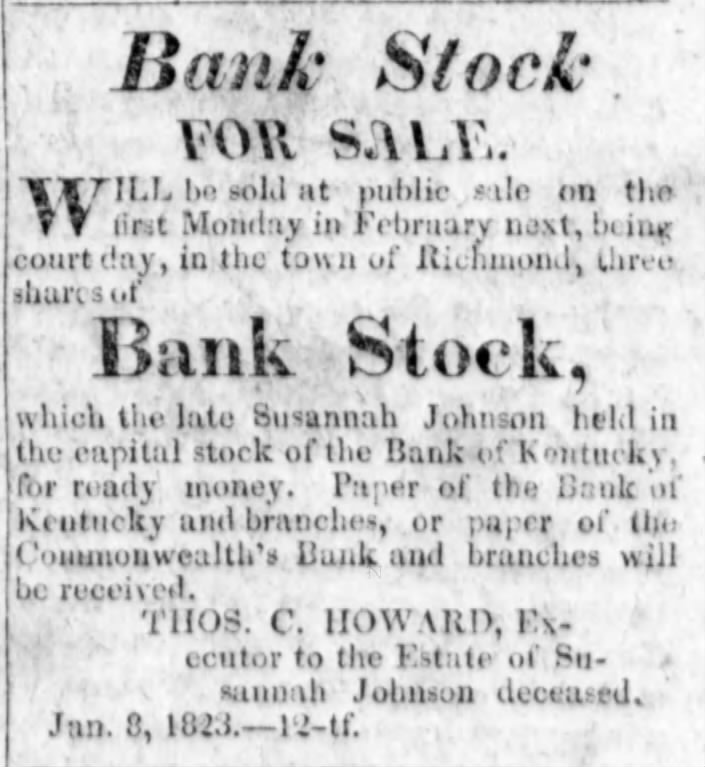
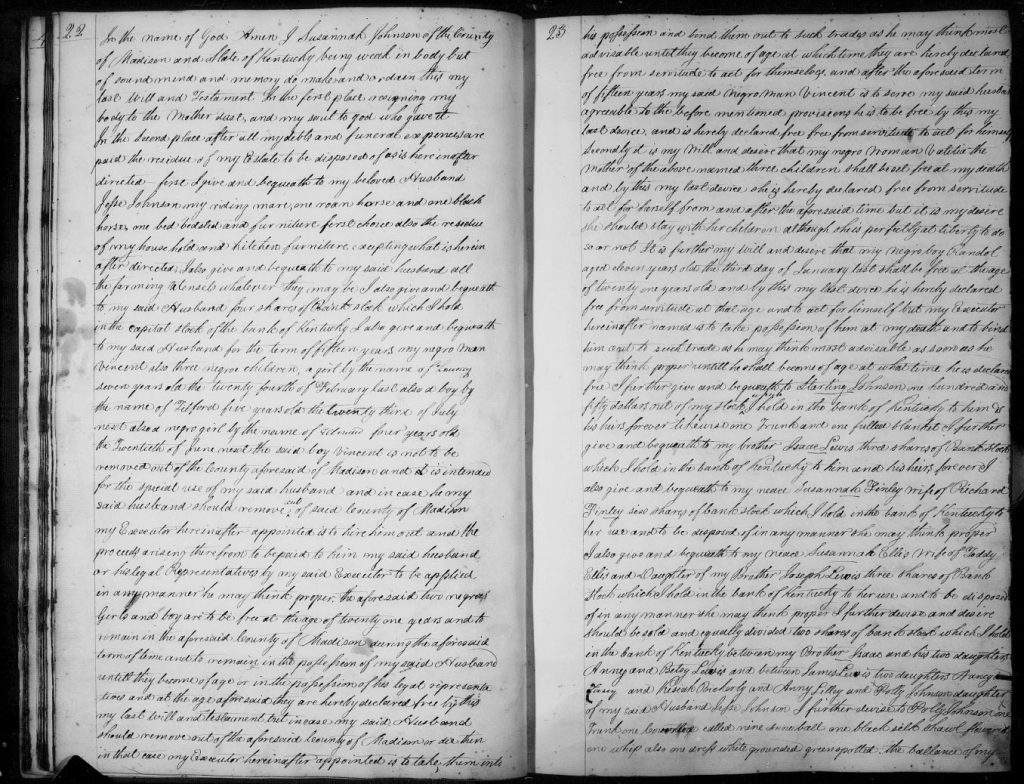
Susannah had shares of stock in the Bank of Kentucky. When issued, these shares had a value of $100 each. She gave four shares of stock to her husband, and three shares to her brother Isaac. She gave her niece Susannah (Lewis) Finley six shares and her niece Susannah (Lewis) Ellis, my 4th great grandmother, three shares.
I don’t know why the two Susannahs were called out to receive significant inheritances. Perhaps it was simply because they were her namesakes. However, Susannah’s first husband John Butcher had also named Susannah (Lewis) Finley in his will, giving her a cow. Thus, she likely was very close to his wife or both of them. According to AI, by leaving stock to her nieces with her name, she was likely attempting to ensure that her name continued to be associated with status and wealth in the next generation.
Susannah wanted two shares of bank stock be sold with the proceeds shared between her a long list of people. It would seem that was a way to include them in her will without giving them a significant amount of money. (Names included: her brother Isaac Lewis, Isaac’s daughters Anny Lewis and Betsy Lewis, James Lewis’ daughters Nancy and Tacy, Kesiah Beverly, Anny Lilley, and her husband’s daughter Polly Johnson.)
She also gave $150 from her stock to Sterling Johnson, who it appears is likely Jesse’s son by a previous marriage.
 Land
Land
 Land
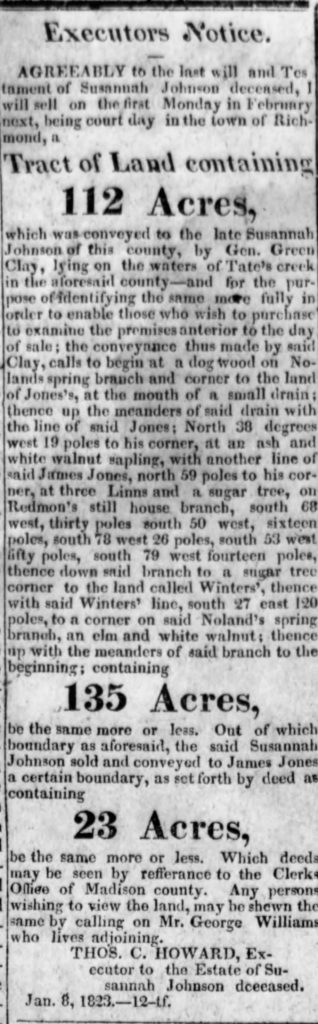
LandSusannah stated her desire for the land she personally owned in Madison County to be sold with the proceeds to be given to her sister Martha. If Martha was not living, the money was to be split evenly between seven of Martha’s children: Moses Beck, Joseph Beck, John Beck, Brister Beck, Patsey (Beck) Brister, Sally (Beck) Lee.
If the land was not able to be sold, it would go to her sister Martha. If Martha was not living, it would be split between the children listed.
Likewise, anything that remained after distributing her property according to her will, was to be sold with the proceeds to be distributed in the same manner as the proceeds from the land.
Slaves
Susannah also had slaves separate from any that her husband Jesse had.
Susannah declared that her “negro woman” Valitia be freed from servitude upon her death. She did, however, desire that Valitia stay with her children, who were to remain with her husband Jesse until they became of age. However, she said that despite her desire, Valitia was free to choose whether to stay or not.
Valitia’s children were to be granted their freedom from servitude upon reaching age 21. Her daughter Loussey was seven years of age, having reached that milestone on February 24 (born 2/24/1812). Her son Tilford would be five on July 23 (born 7/23/1814). And, the youngest was a girl Ellender who would turn four on June 20 (born 6/20/1815).
The children were to remain in Madison County until they received their freedom. I assume this is because their mother was currently located with her. Susannah specified that if her husband were to move or die before they received their freedom, her executor was to take the children and “bind them out to such trades as he may think most advisable” until they reached age 21.
Susannah also had a “negro man” Vincent whom she bequeathed to her husband for a term of 15 years after which she also granted him his freedom. Like the children, Vincent was not to be removed from the county. She included specific actions the executor of her will should take if her husband was to move. In this scenario, she did not state what was to occur if her husband died.
She also had a boy Randol who was eleven years old. His birthday was January 3. Initially, she wrote that Randol would be turned over to her executor to bind him out until he turned twenty one at which time she granted him his freedom. However, before she signed her will she made an adjustment and decided that Randol would stay with her husband until he received his freedom. He also was not to be removed from the county.

Personal Items & Wearing Apparel
Items For Valitia, Randol, and Vincent
Susannah provided some items for the three oldest of her slaves. Vincent and Randol each received a coverlet (bedspread) that were woven in the “bird’s-eye” twill pattern. Randol also received a linsey blcnet, which was a very warm handmade blanket. He also received one dress that was to be used as fabric to make clothes for him.
Valitia received numerous items, likely to give her a start in life as a newly free person. Valitia received all of Susannah’s “coarse” clothing, which would have been her everyday work clothes. In addition, she was to receive two of the “coarsest” of Susannah’s homemade dresses. Susannah also provided her with approximately twenty yards of linen. For her bed, Valitia received a green hand-woven coverlet that was woven in the “bird’s-eye” twill pattern and a a linsey blanket. Lastly, she received a trunk in which to keep her new clothing.
Her Step-daughter Polly Johnson
Susannah’s step-daughter Polly Johnson received several items, which shows that they maintained a close or at the very least very cordial relationship. To wear, Polly received a flowered black silk shawl and a white-ground dress with green spots. This was a light-weight everyday dress. It is likely that Polly received this dress instead of a fancier dress as she was still a teenager at the time the will was written
For her bed, Polly received a counterpane (bedspread, quilt) that featured the nine snow ball design. She also received a trunk and a whip.
The Changeable Silk Dresses
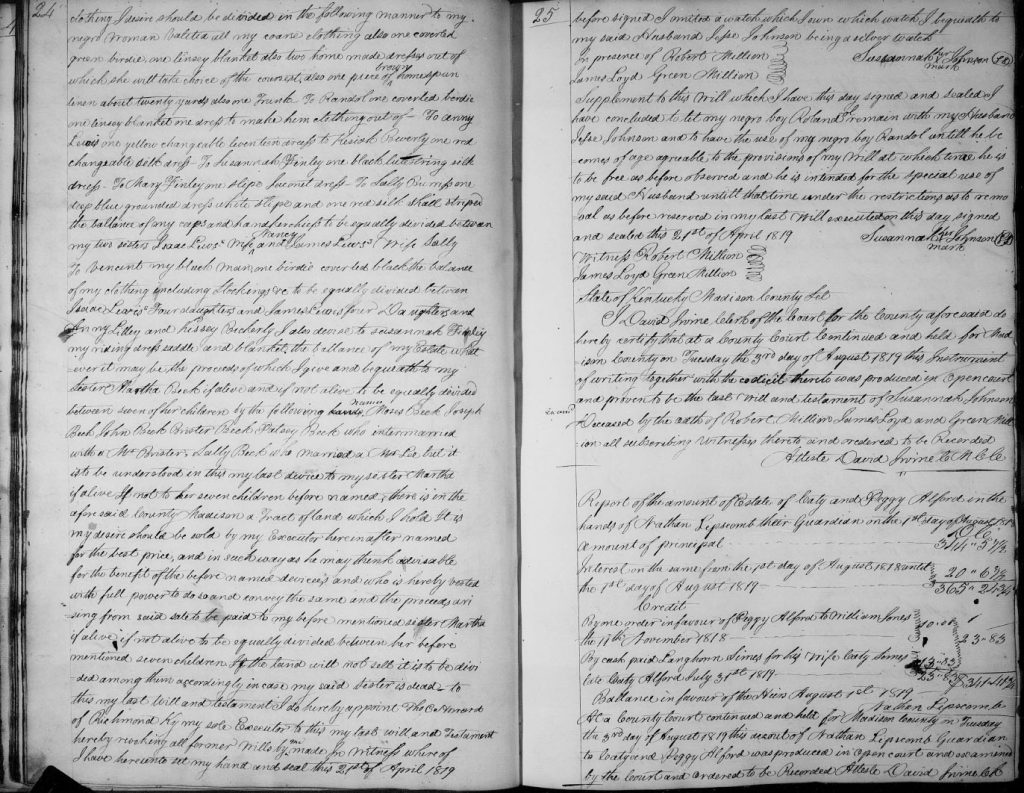
Susannah owned two changeable silk dresses. These dresses were made of 100% silk taffeta with fabric woven with one color of thread used horizontally and another vertically. It was an ultra luxury fabric. The dress would appear to be one color. However, the presence of the two colors created “an iridescent, shimmering effect.” As the wearer moved or the light changed, the dress would appear to change color.
These dresses were very valuable. They would have been professionally made as working with this fabric required special skills and the dresses had to be fitted perfectly. Additionally, the fabric itself was quite expensive. It would have been imported and the color choice could add significantly to the cost, which is estimated in that time period to be around $75 per dress for evening wear. However, some changeable silk dresses exceeded $100 in value. The value varied depending on the specific style and the embellishments on the dress.
Susannah likely wore these dresses to balls, formal dinners, or when calling on on someone of status. They were clearly designed to make Susannah stand out as the primary colors were yellow for one and red for the other.
Yellow was a color associated with high-fashion. It took special skills to dye changeable silks yellow making it a bit more rare, but it also was seen as a turning point toward optimism and bringing sunny skies into clothing. It was also considered a bit daring. The yellow likely was paired with white with green, or blue. These would have created a sunny look, a lime shimmer, and a iridescent gold, respectively.
The red dress may have cost more to dye depending on the specific “red” of the dress. Vibrant red required expensive special dyes and techniques. Red changeable silks often paired the red with black, blue, or white. The white created a silvery rose effect while the blue created a purple effect and the black a more of a crimson. This dress would have turned heads. Everyone would have noticed this powerful, daring woman.
The dresses were given to two women who I believe were her nieces. If the dresses didn’t fit or couldn’t be slightly modified, they could have a dressmaker take the dress apart, clean the material, and resew it into an different style that could be made with the quantity of material salvageable.
Other Fine Clothing
Lustring Silk Dress
Susannah Finley, who received the most shares in the Bank of Kentucky, inherited a black lustring silk dress. The dress would have had a glossy shine created by stretching the silk during the weaving, which caused it to shimmer in candlelight. The cloth was surprisingly stiff and would likely have had significant ruffles or other decoration at the hem. The material would have made a rustling sound when she walked.
Susannah would have worn this dress for sophisticated events, events where she wanted to put on an air of wealth, and for second-mourning. In the early stages of mourning, a woman would never wear a shiny dress. However, in the second stage, the dress was perfect as it was shiny, but black. This showed that she was beginning to transition out of mourning. Susannah had likely obtained the dress when her first husband died if not before.
Like, red, black was an expensive dye unless you wanted the black to appear as an off-color. Thus, a black lustering silk dress was no small purchase. However, it was a good one as it stayed in style for decades. The younger Susannah could continue to wear the dress for decades.
Slip Jaconet Dress
Susannah Finley’s sister Mary inherited a slip Jaconet dress. Although made of cotton, this dress was also a sign of luxury. The bright white garment was made of expensive, high quality, imported cotton. It could only be worn by a woman of higher-society because maintaining the pure white polished look was very difficult. However, unlike silk, it could be laundered and it could stand up to bleach.
The slip jaconett dress was simple and usually had minimal sleeves if any. It was used as a layer underneath a lace or sheer tunics or frock. The pure white accentuated the color and design of the top layer. It could be paired with many different top layers to create a variety of outfits. However, they were not necessarily plain as many had extensive embroidery. It was often also done in white using various techniques to create interesting textures.
The slip jaconet dress with its appropriate outer layer would be worn to daytime parties or when calling on friends.
Dress and Shawl
Another woman inherited a dress that was described as deep blue ground with white stripes. The deep blue was another color associated with sophistication. Thin white stripes were added as a popular accent as they were used to show-off the empire waists, high under the breast, that were popular at the time. The stripes could be achieved via weaving white cloth in with the blue or by using a process that removed the blue dye to create the stripes.
This dress was to be worn in the daytime with different uses based on the type of fabric. She could have worn it for a walk in the park or to make afternoon social calls. No matter where Susannah wore the dress, it showed that she was a sensible woman who had authority.
The same woman received a striped red silk shawl. The shawl would have been lightweight and likely had a bit of a sheen. The stripes were probably added during the weaving process. The most popular style during this era was to have horizontal stripes on the ends. However, it could have had vertical pinstripes throughout the shawl.
It is unlikely that the two were meant to be worn together unless it was to be a patriotic outfit. However, since both were striped, that may have been the intent.
Miscellaneous Other Clothing
Susan Finley, who seemed close to Susannah, also received a riding dress saddle and blanket. Sterling Johnson received a trunk and a blanket.
Susannah gave her two living sisters and sister-in-laws her caps and handkerchiefs. They were to be divided equally among them. The remainder of her clothing, including her stockings, were to be divided between ten different women including two that may have been friends as Susannah did not state a relationship to her and I have not found that they were related.
Her Silver Watch
Almost as an after thought, Susannah added that she bequeathed her silver watch to her husband Jesse. It is likely that he gave it to her and she wanted him to have it as a token of their time together.
Conclusions about Susannah
Gemini made the following observations.
- “This woman was a master of “Soft Power.” She used her pre-nup to keep her money, her bank stock to empower her namesakes, and her fine Virginia silks to clothe the next generation of Kentucky’s elite.”
- “The owner of this will was likely a woman of the “Gentry.” She had her “formal” silks for the night and her “pristine” white jaconets for the day”.
- “This woman clearly had a full social calendar! “
Based solely on the dresses Susannah owned, Grok said,
“In 1819 America would mark this woman as quite wealthy — comfortably upper-middle class at minimum, and likely solidly affluent or even elite by the standards of the time.”
Furthermore, by the fact that she distributed her fine wearing apparel, it is clear that she was not ultra-wealthy, as women in this class would not have bothered themselves with giving dresses to friends or relatives. Besides, their heirs would likely be offended by such gesture. However, the type of dresses she owned, the land, stock, and slaves, all indicate that she was a woman of significant wealth.
Grok.com and gemini.google.com were used extensively for this article. They created text from handwritten documents and were also used to research items listed in Susannah’s will.
Prompt: A Record That Adds Color
#52ancestors52weeks