
The thing that I most admire about my ancestors isn’t if they are wealthy or famous. It isn’t even if they built a town or a business. What I admire most is the ones that got through really challenging times in their life.
This article takes a look at some of the challenges ancestors overcame during each century starting with the 1600s.
The 1600s
Lawrence Peelle
9th Great-Grandfather
Challenge: Staying Alive
Lawrence Peelle, my earliest known ancestor in the Americas, came across the ocean with the London Company in 1621. He settled in Elizabeth Citti, Virginia.
Prior to 1625, 7,389 people had come to Virginia. However, by the end of February of that year, only 1,095 were still living. That was a death rate of 85%. (Source: The First Pioneer Families of Virginia by A. C. Quisenberry)
Deaths came from diseases, clashes with Native Americans, and overall harsh living conditions. Lawrence was very lucky to have lived in Elizabeth Citti as it was spared the Powhatan Uprising, which killed approximately 350 settlers. Still, it is amazing he survived
Elizabeth Veepon (Pearson) Stackhouse
Hubby’s 9th Great-Grandmother
Challenge: New Country, No Parents
Elizabeth Veepon (Pearson) Stackhouse endured her father undergoing religious persecution in England.
Then, the family decided to move to America. Her father died on the journey and her mother died soon after. Elizabeth was only a teenager. She had two sisters, but it isn’t clear that they were able to all stay together as they dealt with life as teenage orphans in a new country where disease was running rampant and the population was very small.
It is amazing that she survived and thrived.
Read more about Elizabeth’s family and their journey to America.
John Tilton
9th Great Grandfather
Challenge: Religious Persecution
John Tilton and his family’s religious beliefs didn’t align with the beliefs of the Puritans. Living in the 1600s near Salem, MA, that was a problem.
However, John and his family’s problems didn’t end there. They moved to an area that is now within New York City. When members of the Society of Friends (Quakers) arrived, they joined with them. They housed them and held meetings.
This was not to the liking of the locals. Again, John underwent persecution for his religious beliefs. He was arrested and banished. His wife was accused of being a sorceress.
Still, they continued their faith.
Read more about the family’s love-hate relationship with religion.
The 1700s
William Bassett
4th Great Grandfather
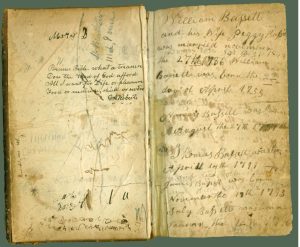
Challenge: Possibly deported from his homeland, POW, wounded, living in wilderness, threat of Native Americans
William Bassett was born in England. He came to America possibly as a deportee. If so, he was only 12 years of age when he arrived.
William fought in the Revolutionary War. If he was a deportee, one can imagine he was strongly in favor of independence. He was both wounded and a prisoner of war.
After the war, William moved to the Kentucky wilderness where he cleared land to live on, and was involved in skirmishes with Native Americans.
William had to fight to get a pension for his service to the country as he lost his papers when fighting with Native Americans. Thus, he recounted his entire history in the military in order to obtain the small pension.
Read more about William’s time in the military and on the frontier.
The 1800s
Arthur Reid Thomson
Hubby’s Great-Great Grandfather
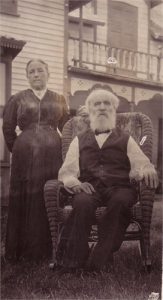
Challenge: Life on his own at a young age
As the story goes, Arthur Reid Thomson was orphaned as a child. It is said that Arthur and his brother Alexander “Sandy” went to live with their grandfather in Edinburgh, Scotland. When Arthur was sixteen, his grandfather apparently sent him to America to live with his uncle.
Louisiana (Matteer) Badgley McCracken
Great-great Grandmother
Challenge: Loss, children to raise, distance to family
Louisiana (or Louisanna) married young and had two children by the time her mother died. Louisiana was not yet twenty at the time.
Then sometime between 1851 and 1859, Louisiana’s first husband, James Badgley, appears to have died. They had been living with his father, Isaac Badgley, who sold some land to her husband in early 1851. Later that year, they sold the land. Those are the last records that have been found for James or Isaac.
It is unknown if James died in Ohio, whether they were moving west and he died along the way, or if he died in Iowa where she later lived. If both James and his father died in Ohio, where they were living in 1850, that would have left Louisiana there without her close family. And, if he died along the trail, she would have had to make the remainder of the trip without a husband.
Anyway, she ended up in Iowa, where her father lived. alone with two young children. In 1859, she married Lemuel McCracken and they had a blended family with children from each of their earlier marriages, plus their own.
D. Lawrence & Joseph (Henry) McCracken
Half-3rd-Great Uncle/ 3rd-Great Uncle
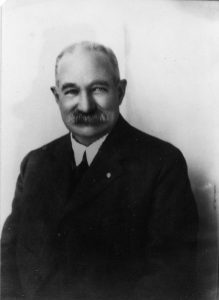
Challenge: Living away from parents and siblings at a young age.
Both Lawrence and Henry somehow ended up living with families that were not relatives. Because of this, they ended up living in totally different states than their parent(s).
Lawrence was Lemuel’s son with his first wife. By the time Lawrence was twelve years old, he was living with a family in the area. When he was about 15, Lemuel and Louisiana moved to Kansas. Apparently, Lawrence did not go with them.
Henry was Lemuel and Louisiana’s son. After Louisiana died, he lived with the Dudley family. The family decided to move from their home in Bates County, Missouri to Kansas. Henry went with them.
Somehow they managed to keep in touch with at least part of their siblings/half-siblings/step-siblings. It seems that Mary Ann, Louisiana’s daughter with her first husband, was the one that maintained contact with everyone. Still, we did not know about Lawrence or Lemuel’s first marriage until I uncovered it while doing research.
Franz Xavier Wittmer
Hubby’s 4th Great Grandfather
Challenge: Losing his wife when their children were still young, struggling to make a living
The 1900s
Dessie May (Thomas) Pellett
Grandmother
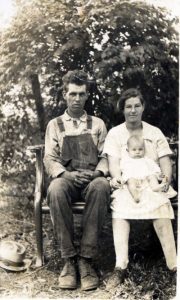
Challenge: Loss & Raising Children
Grandma dealt with a lot of loss in her life. Her mother, Sarah Ellen “Sadie Ella” (Ashby) Thomas, died in childbirth (the baby also died) when Grandma was only 15 years old. She was left to manage the household and care for her five younger siblings. The youngest was only two and a half.
She married and while her children were still young, her husband, Clifford Claney Pellett, ended up in a VA hospital. He had injured himself in a fall and got gangrene in his leg. In addition, he had what we would likely term PTSD. He spent the rest of his life in a VA hospital in Iowa. Again, she was left to care for the children.
She stayed on the farm until the children were high school age. I suppose she got a pension from her husband’s military service, but they were still quite poor. Marvin, the oldest and the only son, helped out by working for neighbors and helping his mother sell produce. The neighbors knew the family was struggling and they found ways to help.
As soon as Inez graduated high school, she went to work at The Western. Between her work and Marvin’s work, the family bought a house. All four children graduated high school, and three of the four went to community college.
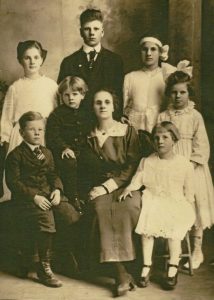
Grinda (Hansen) Van Allen
Hubby’s Great -Grandmother
Challenge: Loss & Raising Children
Grinda (Hansen) Van Allen married a man, John (Warren) Van Allen, who was 25 years her senior.
After 14 years, 7 children, and several moves. Warren was injured in a farming accident. About the same time, Grinda’s young daughter received serious burns. Her daughter would recover. However, although Warren lingered a bit, he would eventually succumb to his injuries.
Grinda was left with seven children to raise. She was also the step-mother to seven adults. Instead of going back to where she grew up and where her family lived, she moved the children to Lincoln, Nebraska where she worked many hours every week doing domestic work in homes.
She also dealt with several accidents involving her kids and herself and more deaths in her family.
Grinda persevered. She outlived most of her siblings and most of her step-children.
McCracken Family

Challenge: Disruption, Loss, Not Knowing
Almost everyone alive during the 1940s experienced a world war in one way or another. Some more than others. The McCracken family first experienced rationing and the children scattering to various places to work.
Rationing lasted throughout the war. They managed the entire war with bad tires, exchanged ration coupons with others for shoes so that they could put shoes on growing children’s feet, and learned to like unsweetened tea.
When their two oldest sons, Dewey and Howard, were drafted, Dad quit school to manage the farm.
Life went on, but it was different and full of worry. Like most people, they knew people who had lost their sons to the war and that only managed to increase their worry.
And, then Howard went missing never to be seen again. The family struggled with that for the remainder of their days.
Read more about Howard going missingand his last letter home.
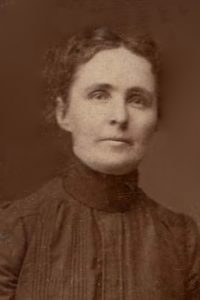
Matilda (jury) Peelle
Great-Grandmother
Challenge: Loss
Matilda lost her mother before her third birthday. She was raised by her father, John Jury Sr., with help from his mother, sister, and possibly his brother’s wife.
Over the next several years, her family would leave their home in Canada, move to Kansas, Missouri, back to Kansas, to Michigan, and finally back to Kansas. Thus, Matilda never got to put down roots anywhere for very long.
She married William Johnson Peelle and had three children. Again, they moved several times, but at least they stayed within a few miles of Hiattville, Kansas.
Then in 1911, she lost her father and her husband in the span of two days. Her father’s death was likely somewhat expected as he had cancer. However, her husband’s death was completely unexpected.
Matilda was left with three children, William J.’s elderly mother, a farm to manage, and a load of lumber that William J. had just picked up for a new building.
Matilda eventually left the farm and became a city lady. She never remarried.
The 2000s
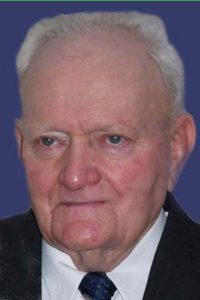
Joseph Edward McCracken
Father
Challenge: Medical and life altering decision
Dad had the constitution of a horse. He didn’t get sick often and he generally rebounded quickly. However, in 2012, he started having pain and feeling generally unwell.
A stress test in February 2013 led to an immediate CT-Scan and hospitalization. During testing, they determined that he needed open heart surgery and they saw what they suspected was cancer in his colon.
He asked the doctor if he could just do the colon surgery. They said, “No.” The doctors told him that he would not live through colon surgery without the heart surgery. And, they said, that it would be a waste to do the heart surgery and not the colon surgery.
He really wanted us to make the decision about what to do. He finally decided to do both surgeries. The heart surgery turned into a septuple bypass. Several weeks later he had colon surgery. That decision gave him 9 more years.