Grinda Josephine (Hanson) Van Allen  had a life full of challenges, including becoming a step-mother to six, including teenagers, when she was only fifteen, losing her husband when she was 29, and almost losing her young daughter at the same time.  These were only a few of the challenges in Grinda’s life.


The Early Years

Grinda Josephine (Hanson) Van Allen was born February 4, 1885 in Richwood, Wisconsin.  She was the daughter of Magnus Hans Hanson, who was born in Wisconsin, and Mary Inga Anderson, who immigrated to the United States from Sweden.  She was the fifth of ten children to be born to Magnus and Mary.

When Grinda was only two, her baby brother John died when only a month old.  She was young enough that she wasn’t likely affected by his death.  However, when Grinda was thirteen, she lost her older brother Martin (Norman) when he drowned while bathing in the river near Port Andrew, Wisconsin.  Her oldest brother Elmer Lewis witnessed the drowning, making it all the more sad.  This had to have been a very significant event in her young life.


The Marriage

Just two years later, at age fifteen, Grinda married John (Warren) Van Allen in Richland, Wisconsin who was a widower twenty-five and a half years her senior with six children.  His wife had died the prior year and he was clearly in need of a wife.  His oldest daughter was only nine and running a household would be a bit much at that age.

What attracted Grinda to a much older man with sons as old as she was is unknown.  However, it must have been very challenging to take over running a household and deal with step-children, especially boys her age and older.


On the Move, Again, And Again

The following March, Warren, Grinda, and his children pulled up stakes and left for Minnesota.  It was in Sleepy Eye in Brown County, Minnesota that John Warren, their first child together, was born on October 18, 1902.

The family’s stay in Minnesota did not last long, as their next child Jessie Wilma was born in Iowa on September 19, 1904.  That was followed by another move to near Fremont, Nebraska, where their third child was born October 3, 1906.

Thus, in the first five and a half years of their marriage, they moved at least three times . . . and to three different states.  What took them on this specific journey has yet to be discovered.  However, the first move may have been made in conjunction with moves by a couple of Grinda’s siblings.


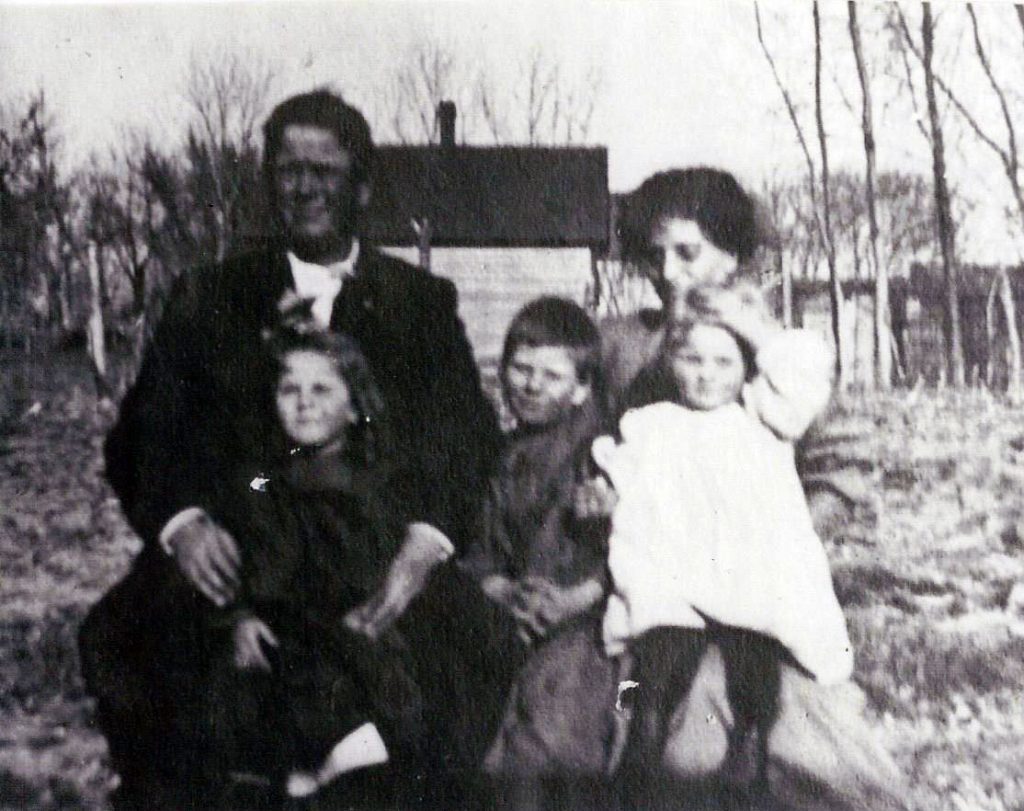
John Warren, Grinda, and their 3 oldest children. Likely taken in Dodge County, Nebraska

Life In Nebraska

The family settled into life in Nebraska, where Warren quickly became known for the fruits and vegetables that he grew.  He had a reputation for excellence in his gardens and fields when he lived in Wisconsin, which he renewed in his latest home.

In 1911, he advertised for a farm with 160 acres and a home with enough room for his growing family, which implies yet another move.  He may have needed more land or simply needed a bigger house as May would bring their fifth child.  Three months after her latest child was born, Grinda was suffering with appendicitis.  It is hard to imagine having a house full of kids including a newborn and being seriously ill.


John Warren’s Accident

Over the next couple of years, Warren and Grinda’s last two children were born.  All appeared to be going well until they received word of Warren’s son Clarence at the end of May.  He had died after a short illness.  The nature of which is unknown.

Then on July 15, 1914, Grinda and Warren’s life took a turn for the worse.  On that day, Warren was riding on his cultivator working in the corn field, when the seat broke.  Warren received internal injuries in his fall from the cultivator.  Despite an operation and expectations of improvement, Warren’s condition never seemed to improve.


Vivian Vera’s Accident

Over a month later, Warren was still ill when Warren and Grinda’s five-year-old daughter Vivian Vera was badly burned.  On August 26, Vivian was playing in the kitchen with one or more of her sisters while Grinda was working in another room.

As they were playing, the oil stored on the shelf above the cookstove fell over and spilled onto the cookstove that had a fire burning in it.  Standing in front of the stove, the flames from the hot oil encased the young girl’s clothing. 

Grinda heard the ruckus and came running.  She saw flames and smoke filled the air and grabbed Vivian.  She wrapped her jacket around her daughter to smother the flames while she used her hand to beat out any flames that escaped. 

After the flames on her daughter were out, Grinda turned her attention to the fire in general.  However, by then the fire had mostly died out.

Despite Grinda’s efforts, young Vivian received serious burns.  Vivian’s burns were the worst on her arm and shoulder.  Additionally, her hair was greatly damaged.  The newspaper described the burns as “ugly” and requiring the attention of a physician.


Death of Her Husband

Five days after Vivian’s accident, Warren succumbed to his injuries.  With Vivian injured and being nursed back to health, the service for Warren was not held at the home as was customary.  Instead, the service was held at the Bader Undertaking Parlor or the Seventh Day Adventist Church (accounts vary).

In the 8 years they had lived in the area, Warren had become quite well known.  He was an expert fruit and vegetable grower, belonged to Modern Woodmen of America, and had even run for Nebraska state treasure on the Socialist ticket.  He was so well known that his death was noted in various newspapers across the state.

The newspaper didn’t mention any of his children with his first wife in Warren’s obituary.  Most were living in North Dakota and there is no mention of them coming to the funeral.  It leaves the impression that perhaps the relationship with them had become strained. However, Floyd, the youngest who lived with Warren and Grinda at least until 1910, did come to help settle his dad’s estate. 

The only relatives of Warren that attended were one of his half-siblings and his step-father, who traveled from Wisconsin for his funeral.  In Grinda’s family, only one sister-in-law and a brother made the trip.  It is not believed that they had any close relatives in the Fremont area.


Life Without a Husband

So, Grinda was a 29-year-old widow.  She was the step-mother to seven adults, who ranged from nineteen to thirty-one years of age.  Additionally, Grinda had four step-grandchildren that she may not even have known about.  In any case, Warren’s children with his first wife were hundreds of miles away and not there to help Grinda.

Grinda had seven children to feed.  They ranged in age from less than a year to almost twelve with four children under age five.

She must have had a pile of medical bills and it is unknown what crops were able to be harvests.  However, knowing midwestern farm spirit, it is likely that the local families helped the family.  In addition, the Modern Woodmen of America provided $3000 to the family and Grinda collected an insurance policy.

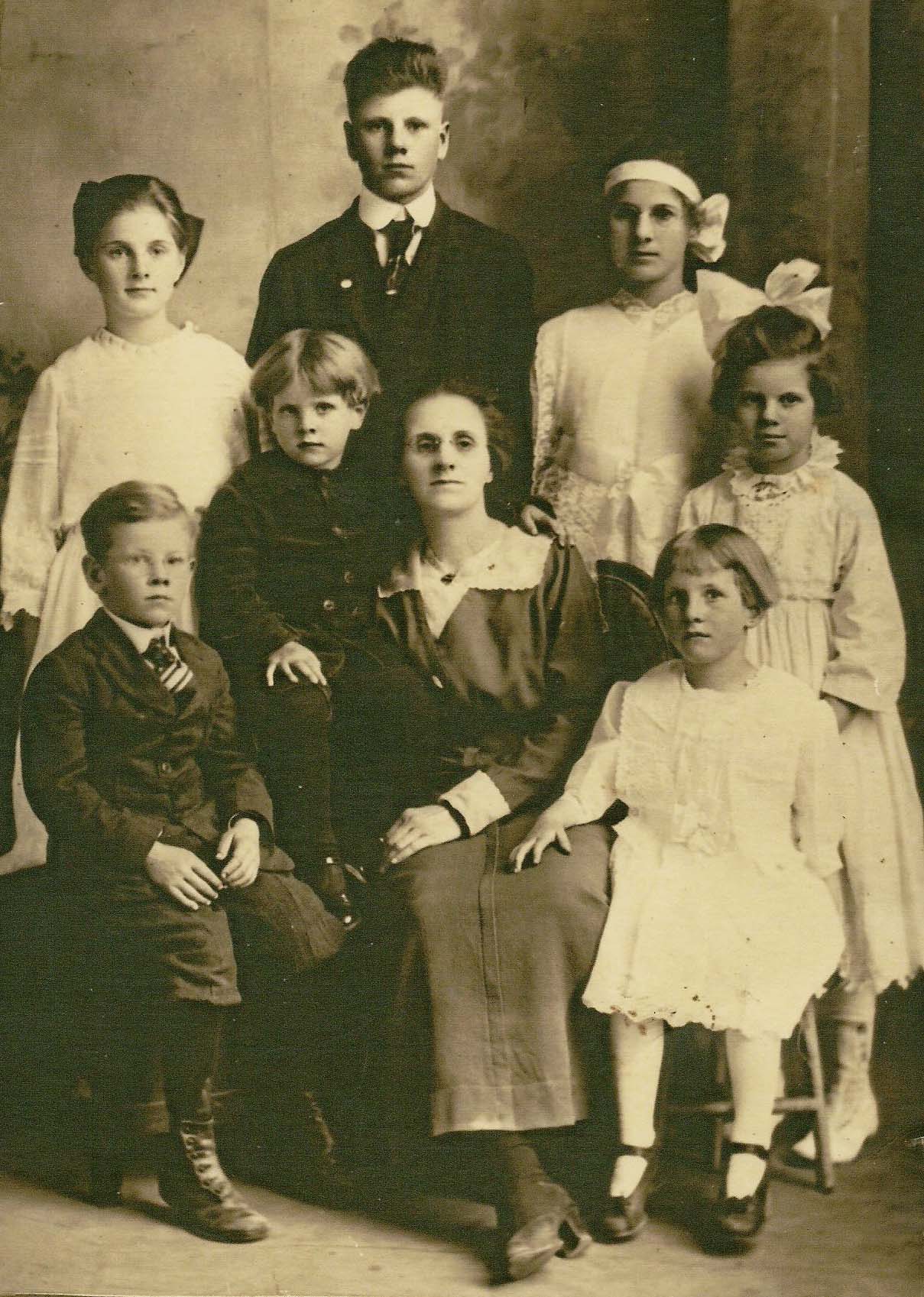
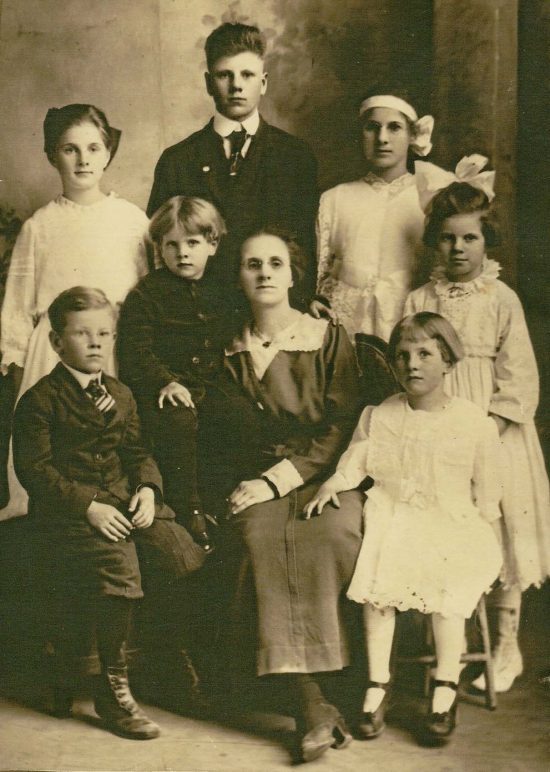
Grinda (Hanson) Van Allen and Children

Another Death Before Moving On

Only a few months after Warren died, Grinda’s mother died.  She was only 61-years-old.  It is unlikely that Grinda made the journey to Wisconsin for her mother’s service.  It would have been both expensive and challenging to make the trip with her children.

The following month Grinda purchased a house in College View (Lincoln), Nebraska.  It was unclear what made her choose this area other than it was a city and provided more opportunities for work for a woman than a smaller farming community.

Grinda and the kids began life in a bigger town. I don’t know if Grinda went to work right away after the move.  However, by 1920, she was doing domestic work in private homes.  It is unclear how she would have managed to work with young children that weren’t school age.  By 1920, however, all the children were attending school.  At that point, her oldest daughter Jessie would have been old enough to watch the younger children.

The children seemed to adjust, joining school, sports, and other activities.  Some of them joined the local garden club.  Clearly, they had gotten their father’s green thumb as multiple of them won awards.

The kids also had their share of diseases, which no doubt added more stress and challenges to Grinda’s life as a single mother.  For instance, Josephine and Jessie had scarlet fever in December 1916.  They missed two weeks of school and surely someone had to look after them during their illness.  Similarly, John and Josephine both had influenza during the great flu epidemic.  And, a couple of them also had the mumps.


Who Needs Trouble

By June 1919, John Warren Jr. was plenty old enough to help support the family.  I am sure the family could have used some extra cash. An older man likely played on that need when he got John involved in a scheme with several other boys and young men to steal various items.  The man enticed them by promising to buy the stolen items from them.  It wasn’t worth it as John was sent to the State Industrial School for his part in the crimes despite testifying against the man who instigated the entire operation.


Death of a Sister

In the summer of 1921, Grinda received more bad news.  Her sister Anna and Anna’s husband had both drowned near their home while bathing in the Wisconsin River.  Anna had been enjoying herself when she was caught in the current.  She called out for help.  Her husband attempted to swim to her, but he sunk under the surface of the water for some unknown reason.  Anna went under a short time later.

Their five-year-old adopted daughter and Grinda’s father, who was nearly 70 years of age, were unfortunate witnesses to the incident.  Neither could do anything to remedy the situation beyond calling for help.  Many people came to help.  Unfortunately, it was a recovery operation rather than a rescue.

Grinda received word of their deaths and made a trip to Wisconsin to attend the funeral.


More Accidents

Donna

In 1922 disaster struck again when Donna, Rod’s grandmother, was struck by a car that was “going at a lively rate of speed.”  Donna was drug 25 to 30 feet and the skid marks were said to have been at least 50 feet.  Donna saved herself from worse harm by grasping tightly onto the front axle of the car.


Kenneth “Kenny”

In 1926 it was Grinda’s youngest child Kenneth’s turn to get hurt.  This accident occurred while he was playing football.  The injury left him with a broken left elbow and required the attention of multiple physicians.


Kenny Again

In 1929, Kenny went to work for the Smith Baking Company.  He wasn’t on the job long before he lost three fingers and part of his palm.  A major court case ensued that lasted several years and included a fight over whether he was 15 or 16.  And, if he was 15, whether the company knew or should have known his age.  Click here to read all the details.


Grinda, Herself

In 1931, Grinda was injured when the car she was a passenger in was hit from behind as the car slowed to turn into a farm driveway.  All five people in the car were injured, some critically.  Grinda was on the lucky side as she received lacerations to her hands and face as well as a chest injury.


In The End

Grinda died in 1966.  She had certainly been through a lot.  Despite all the drama, trauma, and challenges in her life, she had managed to live to be 81 years of age.  She outlived all of her step-children except Floyd, the youngest.  Grinda also outlived seven of her nine siblings.


Prompt: Challenging

#52Ancestors52Weeks 


What happened between 1905 and 1910 that caused Delarma Lawrence McCracken to suddenly report his age as several years older?


The Early Years

Delarma Lawrence McCracken was born to Lemuel Lawrence McCracken, my great-great grandfather, and Sarah Dufer, Lemuel’s first wife, in Lee County, Iowa.  Lemuel and Sarah had married September 23, 1854.   Prior to their marriage, Lemuel was living in Montrose Township, which lies adjacent to Jefferson Township, along its southern border. In the 1856 Iowa Census, they are listed as living in Jefferson Township, where Sarah’s family lived. 

Although a record of Sarah’s death has not been found, it appears that she died sometime between Delarma’s birth April 30, 1858 and the end of the year.  Lemuel married my great-great grandmother Louisiana Matteer on January 17, 1859.  Both of them inherited children with their marriage.  In the 1860 census, Delarma, who later mostly used the name Lawrence, Louisiana’s two children from her first marriage, and their first son are all living in the household.

By 1870, Lemuel and Louisiana still resided in Lee County, but had moved west to Van Buren Township.  However, only the children they had together lived in their household.  Although, Delarma was only 12, he was living with Robert and Diana Kennedy.  They do not appear to have any relationship to the family.  They also had two other young people living in their household. 

Delarma had no occupation listed nor did the record indicate that he had been attending school.  Thus, it is unclear why he lived with the family. However, multiple of Lemuel and Louisiana’s children lived elsewhere after Louisiana died.  So, perhaps he did the same.

In 1873, Lemuel and Louisiana and their younger children moved to Sherman Township near Farlington, Kansas.  Delarma appears not to have made the journey with them, although he was only 15 years old.  At least, he has not been found in any records in Kansas or Missouri where they lived over the coming years.  Thus, he was left in Iowa to make a life of his own.


Marriage

It is unclear what Delarma did over the next few years.  He is not found in the 1880 census.  Perhaps a coincidence, however, Lemuel and Louisiana’s two oldest sons together are also missing in the 1880 census.

The next record of Delarma was in May 1881 when he married Nancy Judy in Franklin Township, Lee County, Iowa.  The next year they had a set of twins, Sarah and Mary, although only Mary survived childhood.  They were the first of eight children to be born before the turn of the century.

Delarma and Nancy spent many years living in Denmark Township, which is along the northeast border of Lee County. To support the family, Delarma worked as a laborer, farmer, and mason.


Sudden Change

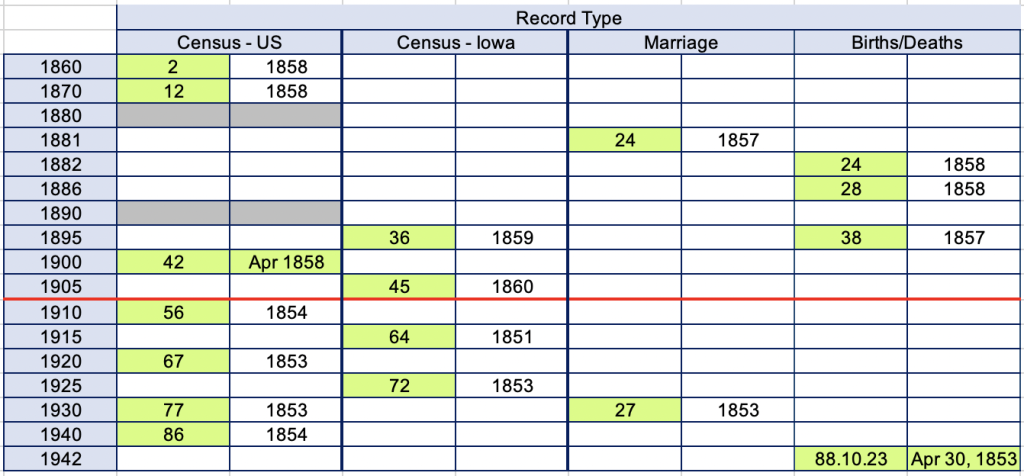
From the time Delarma was young until 1905, his birthdate was always recorded as approximately 1858 with the 1900 census specifically stating April 1858.  However, starting in the 1910 census, his birthdate is consistently recorded as approximately 1853. 

The following chart shows Delarma Lawrence McCracken’s reported age and/or birth year in various records throughout his life.  The highlighted cells show information directly given in the record and the other data is the calculated age or birth year based on what is in the record.  Variations in age or birth year are typical in records, especially ones dating back into the 1800s.  However, in this case, there is an abrupt shift.


Delarma Lawrence McCracken’s age and birth year per records over time. Notes: The record under marriage in 1930 indicates that the record said that he was 27 when he married, not that he was 27 at the time of the record.  Additionally, the date 88.10.23 means that the record said that he was 88 years, 10 months, and 23 days old.

So, the question in my mind is, “Why did Delarma suddenly get 5 years older?”


Why the Change?

What happened around 1905 that caused Delarma or his wife Nancy to report his age as several years older?  She was older than him by several years, but that didn’t suddenly change.  Perhaps she had a mid-life crisis and insisted he had to be closer to her age.  But, in that case, it seems she would have more likely made herself younger instead of him older.  And, it definitely wasn’t his mid-life crisis that spawned him to be older.

I checked the records and the newspapers for something that might have happened to him or the family.  The only thing I found that happened around that time was that in 1910 he was elected constable for Denmark Township in Lee County, Iowa.  However, nobody would have cared if he was 52 or 57. So, that doesn’t seem like a likely reason for a change.

I also considered military service as a reason to change his age as often men changed their age so that they could serve or to avoid service.  I did find military records where he is listed at various ages.  However, I did not find a date for each entry.  Thus, it is impossible to tell if he had changed his age or not.  Additionally, no big push for men in the military existed in that interval.  Even if it did, it wouldn’t have lasted for the remainder of his life.

The only thing I can think of is if they found a birth record where the year appeared to be 1853 instead of 1858.  But, even so, why change at this point?  And, wouldn’t he wonder what happened to the missing 5 years?  It just doesn’t make sense.

So, what else could have caused the sudden shift?  What am I overlooking?


Image Source: beasternchen via pixabay.com
Prompt: Overlooked
#52ancestors52weeks


Was the first known Passco/Pasco Peelle really named Isaac?  Where did the name Passco come from?  And, why did it stick being a family name for generations?


The Early Days

Robert (b. 1709) and his wife Elizabeth (Edgerton) Peelle, my 5th great grandparents, were Quakers.  They married in 1728, likely in Nansemond County, Virginia.  Following the tradition of previous generations, they perpetuated the name Robert by giving that name to their first son.  Then, in 1733, they had another son, who would become my 4th great grandfather.

The debate is about the name they gave him at birth.  Although all the records that I have found except one indicate his name is Passco, his father’s first will lists his name as Isaac.  Within the month, the will was modified with several changes.  In the new will, he is listed as Passco.  Some people assume that the first will indicates that Isaac is his “real” name and that it was changed in the updated will to his nickname or preferred name.  However, I wonder if Isaac was simply an error that was corrected in the second version of the will.


Taking A look at the Records

Birth

The Quaker records list his name with his birth date showing it as Passco/Pasco with a birthdate of 29th day, 7th month of 1733.  This translates to July 29, 1733 based on the way Quakers dated their records.  This is an original handwritten record.  However, it was made years after his birth, having been recorded in The Register of Births and Deaths of the People Called Quakers belonging to Rich Square Monthly Meeting in North Carolina County of Northampton  likely  in the 1760s soon after the Rich Square meeting house was built.


Marriage

Although Passco is believed to have married Tabitha Dunigan/Dunagan around 1755, no record of their marriage has been found.  It is unclear where they married, but given the family’s history being in the Society of Friends before and after that date, they likely married at a Quaker Meeting House.  Tabitha stated at some point that she didn’t know how old she was because the meeting house burnt.  If they married where she lived, it is possible that their marriage record burnt as well.


Business

The earliest recorded record for Passco was in 1759.  December 18th of that year, he signed a petition for the formation of Hertford County, North Carolina.  He used the name Passco.  Thus, either he had either been named Passco at birth or had used the name so much that he used it in his business transactions.  That said, in those early years before and after the birth of our country, a person could use any name they wanted as there was no official legal name for a person.

In 1780/1781, he used the same name when signing petitions to the General Assembly of North Carolina requesting new commissioners. 


Land

Passco became the owner of property in Dobbs County, North Carolina in an area which later became Wayne County.  He was granted 640 acres adjoining William Newsome on the east side of Basses Swamp. He received a subsequent grant for additional land adjoining that property.  Both were issued to “Passco Peelle” (or a form of that name).


Tax Lists & Censuses

Additionally, the 1786 and 1788 tax lists, give his name as Passcow.  We pronounce Passco as “pass” “co.”  However, in those days, they very well may have pronounced it “pass” “cow.”  Thus, the name may have been recorded the way it sounded.  Then in 1790 and 1800, the census records list his name as Pasco.


One Last Record

Finally, when his daughter Anna married Thomas Parker at the Piney Grove Monthly Meeting in Marlboro, South Carolina in 1803, his name was recorded as Passco Peelle.


The Wills

Given his business records show the name as some form of Passco, it seems reasonable to take a look at the document that gave his name as Isaac.  It clearly isn’t just a misunderstanding of what is written in the will as the handwriting, although not perfect throughout the will, perfectly states the name as “Isaac.” 


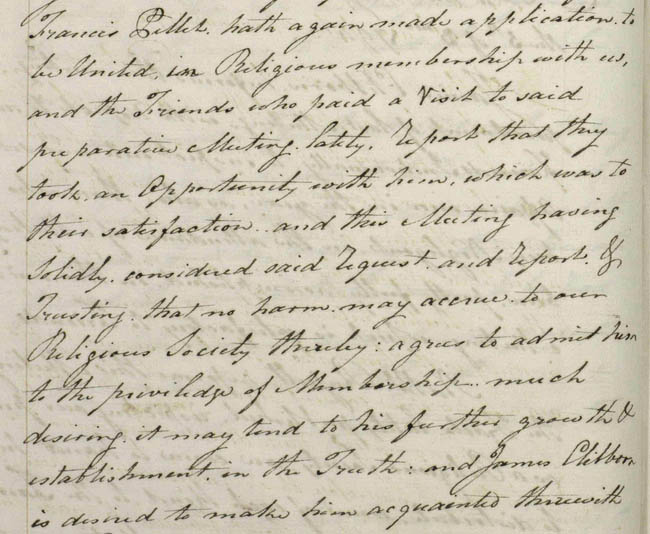
Robert Peelle IV’s original will showing the name Isaac


The second will written only twenty days later is essentially the same with Isaac changed to Passco, the spelling of Peele changed to Peelle, and at least one item being added to the will.


Revised will of Robert Peelle IV showing the name Passco.  Note that in this era two “s'”s together were written in cursive in a way that looks much live a curvie “f.”


Neither name appears to be a family name prior to this point.  However, both names show up in the family tree after this point with Passco/Pasco being common among Passco’s descendants.

In his own will, his name is written “Pascho Peelle.”  There is no reference to the name Isaac.  Additionally, he had followed the family tradition of naming his first son Robert.  However, Robert had died as a child.  His only two living sons at the time of his death were John and William. 

My Conclusion

It is possible that an early Quaker record exists that lists Passco’s name as Isaac.  In absence of such a record, I conclude it is very likely that Passco was his given name at birth and not a nickname.  In either case, the real question is “Where did the name Passco come from?”


Where Did The Name come from?

John Pasco was an immigrant to Virginia in the early days before the Revolutionary war.

A Pasco Curle lived in Elizabeth City as early as 1699.

Pascal/Pascow/Pasco Herbert also lived in Elizabeth City.  At first look, he appears to have connections to the Curle family.

Did one of these people inspire the naming of Passco Peelle?

Featured image: By gerald via pixabay.com

Prompt: Nickname

#52ancestors52weeks


It is said that a picture is worth a thousand words. This one is also worth a thousand memories.  Not only did my ancestors and other relatives live in and around Hiattville from its earliest days, I have fond memories of visiting that very building shown in the photograph.


The Photograph

The photo was taken sometime after A.M. Routh rebuilt his store following the Hiattville fire of 1905, which devastated many of the businesses in town.  It was published on a postcard by the Central Postcard Company in Fort Scott, Kansas sometime between 1907 and 1914.  And, it was sent to my grandma Nellie Peelle sometime before she married March 4, 1914.  I don’t know the exact year as it has no postmark.  Since it was sent locally, the postman simply took a pencil and made marks across the stamp.  Thus, it was delivered the same day it was sent.


The Store

When I was growing up, this building was Salmon’s Grocery.  Imo and Don Salmon ran the store from 1943 until 1973, although it seems their store was in another building in the early days.  The building looked very much the same when I was growing up except that it had gas pumps and benches out front.  As a kid, my favorite two things about the store were the candy counter and the pop machine.  The candy counter was a big display case where a quarter could buy a small bag of candy and gum.  I remember the wax teeth, sour apple suckers, bubble gum, big jawbreakers, and the SweeTart necklaces. 

In those days, soda pop wasn’t something that people drank regularly.  It was a real joy to get a bottle and move it through the tracks, finally getting it out of the machine.  I think the anticipation was half the fun.  There was nothing better than a strawberry Nehi.

We didn’t do our regular grocery shopping at Salmon’s as their selection was limited, but would stop in if we needed something.  In addition, we raised chickens and would sell eggs to them.  And, I believe at least one year, we sold strawberries to them.

My funny story about the store . . . One day the phone rang.  Mom answered and the person on the other end of the phone said, “I think I left my pot on your bench.”  The person was trying to reach the store.  She had left a cooking pot on the bench out front of the store.


My Family

I am not aware that any of the people in the photo are my family.  However, it is very possible that one of the members of the family ventured into the photograph as numerous of them lived in and near Hiattville from its earliest days.


Thomas & Ellen Hartnett Family

Early Residents

Hiattville began its official formation in 1872 when the name of the post office was officially changed from Pawnee to Hiattville.  I don’t know exactly when Thomas and Ellen D. (Jury) Harnett set foot in what became Hiattville.  However, they were both living in Pawnee Township, which includes Hiattville, when they married on February 12, 1873.  October 4, 1874, their son, John, was the first child born in Hiattville.  Note: Historic Reflections of Bourbon County, Kansas incorrectly gives their last name as Hartwell instead of Hartnett. 

The 1880 census is the first census that recognizes Hiattville as a village.  Thomas and Ellen’s household was one of five in the new town, which had a total of 35 residents with 10 of them living at Thomas’ home.  Thomas and three of their boarders worked for the railroad, which was the primary reason Hiattville existed.  Two of the men were from Ireland, Thomas’ birth country.  They also had a doctor from Arkansas, a servant from Germany, and two teenage young men from Illinois, who were the telegraph operators. 

It was quite a group and I am imagining listening to conversation in the household.  The mix of proper English (Ellen was of a very proper English background), Irish brogue, German, and the southern twang of someone from Arkansas must have been quite interesting.

By 1885, my great-grandmother Matilda (Jury) Peelle, Ellen’s niece, had joined the household.  She lived with them until she married in 1892.  Thomas, Ellen, and their three children lived in or close to Hiattville the remainder of their lives.  In 1890, the family moved to their farm two miles north of town.

This story tells you a bit about the Hartnett family.

Read more about the Jury family’s story.


In and Around The Town

Passco Peelle
Martha (Johnson) Peelle

Arriving In the Area

In 1879, Passco and Martha (Johnson) Peelle and three of their younger children (William J., Lillie, and Mossie) moved to a farm north of Hiattville.  William J. took care of business and arrived in Kansas after his father.  He came by train from Indiana arriving at the little Hiattville station.  Read more about their move to Kansas.


Hiattville Map showing land ownership. Pink-Passco Peelle; Green-William J. Peelle; Blue-Walter Jury; Turquoise-Wilburt Jury; Orange-Grocery. Map Source: Historic Reflections of Bourbon County, Kansas

Moving Into Town

In August of 1891, Passco bought lots in the bustling town of Hiattville, which was rapidly growing.  He purchased lots in the area of the original town (pink).  That November, William J. (my great-grandfather) purchased lots in the Wallace Addition (green).  They moved into Hiattville; however, they continued to own the property north of Hiattville.

William J. later switched two lots with A.M. Routh, owner of the grocery store (orange) in the photo, via each of them doing quit claim deeds the same day.  He switched for the lots on the southeast corner of Pine and Broadway.  This gave him four lots that were co-located rather than having them a block apart.  These lots were a portion of the lots that had earlier been owned by William J.’s wife Matilda (Jury) Peelle’s brother Walter, who had at one time owned six lots on that corner (blue).

Matilda’s brother Wilburt and his wife Susan (Stubberts) Peelle also owned property for a time in Hiattville.  However, it was a few blocks away (turquoise).


Busy Bee

Prior to the move, William J. was a popular carpenter and farmer.  In Hiattville, he kept even busier.  He had a shop and was called on to create many different items in addition to building additions to homes and businesses.  Of course, life at home was busy also since William J. had married Matilda soon after moving to Hiattville and they soon had a growing family.  Read more about William J.’s life as a carpenter and farmer.


William Johnson Peelle
Matilda (Jury) Peelle

Out To The Country

Hiattville was booming, but for some unknown reason William J. and Passco decided to move their families out of town.  So, they sold the properties that they had only purchased three years prior.  Although the town was growing, William J.’s property hadn’t increased in value a lot. However, Passco sold his lots in the original town for a whopping $1500.  He had purchased them when they moved to town for a mere $650.

The family, all three generations, moved into a house southwest of Hiattville.  This house was a big two-story, which sat just feet from where Don and Kay (McCracken) Davis lived for years.  

After that they lived in multiple locations within a few miles of Hiattville, including moving back to their first Kansas home.  Their last home together was the home southeast of Hiattville that became known as the Homeplace. Read more about the Homeplace.


Hiattville Address

Many others in the family have had a Hiattville address at one time or the other.  In the earliest days letters and postcards were simply addressed to the person with an address of Hiattville, Kansas.  Later, a route number was added.  Eventually, people living in and around Hiattville had a zip code of 66747.

Some of the family members that lived around Hiattville at one time or another include:  Joe and Nellie (Peelle) McCracken and all their children, Dewey and Jackie McCracken, Don and Kay (McCracken) Davis and family, Weldon and Ester (McCracken) Fisher, Evaline (Peelle) Farmer and children, Donald and Bernetta (Ellis) Rhoades, and John and Harriett (Warner) Jury and family.  And, of course, Mom, Dad, sis, and me. I am sure I missed somebody that should be included in that list.


Theo “Bud” Thomas

Until The Post Office Closed

Mom’s uncle, Theo “Bud” Thomas, who lived just outside Hiattvile, was the town’s postmaster for 21 years.  However, he wasn’t just the postmaster, he literally owned the building and almost all of the contents.  Only one filing cabinet and a mailbox outside belonged the United States Postal Service.  Everything else including the post boxes belonged to him.  After he retired, he had the post boxes in his home.

Soon after Bud retired, they limited the hours the post office was open each day to two hours in the morning.  Those hours didn’t work for people who had employment.  Thus, several chose to change to home delivery.  On June 30, 1986, they closed the post office claiming that there were concerns about the safety of the old building that stood by the railroad.  They did not feel it was economical to come up with another solution as Hiattville was down to 16 people getting their mail at the post office.

The remaining customers were moved to home delivery.  To resolve the issue of purchasing stamps, they allowed people to buy them from the postal carrier.  A person could leave money in the mail box and the postal carrier would leave stamps if they had them.  If not, they would leave them in the mailbox the next day. 


Today

Once topping out at around 500 inhabitants, the bustling town of Hiattville has now been reduced to a small collection of houses.  The small town once had three or four churches.  Today, only the Methodist Church stands.  And, the tracks for the  railroad, which at one time carried 10-15 freight trains and two passenger trains per day, have been removed.  All the businesses have closed, including the store in the photo, the lumberyards, and the bank.  Additionally, the days that the school was open are now a distant memory.  Besides the church, the main things that remain are the two cemeteries and memories of a different time.


Prompt: Favorite photo

#52ancestors52weeks


As 2025 begins, years of research have already passed, DNA tests have been done, stories have been written, records have been found, and mysteries have been solved.  However, much more remains to be done.  This article takes a look at the current state of my research as the year begins with an update on my special projects, which dig deep into DNA and traditional genealogy.


The Family Tree Evolves

Every year my family trees evolve.  People are added and even sometimes removed as research continues.  Currently, my tree on Ancestry contains 44,511 people and my off-line, official tree contains 42,426 people.  Rod’s family trees are much smaller mostly due to the fact that his family immigrated to the United States much later than most of my family.  His trees contain 3,690 people and 5,210 people on Ancestry and in our official database, respectively.

I purposely do not sync the trees as I use the Ancestry trees for research and I have information in my tree off-line that I do not want on Ancestry.  If I learn new data from other sources, I don’t necessarily add it to Ancestry.  Likewise, I add a lot of people on Ancestry when doing DNA research that I don’t know exactly how they tie to our family.  Thus, people are included in Ancestry that are not yet added to the official tree.

People in both trees are proven in to varying degrees.  In recent years, I have gone back and double-checked people in my direct line and noted in my official tree if they are verified.  So, for instance, information seems to point to Lucy Ann Storms’ father being Conrad Storms and we are definitely related to many Sturm/Storm/Storm(s)(es).  However, no record has been found that I can use to confirm that relationship.  Thus, Lucy Ann is marked verified and Conrad is included in the tree, but is not marked verified.


Special Projects

Although I am always working toward generally growing and improving the family tree, I usually have at least one special project in the works for our families.  Those are projects that typically involve using DNA, doing local research, and traditional research online, to try to find some parent or parents that have been difficult to track down.

Three special projects are currently most active.  Let’s take a look.


Lemuel McCracken

Lemuel McCracken’s Parents

An incredible amount of time and effort has been spent over the years to determine who Lemuel McCracken’s parents were.  Today, we know that although he used the surname McCracken, his father was likely one of Jonathan and Elizabeth (Gilmore) Peppard’s sons.  It was his mother who was a McCracken.  DNA indicates she was most likely a daughter or granddaughter of James and Rachel (Kelly) McCracken.  We also know that these families lived close to each other in Wayne County, Ohio in the early 1800s.


DNA

To assist this research, many family members have taken DNA tests for me or given me access to their results and I thank them for that.  Each test has been useful, as we all inherit different pieces of DNA.  I created many charts and spreadsheets to analyze the DNA matches.  As the year begins, I have identified and fit into the family the following number of DNA matches related to this research.

DNA Matches that are . . . Number Comment
Descendants of Lemuel and his first wife 23  
Descendants of Lemuel and Louisiana 62 My great-great grandparents. Includes those that tested for me.
Descendants of Louisiana and her first husband 11  
Total 96  
     
Descendants of James and Rachel (Kelly) McCracken 83 Includes some disconnected branches that have strong evidence that they belong to this family.
Descendants of Jonathan and Elizabeth (Gilmore) Peppard 121  
Bonus Peppard matches through the Bailey family 18 This family did not believe they had any ties to the Peppard family.  However, both autosomal DNA and Y-DNA say that they do.


Who are his parents?

At this point, I have eliminated or determined some of the candidates to be Lemuel’s parents to be unlikely.  The remaining candidates have been evaluated.  However, no conclusion has been drawn although I am toying with the idea that it was one of the younger Peppard sons and one of the McCracken granddaughters.  But, definitely no proof, yet.


Read about Lemuel and Louisiana: A Journey of Discoveries.

Read research notes.  Follow the links on the pages to different pieces of data regarding this research. Not all research has been added to this series of webpages. 


Roger Ellis’ Parents

Background

Roger Ellis is my 4th great-grandfather and our earliest known Ellis ancestor.  He showed up in Kentucky in tax records at age 19.  Within a few years, he marries Susannah Lewis.  Records indicate Roger was born in Pennsylvania.  His story sounds a lot like Lemuel’s except that it was two generations and 50 years earlier. 

There are theories about his parents, but it doesn’t appear that any of them are based on anything other than other Ellis families in the general area.  It may, or may not, be important that this family often spelled their name Elless or Elles.  Additionally, the family Bible spells the name of the original owner as David Alles.  Although, the entries apparently are with the name Elless.  In 1991, at the time of the article, the Bible was in the possession of one of Roger’s descendants.


Research

Over the past year or so, I have been toying with DNA trying to find leads as to who Roger Ellis’ parents were.   Doing that I have identified one group of DNA matches that tie back to a William Ellis who was born in Tennessee in 1823.  I have yet to prove who William’s father was.  No other group of matches has proven fruitful yet.

So, I have decided it is time to seriously work on this project.  I am currently in the process of identifying Roger and his wife’s descendants who have DNA tested.  This allows me to weed out the Ellis clan from all the other families that we are related to that lived in the same area.  Hopefully, it will also lead to descendants of some of the other people listed in the family Bible and then to possible parents.

Read research notes.  Follow the links on the pages to different pieces of data regarding this research.  Not all research has been added to this series of webpages. 


Arthur & Margaret (Ronald) Thomson

Arthur Reid Thomson’s Parents

According to Arthur Reid Thomson, he was an orphan.  He had lived with his grandfather in Scotland before making his way across the ocean.  As the story goes, as a teenager, he was sent to New York to his uncle.  However, he went with friends to Canada instead.  He later came to the United States.  It is believed his father was also named Arthur and that he had a brother and sister, who remained in Scotland.  Supposedly, he lost contact with his family for many years, but did make contact later in life. 

It is unknown if he ever contacted his uncle in New York or not.  It is also unknown if the uncle or grandfather that he lived with was his paternal or maternal family.   Autosomal DNA and traditional research have not led us to a family from New York or his family in Scotland.  Only a few distant matches have the name Thomson appearing in their tree.  A Y-DNA test is now in the works in hopes that it will help connect to his paternal family.


Read about Arthur’s Long Road to a Homestead.


Future Special Projects

In case you were worried that I will run out of things to research, I have numerous other special projects to work on the in the future.  Some include:

  • Was Elizabeth Brown Donaldson really kin to Chief Justice John Marshall? I have worked on this one quite a bit with traditional research.  Additionally, I contributed to a project looking at this with DNA.  Read about the John Marshall research.
  • Was Tabitha Dunigan really a daughter of President John Adams who was born out of wedlock?  To date, I have not found anything that proves or disproves her parentage.  Read Creative Genealogy – The Story of John Adams and our Family.
  • Am I related to women who were persecuted during the Salem Witch Trials?  It is thought that my Thomas family might related, but that we are not a direct descendant.  At least one other family needs to be researched as they had ties to the area.
  • Who were George Nicholson’s parents?
  • Who were Martha (Johnson) Peelle’s 5 missing siblings and what happened to them?  I have worked on this question on and off, but have never undertaken a special project to find them.
  • The German ancestry of Helm, Kutzner, Schmidt, Ackermann, Stetler etc.
  • Identifying descendants of William Hurrie, who rang the Liberty Bell.
  • A woman who was buried at the same cemetery as William Hurrie’s granddaughter claimed to be related to William Hurrie.  Basic research shows she was German and he was said to be from Scotland.  Not sure if she was related to his granddaughter’s husband, William’s wife or if there was really no connection despite her claim.
  • And, the list goes on….


Clearly, I need to live a very long time if I am going to solve all the questions in our family trees.


Attributions & Notes

Featured Image: Source: Pixabay.com

AI Generated

Family Tree Family Life Cycle royalty-free stock illustration. Free for use & download.

Prompt: In The Beginning

#52ancestors52weeks