Many of us long for home. Sometimes that is a longing simply to have a home. Other times it is a longing to be home or to visit our childhood home. The longing is probably the strongest when we are called away and are powerless to return. Thus, is the case with soldiers, particularly during wartime.
World War II
World War II took many men away from their families for extended periods of time. The men didn’t really have a choice although most considered it their patriotic duty. One day a letter would come in the mail that said that they had been drafted and off they would go. The men who served state-side might occasionally get leave to come home. However, the men serving overseas did not have this opportunity.
Many spent Christmas in a foreign land not knowing when the enemy might strike.
The Song
In 1943 Bing Crosby recorded the song I’ll Be Home for Christmas (If Only in My Dreams). The song was written in honor of all the men serving that couldn’t go home for Christmas. The lyrics are of a soldier telling his family that he will be home for Christmas. But, the soldier goes on to say that he will be there . . . if only in his dreams.
People in America fell in love with the song. It peaked at number 3 on the charts and became a gold record. American soldiers, as well as their families, loved the song. However, the British looked upon it differently and the BBC banned the song from being broadcast for fear it would lower morale.
The song played on radios across the country and overseas, including at the McCracken household. Ruthe (McCracken) McCarty, Joseph Andrew and Nellie (Peelle) McCracken’s daughter, was the only one that mentioned thoughts about the song. And, she did not like it. It wasn’t that she thought it was a bad song. But, she felt that it was incredibly sad. She remembered the times that her brothers couldn’t come home for Christmas because they were serving in the military. Worse yet, it reminded her that after her brother Howard shipped overseas, he never came home again.
For her entire life, Ruthe avoided the song whenever she could. Matter of fact, she avoided all Christmas songs from the World War II era. She disliked school reunions (she graduated high school during the war) for the same reason; they reminded her of the war years and the losses that occurred.
So, although she loved coming home, this reminder of the longing for home broke her heart.
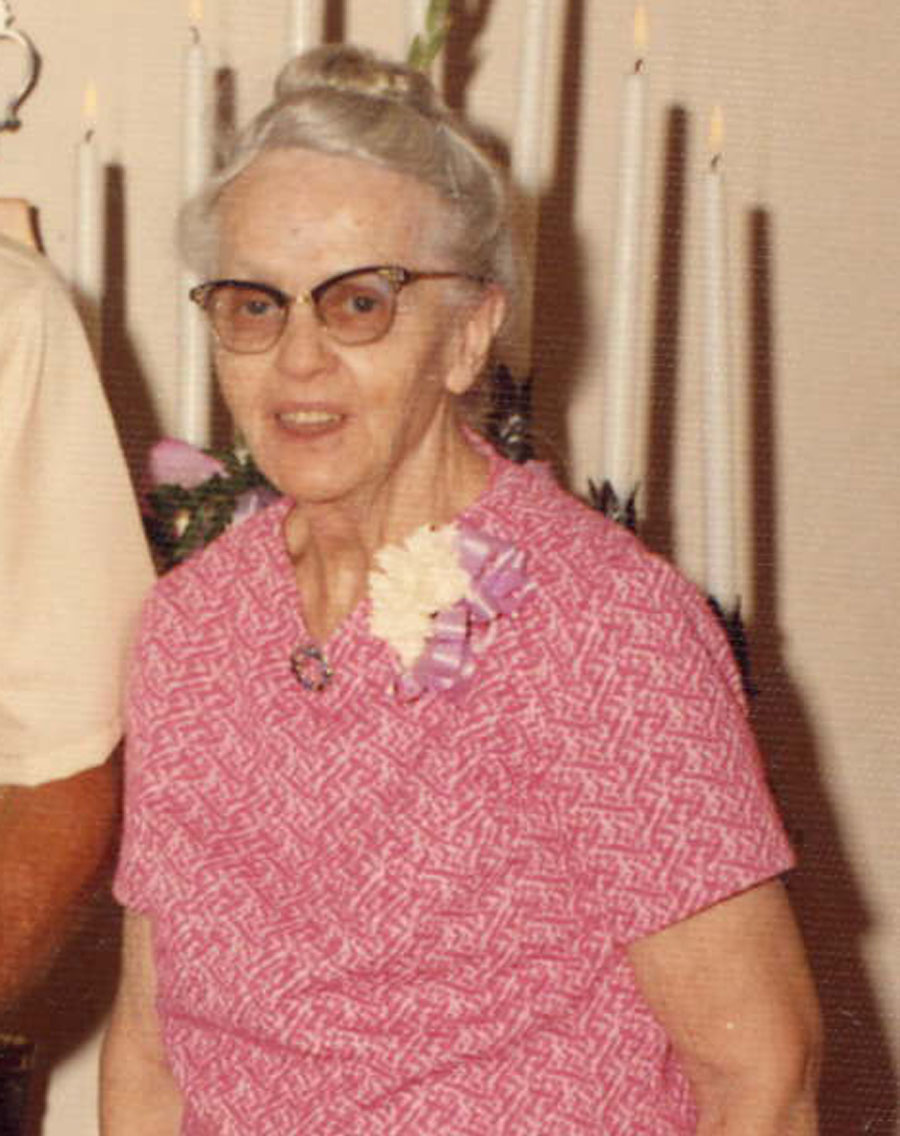
#Photo: The featured image is of Ruthe likely in the 1940s.
Each person likely has some local, national, or worldwide historical event that they would say had a big influence on their life. For many of us today, 9/11 had a great impact on our lives. Meanwhile, for my parents’ generation many would call out World War II as having a great impact on their lives. This event definitely impacted my father and his three brothers.
Ed McCracken was the only one of the brothers that never served in the military.
Declaration of War
Although the conflict that led to World War II had begun several years earlier, it was the bombing of Pearl Harbor that got the United States directly involved in the war. Many call out Pearl Harbor and United States’ Declaration of War as being very significant to their life.
Dad talked about the years surrounding World War II a lot. When the Japanese bombed Pearl Harbor, he was a freshman at Girard High School. On December 8, 1941, the day after Pearl Harbor, President Franklin D. Roosevelt gave an address to Congress at 12:30 p.m. asking them to declare war.
In anticipation of the content of the President’s address, all the students in his school were called to the gymnasium to listen to the speech. It became known as the “Day of Infamy” Speech and is one of the most famous speeches in American history. Listen to FDR’s speech to Congress.
Although Dad could quote pieces of the official speech, it was other words that FDR said in a radio address that Dad quoted the most. He said,
I didn’t want war,
Eleanor didn’t want war,
And, Fala didn’t want war.
But, we’ve got war.
And, you fight war with war.
Dad would repeat these words often, always imitating FDR’s accent. For instance, he said the word “war” more like “waaaarrrr.” Now, if you are wondering who Fala is, that was FDR’s dog. FDR’s Scottish Terrier is likely the most famous dog that ever spent time at the White House. He traveled with FDR, was mentioned on the House floor, and had his own secretary to answer his fan mail. Read more about Fala. . .
Dad’s brother Don questioned him about the story, as he didn’t believe FDR talked about his dog not wanting war. However, he researched it and found a transcript of the speech, which confirmed Dad’s story.
Kenneth Donald McCracken when serving during the Korea conflict.
Atomic Bomb
The historical event of World War II that appeared to most greatly impact Don was the use of atomic bombs in Japan in 1945. He had the realization that the war would now end, but that it would be at a high human cost. As he wrote in his poem “August 1945,” “I don’t want to die; I am only fifteen.”
Before that, he had believed that the concept of atomic bombs was merely a theory. But, once it became a reality, it brought the idea of death to him in a way he had not previously considered. His own mortality sunk in. The last verse of his poem states,
I want to live, but it is more than that.
I want to be survived.
When other people died, others survived them; I want the same;
I will die happier if I know others still live.
For years, I have dreamed about the end of the war;
And now that it is over, my dream has changed to a nightmare.
I don’t know exactly how much of the poem he wrote in 1945. However, he told me that at that time he wrote a portion, but just could not complete the poem. It was years later that he finished capturing his thoughts about the atomic bomb.
Daily Life
Although these two events etched memories into both Dad and Don’s minds, the war also changed their family’s life. Schools immediately required all males to take some form of physical education to get in shape for the military. The schools participated in scrap metal drives, bond drives, and more.
The most significant change was that their older siblings scattered as they went to work and to war. Dewey was in charge of the family’s farm when he got the call to serve. Since Grandpa worked on the roads for the state of Kansas, the farm was left without anyone to run it. Thus, at age 14, Dad dropped out of school (he would finish later) to become a full-time farmer with responsibility for a portion of the family’s income and food supply.
Dewey and the Army Air Force
Dewey was the first brother to be called into service. The draft would have to be the event of WWII that most impacted his life.
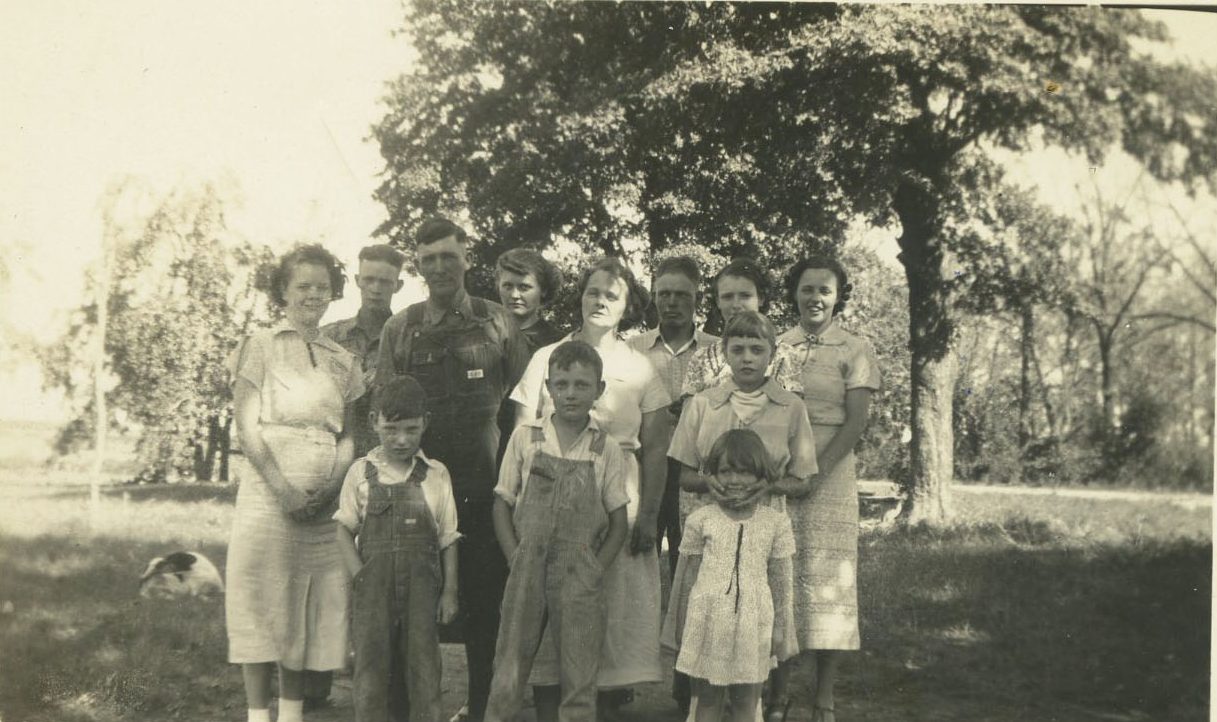
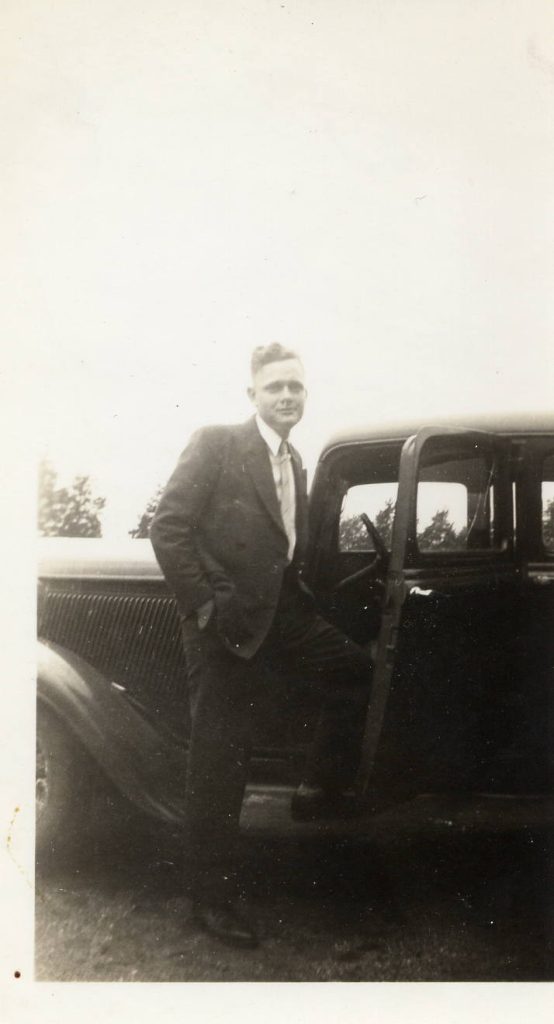
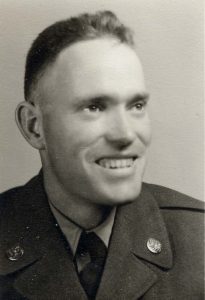
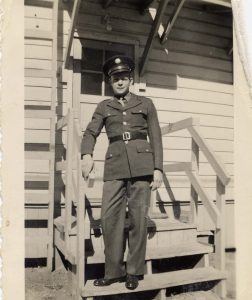
Dewey became a mechanic in the Army Air Force. Although Dewey had multiple assignments, he spent most of the war at the airbase in Greenville, South Carolina. He primarily worked on engines for B-25 Mitchell medium range bombers. At times, maintenance crews worked multiple shifts to keep the planes flying for training missions. He thought that he might get shipped overseas, but that day never came. Although he never left U.S. soil, Dewey definitely had different experiences because of his experience being in the Army Air Force.
Dewey may have talked about his experiences, but never in my presence. I do know that when equipment broke down, he was very open to Dad working on it. I suppose he had enough of ‘mechanicing’ during his time in the service. Read more about his service . . .
William (Howard) McCracken
Howard and the Blue Devils
Howard’s work at Solar Aircraft in San Diego had bought him a deferral. However, he knew it would not last as they were seeking all able young men. In fall of 1943, he was called into service. After basic training, he was sent to North Africa and then to Italy where he joined the 88th Division Blue Devils.
Howard marched through mud as he fought in the mountains in pouring rain. He saw plenty of death and destruction although he, like all the others, were instructed not to write home about such things. On good days, he saw old cities and even ate some local food. He definitely wasn’t in Kansas anymore.
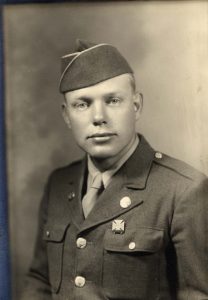
Howard had many experiences that would have shaped his life had he not been injured and then gone missing in action on April 17, 1945 near Monterumici Hill, a short distance from Florence. He has never been found. Read more about Howard’s service . . .
Clearly, the historical event that impacted Howard the most was that last battle where the Allies pushed through the mountains to the Po Valley. The Allies were successful and it was one of the keys to them defeating Germany. Had he not received an injury that day, that battle still may have been the most significant historical event as it helped end the war in Europe.
It’s Personal
In the end, it isn’t the historical event per se that impacts us. It is the personal aspects surrounding that event that stick with us most and changes our lives.
When I think about Dad, I know that all the personal aspects kept the war in the forefront of his mind, especially the loss of his brother. Had his brothers not served and he had stayed in school, his experiences would have been very different. Although he did not serve in the military, the war likely changed the trajectory of his life.
Featured Image: Rare photo containing all four McCracken boys. I do not know of any photographs of just the four boys by themselves.
When your name is Mary Inga Anderson and you live in Sweden, you are about as easy to find as Mary Ann Jones in America. Lots of them exist, but which one is the right one? It is often impossible; thus, leading to one solid brick wall. However, sometimes you get lucky and a DNA match puts a crack in the wall. Soon, it comes tumbling down.
In Front of the Wall
My husband has known for a very long time that he had a great-great grandmother whose maiden name was Mary Inga Anderson. She had immigrated to the United States in the 1800s, married, and had children. One of those children would marry and give birth to his grandmother Donna Isabelle (Van Allen) Thomson.
Mary married Hans (Magnus) Hanson, a first generation American whose parents were born in Norway, in Wisconsin in 1873. Until recently, very little was known about Mary’s life prior to her marriage other than that she was born September 10, 1852 in Sweden and had immigrated sometime prior to her marriage.
Magnus and Mary lived in Richwood Township in Richland County, Wisconsin where Magnus worked as a carpenter and farmer. Over the coming years Mary gave birth to ten children. All their children except John, who died in 1887 as an infant, and Martin (Norman), who died at age 18, lived into their adult years.
The family rented property until sometime between 1900 and 1910 when they purchased a property in or near the Village of Byrds Creek. By that time, Mary was a naturalized citizen who was able to read and write.
Mary died January 29, 1915. Magnus lived another 21 years during which he continued working as a carpenter despite his advanced age.
Research
Despite searching, we could never learn anything more about Mary. Her name was simply too common. We did not know her parents’ names or the location of her birth or departure from Sweden.
The DNA Match
We had uploaded my husband’s DNA results from ancestry.com to MyHeritage.com since his family is relatively new to the United States and MyHeritage tends to have DNA from more people outside the United States.
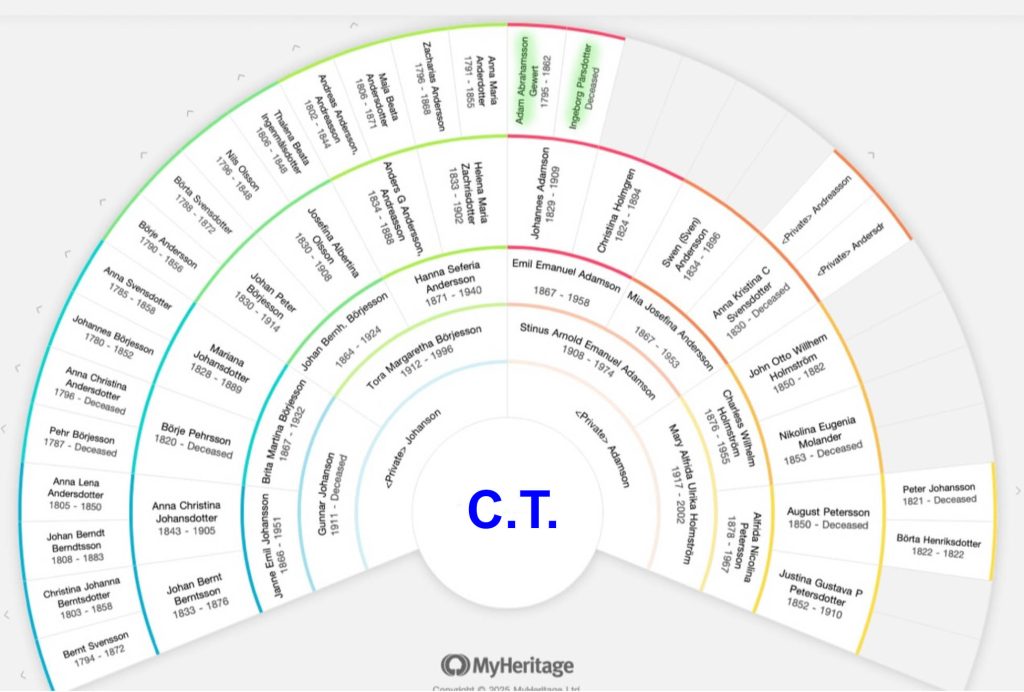
In February, my husband got an interesting DNA match from Sweden. C.T. matched him at 73.8 centimorgans, which is a good match for a more distant relative. Although there are a variety of possible relationships with that amount of shared DNA, MyHeritage estimated that C.T. was likely a third cousin (3C).
The diagram below shows C.T.’s family tree from MyHeritage. Her Name has been replaced with initials for privacy.
With this tree in mind, searches were done for Inga. People’s trees were utilized to create possibilities of Inga’s family line. From there records were used to match up with the trees, people, and locations, to find the connection to C.T.’s tree.
Breakthrough
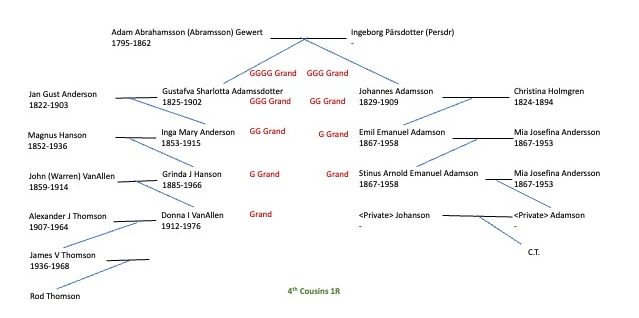
As can be seen in the chart below, the breakthrough led to the identification of Mary’s parents’ names: Jan Gust Anderson and Gustafva Shalotta Adamsdotter. In addition, her maternal grandparents, Adam Abrhamson (Abramsson) Gewert and Ingeborg Parsdotter (Persdr), were identified as the common ancestor with C.T. They are highlighted in green in C.T.’s family tree above.
It turns out that the relationship to C.T. is more distant than MyHeritage predicted. At 4C1R (fourth cousins once removed), it is still within the range of possibility, but DNAPainter only gives a 4% chance of this relationship. Thus, it may be that their is a second direct connection, that one segment is a “sticky segment” (it just doesn’t breakdown easily), or that enough intermarrying between families in the community over the years led to increased shared DNA.
Immigration
A church record was found that shows Mary immigrating with her family to the United States in 1869. According to the record, they departed for North American (Nordamerika) on April 23, 1869 from Varmland, Langserud in Sweden. She traveled with her parents and several others.
Mary’s father is listed as Jan Gustaf Andersson Gäfvert (b. Jul. 24, 1822) and her mother as Gustafva Adamsdotter Andersson Gäfvert (b. Aug. 1, 1825)
Everyone else is listed as a son or daughter. This would imply that the children would be Jansson or Jansdotter by typical naming convention where the last name of the child is based on the first name of the father. However, some are listed as Gustafsdotter. The father’s second name is Gustaf and the mother is Gustafva. So, it isn’t clear if this is a reference to one of them or someone else. It is known that Stina likely isn’t a full sibling to the others. However, more research is needed to understand the specific naming of the children.
The children are:
Stina Kajsa Jansdotter (b. Oct. 22, 1849)
Inga Maja Andersson Gäfvert Gustafsdotter (b. Sep. 10, 1852)
Anders Gustaf Gäfvert Andersson Jansson (b. Aug. 27, 1862)
Augusta Gäfvert Andersson Gustafsdotter (b. Aug. 3, 1865)
Johan August Gäfvert Jansson Andersson (b. Nov. 28, 1867) (last two names are possibly switched)
Life in the United States
In 1870, the family, excluding Mary, appears to be in Richland County, Wisconsin where Mary later married. Mary is living in Racine, Raymond County, Wisconsin working as a domestic in the Cross household. She was 16 and was the oldest child able to work as Stina was “deaf and dumb.”
By 1880, Mary was married and it appears that her parents moved on from the area. They possibly lived in or near Forest City, Iowa. However, more research is needed to track her parents and siblings after their arrival in the United States.
Life in Sweden
In Sweden, Mary Inga, who was sometimes Inga Mary, shows up as Inga Maja. Now, Maja is another spelling of Maya and can also be used for Maria or Mary.
We find Mary with her parents in Långserud, Värmland, Sverige (Sweden) in the village or farm of Eldansnás (Eldansnäs) during the period 1851 to 1855. Mary’s parents and Stina had all been born in Svanskog. Only Mary had been born in Långserud at Långelanda . From this record, we also learn that Stina was considered illegitimate.
By the first half of the 1860s, The family had grown to include Stina, Inga Maja, Wilhelmina, Emma, Anders Gustaf, and Augusta. Emma (b. Mar 6, 1860) was not with them when they made the journey to America, as she died at age 4.
More Work To Do
Plenty of research on Mary Inga and her family remains. However, we now have names and places to aid in that research. Perhaps we will be able to uncover more details and possibly even more generations.
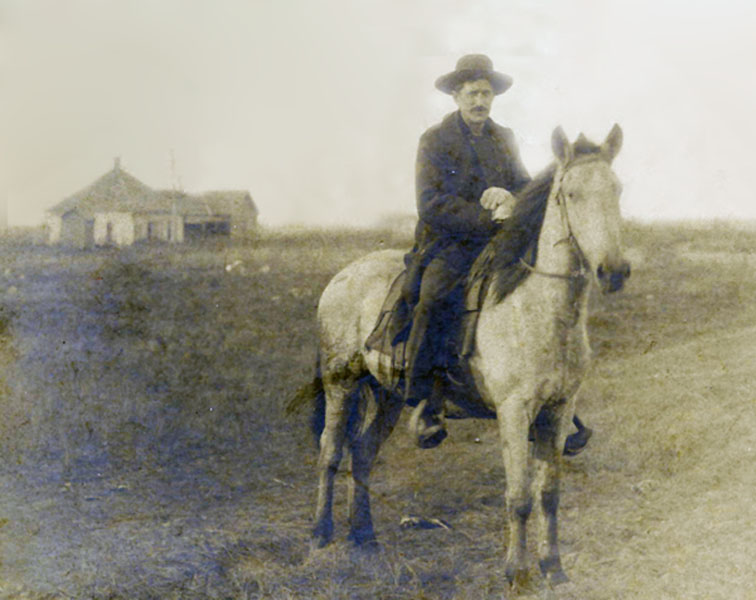
The image above is what I always think of when my Great-Grandmother Rosa Isabell (Ellis) McCracken Apt’s brother Joe Ellis is mentioned. He was a man with a horse on the frontier, but why did he keep moving his family? And, why did he go to a place where the entire population of the township filled less than three pages of census forms?
The Early Years
Joseph Andrew “Joe” Ellis, son of Joseph Lewis and Cynthia Ann (Nicholson) Ellis, was born in Brown Township, Ripley County, Indiana in January 1869. He was the sixth of eight known children although it appears that one other daughter died as an infant or young child, likely prior to Joe’s birth.
Joe moved with his parents to Kansas about 1879. He was living with them in Grant Township, Neosho County, Kansas in 1880. By 1885, Joe had moved with his parents to Walnut Township, Crawford County, Kansas.
Married Life Began On The Move
Nine years later, when Joe was 25, he married Emma (May) Johnston in Sherman Township, Crawford County, Kansas. At the end of 1896, he moved his family to near Galesburg in Neosho County, Kansas where he planned to farm the following year.
That venture didn’t last long as Joe, May, and their son were living in Jordon Valley in Pawnee County, Oklahoma in 1900. Oklahoma was not yet a state and much of the area remained Indian Territory. Thus, it is unclear what attracted Joe, May, and her brother George’s family, who lived next to them, to Oklahoma.
Again, the venture did not last long. By the time their second son was born in March 1903, they were back in Crawford County, Kansas. In May, 1906, their third son was born in Jetmore, Hodgeman County, Kansas.
Joe and May’s sons. L to R: Raymond Francis, Joseph Philip, and James “Jimmie” Lee. The photo was likely taken shortly before (or possibly after) Joseph died as Jimmie was only two years old at the time of his death.
Settling Down?
The family soon moved to Sutton Township, Lane County, Kansas. In August 1906, they filed a homestead claim on 160 acres of land. On this property, Joe built a sod house, barn, and well on this property. It isn’t known what all crops or livestock Joe had at this point. However, among items Joe raised were melons, corn, and cane.
Nearby, and likely having made the move with them, were May’s father, some of May’s siblings, and Joe’s nephew Robert F. “Frank” Plummer, son of his sister Mary Jane.
The school age children in the families would have had a bit of a hike to school, as Joe and May’s home was two and a half miles from West Lake School, which was the closest school to their home.
It was while living in this home that Joe and May lost their oldest son Joseph. They had moved to the area hoping the climate would be good for his health, but the change was not enough. In 1908, he lost his battle with tuberculosis.
Just a Few Miles Away
The family stayed at the homestead a bit longer than their previous homes. Still, seven years after they obtained the homestead property, they moved again. This time they purchased 640 acres a few miles away. This property was only one mile from West Lake School. Thus, the kids now had a shorter distance to travel to school.
On this property, Joe built a larger sod home with three rooms and a half-basement, a well, a large chicken house, a barn, granary, and more. The well was over 60 feet deep and provided water for both the home and the livestock, which included 7 head of cattle, 4 swine, and 11 horses. It is clear the family got quite a workout since the well was 200 feet downhill from the house.
The family’s farm flourished. In 1919, the family had 130 acres of winter wheat, 25 acres of corn, 10 acres of oats, 20 acres of barley, 60 acres of sorghum, and 20 acres of millet. Additionally, they sold $150 of milk and cream, $150 of poultry and eggs, $1337 of livestock, and 100 pounds of butter during the year. This may or may not include the 100 turkeys that they put on the market.
It was said, that despite the very rural area with few families, that at one PTA meeting the crowd devoured 300 pounds of Joe’s best watermelons. Either they had a big crowd, each person ate a lot of watermelon, or somebody embellished a bit.
The Next Phase of Life
About 1943, Joe and May decided that being in their seventies, it was time to give up life on the prairie. After all, they still didn’t have running water in the house and they were looking forward to having a few conveniences. So, they made one more big move. This time they moved to Garden City. Joe died in 1951 and May followed seven years later.
The Wrap Up
What started as finding a place to settle and raise a family had turned into a hunt for a place that would bring healing to Joe’s namesake son. Sadly, that did not occur. However, the family was able to obtain a sizeable property where they could live for years to come.
Side Story
The notes of Raymond Lee Ellis, grandson of Joe Ellis, mention a time that outlaws visited Joe and May’s home. According to the story, they “dropped in” for dinner. And, then left a sizeable amount of money (for those days) in payment for the meal.
Now, the story as written cannot be true as the names and dates don’t align with history. At the time of the supposed visit, the family lived around 30 miles from Dodge City, which had a reputation for having outlaws and gunfights. Additionally, plenty of outlaws still roamed Kansas at the time the event supposedly occurred.
So, questions remain. Did someone along the way get the names wrong? Did it happen at a different location at an earlier date? Or, was it simply an Old West yarn told by a grandfather to young listening ears?
Credit: The notes and writing of Joseph Andrew Ellis’ grandson Raymond Lee Ellis, who graciously shared them with me prior to his passing in 2015, contributed to this story.
Some years ago, Dad told me a story and then told me not to tell people. Well, now that all of the older generation have passed, I am sharing the story. I think Dad thought it was too risque and might put his mother in a negative light, but I believe shows a side of my Grandma Nellie (Peelle) McCracken that many of my generation may never have seen.
Grandma, Grandpa, O’Ella, Esther, (center) Dewey, Howard, and Grandma must be holding Ruby
The Story
Someone, although I don’t recall who, was questioning Grandma about her second oldest daughter Ester’s looks. Apparently, they thought her coloring and maybe her height did not match Grandma and Grandpa. I guess they thought Ester was too blonde and too tall. Anyway, Grandma, in a rarely seen moment expressing humor, calmly stated, “Well, we lived across the road from a family of Swedes back then.”
The Assessment
It was true that Ester was very light in color when she was young and she was taller than her older sister O’Ella. However, anyone that knew Grandma McCracken would know that there was absolutely no chance that her implication was true. First of all, if it had been true, she would never, ever have made the statement. She was far too proper and she would never have stated that if she had even given the Swede a glance. Secondly, unlike some people that married just to be married, letters between Grandma and Grandpa show that they were quite smitten with each other.
Nellie (Peelle) McCracken & Lydia Peelle
In addition, they clearly didn’t notice Grandma’s very light colored skin. It isn’t as if she had dark hair and olive skin like her sister. Nor did they realize that many children, including several of Grandma and Grandpa’s children, have light colored hair that darkens as they grow older.
Anyone that is still questioning if there is a chance that the implication could be true, Aunt Ester’s great-grandchildren’s DNA proves that they are indeed descendants of Grandpa McCracken.
The Humor
Her statement reminded me so much of the humor of her son, Dewey – dry, calm, and simple. It was funny if you caught it, but sometimes it came out so smooth that some of the people missed it. Her style was very different than her son Don who would be chuckling and making exaggerated gestures with his hands as he made statements that were meant to be humorous.
Don’s gestures reminded me a bit of stereotypical Italian gestures. But, before you get any ideas, I can attest that a German family – not Italian – lived across the road when Don was born.

 Dewey and the Army Air Force