My family has been supporting our country since before it was a country.  Therefore, when I think of cultural traditions, I think of soldiers and fireworks to celebrate the birth of this great nation.


Soldiers

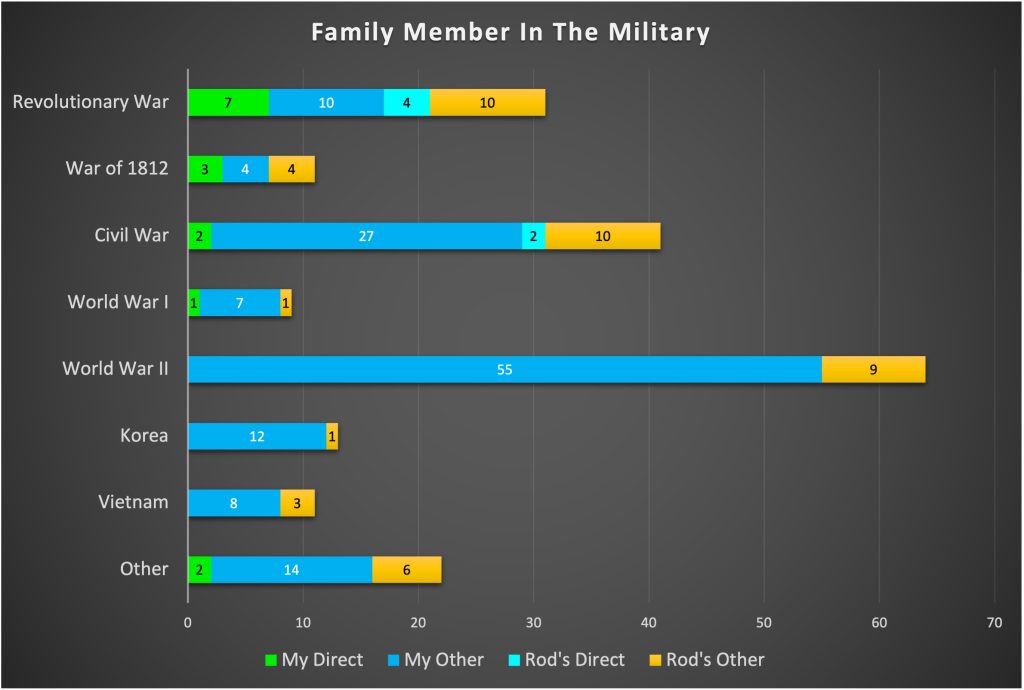
With Veteran’s Day being this week, it is a good time to honor all that have served.  Reviewing my Military Honor Wall, over 200 of Rod’s and my direct ancestors and relatives (including spouses of relatives), who served in the military, have been identified and documented.  The number continues to grow.  If certain family lines can be confirmed, the total will increase significantly.

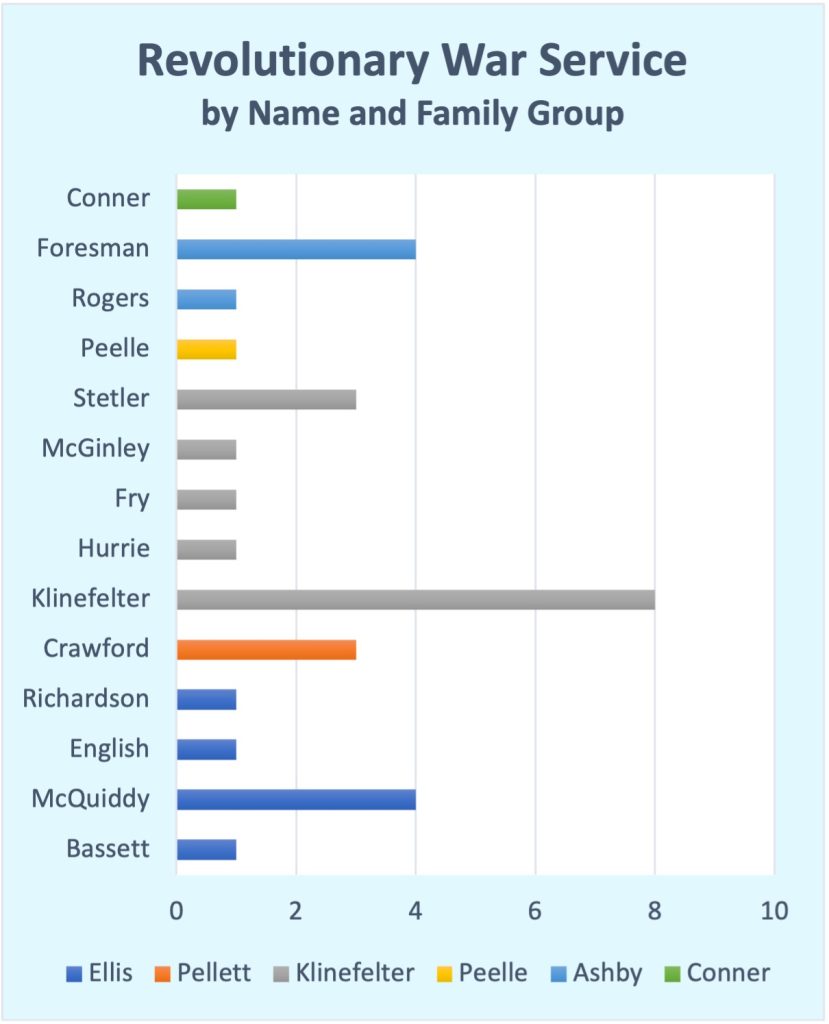
These ancestors have served in every major conflict starting in the Revolutionary War and relatives continue to serve today.  The chart below shows the number of relatives identified as serving and when they served.


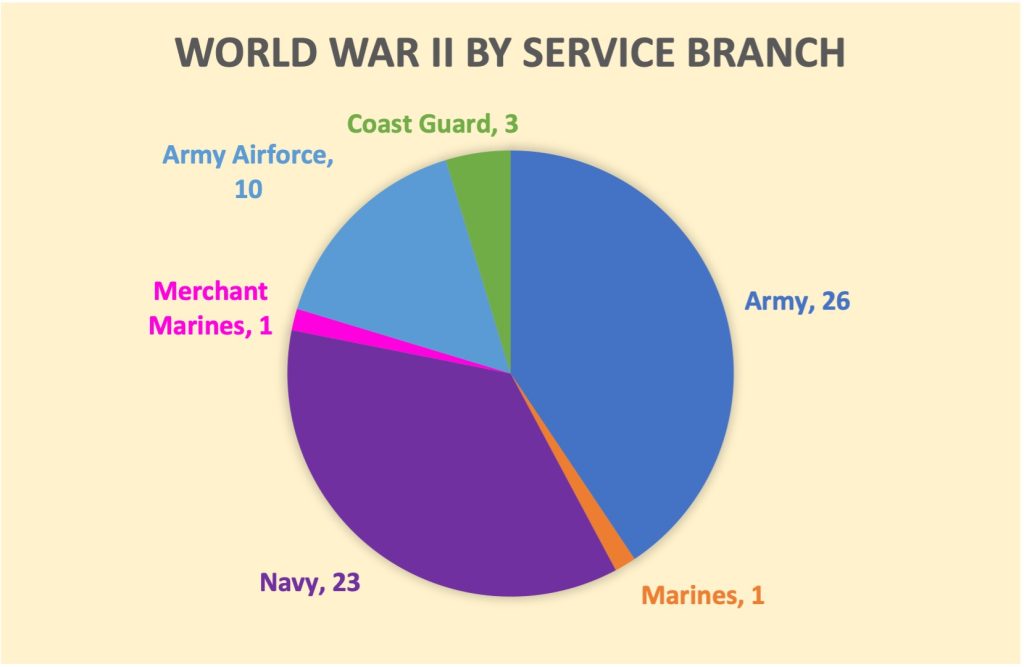
Members of the family served in various branches of the military, plus various early militia groups.  The early days of the military looked very different than it does today.  Thus, looking at the service branches over the entire 250 year period isn’t practical.  So, I decided to look at the breakdown of service by branch during World War II, since it has the greatest number of people who served.


To read about family members that served, view my Military Honor Wall.


4th of July celebrations

I can’t speak for all the families, but the McCracken family had big gatherings to celebrate the birth of our country.  The 4th of July celebrations were usually held at one of the family farms.  Everyone gathered before the noon meal.  A hay rack served as a table.  Chairs, the hay rack, and blankets served as seating.


The Food

Food was always abundant, as it wouldn’t be a McCracken gathering without plenty of food.  We didn’t grill or have a wiener roast.  Sometimes people brought fried chicken, but I am not sure what other meats we had.  We did have numerous salads with potato salad being a favorite.  Often, we had at least two potato salads.  Of course, baked beans and chips were also on the menu.  And, if the corn cooperated and was ready at the right time, we would have corn on the cob.

In those days, people didn’t drink pop as often as today, so that was a special treat on the 4th of July.  However, it was even better than as a regular treat as it would have been soaking in a big tub of ice, which became ice water over time.  The longer you waited to drink one, the better it was.  It was so icy cold and on a hot day, which it usually was, it was amazing.

Of course, the watermelon, straight out of the garden, soaked in the same tub of icy water.  By mid-afternoon it was delicious.  If you have never tasted watermelon fresh from the garden soaked for hours in an icy cold water, you haven’t really tasted how good watermelon can be.

The highlight of the food had to be the homemade ice cream.  Usually there were several flavors and I never tasted any of it that wasn’t delightful.

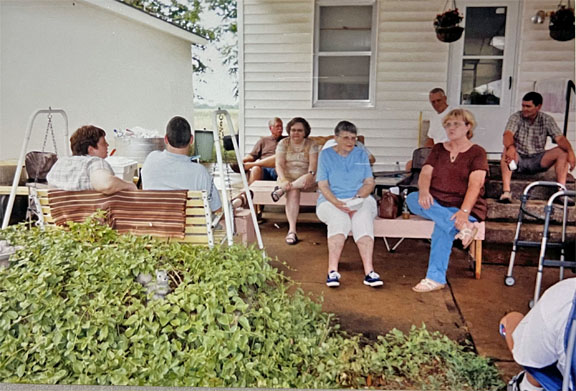
Family visiting at the 2006 Fourth of July celebration. In the back Stan, Dad (hiding behind Dee), Steve, Dallas, Cindy (back turned), Sky (back turned), Jo, Dee, Beth (Uncle Ray’s daughter).

Now Energized

The visiting, conversation, and fun started from the moment people started arriving.  However, it kicked into high gear after everyone ate.  The fire crackers started popping left and right. Meanwhile, the more senior members of the family split their time between visiting and keeping and eye on the action.  I would say adults, but at least some of the younger adults were right in the middle of the action.

Often a baseball game or game of catch sparked the interest of people of all ages.  The old guys (Dad and his brothers) took it easy on us young ones.  I think it may have been a way to simmer down the fireworks a bit, but we all had fun.


Noise & Sparkles

Nearly everyone brought fireworks to the celebration.  And, when you have nine living siblings and their families, that adds up to a lot of fireworks.  Of course, it seems that somebody would always run low on some type of fireworks, leading to one or more fireworks runs during the day.  I remember cousins going to the fireworks stand at the Farlington Lake corner one year.  And, of course, runs to Fort Scott.

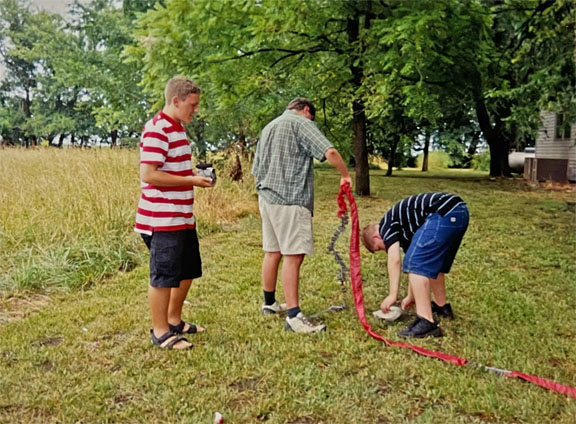
Jared and Josh appear to be at work on some major firecracker event. Meanwhile, Jake is standing by to collect evidence.

The Famous Fireworks Run

The most famous fireworks run occurred when Josh Davis was a around twenty.  He, along with my sons, ran to town for more fireworks.  Josh parked the car and they proceeded to shop and purchase fireworks.  When they walked back to the car, it wasn’t there.  Josh thought it had been stolen.  However, it wasn’t.  Josh had apparently parked on a hill and neglected to set the emergency break and the car had rolled down the hill. Fortunately, no one or nothing was harmed.  Still, he was afraid to tell his dad what happened.

In the evening, night works would be set off.  And, usually there were quite a lot of them.  When the gathering was held at the home place, which was just off the highway, people were known to stop along the highway and watch.  It was probably as good a display as any of the nearby small town displays.

No 4th of July celebration ended in a significant fire or a major injury.  Of course, a sprayer of water was kept nearby to combat any small fire that started.  If it was very dry, extra rules were put in place by the older generation to limit the possibility of fire.  Usually, however, a minor injury or two occurred during the day.  Fortunately, and miraculously, no one ever was seriously hurt and nothing ever burnt down despite the fact that safety was not the number one concern of everybody.


The Day After

For kids, fun from fireworks doesn’t necessarily end on the 4th of July even if all of them have been set off.  When I was probably 8 or so, we had the 4th of July at our house.  The next day, sis and I went around the property and down the road collecting the cardboard that housed the fountains, cones, roman candles, and any other leftover debris.  I am sure Mom and Dad appreciated us picking up the trash.  However, it wasn’t trash to sis and me.  They were great objects to add to our collection when we played house in the outbuildings.  It is amazing what a little creativity could do with 4th of July trash.


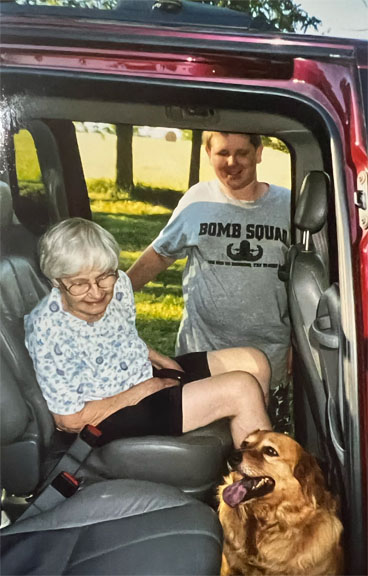
Mom loved to watch the fireworks, especially night works. However, she didn’t get around very well, so she always got a seat for supper and the nightworks.

As Time Went By

The Last Big Family 4th Of July

As time went by all of us cousins got older and the big family gatherings on the 4th of July occurred less often.  The last one I remember was in 2006 at Cindy and Lee’s house.  It wasn’t as big as the ones of days gone by, but it still had characteristics of a McCracken 4th of July.  It even had a roman candle being pointed backwards and the thought of putting saturn missiles on their side.  Fortunately, the latter was quickly decided to not be a good idea.


Celebrations At The Farm

During many of the years that my boys were growing up, we visited Mom and Dad around the 4th of July.  Our celebrations were smaller, but were great fun.  Dad would take the boys on a hay rack ride.  It wasn’t always on the 4th, but definitely a tradition that almost always happened unless there was lots of rain.  On the 4th we would often have a wiener roast complete with brats, hotdogs, and marshmallows cooked over an open fire.  That is unless it was too dry and too risky.  Like at the big family celebrations, firecrackers went off all day long and nightworks started as soon as it was dark enough.

One year, however, it was the opposite of too dry.  Dad pulled the vehicle out to the typical picnic spot north of the barn where the pig pen had once been.  He rolled down the windows and it was so humid that the inside of the windows steamed over.  The air had so much moisture in it that it was nearly impossible to get the fireworks to light, but it was quite safe as it would have been very difficult for anything to catch fire.  The boys had a huge pack of fireworks and with Ann’s help they finally shot them all off.  Then, they ran to the house drenched in sweat.


Newspapers reported that although they could report on John Peelle’s stories, a person had to hear them directly from John to properly appreciate them.  He told many of the same stories over and over.  Yet, it seemed the people of Wayne County, Indiana never grew tired of hearing them. 

Old Settlers Organization

Organizing

The Old Settler’s Organization held an organizing meeting on July 21, 1855.  John Peelle, son of Passco and Tabitha (Dunigan) Peelle, was not only a founding member, but was also elected to serve as one of the two vice-presidents.

On September 7, 1855, they met at the Temperance Hall in Richmond.  Four rules were adopted:

  • Meetings would start with a prayer.
  • Old settlers would share stories about how things were in the olden days, how things had changed, interesting incidences, etc.
  • They were to make each other sociable and agreeable.
  • A book would be obtained to record the names of old settlers, their age, and when they came to the area.


The Program

After the business was complete, a program was held.  The auditor brought records from the county clerks office which showed the growth in the county based on the very small amount of paper required for tax records in 1819 compared to 350 large pages that were needed for the same task in the most recent accounting.

The auditor also presented records that showed that the Board of County Commissioners fixed rates for taverns in those early days.  Prices were fixed for meals, lodging, whisky, beer, brandy, and wine.  By 1855, this was not in effect.

Following the information shared by the auditor, some of the men began sharing their stories.  It was on this day that John told his story to the old settlers for the first time.  However, it would be far from the last time as he was a highly requested speaker and told his story over and over for years to come.  In his later years, he would begin, “I have so often told you the same old story, that you know it by heart.”


Old North “Carliner”

His story would usually start with his birth on March 27, 1791 near (David) Beard’s Hatters Shop in Wayne County, Old North Carolina or “Carliner,” as he would say.  He told of the early days before the cotton gin was common.  Everything with cotton had to be done by hand.  He was required to pick seeds from the cotton.  He admitted that sometimes he burnt some of the cotton to cut down on the number of seeds that needed to be picked out.


Indiana Here We Come

When he was a young man, John became restless and went on an adventure to Indiana Territory, arriving in August 1813.  He worked near Richmond for only a few days and then worked for another man for $10 per month.  John had only a tin of milk and a similar amount of mush to eat.  He claimed, “He had often got up from his meals, oh! So hungry, and with tearsi n his eyes.”  It made him long for North Carolina, where people had two-part homes.  One part where they lived and slept and another where they cooked and ate.  He eventually returned to North Carolina. 


The Silver Dollar

On March 6, 1815, he married Penina “Penny” Pate.  John paid the minister, who married Penina and him, with a silver dollar that he claimed was once owned by John Wesley.  Now, how someone who grew up in the Society of Friends (Quakers) would have come to have a coin once owned by John Wesley, a Methodist leader who died prior to John’s birth, is unknown.  However, I am sure John had a story about it.

At the Old Settler’s picnics, he would often pull out a silver dollar (or English shilling, as some report) that he said was a mate to the one that he had paid when he married the prettiest woman in “North Caroliner.”  Even when she was in her seventies, he stated that he had never seen a prettier one – ever.

His story did not end there.  He went on to explain why he had kept the coin.  He said that at the time of his marriage that witches were very bad in the Carolinas.  If a man had no money, they would eat him.  Thus, he kept the silver dollar so that he always had money on him.  Now, never mind that in his story about the early days in Indiana, he says that he arrived in the territory without any money.  Details, details, details . . .


Moving West

On March 6, 1815, he married Penina “Penny” Pate in South Carolina.  Three days after John and Penina married, they piled their belongings into a two-horse wagon, said, “Good-bye” to their friends and family, and left for Indiana. 

John and Penina arrived in Indiana in October.  They had been on the road for seven months.  Their journey had taken them through the Appalachian Mountains, across streams and rivers, and through wilderness.

They stopped where Richmond, Indiana stands.  They found John Smith selling goods in a small building on the corner of Front St. and Main St.  Although Main St. still exists, I have not yet identified this specific location.


Life In Indiana

John and Penina settled in Randolph County, Indiana just to the north of Wayne County.  They cleared the land and made a home.  It was here that their first child, a son, was born.

John and Penina had grown up in the Society of Friends (Quaker) faith.  However, after the Methodist Episcopal Church formed in the area, they became early members.  It was the “old religion” as the pioneers would later say.  They thought “old religion” was better than “new religion.”  One factor seemed to be that in the days of few settlers clearing the wilderness to create farms everyone for miles around was considered a neighbor and friend that could be counted on.


Hard Times

Those early days in Indiana were not easy.  He claimed he arrived in Indiana with no money.  Now, he may have meant that he had no significant money.  In any case, “he traded his wagon for a cow and some sheep.”  As he told it, “Dogs killed his sheep, his horse died,” and the cow killed itself by drinking syrup.

In those early days, John would make money by killing wolves.  The county would pay a small amount for each wolf scalp that he brought in.  Despite this, he said that he was not a skilled hunter.  Still, on one occasion, he claimed to have killed two wild geese with one shot.

John’s story of hardship in the old days continued, “You know the plow made of a forked stick; the cotton rope traces; my tanning of leather or pretending to for the purpose of making my wife’s shoes, which hurt her feet to this day.  You know I have told you before that after I came to this state, I often got up from the table hungry.  I sighed with tears in my eyes for my mother’s milk house in North Carolina.”  He went on to say that he thought he had “seen as hard times as the next man.”


Things Are Looking Up

John kept a positive outlook on life.  He stated, “We soon raised plenty of corn and squashes and pumpkins on which we fared sumptuously.  We used to hand around a basket of turnips in place of apples.  I remember once at a neighbor’s house I did not scrape the turnip as close as the good lady of the house thought I ought to; so she scraped it again and ate it herself!”


Wayne County

John and Penina stayed in Randolph County two years before moving to Wayne County.  Their new property was approximately two miles north of where New Garden was laid out in 1818.  The name of New Garden was changed to Newport in 1834.  Today the town is called Fountain City with the last name change occurring in 1878.  Here they again cleared the land to create a farm.  Their last 11 of 12 children were born in this home.

Around 1854 or 1855, John and Penina made a move again.  This time they moved to Centerville, the county seat of Wayne County.


The Old Settlers Picnics

Living in Centerville was convenient for anyone involved in Old Settlers.  Although some meetings were held in Richmond, many of the picnics over the years were held at the Centerville Fair Grounds or in nearby groves.

By 1875, the 20th year of the organization, the Old Settlers Picnics had grown tremendously.  The crowd was estimated at 4000 people, a bit over four times the population of the town.  It drew people from the surrounding areas and even some old settlers who had moved far away returned for the annual event.


Events of the Day

Over the years the event had settled into a general pattern.  The picnics generally opened with a prayer sometime in the mid to late morning.  Often music followed and possibly a speech or two would be given to complete the morning.

Dinner (noon meal) was a time to eat the food they carried in while enjoying their surroundings and  conversing with new and old friends and neighbors.

After dinner, they would tend to the business of determining officers and people for planning next year’s event.  Typically, that was followed by  speeches by old settlers and the displaying of old items.  When known, the history, usage, or story about items was also explained.  Occasionally, special guests would also speak.

Music was also inter-weaved into the event with both bands and singing.  The event ended with the playing and/or singing of “Yankee Doodle.”

By now, the regulars like John Peelle, and their stories were well known to most of the members of the crowd.  John was known to many as Uncle John.  However, he referred to himself simply as “Old Peelle.” 

Besides the stories previously mentioned, he spoke of wearing leather pants, nettle shirts, and going completely without breeches wearing instead a gown that tied close at the neck.  Apparently, he also had some interesting adventures serving as constable.  However, two stories seem to stick out as favorites . . .


 Old Items

Displayed at the Old Settlers’ Picnic


Over the years, John displayed various items at the Old Settlers’ events.  These included:

  • An old trumpet
  • An iron wedge that he had brought from North Carolina to split rails
  • A pewter dish
  • Primitive hames
  • A ladder he made in 1813

And in 1872, he brought his great-great grandchild to show off.  Not as something old, but more to show that he was old.

Items displayed by the old settlers were as much as 200 years old and possibly older.  Some of the items displayed by the group over the years include:

  • Clothes & Accessories
    • Bonnet, shirt, hat, pocketbook, wedding vest, knee buckles
  • Household items
    • Table cloth made from fibers of thistle flowers
    • Dinner horn. It was 5 feet long or maybe 6 feet – its length seemed to grow over the years.
    • Cooking utensils
    • Cup and saucer brought to Kentucky in 1776.
  • Work items
    • Plow
    • Powder horn
    • Packsaddle
  • Specialty items
    • Issue of Centerville’s first newspaper (Possibly the first issue)
    • Newspaper announcing George Washington’s death
    • Wooden boxes supposedly made from wood from a tree under which William Penn signed a treaty
    • 1800 piano manufactured in Philadelphia
    • Bullet molds supposedly once owned by Daniel Boone
    • Paint bag once owned by a chief of a group of Native Americans
    • Double barreled flintlock pistol

Judge Peelle

At each reunion, John would have to mention his nephew Judge William Adams Peelle, who was the son of his brother William (my great-great-great grandfather).  In 1820, John had help lead William and his family on their journey from North Carolina to Indiana.  His nephew was an infant at the time the family made the journey.

John would say that “he (William Adams Peelle) was as bad a child as I ever knew.  He cried nearly all the way from North Carolina, for which I often wanted to thrash him.”  John’s brother William explained to John that young William was crying because he had colic.

John also told about William’s adventure in North Carolina.  As a young man, William had gone to North Carolina to see family.  While there he met a young lady and took her to church the following Sunday.  According to The Richmond Independent, he “attracted the attention of the congregation a great deal more than the sermon did, and so William got up and walked out.  But the congregation followed him, and William sat down at the foot of a large pine tree, while the folks eyed his pegged shoes, the greatest curiosity they had ever seen.  William sat at the foot of the tree for awhile, and when he attempted to get up to go home with the girl he brought, he found that the turpentine and tar had run down and stuck him fast!  The people had to cut him loose with their knives.”

John would go on to say that young William had now become “quite a man.”    And, that he was.   William Adams Peelle was a teacher, lawyer, judge, and had served as Indiana Secretary of State. 


The Pantaloons

On one occasion, John started to wrap up his talk and leave the stand without telling the full story of the pantaloons.  And, the audience quickly reminded him that without the story of the pantaloons that he was not done.  Apparently, no Old Settler’s picnic would be complete without it.  So famous were John’s pantaloons that a newspaper article about a gathering, which had nothing to do with John Peelle, mentioned this famous story.  Likewise, one newspaper reporter even believed that it was worthwhile to come to the event just to hear the story of the pantaloons one more time.   

As the story goes, at each event John claimed to be wearing the “identical pantaloons” that he had swapped for soon after he came to Indiana Territory.  The pantaloons were snowy white cotton dimity with stripes and steel buttons.  He said that he had gone to a log-rolling contest and had decided to swap pants with Thomas Woodard, another young man in attendance.  Why they exchanged trousers, I do not know.

He went on to explain that they went to the nearby New Garden Meeting House (Quaker), which was a log cabin at the time, to exchange pantaloons.  The Richmond Independent reported that “he said it was the only time he ever saw two gentlemen in such airy a costume inside a church.”  John was quick to point out that no meeting was in progress and that the two men were the only ones inside during the exchange.

John said that when he got the pantaloons that they were tight as skin.  Still, years later he was wearing them.  One day, Penina let out the secret that she had removed the waistband and made other adjustments as John had become a bit thicker around the middle over the years.  I really wondered if this had been a repetitive process and if she had also had to patch the pantaloons.

In 1874, he indicated that he had owned them for 61 years, which would have meant that he got them when he traveled to the area prior to his marriage.  He went on to indicate that he didn’t actually know the true age of the pants, as he didn’t know how old they were when he obtained them. He wondered if there were others that had “survived the wear and tear of time” as well as his.

To emphasize his story and make sure everyone could see his pantaloons, he would often slap his leg.  He was known to take off his jacket and vest for a better view as they were somewhat like overalls with the buttons for suspenders between the shoulder blades.  When he was 86 years of age, he took it a step further and climbed up on a table so that everyone could get a better look.


The End of The Stories

An Aging Man

John appeared to have aged gracefully.  On August 15, 1872, the Cambridge City Tribune described John as “aged 83 years and as spry as any boy of 50 or 60.” (Note: John would have only been 81 in 1872.)

Still, John described himself as “a little, poor, worn-out feller.”  The Richmond Daily Independent disagreed saying, “he is a well preserved, bright old gentleman, straight as a cadet, and spry as a cricket genial and pleasant, as an aged Christian ought to be.”

Proving how spry he was, John celebrated his 86th birthday by walking from his home at Centerville to Richmond, Indiana, a distance of approximately 6 miles.  He arrived in Richmond in time to have breakfast with his nephew Judge William A. Peelle.  He returned home that evening.  The Richmond Independent Telegram reported he was “feeling as good as a North Carolina bridegroom.”  The Cambridge City Tribune said that he was “straight in body and morals” and that was why he had lived so long. 


The Last Speech

1878 brought John’s last opportunity to tell his stories at the Old Settler’s Picnic.  As usual, the crowd laughed and cheered as the 87-year-old entertained them.  He would only live another few months.

He died April 20, 1879, less than a month after he turned 88.  In their later years, John and Penina had returned to the Society of Friends.  Thus, his death is recorded in their records.

In John’s will dated approximately one year before his death he showed his unwavering affection for his wife by writing “my beloved wife Penina who has been my partner in life.”  Calling her his partner in life is very unusual.  It was very touching and special given the year.

After John’s death, Penina lived alone for several years before a daughter helped her out.   She died in 1892 at age 96, but had lived long enough  to see the birth of her great-great-great granddaughter.


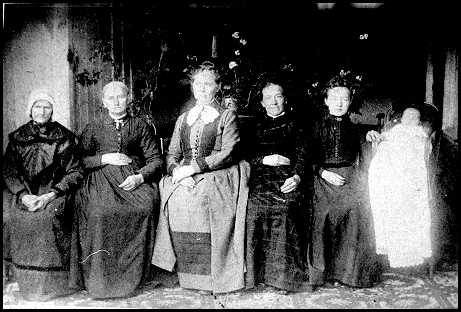
Six Generations of Peelle Women. Left to right: Penina (Pate) Peelle, Harriett (Peelle) Keever, Elizabeth A. Rinard, Rebecca J. J. Lontz, Luella M. Gray, and Goldie V. Gray. October 21, 1890.


Not a lot is known about my great-great grandfather Joseph Lewis Ellis’ brother Stephen.  However, his life and the life of those around him must have been very challenging.


Stephen’s Illness

Stephen E. Ellis (Elless) was born August 5, 1841 in Ripley County, Indiana.  He was the fourth child and third son of David and Lucy Ann (Storms) Ellis.  David and Lucy Ann would go on to have 4 more children after Stephen was born.

Apparently, Stephen was a normal little boy until around age two or three when he had spinal fever (spinal meningitis).  It affected his limbs and left them useless.  At the same time, he became totally blind although his hearing remained intact.  The fever also resulted in him being epileptic and what was described at the time as “idiotic.”  The latter term appears to have been used to described a variety of mental issues.  It was used for everything from depression to someone who was mentally disabled.  Thus, it is unclear as to Stephen’s exact mental state.  However, his obituary states,

“[H]is life was mingled with deep sorrow on account of the loss of his eyes and the use of his limbs.  For fifty-two years in total darkness.  The days, weeks, months and years went wearly by.  The clouds, the deep blue sky, the sun, the verdant plains, rolling hills, the murmuring brooks and the beautiful and romantic scenes of this fairy world had no charm for him.”

It is hard to imagine a playful young boy whose ability to run and play was so quickly snatched away from him. 


Life Afterward

The census stated that when he was eight that he was attending school alongside his older brothers and sisters.  However, this appears to have been an error as it seems he never had that opportunity.  His days it appears where spent at home with his mother and younger siblings that were not in school.  Without use of his arms and legs, he couldn’t play with his siblings, help around the house, or even do basic care of himself.


Move to Illinois

By 1870, Stephen’s father David had died.  Lucy Ann, Stephen, his younger brother Henry, and his younger sister Susan had moved to Rutland, La Salle, Illinois, which was about 100 miles southwest of Chicago.  I can’t imagine making that move in that era with a grown man who was both blind and physically disabled.  It is unclear if he even fully understood what was happening.  Making a move like that must have been a bit unnerving for him with the change in routine, his bed, and all the movement.


Moving Again

A few years later, Lucy Ann would make another big move.  This time moving from Illinois to Galesburg in Neosho County, Kansas.  Lucy Ann’s son James had previously relocated to Neosho County, arriving there prior to 1870.  Galesburg had been created the following year with the Missouri, Kansas, & Texas (MK&T) Railroad extending to the small village.

By the mid-1870s, some of Lucy Ann’s other children came up to La Salle County.  My great-grandmother Rosa Isabella (Ellis) McCracken Apt was a young child and she had her photograph taken by J. A. Wilson, whose studio was above the 1st National Bank on the corner of Maine and La Salle streets in nearby Ottawa, Illinois.

In September 1876, the La Salle Board of Supervisors recognized Lucy and Stephen as paupers.  Thus, they allocated money to the town of Rutland to provide them railroad fare to Neosho County if the leaders of Rutland felt so inclined.  It seems that it would have been very difficult for Lucy to travel alone with Stephen.  Perhaps Susan or some other member of the family traveled with them.

All of Lucy and David’s living children ended up relocating to Neosho County except Henry, who spent time back in Indiana before moving to South Dakota.  However, it is unknown how the others traveled and if they traveled together.  In any case, all of Lucy’s children that moved to Neosho County ended up arriving there by 1880 with her daughter Ellen and her husband William H. Nicholson making the trip sometime between May 1876 and May 1877.  So, they traveled close to the time Lucy did, but it is unknown if they traveled from La Salle County, Illinois or elsewhere.


Kansas


In Galesburg, Lucy Ann, Stephen and Susan lived with her daughter Amanda and Amanda’s husband John Kirkpatrick. Their household made up 8% of the village, which had only 63 inhabitants in 1880.  The women were Stephen’s primary caretakers, as John worked for the railroad.

Lucy received money from the county to help with expenses.  The county would continue to assist the family from time to time throughout the remainder of Stephen’s life.

In December 1880, Susan married Ormas Doolittle.  By 1885 Susan and her husband, who was a Civil War veteran turned plasterer, were living in a separate home.  Similarly, Amanda and her husband, who had quit the railroad to become a hotel keeper, had a separate property.  Lucy and Stephen are not listed in the 1885 state census, but it is clear that they are not living with either Lucy or Susan.  Thus, it is most likely that they were living in a separate residence in Galesburg since Lucy was not known to live anywhere else.  

It would seem that the care-taking of Stephen fell squarely on Lucy’s shoulders.  Likely, Susan and possibly Amanda continued to help care for Stephen part-time.  However, having a hotel, Amanda would likely not have been able to get away often.  By this time, Lucy’s son Joseph and her daughter Ellen had moved to other nearby counties.  Leaving James, who lived in Osage Mission, as the only other of her children nearby.


In The End

After Lucy died at age 71 in October 1886, Stephen lived with Susan and her husband until his death on June 26, 1897.  He was only 55, but death must have come as a relief to him.  Finally, Stephen could once again run, play, and see the world.  He was buried next to his mother at Mt. Hope Cemetery and he shares a gravestone with her.


My Grandma Nellie (Peelle) McCracken’s cousin Charley D. Farmer disappeared in the late 1890s.  Where did he go?  And, what kept him from coming home? It is a story with a twist that begs even more questions.


Who is Charley Farmer?

Charles D. “Charley” Farmer was born in Winchester, Indiana about 1877 to John A. and Evaline (Peelle) Farmer.  He joined sister Indianola “Nola,” who had been born two years prior.


Trego County

In February 1879, the family had moved to Wa-Keeney (how it was written at that time) in Trego County, Kansas.  This was around the same time that Evaline’s parents/my great-great grandparents (Passco and Martha (Johnson) Peelle) and part of her siblings moved to Bourbon County, Kansas.  However, Trego County is in western Kansas and is a long way from Bourbon County making it unlikely that their move was related to Evaline’s parents’ move.

It wasn’t the lure of a ranch that took them west, as John was a painter and didn’t appear to show any interest in cattle or ranching.  No relatives of either of them have been identified in that area at that time.  It makes one wonder if perhaps they were going to venture further west and simply had enough by the time they got to Trego County and decided to stop.  In any case, John hung out his shingle and went to work as a painter. 

People in the area were really struggling.  At the beginning of May 1880, he wrote a letter to the editor of The Western Kansas World talking about the struggles of people in the area and the need of some families for assistance.  He went on to say that if things did not improve soon, that a lot more people would be in need assistance or would move away.

On May 29, 1800, John advertised that he had timber land that he would exchange for a wagon, team, and harness.


Olathe

By early 1881, John, Evaline, and family were living in Olathe, Johnson County, Kansas.  That fall, John stated that he still owned property in Trego County and that he hoped to return one day.  However, he was busy as a painter in Olathe.

In 1884, Charley began attending school in the Olathe School system, which had over 500 students across ten grades.  The following year, Charley’s younger brother Clayton “Clate” was born.  Evaline gave birth to another child, likely between Charley and Clate.  However, that child died and nothing more is known about the child.

Over the next few years, Charley attended school while his father worked in a seemingly booming business.  John had a staff of workers who worked on projects ranging from painting wagons and vehicles to signs to the interior and exterior of businesses and homes.  Among his contracts were one to paint and stain the interior of the Presbyterian Church, one to update the court rooms, and one to paint oboth the interior and exterior of a school house.

However, despite what appears to be a good amount of work, John got in financially over his head.  This led to foreclosure and sale of property in Olathe and property he owned in Fort Scott, Bourbon, Kansas.


Fort Scott

As a result, around 1890, John, Evaline and their children moved to Fort Scott.  John, again, started up his paint business, adding paper hanging to the services offered.  As in the past, he located his business near the core business area of the town with his store located at 208 First Street.

The biggest known event in Charley’s life in the early 1890s occurred in 1892 when Charley cut the tip off the end of his forefinger (index finger) on his right hand when oiling his bicycle.

By 1895, Charley joined John in his business.  The store was moved to the Strothers Building at 203 Market Street and renamed J. A. Farmer & Son.  At that time, Clate was still in school and Nola was employed as a bookkeeper while Evaline managed the household.


Charley and Nola Farmer

The Wandering Son

Charley apparently liked to travel and see the country.  Thus, in 1896, he took a break from working with his father to do just that.  In July 1896, he returned to Fort Scott from a 4-month journey that had taken him to Indian Territory, St. Louis, Chicago, Bloomington and more points of interest.  Although he worked as a painter as his primary occupation, it is possible that Charley may have joined a railroad construction crew in Arkansas and traveled with the crew. 


The Disappearance

Then in 1897, Charley traveled north.  He visited Wisconsin and Minnesota, among other states.  On September 20, 1897, (or September 22, accounts vary) he sent a letter to his father from Stevens, Minnesota stating that he would be coming home.  He never arrived!

John contacted the man who had recently employed Charley.  He told the same story that the letter did.  He believed Charley was going to take his $75 and head back home.


The Search

Over the next two years the family did not hear a peep from Charley.  John searched to learn what had happened to his son.  Since Charley was adventuresome, John considered if he might have headed to the gold fields in Alaska or joined the military.  He also wrote to the leaders of military groups in the area to see if Charley might have joined up with one of them.  All of them responded saying that they had no one by that name on their rolls.

John concluded that something must have happened to Charley.  He learned of a fire at a barn 40 miles from where Charley had been staying that claimed the lives of multiple men.  John wondered if Charley might be among them as the men had been sleeping in the barn.  He thought it was just like his son to ride the rails and then get off and find a place to sleep.


Located?

Finally, on September 2, 1899, the Adjunct General’s Office of the War Department responded to his inquiry stating that Charley had joined the cavalry May 27, 1898 and had been discharged April 13, 1899 at San Marias, Porto Rico (this was the Anglicized spelling, the original spelling of Puerto Rico was later restored).  He had served in the 5th United States Cavalry, Troop L.  The War Department had no additional information regarding his whereabouts.

It was met with some relief.  John believed it must be his son because the location of birth (Winchester, Indiana) matched that of his son.  He didn’t see the actual record, but if he had, he would have known for sure as it also stated a physical description and gave his occupation as painter. the question is, “Was Charley 5’6″ with light blue eyes, light brown hair, and a fair complexion?”

John and Evaline still didn’t know where Charley was, but they knew that a few months earlier he had been alive and well.


1923 Message from Adjunct General’s Office

More Information

The family soon received a letter from L. T. Bybee of Slater, Missouri.  Mr. Bybee had seen an article in the St. Louis Globe-Democrat regarding Charley.  He said that he had served in the same unit with Charley and knew him well.  He went on to say that Charley had gotten a job working for the government in Puerto Rico.  Charley was driving a team and making $40 per month.

Most importantly, Mr. Bybee provided Charley’s address in Puerto Rico.  John immediately wrote to Charley.  According to the Fort Scott Weekly Tribune on October 26, 1899, Evaline had received a letter from Charley.  The first they had heard from him in over two years.  The only additional piece of information they provided was that he was headquartered at Mayaguez.


In the years to come

Less than two months later, John died suddenly of painter’s colic (constipation caused by lead poisoning) in Galena, Kansas, where he had a painting business.  Why he had moved his business there is not known, but he had been in some conflicts with the pastor of the Brethren Church in Fort Scott.  It had become very public and perhaps that drove him to move his business. 

Leading up to his death, John appeared to be well until the last day.  He had written Evaline telling her that he would be home for Christmas, but he didn’t live that long.

After his death, Evaline used John’s $3,000 life insurance to purchase an 80-acre farm near Hiattville, likely to be close to her brother and parents.  After her move, no indication of communication with or about Charley has been found until 24 years later.  In December, 1923, the Adjutant General’s Office sent a memorandum to Charles W. Turney of Hiattville, Kansas.  Charles must have been a kind neighbor and helped Evaline by writing a letter to the government, as he had no other known connection to the family.  Apparently, she sought additional information about Charley.  The letter, however, provided basically the same information that had been sent to the family in 1899.


The Twist

Military Records

As I reviewed Charley’s military records, I found something unexpected.  I found a military headstone application that showed the name Charles D. Palmer alias Charley Farmer.  It stated the service had been in the unit the government had identified in their message to Charley’s father and had dates coinciding with the information the government had sent the family. Then, I found a pension record that showed Charles D. Farmer (alias) Charles D. Palmer.  This record again gave the same unit.

The records showed that Charles or Charley had died September 21, 1931, almost 34 years to the day that Charley had gone missing.  The records showed that Charles D. Palmer had a wife Catherine who lived at 548 Kensington Ave, La Grange, Illinois (a suburb of Chicago).  In 1930, that home was valued at $6,000 and today Zillow values the 2500+ square foot house at over $700,000.


The Palmer Family

Charles Palmer married Catherine September 20, 1911 in La Grange, Illinois.  In 1920, they had three children Vera K. Palmer, Ralph D. Palmer, and Charles A. Palmer.  The family lived at 218 Forest Avenue (That home no longer exists.).  However, the most interesting thing in the 1920 census was that Charles Palmer’s occupation was a painter!

The information for the family remained consistent in the 1930 census.  Charles sounds a lot like Charley.  The only difference is that he claimed to be born in New York and claimed his parents were from England; whereas, Charley was born in Indiana with his mother also born in Indiana and his father born in Ohio.


Mix & Match

One Charles Day Palmer was found in New York with a birth year around 1875.  His parents are James and Ellen.  However, he appears to have lived his entire life in New York, dying many years after Charles of Illinois.

In comparison, Charles D. Palmer of La Grange’s records with the Veteran’s Administration give a birth date of June 20, 1877.  Meanwhile, his WWI draft registration card and his death record show June 20, 1878 as his birth date.  In a possibly odd coincidence, his WWI draft registration shows a middle name of Dayton.  It is so very similar to the middle name Day of the man of New York.

His death record, however, provides some information that seems to tie Charles D. Palmer back to Charley D. Farmer.  His father is listed as John Albert and his mother is listed as Cornelia E. Peel.  Some researchers have John’s the middle  as Albert.  There are Quaker records that show a John Albert Farmer.  However, I have yet to prove those records are for this specific John A. Farmer.  The name Peel, on the other hand, seems so unlikely if the man wasn’t Charley.  As far as I know, Evaline was not really Cornelia.  However, it is possible that was her name and she never used it or the name is a mistake.  It does show an initial of E, which could stand for Evaline.


The Questions


Charley Farmer Changed His Name

Was Charles Dayton Palmer really Charley D. Farmer? If so, why did Charley change his name?  Was he in Puerto Rico the entire time from when he was discharged from the military until just prior to his marriage to Catherine?

It seems very possible that they are the same man.  No records of Charley Dayton Palmer have been found before his marriage to Catherine.  Likewise, no records of Charley D. Farmer have been found after 1899.  If he was in Puerto Rico in 1900, he wouldn’t have been in the census.  However, he should have been in the 1910 census in Illinois, Puerto Rico, or some other location, although it is possible that he was missed for one reason or another.


If it was Charley that joined the military, where was Charley between September 20, 1897 when he said he was coming home and May 26, 1897 when he joined the army?  And, why didn’t he contact his family during this time?  Who says, “I am coming home” and then never contacts the family again?

These questions seem to have no answer.  To speculate, it is possible that he did go off to Alaska, where communication might have been limited.  Still, it seems like he would have contacted his parents before joining the cavalry.  It is also possible that he got in trouble and ended up in jail somewhere.  But, again, you would think he would have contacted his parents before joining the military.  This just doesn’t match the behavior of a person who contacted their parents to say that they are coming home.


Charles Dayton Palmer Isn’t Charley D. Farmer

If Charles Dayton Palmer isn’t Charley D. Farmer, where did he come from?  Why did he claim Charley D. Farmer’s military service?  Did he learn about Charley in the newspaper?  How did he know anything about Charley’s parents’ names, especially his mom’s maiden name? Could Charley have died and another man have stolen Charley’s identity before joining the military?  If so, who was he before that?

This seems less likely because of the information that he would have to have known.  However, it would definitely explain the lack of contact.  Someone who stole someone’s identity likely would not want contact with the person’s family.


Years In Puerto Rico

What was it that the man who served in the military did in Puerto Rico?  If he is the same as Charles Dayton Palmer, what was he doing for those 12 years?  Was he in Puerto Rico the entire time?  If that was Charley D. Farmer, what happened to him?  Why is there no record of him in Puerto Rico?

He was working for the government in a time of great change in Puerto Rico.  It is possible that he continued with the government, possibly coming back to the states in a role with them.  However, it is possible that something happened to him in Puerto Rico, but that doesn’t explain someone else claiming his military service.


No Contact?

Did Charley really respond to John’s letter in 1899?

The reason to question this is that Evaline had a letter written to the War Department years later to try to get information on Charley.  In addition, Evaline (Peelle) Farmer’s obituary states that her son Charles “has been missing in action ever since the Spanish-American war.  He enlisted in the army and was last heard of in the Philippines.  Great efforts were made to find him but his fate was never known.”  Her obituary was likely written by Nola and Clate.  It is inconsistent with him being released in Puerto Rico, but years had passed and perhaps they didn’t remember the details.  However, they definitely didn’t seem to think contact had been made. It seems that they would have definitely known if their mom got a letter from him – even if it was only one.


In Conclusion

When it comes to Charley D. Farmer, there are simply more questions than answers!


Three Generations

In 1906, three generations of the Peelle family moved to the Fish farm southeast of Hiatville, Kansas.  The two-story house was nestled amongst elm, pear, maple, and catalpa trees atop a hill a mile north of the Bourbon-Crawford county line.  The 190-acre property included a garden, an orchard, fields, a root cellar, an outhouse, and some out buildings.


Early Photo of the home place. It is clear that one of the early families had a green thumb given so many plants were growing in the yard.  The Peelle family added a cutting from a rose bush that they had brought from Indiana.

The House

Initially, the house consisted of a living area, kitchen, three bedrooms and a small loft space.  The kitchen was a nook area between the living area and the bedroom on the main floor.  The space was heated by two fireplaces or stoves.  One chimney was between the living space and the kitchen and another was in the main floor bedroom.  Heat going up the chimneys would have helped warm, even if ever so slightly, the upstairs.

It is assumed that Passco, who was in his eighties and his wife Martha (Johnson) Peelle, who turned 80 that year, slept in the main floor bedroom, which contained the only closet in the entire house.  It would have been difficult, if not impossible, for them to sleep upstairs, as the upstairs could only be reached via a ladder to the loft from the kitchen area.

The upstairs bedrooms were likely occupied by William Johnson Peelle and his wife Matilda (Jury) Peelle in one and their daughters Lydia and Nellie in the other.  It is likely that their son Passco “Pat,” who was 7, slept in the loft.

It was tight, but everyone had a place to lay their head.


Windows & Doors

A door existed on the front of the house between the two primary rooms.  A door must have also existed on the back of the house to allow access to the well, which initially was east of the house before a different one was dug out west of the house.   Additionally, the wood or coal used to heat the house and the cook stove would likely have also been stored out back.

As can be seen in the photograph, only the top portion of some of the windows had glass. It was not uncommon in those days to put in openings for windows before the windows could be purchased and that appears to be what was done on this house.  It is likely that they couldn’t afford glass for all the windows at once or could not get enough glass for all the windows. 


Expansion

It wasn’t long; however, before William J., who was a carpenter by trade, began building a proper kitchen onto the back of the house.  It was the length of the living room and the old kitchen.   An additional chimney was added at the northeast corner of the kitchen for the cook stove and the wall between the kitchen and the living room was opened up.  Opening the space helped with heating and made the space more usable.

The kitchen also doubled as a room for bathing.  The water was brought into the house and heated on the stove.  When the bathing was complete, they could simply pour out the tub of water and use it to scrub the floor as William J. had sloped the floor and built a drain in the northwest corner of the kitchen. 

A new stairway was built in the space vacated by moving the kitchen.  The new stairway was extremely steep, but it was better than climbing a ladder.

Even after the expansion, the house was less than 1300 square feet.


Changes Over Time

In the fall of 1911, William J. died.  His father Passco had already died in 1908 and his mother Martha died in 1912.  Since William j. was the primary breadwinner for the family, it is amazing that Matilda was able to keep the farm.  Lydia started working at the local grocery and other businesses to help out with expenses.  And, Matilda’s brother Walter, who lived nearby, likely helped out.  In the spring of 1914, Nellie married Joseph Andrew “Joe” McCracken.  It wasn’t long before, The Home Place, as it came to be known, would take on a new life.


A Growing Family

After they first married, Joe and Nellie rented property.  However, with a growing family and a house that was empty except for Matilda, a move to The Home Place seemed like an obvious choice.  Thus, about 1920, Joe, Nellie, and their four oldest children moved to The Home Place. 

The family grew and grew.  Eventually, Joe, Nellie, and ten children were all living in the three-bedroom home.  Joe and Nellie shared the downstairs bedroom, with the youngest one or two usually sleeping in the same room.  The remaining girls shared the upstairs bedroom over the living area, and the boys shared the other bedroom.


Guests

The house, however, was never too full for one more.  It was not uncommon for one, two, or more to join the family for Sunday dinner.  Dad remembered one time that for some reason Fred and Florence (McCracken) Barton were gone and their kids, his second cousins, stayed with his family.  Assuming all the kids stayed, that would have been 3 extra boys and 3 extra girls.  Dad said that they slept crosswise in the bed to fit in more kids.


More Changes

The family almost lost part of the house in the late 1930s or early 1940s when a tornado came barrelling through.  Fortunately, the family made it to the root cellar and the damage was limited.  Trees were all down along the road, but the house escaped with only some damage to the roof.

It was about the time that the oldest kids started going away to work or study that the house started to feel empty.  It was still quite full, but Dad said that every time one of the kids left home, it felt more empty.  Eventually, the house had only a few inhabitants. 


The Next Generation

When electricity came through west of what is now Highway 7, Joe, Nellie, and the kids that remained at home moved to the property that Joe and Nellie had purchased during the war.  Ed, probably with some help with his dad, wired up the new property and the family had electric lights for the first time.

Within the year, Dewey married and moved with his bride to The Home Place.  Eventually, the Home Place had running water and electricity.  Wood would heat the home for years, but eventually it would be converted to propane. 

Additions

Joe, Dewey, and Dad added out buildings to the property while Joe and Nellie lived there.  Dewey continued to update the property after he moved to The Home Place.

The only major addition to the house prior to the 1970s was enclosing the area behind the first-floor bedroom into a “back porch.”  A shower was added to this area just off the bedroom, however, it would have been mighty cold in the winter as the area was not heated.

An Indoor Bathroom

It wasn’t until the mid-1970s that the house got indoor bathroom facilities.  At that time, improvements were made to a portion of the back porch and a proper bathroom was added into the space just off the kitchen.  The bathroom was small, but was far better than going to the outhouse on a cold winter night.  And, you didn’t have to worry about what was lurking in the shadows.  I can only remember one time that I went to the outhouse in the middle of the night.  It was plenty creepy! 

The Home Place 1997

Cabinets

About the same time that the bathroom was added, Ed added custom built-in cabinets in the kitchen.  They had to be custom built because nothing in the kitchen was straight.  The floor and ceiling were both sloped by design and the walls and windows just weren’t quite straight.

The Fire

In March 1993, the family came close to losing the house.  Dewey, Jackie, and Ruthe were living in the house when they realized that there was fire in the chimney.  Their first reaction was to call Dad – even before the fire department.

Dad grabbed the fire extinguishers.  Then he jumped in the old white pickup and took off for The Home Place not knowing anything other than that they had a fire.  Reports have it that he was driving so fast that the took the corner south of our house on two wheels.  Let’s just say that his driving alerted the neighbors that something was wrong.

When Dad arrived they directed him to the chimney on the main floor where they were fighting fire.  He responded that they needed to fight the fire from up above, as he could see smoke coming out under the eaves as he drove in.  So, he grabbed a water sprayer and raced up those steep stairs and got up into the attic. 

He had the fire out and was moving into control mode of watching for hot spots before the fire department arrived.  No structural damage resulted.  However, smoke and water cleanup was required.  Had they not called Dad first or if he missed seeing the smoke under the eaves, the damage likely would have been much greater.


Family Gatherings

Many family gatherings occurred at this house over the years.  Some were just a couple of families and others had lots of attendees.  Summer gatherings worked well as people could spread out under the many shade trees in the yard. 

However, in the winter it could be mighty cozy if the weather drove everyone inside.  Fortunately, the family usually found a way to get out for a football game or just to wander around even when it was cold and snowy.  No matter what, there always was room for one more!


Afterward

The property remained in the family for 90 years.  The house has now been torn down as have some of the out buildings.  However, a new house has been added to the property and someone else is now making new memories.  One can only hope they look upon the property as fondly as our family looked upon The Home Place.