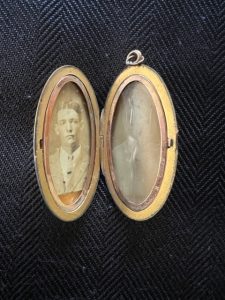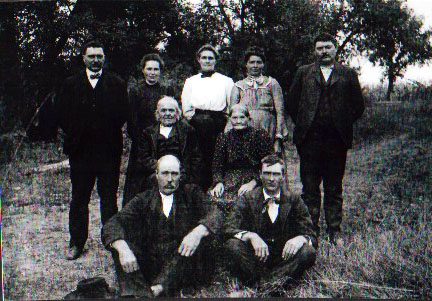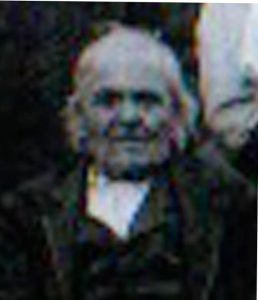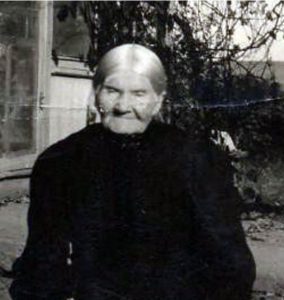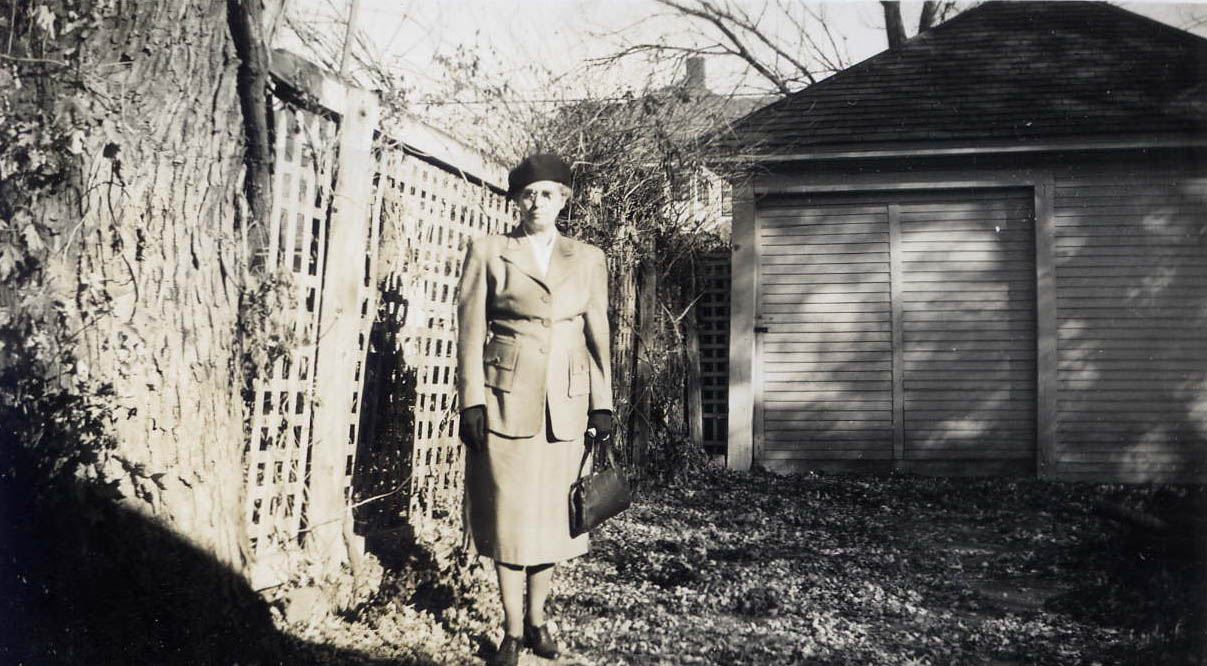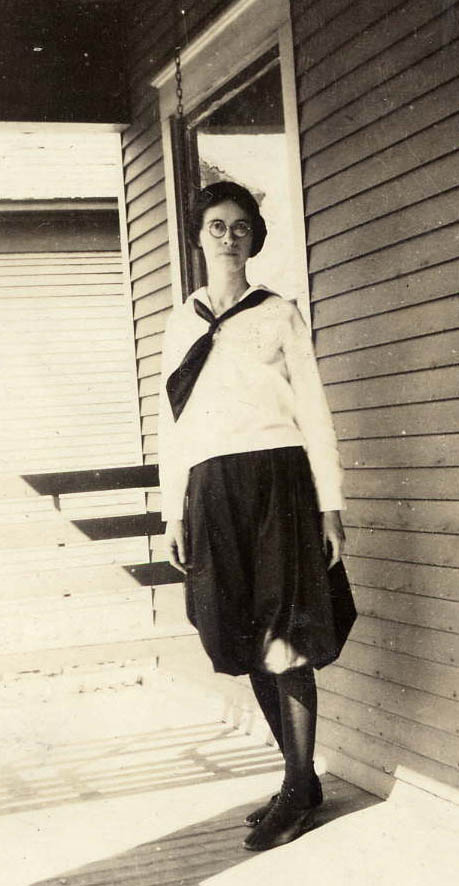
My Great Aunt Lydia Peelle was one of  a small number of women in the early 1900s who moved to the city, went to business school, and pursued a career forsaking the traditional marriage path. 


Grocery Clerk

Although Lydia may have held a job prior to her 20th birthday, the first record of her working is in 1913 when she was clerking in Morrison’s store in Pawnee (Anna), KS.  It seems that she helped in the store off and on (July 13, 1913; October 1913 newspapers) and also worked for some time in Fort Scott (December 15, 1914 newspaper).  It appears that she had been working at Morrison’s store more regularly in May 1915, as the newspaper reported her absence from the store when she took a trip to Fayetteville, Arkansas.


Wichita Bound

In November 1917, Lydia threw a party as she was soon to depart for Wichita.  The oil boom had brought rapid growth and Wichita’s residents numbered approximately 70,000, which was a far cry from the few that inhabited Pawnee.


Despite having moved from a farm to the city myself, I can’t imagine the experience Lydia had moving alone in the early years of the 20th century  to what had to seem like a huge city to a country gal.  I do know that years later she worried about everything.  She even put cement on the locks on her windows in one house so that no one could get in.   I don’t know whether her mother put fear in her before she moved, she had a bad experience, or it was just her nature to worry.


Business School

Upon arrival in Wichita, Lydia attended business school before journeying into the working world. Over the coming years Lydia would move from residence to residence and from job to job, earning enough to support herself.


The Implement Company

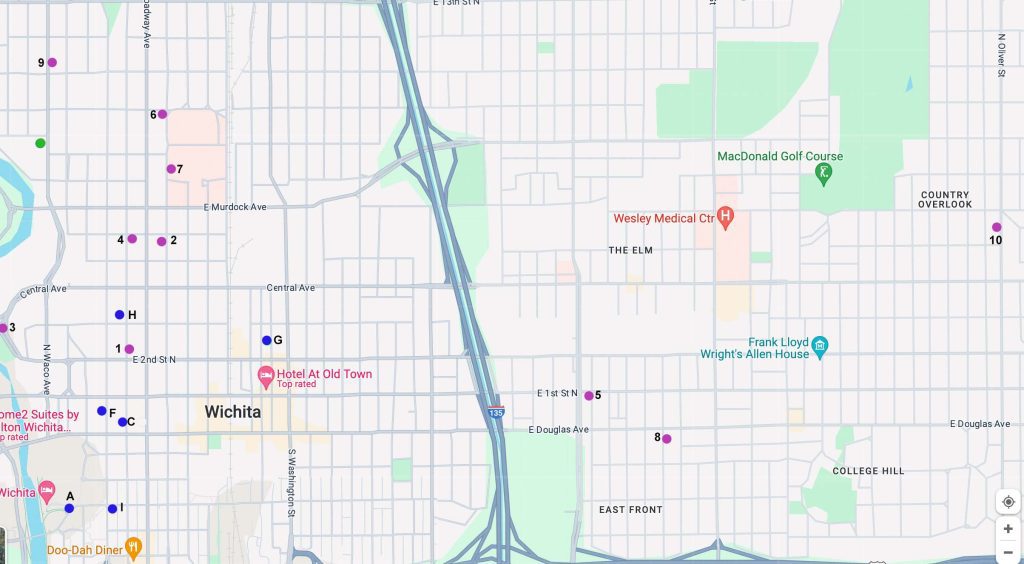
In 1919, Lydia was a stenographer for Emmerson-Brantingham Implement Company at 218 S. Wichita.  She lived at 340 N. Market, with a less than 20 minute walk between her home and her job.  Note:  A map at the bottom of the article shows the locations mentioned in this article.


Inland Printing Company

By 1922, Lydia was living at 631 N. Topeka.  Her brother Passco “Pat” lived with her.  They were both employed by Inland Printing Company (410-412 E. Williams St.) with Lydia still working in the role of stenographer.  The plant was believed at that time to be the largest of its kind in the country, selling products across the country with the exception of to the New England states.


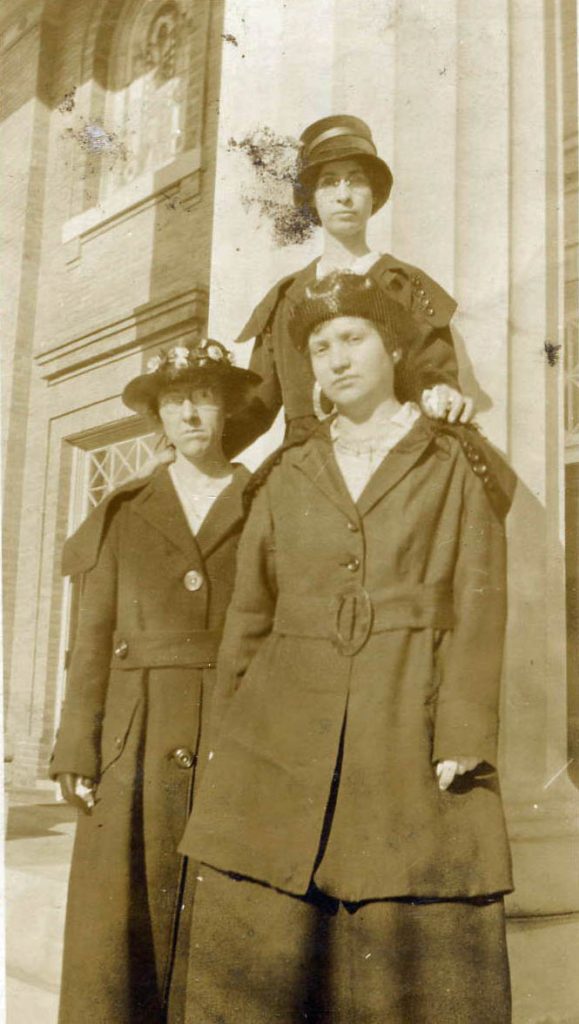
Lydia (top) with friends in Wichita

Central Electric Company

By 1924, Lydia and Pat had moved to 728 W. 3rd St.  That area is close to the Arkansas River and has been redeveloped.  Thus, this address no longer exists.  Lydia’s job was a stenographer for the Central Electric Company (133 N. Market/117 N. Market), which sold lighting fixtures. She had a 20 minute walk to work.  Later that year, Lydia shortened her walk to work by moving to 638 N. Market St.


The Accident

In November, Lydia had to take a break from work as she was hit by a car while walking to church with a friend one Sunday evening.  The accounts vary with one stating that she was hit as she crossed the street in front of St. Paul’s Lutheran Church at 925 N. Waco Ave.  However, a later article stated that Lydia was hit when she crossed the street at 8th and Market St.  The articles also provided different details as to her injuries with one stating that she broke her leg and the other stating that she suffered internal injuries and nervous shock. 


In either case, upon receiving word of the accident, her mother, Matilda (Jury) Peelle, rushed to Wichita to be with her.  Before the month was out, Lydia had filed a $5,000 lawsuit against the two couples in the car.  She claimed they were going 40 miles per hour and that she had been dragged about 100 feet.  I have not yet found any information regarding the resolution of this lawsuit.  I don’t know of any known long-term effects of this accident and don’t recall ever hearing anyone mention it.  However, she did return to this job as she was working there the following year.


The Texas Company


In 1927, she was still living at the same location, but had started working for The Texas Company.  You might recognize them better by their later name, Texaco.  At this time, Texaco was advertised as new type of gasoline.


Cities Power Company

Two years later, she had moved to 155 N. Poplar Ave. and changed jobs again.  She was working for a company that only been charted a few years earlier.  They provided water, gas, and electricity.  However, by 1931 KG&E had bought out at least a portion, and perhaps all, of this company.


Utility Garment Factory

In 1930, business was booming for Utility Garment Factory, located at 137 ½ Main St.  The growth in manufacturing and other business had driven the need for their product much higher than previous levels.  Lydia was a bookkeeper for the company.  She was now living at 1059 N. Topeka Avenue, where she shared a room with Helen Clark.  This rooming house was located near the north edge of the Ascension Via Christi St. Francis campus.  The house has been replaced with parking and access to a McDonald’s.  However, a big Victorian next door still stands.


Service Foundry


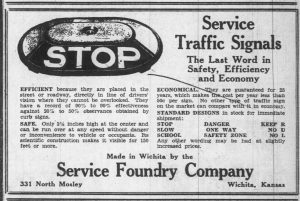
Service Foundry, which is also referenced as Service Brass Foundry and Service Brass and Aluminum Foundry, appears to have been Lydia’s next employer.  The foundry located at 331 N. Mosley made bronze monuments, brass and aluminum castings, iron castings, stoves, unique traffic signals, golf club heads, other sporting equipment, numbers for homes, etc.


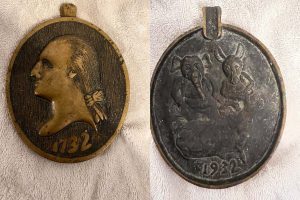
Lydia is documented as working as a bookkeeper for the company for 10 years between 1933 and 1943. However, it is likely that Lydia was working there at least by 1932 as she gave Grandma and Grandpa a very unique ashtray  of George Washington made at the foundry.  It appears to commemorate his birth.  1932 was the 200th anniversary of Washington’s birth and many celebrations and events celebrating his life and contributions to the country were held.  It seems likely that this ashtray was Service Foundry’s contribution to that celebration.


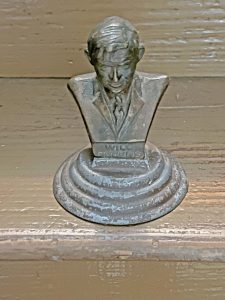
Lydia also gave my grandparents two small busts of Will Rogers that were made by Service Foundry.  I would assume that they may have been made to honor him after he died in a plane crash in 1935.


During her tenure at Service foundry, Lydia lived at 928 N. Topeka and 128 S. Erie.  She lived at the latter address by 1935 and would remain in that house for many years.

George Washington

This artifact was missing for many years.  Dad said that we had a George Washington, but he had no idea what had happened to it.  I always assumed that it was a bust like Will Rogers. After Dad passed, we found it hiding in a cabinet.  We initially thought that this piece was a plaque or perhaps a piece that had not come out correctly.  However, we have since decided that it is likely an ashtray with George’s face on the outside (bottom) and the political image of the elephant, donkey, and the United States on the inside.

Will Rogers

This bust of Will Rogers is likely made after his death in 1935.   The bust is bronze and the base is aluminum.


My Dad’s youngest sister liked to throw  Will at her siblings when they bothered her.


The Internal Revenue Service

Towards the end of 1944, Lydia took out advertisements in the Wichita Eagle and the Wichita Beacon looking for a job as a bookkeeper or stenographer.  Her reason for leaving her previous job is unknown.


Her next job (or at least long-term job) was working as a clerk, typist, and stenographer for the Internal Revenue Service.  She worked for the IRS until her retirement February 28, 1960.


Lydia’s exact work location prior to 1953 is not known as the IRS offices were distributed between the Federal Building at 401 N. Market, the post office, and other office buildings in the area.  In 1953, however, all the IRS offices were consolidated in a new building at 412 S. Main St. (Main & Waterman).


She remained in her home on Erie Street (1182 sq ft., 2 bedrooms, 2 baths) until 1955 or 1956.  She then lived briefly at 1218 Jackson, before moving to 619 N. Oliver (712 sq. ft., 2 bedrooms, 1 bath).  Unless the IRS moved her to a different location, this house was much more distant to her work than her previous ones.

Retirement

By the time she retired, Wichita had become known as the Air Capitol of the World and had grown to a city of over 250,000 people.  Lydia left the city and returned back to her roots. 


Although she lived in Fort Scott, I did not get to know her well, as I was only nine when she died.  However, in my mind, Aunt Lydia perfectly fit my idea of an IRS employee.  She seemed very stern and rigid.  She knew exactly how things should be done and she would advise you on how to do it whether you wanted such advice or not.  The image I had of her also matched the image of multiple of the organizations to which she belonged.


She always had an image to uphold.  If a woman lit up a cigarette in her house, she closed the blinds so that no one could see that someone was smoking.  In a similar vein, despite the fact that she came and went on her own for years, she once asked my dad to check the house for men.  That day, he had driven her back to Wichita from Fort Scott.  When they arrived, she made her request and she was less than amused when he replied, “What do you want me to do if there is?  Hold him for you?” 


My older cousin once told me that Aunt Lydia had always been kind to her and that she thought Aunt Lydia was sweet.  Although I didn’t see this side of her, she did have a compassionate side as she was awarded a pin for volunteering 500 hours for Mercy Hospital.

Organizations


Lydia belonged to the following organizations:


NARCE (National Association of Retired Civil Service Employees) 


WSCS (Women’s Society of Christian Service) 


WCTU  (Women’s Christian Temperance Union)


Philathea Class of the Methodist Church


Prayer Group


Lydia lived  at 721 S. Crawford St. in Fort Scott until she died on December 19, 1969.   Apparently, she had a heart attack while walking to the Post Office to mail Christmas cards.


Map Of Lydia’s Life In Wichita

Where She Lived

(Purple Dots)


1 – 340 N. Market

2 – 631 N. Topeka

3 – 728 W. 3rd St. 

4 – 638 N. Market St.

5 – 155 N. Poplar Ave.

6 – 1059 N. Topeka Avenue

7 – 928 N. Topeka

8 – 128 S. Erie

9 – 1218 Jackson

10 – 619 N. Oliver


Church

(Green Dot)


St. Paul’s Lutheran Church

925 N. Waco Ave


Map Source: Google Maps

Where She Worked

(Blue Dots)


A – Emmerson-Brantingham Implement Company

      218 S. Wichita

B – Inland Printing Company

      410-412 E. Williams St (location could not be identified)

C – Central Electric Company

      133 N. Market/117 N. Market

D – The Texas Company

      (Unknown location)

E – Cities Power Company

      (Unknown location)

F – Utility Garment Factory

     137 ½ Main St

G – Service Foundry

      331 N. Mosley

H – Federal Building

       401 N. Market

I – IRS Building

      412 S. Main St.

As our country was being settled and the population grew across America, many opportunities for influencing the country, community, their families, and other arose.  One of those opportunities that you don’t typically find today was to influence the community by starting a town.


Flooded Farm – View From Old Gristmill. Unknown if this is the oldest mill or if this is actually from a later one.  If the earliest, it would be the Johnson property.  Source: The Indiana Album, Wayne C. Klusman Collection https://indianaalbum.pastperfectonline.com/

Wayne County, Indiana

In 1810, John Lewis’ family became the first settlers in an area northwest of Richmond in Green Township, Wayne County, Indiana.  The following year several more families, including William and Sarah (Adams) Johnson, moved to the area.  William and Sarah are the grandparents of Martha Johnson who married Passco Peelle, making them my 4th great grandparents.  They had left their home state of North Carolina  with a destination of eastern Indiana, as many others who would move to the area did over the coming years.


By 1818, signs of a community started to spring up.  That year William built the first gristmill in the area.  A Baptist Church gathering began about this time.  Included in its early membership was Eleazer and Ruth (Davis) Smith .  A few years later their daughter Rachel married William Johnson,  Sarah and William’s son.


Then, around 1820, a Methodist Episcopal Church was organized.  A community was forming.


Williamsburg

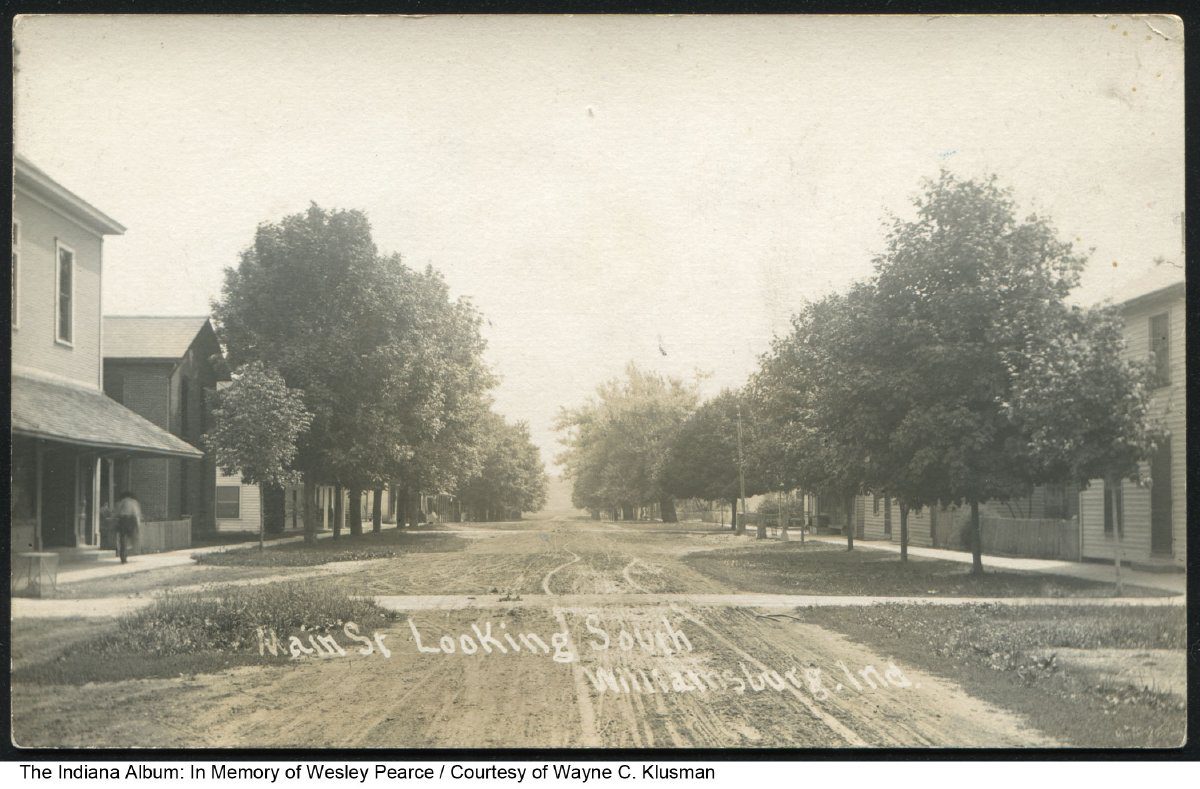
In 1830, William Johnson set aside some land for the creation of a town.  On March 16, the town of Williamsburg was platted at a location due north of Centerville and about 3 miles south of the Baptist Church.   A post office went into operation July 22.


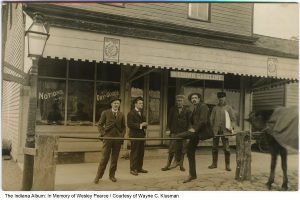
Dry Goods & Grocery Store in Williamsburg. Source: The Indiana Album, Wayne C. Klusman Collection https://indianaalbum.pastperfectonline.com/

Over the coming years, many businesses and organizations would set up operations in and around Williamsburg.  The first merchant commenced business in 1831 and would be followed by many others including William’s sons Stephen and Samuel.  Other businesses in the area included more gristmills, saw-mills, a slaughter house, a hotel, a train station, an ice house, wagon makers, doctors, and the First National Bank of Williamburg.  The latter did not open until May 1, 1907.  It is unclear if the town had any banking facilities prior to that date.


Other church organizations were formed.  A Friends Meeting was also formed, but it only lasted for about 15 years before it dissolved and its members went to other nearby meetings.


In 1845, the United Brethren Church was organized.  William’s son Samuel and his wife were early members of that church.


Samuel also became one of the Justices of the Peace.  The area would also be the home to politicians, Masons, and Odd Fellows.  As a growing community, the town also joined with others in the area to support the Union during the Civil War.  Likewise, when the issue of temperance became an issue in the area, men from the surrounding area joined a debate on the subject.  Clearly, each side had a lot to say as the debate started at 2 p.m. and lasted until midnight.


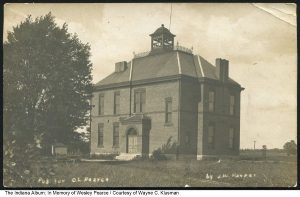
School In Williamsburg. Source: The Indiana Album, Wayne C. Klusman Collection https://indianaalbum.pastperfectonline.com/

A Legacy

Unfortunately, William did not live to see the town take shape, as he died on August 1, only days after the post office was established.  He left his wife Sarah $100 in personal property, $100 in money, the dwelling where they lived, and one quarter of the profits from the plantation where he was living.  The remainder of his personal property, the mill, and the tract the mill was on was to be sold with the money divided among his heirs (Thanking him for specifically listing his children in his will, including his daughters married names.)


Sarah would live another 32 years.  She maintained her own household until she was at least in her mid-80s.  She died at age 97.  William and Sarah are buried at the New Garden Friends Cemetery.


Williamsburg Today

Williamsburg still exists today as an unincorporated entity with a population of over 1700 people.  It doesn’t have the stores and businesses it once did as travel to Richmond only takes a few minutes on modern highways.  However, the post office is still in operation.  It also has a community center, spiritualist church, and baseball fields.


Important Note:

Ezekiel Johnson moved to the area in 1838.  He was an M.E. minister and was from New Jersey.  Thus, a totally different Johnson family line in the same small town.


Featured Image Source: The Indiana Album, Wayne C. Klusman Collection https://indianaalbum.pastperfectonline.com/


 Sometimes when you are minding your own business, you bump into someone famous or infamous, as in this case.


Road Work

Grandpa Joe McCracken worked for several years maintaining the highways in the southern portion of Bourbon County.  In those days, many of the highways were better maintained gravel roads. Thus, road graders or maintainers, as we called them, were used to keep the roads drivable.


Most of the time,  Grandpa worked on highway 7 or highway 39 in Bourbon County, Kansas.  At that time, highway 7 meandered through Pawnee/Anna.  South of there, it turned to the west on what is now Birch Road.  Then about a mile west of where highway 7 now runs, it made another turn to the south.


Highway 39 approached Hiattville from the west, turned to the north. Then, about three and a half miles north of Hiattville near the Scofield School, it turned to the east before making more turns on its way to Ft. Scott.


Washing The Car

In was on the stretch of highway 39 east of Scofield School not far from where our Peelle family had lived at one time, that Grandpa had his brush with the infamous.  As he was working along the stretch of the road, he came to a creek.  Today the roadside in that area and the creek bank are covered with trees and brush.  However, in the 1930s, the banks of the creek and the nearby ditch wasn’t quite so covered with trees and brush.  It was such that a car could drive right down to the water without difficulty.


Yet, the creek was enough lower than the road that someone in a car or horse and buggy passing by wouldn’t easily see what was going on at the creek.  However, on a maintainer, Grandpa was high enough that he had a view of the activities down by the creek.


On that day, Grandpa saw a car down by the water.  Nothing appeared to be amiss as there was a couple and they were washing their Ford.  Grandpa took in the scene and kept on working as they didn’t appear to need any assistance.


The Recognition

Perhaps at the moment he saw them, he thought he recognized them.  After all, they had become front-page news since the incident in southwest Joplin in March of the previous year.  The story was too good – hiding out in an apartment over a garage¹ for two weeks; almost getting away with it; an accidental shot of a rifle; a raid by law enforcement; and two dead law enforcement officers.  In their escape, they had also left most of their belongings including undeveloped film behind when fleeing the police.  The film had provided many captivating photographs that gained the attention of newspapers across the country.


The next day,  when the news mentioned that they had been in the area, he was certain. And, he was glad that he had not approached them.  Getting in their way or asking too many questions could get you a few bullet holes.  It was best to keep your distance from Bonnie and Clyde.


Poem By Bonnie Parker. Appeared in many newspapers. This copy from The Parsons Sun, May 24, 1934 via newspapers.com

When Did Their Paths Cross?


I never heard a specific date for this event and Grandpa drove a maintainer during all the years that Bonnie and Clyde were active in the area.  So, in theory, their paths could have crossed any of the times that Clyde’s gang was on the move.


Since Bourbon County borders Missouri, it fit Clyde’s choice of travel locations as he liked to travel near state lines so that he and his cohorts could easily escape to the neighboring state if the law got too close.  So, skirting through the county occurred on more than one occasion.


Although Grandpa could have seen them on one of their trips moving around the country just trying to avoid the law, it seems most likely that Grandpa saw Bonnie and Clyde on April 6, 1934.


By this time, the true nature of Bonnie and Clyde was well known.  They had to be very careful in their movements as they had become recognizable.  They had once stayed in hotels and ventured into restaurants, but did no longer dare to on most occasions as far too many people recognized them and were willing  to turn them in.


April 6, 1934

Stuck In The Mud

On the morning of April 6, Constable Cal Campbell and Percy Boyd, the chief of police at Commerce City, Oklahoma were called to the scene where Clyde’s car had become stuck in the mud.  Multiple reasons for the call have been provided.  A majority of the stories focus on a motorist that reported that a man had told him to stop and help get a car out of the mud or he would shoot the person.  Another version says that they were called to the scene based on drunken behavior and that in an attempt to evade the law, Clyde backed into mud that he couldn’t escape.


In any case, when the two lawmen got out of the car, the Barrow Gang, as Clyde and his cohorts were called, immediately began shooting.  Mr. Campbell immediately fell to the ground and Mr. Boyd hurriedly put his hands in the air, but still received a scalp wound.


At that point, the Barrow Gang forced Mr. Boyd into their car.  A truck driver freed them from the mud just prior or just after the shooting.  Thus, they were able to flee the scene.  Clyde drove off with Bonnie at his side wearing a red dress and having  a gun lying across her lap.  Mr. Boyd and another man, who was believed to possibly be Raymond Hamilton, another known criminal who had recently escaped, rode in the backseat. (Raymond Hamilton later wrote a letter proving that he was in Louisiana at the time of these events.)


On The Run

It wasn’t long before the muddy roads caused trouble again.  There were reports that they held guns on one farmer while he pulled their car out of the mud.  Another report was that someone was in the middle of the road hindering their progress.  So, the threats came out again to get out of their way.


Mr. Boyd couldn’t describe the details of their travels as they were always taking back roads and skirting the towns.  However, Mr. Boyd and eyewitnesses indicated that they headed toward Chetopa, Kansas after the shooting.  When they were just south of Chetopa, they turned west toward Bartlett, Kansas.  After that the reports seem to diverge with some people indicating that it appeared that they were traveling in circles.


As they tried to evade the law, the speedometer passed 90 on multiple occasions (according to Mr. Boyd).  So, they were moving quickly, but also trying not to be detected.  Still, they did have to slow down at times and even come in contact with people.


The group stopped three times during the day to get gas.  No one appeared to suspect anything or recognize them.  However, the attendant at the gas station in Bartlett reported them to the sheriff.  The others either didn’t recognize them or thought it was better to keep their mouths shut.


The Search

Meanwhile, a posse was immediately raised to look for Bonnie and Clyde.   At least one plane took off to search for them from the sky.  Reports went out to all neighboring states alerting them that Bonnie and Clyde were on the run and could be coming there way. 


A huge focus was put on known hideouts and places connected to the Barrow Gang and others that could possibly be with them.  This included several locations in Oklahoma just to the south of Chetopa.  They also focused on Joplin as Clyde had connections in the area.


The various law enforcement officers followed many leads; most of which were misleading.  They had trouble keeping tabs on where the group was  headed.  Some believed they were headed to Coffeyville, Kansas.  Others thought that they would head south and hide out in the area where they had been or even head to Texas.


Staying Out of Sight

The Barrow Gang, along with their hostage, spent the afternoon mostly criss-crossing the area between Pittsburg and Fort Scott in Southeast Kansas.  They weren’t far from Oklahoma, but more importantly they were close to the Missouri state line and they could jump the line if the law got too close.


It would have been during this time that Grandpa encountered Bonnie and Clyde.  They likely stopped to wash the car since the black Ford V-8  had become covered with mud in their earlier escapades.  Mr. Boyd reported that “the windows were so muddy that no one could see in.”  He also reported that they had gotten stuck in a ditch near Ft. Scott.  It very well could have been that they got stuck when they pulled off to wash the car. 


High school students tried to push them out of the ditch, but couldn’t and Clyde  told them to go on their way.  Then Clyde stopped a truck and made the man use his truck to pull them out. 


During their journey, Mr. Boyd made conversation with the group.  Bonnie indicated that Mr. Boyd should tell the world that she wasn’t a cigar smoker.  She said that the photo of her with a cigar in her mouth was not what it seemed.  She indicated that she had posed with Clyde’s cigar and that it had made her very angry that she had been made out to be a cigar smoker. They also talked about being sorry that they had to shoot Mr. Campbell.  However, they indicated that they “had” to do it.  Still, in the next breath, they joked about shooting him.

Bonnie Parker and Clyde Barrow. Library of Congress, Public domain, via Wikimedia Commons


Quick Trip Into Town

Late in the afternoon or in the early evening, they ventured into Fort Scott.  The other man besides Clyde bought a newspaper at a drugstore and food at a grocery store as he was not as recognizable.  As soon as they got the items they desired, they headed back out of town.  They stopped and ate in the woods.  The newspaper indicated that Mr. Campbell had died, which they had not previously known.  Clyde had hit him with one shot, but it had pierced his heart.  Death had come immediately.  Mr. Campbell had shot three bullets before he was shot.


Attempt To Steal A Car

Later that evening, they went back into Fort Scott to steal a car.  Far too many people had seen this one and it was time for a change.  However, Clyde couldn’t find a car to his liking.  So, they left town in the same car that they had been driving all day. 


During their excursions into town, Clyde had arrogantly driven down Main Street and even driven by the police station.


The Release

Shortly after midnight on April 7, Bonnie and Clyde released their hostage several miles south of Fort Scott.  Mr. Boyd walked to Harry Dugan’s home and contacted the sheriff.  The sheriff came as quickly as possible.  An officer took Mr. Boyd to Fort Scott Mercy Hospital for treatment  of his wound while the search for the killers cranked up.


The alert went out as to the last location of Bonnie and Clyde. Local, state, and federal officers amassed along the Kansas border with Missouri and Oklahoma.  The National Guard was put into service and officers came from Kansas City, Joplin, and Springfield to assist.  In Texas officers rushed to the border with Oklahoma in case the Barrow Gang made it that far.  In the coming hours, people reported seeing them in Missouri, Oklahoma, and even Texas.  Most of these, and possibly all, weren’t them at all.  Despite driving at break-neck speeds, there is a limit on how quickly they could move from place to place.


Another Connection


An interesting side note is that I am also related to Harry Dugan’s wife, whose maiden name was Frances Pellett.  She was the great-granddaughter of Able John & Eunity (Harrison) Pellett.  Thus, Frances and my grandfather Clifford Claney Pellett were second cousins.  Although I have not identified the specific location where Harry and Frances were living at the time,  I know that they were likely living  near Godfrey in the same general area as my Grandpa Cliff as they lived near my Mom when she was growing up.


Meanwhile, Mr. Boyd filled the officers in regarding the details of the day.  He said that the Barrow Gang  had treated him well (other than wounding him in the initial conflict).  They had helped bandage his head and had given him a fresh shirt and tie to wear.  Both actions, however, were likely self-serving since someone with uncovered wounds on their head and bloody clothes was more likely to garner attention than someone who was cleaned up even if bandaged.


Mr. Boyd told what he knew of the path they had taken and filled the officers in on the weapons in the gang’s possession.  He had seen 3 machine guns, 3 shot guns, and numerous pistols.  They also had a suitcase full of ammunition. The oddest thing  he shared might have been that Bonnie had a white pet rabbit with her. 


Mr. Boyd told of their confidence and arrogance.  Clyde thought he could avoid capture by outsmarting the officers.  Bonnie and Clyde felt invincible.  And, for the moment they were as they had once again escaped by going against everything the officers thought they would do. Instead of moving toward areas where they had hideouts and knew the roads,  they went north and further into the interior of Kansas.  Clyde ditched the car in a haystack north of Ottawa, leaving behind a smattering of belongings and a fingerprint.


The End

In the end, Clyde wasn’t smart enough to escape 130 rounds that were fired upon Bonnie and him less than two months later on May 23, 1934. Tipped-off, a posse in Louisiana ambushed them and they never had a chance.


In Retrospect

Given the circumstances of April 6, 1934, there is no telling what might have happened had Grandpa approached or even called out to the people washing their car.  Maybe they would have just let Grandpa go like the high school students and the man that pulled them out of the ditch.  However, it is hard to tell what might have happened because Clyde, it is said, had a nervous trigger finger.  As it was, Grandpa went home that night and went to work the next day like usual.


¹This garage was located at 3347 ½ Oak Ridge Drive.  It is preserved and is on the National Historic Register.


It is hard to select a “single favorite” photo.  So, instead of trying to find my favorite one to write about, I started looking at photos and stopped when I found one that “spoke” to me.


The Photo

The photo that I chose to write about is one of Rod’s grandfather Alexander Joseph Thomson.  It is a modern photo and not extremely unique.  However, it spoke to me because everything about it said, “Farmer.”  His hat and clothes are typical of farmers of his era.  And, I love his stance – leaning on the fence post.  It personifies a farmer in every way.


Barn on the farm in Stettler, Canada.

Farm Life


The Early Days

Alexander J. Thomson (being specific because his uncle William Alexander Thomson also went by Alexander) was born March 4, 1907 at Palmyra, Nebraska to Herbert & Blanche (Klinefelter) Thomson.  He grew up living and working on the family farms.


The various Thomson families owned several farms in the Palmyra area.  However, Herbert also owned a couple of 320-acre farms just a tiny bit more distant.  One farm was near Stettler, Alberta, Canada and the other just down the road in Halkirk (between Calgary and Edmonton).  The farms were only a little over 1300 miles away from the family’s farms near Palmyra, Nebraska.  


Herbert Thomson family in Stettler, Alberta in 1928 L. to R. Back-Alfred, Arthur, and Alexander Thomson Middle: George W. Ackermann, Blanche Thomson, Herbert Thomson Front George, Faith, Alma, and May Thomson (Reid is not shown)

According to one of his cousins, Alexander accompanied the family farm equipment and animals on a train to the Canadian property when he was a teenager.  Now, I am not exactly sure when that would have been as he arrived in Canada the first time in 1919 or 1920, which means he would have been no more than 13 upon arrival.  But, it is possible that he went with his father and his uncle on the trip.


He took other trips  back and forth at later dates.  One was in 1926 when he went with his Uncle John to manage the harvest on their farm.  Although he was not listed with his parents when they went in 1928, he was in Canada as he is shown in a picture taken there at that time.  I have not yet; however, found documentation of all the family’s trips.


Later Years

Alexander later purchased land near one of the farms in Canada.  However, he lost the farm for reasons that have yet to be uncovered.  Thus, settled for life in Palmyra. 


Alexander and his wife Donna (Van Allen) Thomson lived on a 160-acre farm just southeast of Palmyra.  There they raised their six children. Alexander and Donna had cattle, pigs, and chickens.  And, in the fields, he grew corn, milo, and winter wheat.  The family also had a large garden and fruit trees.  While the pasture and treed areas were ideal for hunting game.


It was said that he was always the first one to finish planting, shucking corn, etc.  One thing, however, held Alexander back from doing more with farming.  That was his asthma.  By 1937, he was suffering terribly from it.  He even went out to McCook, Nebraska where some relatives lived in hopes of getting relief in a different climate.


Due to ongoing issues with asthma, he had his boys out working in the fields when they were very young.  He would wheeze while standing on the edge of the field while his sons James and Howard worked in the field with the old Farmall tractor or the little Ford.  As such, they became very adept at working the farm equipment .


Unintended Crops

Per Rod’s sister Jackie, the photo is said to have been taken when hemp was found growing in the ditch on Alexander’s farm.  Likely everyone thought it would be fun to have a photo (although I can’t tell what is growing there based on the photo) and he likely went along with it as he liked a good joke.


The Family Farm – After Alexander


Alexander died suddenly Aug 14, 1964 of a heart attack.  Given the age of the picture and the date of his death, the photo must have been taken between 1960 and 1964.  Jackie noted that if you look close, you can even tell that he isn’t wearing his dentures, which he apparently didn’t like to do. 


Donna continued to live on the farm for a time.  Howard and James farmed and hoped to one day take over the farm.  But, it wasn’t meant to be.  James died a mere 4 years later.  


Various family members, including Donna, their daughter Rachel, and their daughter Virginia lived on the property after that.  Still, remembrances of Alexander remained on the farm.  After Donna died 12 years later, Rachel found his false teeth sitting on a shelf in the kitchen!


Although my Pellett family moved from Ireland to America in the colonial days, I learned many years ago that they might actually have been from France.  In addition, I learned that our direct ancestor had supposedly barely escaped when his parents were persecuted for their religious beliefs.


The Old Bible

The information I received from a distant cousin, who was also a genealogist, stated that Rebecca Cole, daughter of George and Mary (Pellett) Kennedy and granddaughter of Francis A. Pellett (my 4th-great grandfather, had read the following passage at a family reunion on August 9, 1900.


“Now we come to the mother’s side and I quote a few instances that my cousin sent dictated by Uncle Lorenzo Dow Pellett and from a copy of the record as found in grandfather’s old Bible.


‘As for the record of Grandfather Pellett’s family, we will send you a copy as it is in the old Bible.  It will take you back some 5 generations, that is counting us as one, that is, grandfather’s grandfather and grandmother.  One was burnt on the spit and one on the gridiron for their religion in France, and their son (George Pellett), our grandfather, was tied to a chair and left there to see them burn.  He got worked loose and fled to Ireland.  Grandfather came to America in 1795 .  .  .  .'” 


This leaves me with a very disturbing image in my mind.  It is an awful way to die, but possibly worse to watch a loved one die in this manner.


The Investigation

The person who provided the information to me also provided me with her source of the information.  However, she had no copy of the actual Bible page(s) that contained the story. 


I kept expecting to see the story show up on Ancestry.com or other genealogy sites, but it has not.  The only place that I have seen this story other than in the messages I received is in “Griffith John: His Ancestors and Descendants” compiled by Marijane (John) Zerphey.  It is included in her manuscript as Francis was married to Mary John, daughter of Griffith John.


Unfortunately, her source is the same woman that provided me this information.  Therefore, it provides no confirmation of the information.


Additionally, the whereabouts of the family Bible is unknown to me.  At the time the story was read (1900), the old family Bible was in the possession of Lorenzo Dow Pellett, the youngest son of Francis A. Pellett.  Therefore, it is likely that if the Bible is still in the possession of descendants of Francis Pellett that one of Lorenzo’s descendants has the Bible.


Thus, we turn to what we know about Francis and history to determine if this story is feasible.


Family History

Immigrant to America

Records do indicate that Francis immigrated to America in 1795 as stated in the statement Rebecca read.  We know from Quaker records that he was in Ireland in 1793 and 1794. At that time, he requested to associate with the Monthly Meeting. Then, in 1795 he requests a certificate from the Meeting in Moate, Westmeath, Leinster, Ireland as he is preparing to move to America.


No specific reason for Francis’ immigration to America has been passed down in family stories.  However, it seems reasonable to assume that his Quaker faith may have played a part in his decision to move.  After all, at the time Penal laws forced everyone to support the Church of Ireland – even if they belonged to another church.  In addition, one was required to be a member of the Church of Ireland to hold civil and military positions.  A motivation of religious freedom was common and seems quite likely for someone who’s grandparents were killed for their religious beliefs.


Francis’ Father


Francis’ father is said to be George Pellett.  It is unclear if his name being shown as George in the Bible reference means that George was his name or if someone added that commentary.  In addition, some people list him with a birth date in 1739 and claim he was born in Ireland.  However, I have found no records showing his name, birthdate, or birth location. I do have this information in my tree for research purposes.


From what is stated in Rebecca’s statement, I assume that at least his name was recorded in the old family Bible.  If the story is accurate, Francis’ father would have most likely been born in France.


Other Supporting Evidence

Name

The name Pellett is of French origin.  In Old French, the name would have meant a furrier coming from the word “pellet,” which meant fur.  This reasonably supports that the family had likely lived in France at one time.


In addition, the name Francis means Frenchman.  That said, many men were named Francis over the years without having any relationship to France.


The name George and other forms of the name are used in many countries including France.


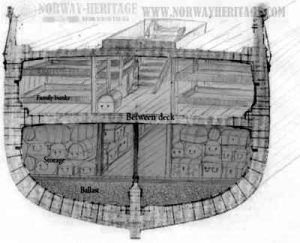
Galley Style Ship

Religious Persecution in France


France worked hard to eliminate Protestant religions.  And, in 1715 Lois XIV announced that he had done so.  However, Protestants continued to persist in France despite loss of rights and persecution.  The penalties for being a Protestant included confiscation of all property, life terms for men working the oars on the galleys (ships), and prison terms for women.  Minsters, when caught, were often executed.  In the era between when Francis’ father was likely born and when Francis was born, it is estimated that a couple thousand people were persecuted in some form for their religious beliefs.


As terrible as this seems, it appears that criminals (which would include anyone who did not follow the correct religious beliefs) were still being tortured or executed by inhumane means into the 18th Century.  Torture was often used to gain confessions.  Of course, once the person confessed, the punishment was often worse than the original torture.


In this case, both of Francis’ grandparents were burnt.  This is consistent with an execution for heresy (having the wrong beliefs).


My Conclusion

I cannot prove this story true or false at this time.  However, based on my research to date, I believe it is plausible that my 6th-great grandparents in my Pellett family were burnt for their religious beliefs. 


Still, I wil be keeping an eye out for that old family Bible. Seeing exactly what is written therein could shed more light on the history of the Pellett family.


Note:  Featured image of the Bible with the angel is from pixabay.com.  Created by Darkmoon_Art.