When I thought about the oldest story, which was the prompt for this week, I thought of stories of long ago, stories we had known the longest, the oldest ancestor in a family, the person who lived to be the oldest, and more.  I finally settled on something much closer to home . . . the oldest man-made feature on the property where I grew up.


Growing Up

As kids, my sister, cousins, and friends explored the natural wonders of the property where I grew up.  The creek, big boulders along the bluff, and the cave provided endless entertainment.  It seems there were a lot less ticks, snakes, and other critters in that pasture back in those days. Yet, the little mom knew about our exploration still probably made my her nervous as a cat. 


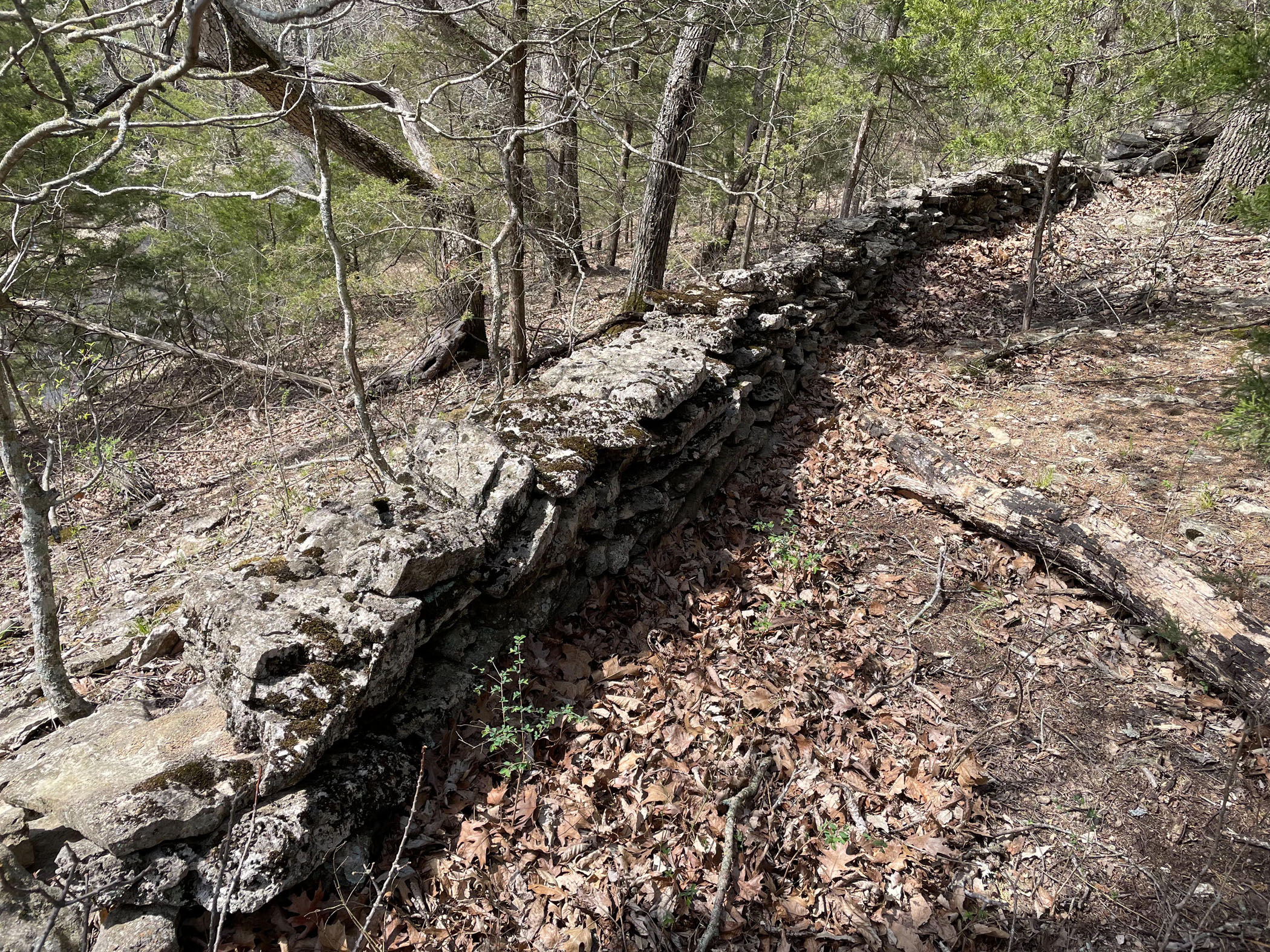
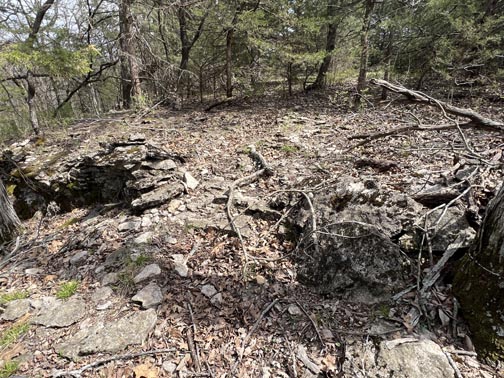
This shows the detail of the wall. Most places it seems to be around two feet high. This point, however, is higher than the rest of the wall.

The Wall

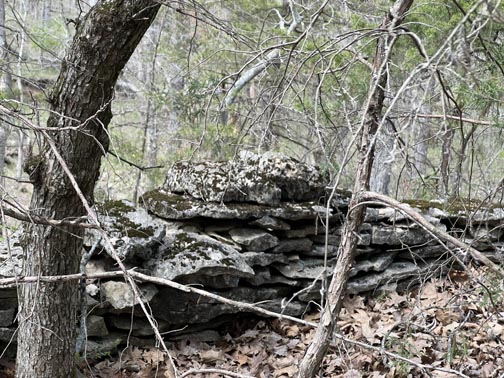
One place that my sister and I never explored, most likely because we didn’t know that it existed until we were older, was an old rock wall.  It sits at the top of the bluff on the far side of the creek.  The wall is made of large flat stones piled on each other with apparently nothing, but gravity, holding them in place.  A majority of the wall appears to still be in place today.

Dad said that the wall was the location of an old sawmill.  It is unclear how the wall was used.  It might have been used to keep logs from rolling down the bluff into the creek.  Alternately, it might have been to keep humans from accidentally stepping off the edge of the bluff.


This shows the opening in the wall to the path to the creek. In the center are the rough steps.

The Path To the Creek

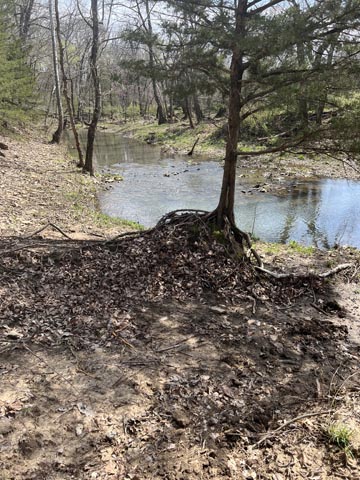
Toward the north end of the wall, a clearly intentional opening in the wall exists.  Through it is a path down toward the creek.  It is in an area where the creek is more accessible than many other spots.  It would have been good for accessing water. 

Along the path, there are a couple of places where it appears that rocks in the side of the bluff were chiseled or cut to make rudimentary steps.   This made walking up and down the path easier than climbing over big rocks.


Creek area near the path to the wall.

Location of the Mill

It is possible that the saw mill was down near the creek.  However, even on the highest spots down near the river, the sawmill would have been easily washed away in floods.  Additionally, it would not seem likely that they would have wanted to carry the lumber up the bluff.  And, if so, what would the purpose of the wall have been?

It seems more likely that the sawmill stood on the top of the bluff.  It might have stood just east of the wall.  Trees now cover that area.  However, it may have stood a bit further east in a larger, open area covered with flat-ish rocks.  Some of the rocks are a part of the rocky terrain.  However, others appear to be loose or placed on top of the ground.  The rocks don’t create a 100% solid surface, but are close enough together to have created a surface for wagons hauling lumber.

Rocks also appear to create a walking path to this area.  It is possible that the rocks are just a part of nature.  However, they don’t match rock patterns in other areas nearby.  And, again, they appear intentional.  Thus, we believe that rocks were added specifically to create the path and a work area.


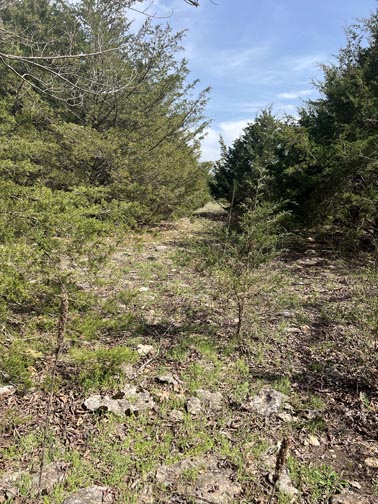
What appears to be an old road near the sawmill site.

The Road

Coming from the rock open space is what appears to be a rock road heading east, although not completely straight.  The road is covered with rocks in a similar way with trees and brush along the sides of the road.  Again, it is possible that these rocks were somehow just randomly located in a way that appears to be a road.  However, the rocks on the road, open space, and walking path are completely different than the big boulders and other rocks that dominate the landscape.


So, how old is it?

I don’t know exactly when the sawmill was built.  It may likely have been built during the time the Missouri River, Fort Scott, and Gulf Railroad Company (later known as the Kansas City, Fort Scott, and  Gulf Railroad company) owned the property, which would be the 1870s.  And, it may have been built even earlier as investors led by James F. Joy of Michigan had obtained the property a few years earlier with the idea that it would be granted to the railroad.

In 1869, the railroad company hired almost all of the sawmills in the county, leaving the area with a shortage of lumber for building homes.  Thus, it is likely the sawmill  was used by the railroad.  This is especially true since it was on property that the railroad was in the process of acquiring.

Next Oldest

The only other man-made structure on the property that rivals the wall in age, is the kitchen in the existing house.  It once was a one-room house.  It sat on a slightly raised area in the bottom below the bluff on the west side of the creek some distance from the sawmill.  I believe that house was built in the late 1870s, which was while the land belonged to the railroad.  It wasn’t until 1880 that it was officially sold to the Billman family.  They also owned the property where Uncle Dewey lived.

This house was later moved up the bluff to its present location.  However, I have no idea how they ever got it up the bluff with a team of horses. Sometimes getting a pickup loaded with hay or a wagon-load of hay up the bluff with a tractor was quite challenging.

If the house had been built on the same side of the creek as the saw mill, I might have assumed it was the family’s business.  However, being on opposite sides means that is unlikely since there are times that crossing the river without a bridge would have been impossible.  The closest sizeable bridge was on the road north of the property.  Traveling from down by the river up to the  road, across the bridge, and back to the sawmill would have been quite a trek. The only other bridge  across the bridge at the time  at the time was a foot bridge south of where the house sat, although I don’t know exactly where it was located. 


Another Pre-Dates 1900

The last man-made feature of the property that pre-dates 1900 is the dining room on the house.  It was built sometime in the 1880s.  I am not sure exactly where it sat, but it was in the general area of the current house.


The Exact Location

If you get the idea that you might try to go find the wall and road, I will warn you that if you don’t know where it is, you likely won’t find it.  Also, reaching it is going to require a lot of difficult walking, including climbing bluffs and over rocks while fighting thorn-covered trees and brush.


My great-great grandmother Louisiana has been a bit tricky to search.  It would have been much easier if there hadn’t been so many mistakes both in family information and records.


The Family Story

Louisiana was married to Lemuel McCracken.  Her maiden name was Johnson.  She was feeling ill and the family headed to other family, in Peoria, Illinois.  It was said that she died along the way and at least part of the family assumed that she was buried along a trail.  She was only 49 and left behind several young children.

Louisiana’s Maiden Name

Johnson

I spent years searching for Louisiana Johnson. Records said that she was born in Ohio, but where?  And, why couldn’t I find her?

Since our grandfather was Andrew Johnson McCracken, I thought it was likely that Louisiana’s father was Andrew Johnson.  So, I searched for an Andrew Johnson that had a daughter Louisiana or who could have a daughter her age.  Again, I found nothing.

Still, I really didn’t question the name as it had been passed down in the family. Cousin Mitzi said that she never questioned it because she was told that Louisiana was a cousin to her great-grandfather William T. McCracken’s first wife Lauretta Johnston.  Since Johnson and Johnston are often interchanged, that seemed to support the story.


Mattser

During this time, I was contacted by a man who claimed Louisiana’s maiden name was Mattser.  A genealogist he knew had looked (I believe in person) at records for Louisiana and had determined Mattser was the correct last name.

I shared our story of Johnson.  He simply stated that he trusted and believed the woman and he knew her to be accurate.

So, I researched the name Mattser.  I did not find anyone in Ohio with that name at the time that Louisiana was born or during her early years.

It appeared that neither Johnson nor Mattser were Louisiana’s maiden name.


Incorrect “Fact” Highlights

Family Information

  • Family believed Louisiana’s maiden name was Johnson.
  • The family believed she was headed to Peoria, Illinois where family lived.
  • Family believed Louisiana and Lemuel’s marriage was the first one for each of them.

Records

  • Louisiana and Lemuel’s son Lemuel’s death record states his middle name as Francis. Is it?
  • Lemuel Francis’ death record states his mother was  Leousia Mc Koree  and his father was Lemiel L. Mc Cracken.
  • 1860 census Rosannah McCracker and her husband Sam McCracker and everyone’s name was incorrect in some way either in the record or in the transcription.
  • Louisiana’s son from her first marriage was recorded as being 7 years of age when he was actually 11 years of age.
  • Louisiana’s marriage record appears to say her name was Mattser.
  • Cemetery book had the directions to the cemetery wrong.
  • Son Lemuel’s death record lists his mother as Leousia Mc Koree.”


Bonus Errors & Name Changes

  • Delormah, Delarma, Delorma went by Del and later almost exclusively by Lawrence, his middle name.
  • Not included in this article:  Their youngest child was a female F.E. in 1875, a male Francis in 1880 and later Minnie Alameda.

Badgley

I also had probate papers for one of Lemuel and Louisiana’s daughters that listed several people that I did not know.  By searching those people, I learned that both Lemuel and Louisiana had been married before.  Why no one in the family seemed to know about these earlier marriages is unknown.  One has to assume that, although much younger than the children from their first marriages, great-grandpa Andrew McCracken would have known they had earlier marriages.  Some of his siblings lived near and possibly with Louisiana’s daughter from her first marriage.

Lemuel and Louisiana’s marriage record listed her name as Badgley, but it wasn’t her maiden name.


Matteer

Eventually, I found a marriage record for Louisiana and her first husband James Badgley.  I could see why the researcher had believed the name was Mattser as it could easily be interpreted that way.  Fortunately, a secondary note was written on her marriage record with her father giving her permission to marry since she was not of age.  The surname was not clear, but with her father’s first name, multiple images of the name, and some research, I finally found her family.  I learned her father was William Matteer and her mother was Mary Rodgers.

In addition, although I won’t refer to  them incorrect, the many spellings of Matteer created the necessity to search multiple ways.  Her father appears to have preferred the spelling “Matteer.”  Meanwhile, her siblings generally used “Mateer.”  However, the name is misspelled or mistranslated many  other ways, including “Matter,” which causes lots of headaches when searching newspapers, and “Mattier.”


Given Name

I never thought that Louisiana’s given name was a question since her son Andrew had a daughter with the middle name of Louisiana.  However, once I started going through her records, I found her name recorded several ways, which is not uncommon.  Some, such as when she showed up as “Rosannah” in the 1860 census, were clearly wrong.  However, others made me question her name.

When she married her first husband, her name was recorded as Lucianna.  In 1850, she is listed in the census as Louisana.  Then, when she married Lemuel, she was Louisianna Bagley.”


They Got It Really Wrong

Then 1860 as Rosannah with her husband Samuel.  Finding this record required manually scanning the census for the area where I suspected the family lived, because the transcription of the record showed them as the McCracker family with husband Samuel, wife Rosannah, and children Mary, Lewis, Delormah, and Samuel.  Mary and Lewis’ given names were correct, but their last name was Badgley.  It isn’t clear if “Delormah” is the correct spelling of Lemuel’s son with his first wife or not.  Based on other records as his son used Del or Lawrence in later records.  And, of course, it should have listed Lemuel, Louisiana (or something close), and Lemuel.

Additionally, Lewis, Louisiana’s son from her first marriage, was listed as being 7 years of age when he was listed in the 1850 census.  It seems this was misheard by the census taker and should have been recorded as 11.  So a mix of transcription errors and errors in the record gave me lots of trouble.

In 1870, she was Louisiana, but her husband was still Sam.  This time the record stated “Sam” instead of “Lem” and “Samuel” instead of “Lemuel” for their son.  Additionally, Ida Belle was listed as Billie in the transcription.  The record looks like they might have written “Billie” and then attempted to change it to “Bellie.”  I am not sure which is worse.  I wouldn’t want to be called “Belly.”


Still Wrong

The 1875 Kansas Census added no clarity to Louisiana’s name as it simply recorded her first name as “L.”  However, when she died four years later, the cemetery records list her as Louisanna.  Meanwhile, her daughter Mary Ann’s death record lists her mother as “ Louisiania Mattier.”  On the other hand, her son Lemuel Francis’, we always thought it was Franklin but perhaps not, death record lists his mother as “Leousia Mc Koree.”

So, I believe her name was either Louisiana as we thought or Louisanna.  At least most of the names were similar.  And, perhaps, there wasn’t a correct spelling of her name at all!


Location, Location, Location

Louisiana’s Birth

Unlike Lemuel who it seems couldn’t make up his mind if he was born in Pennsylvania or Ohio, Louisiana’s records are consistent on that face.  In the 1830 census, the year she was born, her parents were in Windsor Township in Morgan County, Ohio.  It is assumed, but not proven, that she was born in that location.  She married in Washington County, Ohio, which is adjacent to Morgan County.

Her mother’s birthplace is another story.  In Louisiana’s father’s biography, it states Louisiana’s mother was born in Perry County, Tenn.  This appears to be incorrect.  It seems that her mother was far more likely born in Perry County, Penn.  The difference of one letter and approximately 800 miles. 

Louisiana’s mother also had controversy about her death date.  One record shows her dying in 1849 and another in 1850.  The kicker is that the latter shows, Mary’s death a being a couple of weeks after her husband Matthias remarried.  If the latter is correct, it seems like her husband jumped the gun a bit.  However, I suspect that despite that date being on Mary’s gravestone, she likely died in 1849.


Why Did She Move?

I wondered why a woman would move from the eastern edge of Ohio to Lee County, Iowa with two children. Records showed that  her husbands’ family moved west from Ohio. I questioned if her husband had moved and then died or what exactly had happened.  Why, Lee County? 

Well, what happened to her husband may remain a mystery forever.  Instead of incorrect records, no records at all have been found of his death.  Other researchers told me that they assumed he died in the Civil War, but none had any proof.  If that is the case, which I suspect it isn’t, James and Louisiana divorced or Louisiana simply left him.  Louisiana was married to Lemuel before the Civil War began. Thus, she didn’t lose her husband in the war.

Once I found her father, however, I knew why she ended up in Lee County, Iowa as her father and most of her siblings moved there in the 1850s.


Louisiana’s Death

Dad believed he had heard that they were headed to Peoria, Illinois to family when Louisiana died.  For many years, I figured that I would never find her in a cemetery.  Then, one day, I looked at a book that contained cemetery information for Bates County, Missouri.  There she was in Morris Cemetery near Butler, Missouri.

I decided to go to the cemetery for clues.  Well, we followed the directions from the book and ended up at the wrong cemetery.  Turns out, we weren’t even close.  We later got new directions and were able to visit her grave, which is just to the left of the drive only a few rows back. 

I found a few clues about the family that raised their son Henry, but none about Louisiana herself and none about where they were headed when she died.  There was a very, very short-lived post office called Peoria near where Louisiana was buried, but I haven’t been able to identify any family that lived in the area.  However, several family names show up in the county.

Likewise, no relatives have been identified in Peoria, Illinois.  However, some members of the McCracken family of which Lemuel appears to associated do live in other counties nearby.  I believe it is likely that they were instead headed to Quincy, Illinois, where her oldest daughter Mary Ann (Badgley) Macklin lived. 

Still, it is a bit odd that she died in Bates County and Lemuel stayed there, remarried, and lived there for almost 15 more years before moving on. Read more about Louisiana.


In Total

If you add in all the incorrect records for Louisiana, Lemuel, Louisiana’s parents, and her, his, and their children, I think it would fill a small book.  Far more records were inaccurate in some way than were 100% accurate.  Working with records for this family is a challenge because every record has to be analyzed to determine if it is someone else or if it simply contains a mistake.  But, it demonstrates that if you are careful, you can still solve the puzzle even if the pieces are tattered and torn.  Read more about my research of Louisiana and Lemuel.


Featured Image: By Maiconfz via pixabay.com

Prompt: Big Mistake

#52Ancestors52Weeks


Doing genealogy has lots of challenges regarding reading and understanding documents from the past.  I have encountered documents in a variety of languages.  However, sometimes the most difficult issue when reading documents is the specific “language,” as in words or phraseology used.


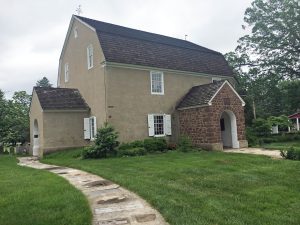
The Old Augustus Lutheran Church. Built in 1745, it is the oldest standing Lutheran Church in the United States. We took this photo on our visit in 2018. The graves of those mentioned as being in the graveyard are not far from this building.

The Claim

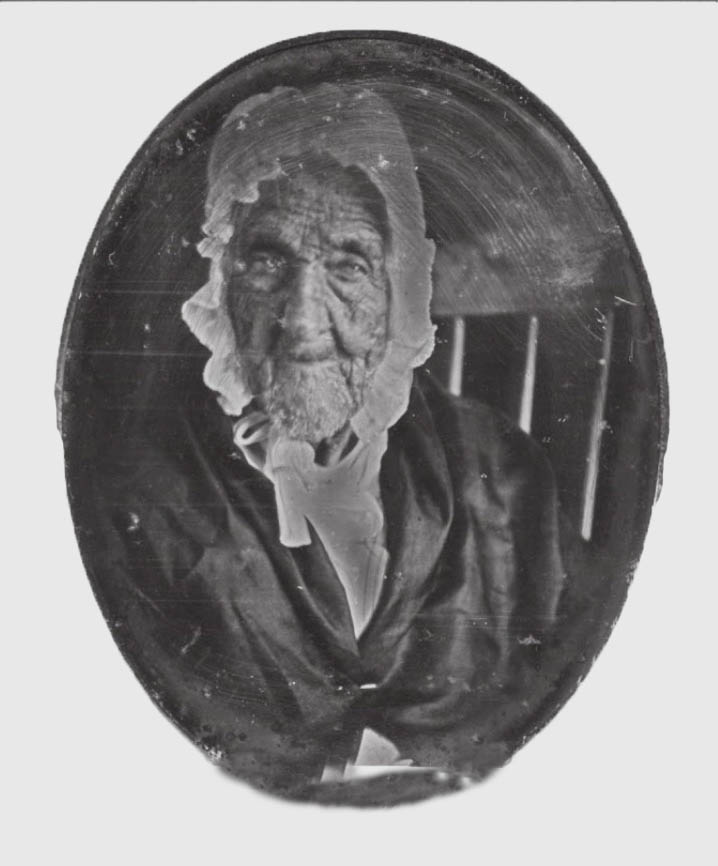
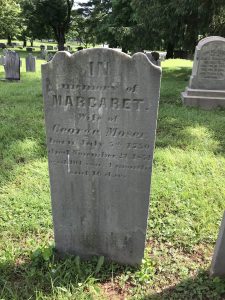
Margaret (Leber) Moses, shown in the image above at age 102, claimed to be near kin or a near relative of Rod’s 7th Great Grandfather William Hurrie, who famously rang the Liberty Bell to announce the signing of the Declaration of Independence.  Read more about William Hurrie.

Margaret lived in Trappe, Montgomery, Pennsylvania and attended the Augustus Lutheran Church. The Old Trappe Church, A Memorial of the Sesqui-Centennial Services of Augustus Evangelical Lutheran Church, Montgomery County, Pennsylvania, which was published in 1893 documented her claim.  In 1917, the claim was also included in Old Roads Out of Philadelphia by John Thomson Faris.


Augustus Lutheran Church Graveyard

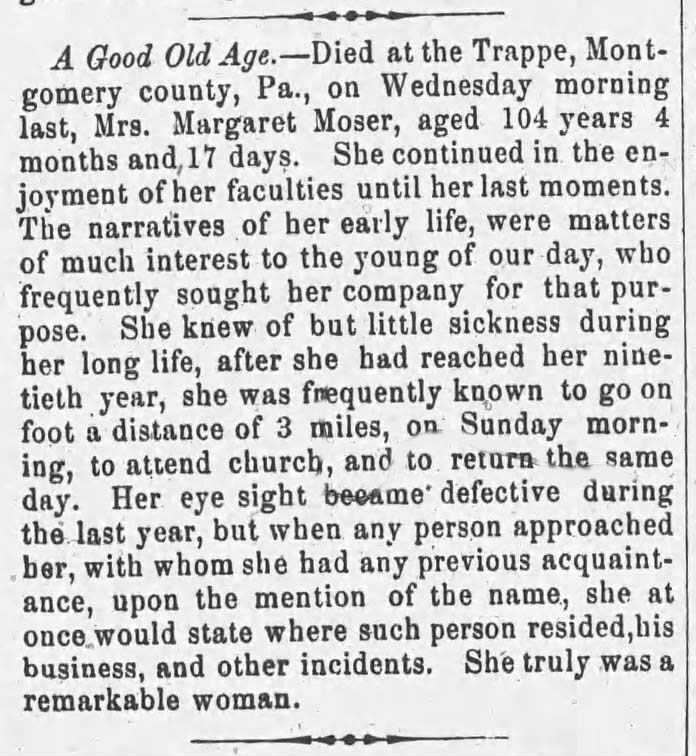
Margaret was mentioned in the church memorial as she was the oldest person to ever have been buried in the graveyard at the time it was written.  She had died at age 104 years, 4 months, and 16 days.  It stated that she was buried not far from Reverend Muhlenberg.  When we visited the church and graveyard, we found both of their graves.  Although not immediately adjacent, they were not far away from each other.

Although interested in her story, our primary reason for our visit to the graveyard was not, however, to visit her grave.  It was to visit the graves of Rod’s 5th Great Grandparents Christian and Ann (McGinley) Stetler.  Having died in the early 1800s, their graves were also nearby.


Source: The Jeffersonian

Who Was Margaret?

We did wonder how Margaret was related to William Hurrie.  Ann (McGinley) Stetler was William’ granddaughter.  And, we knew that Margaret and the Stetler family both had ties to Augustus Lutheran Church.  However, the only thing we knew about Margaret was what was written in the church history.


Shingling

It turns out that Margaret was a very formidable woman.  She was born July 5, 1750 in Montgomery County, Pennsylvania.  She was engaged to George Moser when he got the call to serve.  George was in the process of shingling his new barn at the time.  So, while George went off to fight for America’s freedom, Margaret did what needed to be done.  She climbed up on the barn and finished shingling it.


Troops in Trappe

While George was serving, the war came knocking at her doorstep.  American soldiers decided to camp in Trappe.  Augustus Lutheran Church was used as a barracks and a hospital.  The church secured its place in history, by not only being used by the troops, but also with a visit from General Washington.

Despite the presence of the American troops (or because of the presence of the American troops), the church and area was not without threats of violence.  The Reverend wrote in his journal that he was so disliked by the British that they threatened him with capture, torture, and even death.  Apparently, they did not care for him and others in the area giving aid to the American troops.

After George finished his service, he served for his brother Peter who did not wish to serve.  This may be because Peter was busy building a very large family and did not feel he could leave his wife and children.  Once that service was complete, George came home.


Life Post-War

Reverend Muhlenberg married them in Trappe in May 1782.  They were together until George’s death in 1806 at age 66.  Margaret outlived him by 48 years.  They had no children.


Meaning of the Phrase

The meaning of the phrase “near kin” or “near relative” is not clear and has been a stumbling block in understanding how she was related to William Hurrie.  In some cases, it is used similar to next of kin.  In other cases, the term “near of kin” implies that they were “almost like a member of the family.”

The Bible uses the term “near kinsman,” which is very similar.  In that case, it is a close male relative and at least one reference implied that there was an order of closest, next closest, etc.


Possible Relationships

Since we don’t have clarity around the words that were used, let’s take a look at the possible relationships to see which ones can be ruled out.

Relationships to consider are: 

  • A direct relative (sibling, cousin, etc.)
  • A relative by marriage
    • Related via her husband George
    • Related via a marriage of a child
    • Related via William Hurrie’s wife Mary
    • Related via the Stetler family since Christian married William Hurrie’s granddaughter
  • A close friend . . . so close that they were like family


Direct Relative

Margaret was born in Montgomery County, Pennsylvania.  However, her parents, Phillip Leber/Lever and Anna Margretha Muellerin/Mueller were both born in Germany.  Since William Hurrie was from Scotland, it seems that a direct relationship is nearly impossible. 


Related Through Her Husband

George Moser was born in Germany as were his parents.  Thus, this connection also seems nearly impossible.


Related through A Marriage of A child

This scenario can be ruled out since George and Margaret never had any children.


Related to William’s Wife

William was married to a woman named Mary.  Her surname and heritage is unknown.  It is possible that she was related to Margaret.  However, I have not yet found a woman named Mary in Margaret’s family tree who would have been reasonably close in age to William Hurrie.  That said, this remains a possibility.


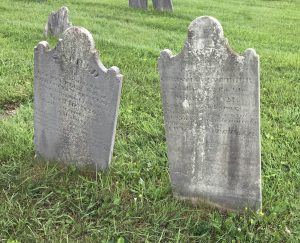
Christian and Ann (McGinley) Stetler’s Gravestones

Related Via the Stetlers

The Stetler family lived in Montgomery County, Pennsylvania and were of German heritage.  Additionally, they have ties to Augustus Lutheran Church.  Since William’s granddaughter Ann McGinley married Christian Stetler, it is possible that she was the connection between Margaret and William Hurrie.  This seems like a bit of a stretch genealogy-wise since she would have been, for example, a cousin to the husband of William Hurrie’s granddaughter.  That doesn’t seem very near, but it wouldn’t surprise me as people were a bit more generous in those days as to who was family.

That said, to date I have found no connection between Margaret’s family and the Stetler family.


Close Friends

It is definitely possible that Margaret considered herself a close friend of William’s granddaughter.  They both lived in the same general area and it is very possible that they knew each other well.  It should be noted, however, that Margaret was considerably older than Ann and that Ann died over 30 years before Margaret.


More Questions

One factor that I believe must be considered in figuring out the meaning of “near kin” in this case is to consider how Ann McGinley, a Scottish/Irish young lady, who lived in the center of Philadelphia became acquainted with and married Christian Stetler, a man of German heritage who lived near Trappe.  The distance isn’t great and if traffic cooperates, you can make the drive between the two locations in less than an hour.  Even today, though, it is full of twists and turns.  In the Colonial days, it would have taken much longer to make the trip.


Prompt: Language

#52Ancestors52Weeks 


Many of us long for home.  Sometimes that is a longing simply to have a home.  Other times it is a longing to be home or to visit our childhood home.  The longing is probably the strongest when we are called away and are powerless to return.  Thus, is the case with soldiers, particularly during wartime.


World War II

World War II took many men away from their families for extended periods of time.  The men didn’t really have a choice although most considered it their patriotic duty.  One day a letter would come in the mail that said that they had been drafted and off they would go.  The men who served state-side might occasionally get leave to come home.  However, the men serving overseas did not have this opportunity.

Many spent Christmas in a foreign land not knowing when the enemy might strike.


The Song

In 1943 Bing Crosby recorded the song I’ll Be Home for Christmas (If Only in My Dreams).  The song was written in honor of all the men serving that couldn’t go home for Christmas.  The lyrics are of a soldier telling his family that he will be home for Christmas.  But, the soldier goes on to say that he will be there  . . . if only in his dreams.

People in America fell in love with the song.  It peaked at number 3 on the charts and became a gold record.  American soldiers, as well as their families, loved the song.  However, the British looked upon it differently and the BBC banned the song from being broadcast for fear it would lower morale.

Watch & listen to the official music video for I’ll Be Home for Christmas.


Ruthe’s Reaction

The song played on radios across the country and overseas, including at the McCracken household.  Ruthe (McCracken) McCarty, Joseph Andrew and Nellie (Peelle) McCracken’s daughter, was the only one that mentioned thoughts about the song.  And, she did not like it.  It wasn’t that she thought it was a bad song. But, she felt that it was incredibly sad.  She remembered the times that her brothers couldn’t come home for Christmas because they were serving in the military.  Worse yet, it reminded her that after her brother Howard shipped overseas, he never came home again.

For her entire life, Ruthe avoided the song whenever she could.  Matter of fact, she avoided all Christmas songs from the World War II era.  She disliked school reunions (she graduated high school during the war) for the same reason; they reminded her of the war years and the losses that occurred.

So, although she loved coming home, this reminder of the longing for home broke her heart.


#Photo: The featured image is of Ruthe likely in the 1940s.

#Prompt: Home Sweet Home

#52ancestors52weeks


Each person likely has some local, national, or worldwide historical event that they would say had a big influence on their life.  For many of us today, 9/11 had a great impact on our lives. Meanwhile, for my parents’ generation many would call out  World War II as having a great impact on their lives.  This event definitely impacted my father and his three brothers.


Ed McCracken was the only one of the brothers that never served in the military.

Declaration of War

Although the conflict that led to World War II had begun several years earlier, it was the bombing of Pearl Harbor that got the United States directly involved in the war.  Many call out Pearl Harbor and United States’ Declaration of War as being very significant to their life.

Dad talked about the years surrounding World War II a lot.  When the Japanese bombed Pearl Harbor, he was a freshman at Girard High School.  On December 8, 1941, the day after Pearl Harbor, President Franklin D. Roosevelt gave an address to Congress at 12:30 p.m. asking them to declare war.

In anticipation of the content of the President’s address, all the students in his school were called to the gymnasium to listen to the speech.  It became known as the “Day of Infamy” Speech and is one of the most famous speeches in American history. Listen to FDR’s speech to Congress.

Although Dad could quote pieces of the official speech, it was other words that FDR said in a radio address that Dad quoted the most.  He said,


I didn’t want war,

Eleanor didn’t want war,

And, Fala didn’t want war.

But, we’ve got war.

And, you fight war with war.


Dad would repeat these words often, always imitating FDR’s accent.  For instance, he said the word “war” more like “waaaarrrr.”  Now, if you are wondering who Fala is, that was FDR’s dog.  FDR’s Scottish Terrier is likely the most famous dog that ever spent time at the White House.  He traveled with FDR, was mentioned on the House floor, and had his own secretary to answer his fan mail.  Read more about Fala. . . 

Dad’s brother Don questioned him about the story, as he didn’t believe FDR talked about his dog not wanting war.  However, he researched it and found a transcript of the speech, which confirmed Dad’s story.


Kenneth Donald McCracken when serving during the Korea conflict.

Atomic Bomb

The historical event of World War II that appeared to most greatly impact Don was the use of atomic bombs in Japan in 1945.  He had the realization that the war would now end, but that it would be at a high human cost.  As he wrote in his poem “August 1945,” “I don’t want to die; I am only fifteen.”

Before that, he had believed that the concept of atomic bombs was merely a theory.  But, once it became a reality, it brought the idea of death to him in a way he had not previously considered. His own mortality sunk in.  The last verse of his poem states,


I want to live, but it is more than that.

I want to be survived.

When other people died, others survived them; I want the same;

I will die happier if I know others still live.

For years, I have dreamed about the end of the war;

And now that it is over, my dream has changed to a nightmare.


I don’t know exactly how much of the poem he wrote in 1945.  However, he told me that at that time he wrote a portion, but just could not complete the poem.  It was years later that he finished capturing his thoughts about the atomic bomb.


Daily Life

Although these two events etched memories into both Dad and Don’s minds, the war also changed their family’s life.  Schools immediately required all males to take some form of physical education to get in shape for the military.  The schools participated in scrap metal drives, bond drives, and more.

The most significant change was that their older siblings scattered as they went to work and to war.  Dewey was in charge of the family’s farm when he got the call to serve.  Since Grandpa worked on the roads for the state of Kansas, the farm was left without anyone to run it.  Thus, at age 14, Dad dropped out of school (he would finish later) to become a full-time farmer with responsibility for a portion of the family’s income and food supply.


Dewey and the Army Air Force

Dewey was the first brother to be called into service.  The draft would have to be the event of WWII that most impacted his life.

Dewey became a mechanic in the Army Air Force.  Although Dewey had multiple assignments, he spent most of the war at the airbase in Greenville, South Carolina.  He primarily worked on engines for B-25 Mitchell medium range bombers.  At times, maintenance crews worked multiple shifts to keep the planes flying for training missions.  He thought that he might get shipped overseas, but that day never came.  Although he never left U.S. soil, Dewey definitely had different experiences because of his experience being in the Army Air Force.

Dewey may have talked about his experiences, but never in my presence.  I do know that when equipment broke down, he was very open to Dad working on it.  I suppose he had enough of ‘mechanicing’ during his time in the service.  Read more about his service . . .


William (Howard) McCracken

Howard and the Blue Devils

Howard’s work at Solar Aircraft in San Diego had bought him a deferral.  However, he knew it would not last as they were seeking all able young men.  In fall of 1943, he was called into service.  After basic training, he was sent to North Africa and then to Italy where he joined the 88th Division Blue Devils. 

Howard marched through mud as he fought in the mountains in pouring rain. He saw plenty of death and destruction although he, like all the others, were instructed not to write home about such things.  On good days, he saw old cities and even ate some local food.  He definitely wasn’t in Kansas anymore.

Howard had many experiences that would have shaped his life had he not been injured and then gone missing in action on April 17, 1945 near Monterumici Hill, a short distance from Florence.  He has never been found.  Read more about Howard’s service . . .

Clearly, the historical event that impacted Howard the most was that last battle where the Allies pushed through the mountains to the Po Valley.  The Allies were successful and it was one of the keys to them defeating Germany.  Had he not received an injury that day, that battle still may have been the most significant historical event as it helped end the war in Europe.


It’s Personal

In the end, it isn’t the historical event per se that impacts us.  It is the personal aspects surrounding that event that stick with us most and changes our lives.

When I think about Dad, I know that all the personal aspects kept the war in the forefront of his mind, especially the loss of his brother.  Had his brothers not served and he had stayed in school, his experiences would have been very different.  Although he did not serve in the military, the war likely changed the trajectory of his life. 


Featured Image:  Rare photo containing all four McCracken boys. I do not know of any photographs of just the four boys by themselves.

Prompt: Historical Event

#52Ancestors52Weeks